"6c6413bef81af556"{"id":"1000798","slug":"car-interact-animations-vol-1","title":"Car Interact Animations VOL. 1","category":"Variety","engine":"4.27,5.0+","assetVersion":"","engineVersion":"Engine Version: 4.27,5.0+","tag":"Variety","accent":"blue","visual":"animation","summary":"A collection of 26 car interaction animations covering driver and passenger enter/exit, idles, honking, gear changes, steering, look-back loops, and death seque","platform":"Unreal Engine","publishedAt":"2026-07-30T15:30:22.531Z","updatedAt":"2026-07-30T15:30:22.531Z","sourceNotes":[],"fileContents":[],"compatibility":["Unreal Engine","Engine Version: 4.27,5.0+"],"featuredImage":{"alt":"Car Interact Animations VOL. 1","src":"/wp-content/uploads/published/2026/07/abcba5354568-9ae90b34-1917-490d-86a3-7b5240f7c10c-348ce38151.webp"},"hasDownloadLink":true,"downloads":5,"terms":[{"taxonomy":"category","slug":"variety-animations","name":"Variety"}],"galleryImages":[{"src":"/wp-content/uploads/published/2026/07/e99b191018cb-187b3dfc-8a2d-4a59-8a6f-a6064605e76a-2af8859be8.webp","alt":"Car Interact Animations VOL. 1"},{"src":"/wp-content/uploads/published/2026/07/39a591c64fa2-2d19e819-0777-4e32-a84d-cd48e9462800-ad73188a5f.webp","alt":"Car Interact Animations VOL. 1"},{"src":"/wp-content/uploads/published/2026/07/593cd4740911-4ce68e13-c4af-452d-a217-0def66ae70eb-c44df2e0f4.webp","alt":"Car Interact Animations VOL. 1"},{"src":"/wp-content/uploads/published/2026/07/45eab8acddd4-834c132f-0584-486c-a3ea-d4e9cad682ac-170db225ea.webp","alt":"Car Interact Animations VOL. 1"},{"src":"/wp-content/uploads/published/2026/07/7bea9fd3d16e-645e26e4-7087-4f8c-a0cc-f8fe4122346b-9328b4ed06.webp","alt":"Car Interact Animations VOL. 1"},{"src":"/wp-content/uploads/published/2026/07/efa4cc8db79a-5ff62e42-c000-42a5-b873-524f342a01b7-094edefbbc.webp","alt":"Car Interact Animations VOL. 1"},{"src":"/wp-content/uploads/published/2026/07/45d677e75efc-fa01ea0f-6358-46d8-8810-59e1e67f504e-4ed60d92e3.webp","alt":"Car Interact Animations VOL. 1"},{"src":"/wp-content/uploads/published/2026/07/45fbd14d4105-5b8cbc73-25eb-47c1-b958-8db2bcb8d920-fa8789a7ca.webp","alt":"Car Interact Animations VOL. 1"},{"src":"/wp-content/uploads/published/2026/07/d9ff6d243835-72f78fe6-793b-44e6-a92c-cb7a75c60113-a94414e75f.webp","alt":"Car Interact Animations VOL. 1"},{"src":"/wp-content/uploads/published/2026/07/db44229feef4-06cb07c7-b50c-4f2d-a0c5-698ce1e0d293-7708f298fb.webp","alt":"Car Interact Animations VOL. 1"}],"accessPanel":{"kind":"resource","title":"Download this resource","eyebrow":"Free Download","message":"Log in or create a free account to start your download.","fileName":"Content.7z","safetyNote":"Resources are manually reviewed before listing to improve quality and reduce obvious risks.","actionLabel":"Download Free","resourceType":"Resource archive"},"contentHtml":"\u003cp\u003eAnimating a character entering a vehicle, settling into the seat, and transitioning into a driving state requires a sequence of precise movements that align with the car interior. Without a dedicated set of interactions, developers often face the task of blending separate clips together manually, hoping the hands align with the door handle and the steering wheel. \u003cem\u003eCar Interact Animations Vol. 1\u003c/em\u003e addresses this production bottleneck by providing a dedicated suite of character movements tailored for in-car actions.\u003c/p\u003e\n\n\u003ch2\u003eDriver and Passenger Entry and Exit Flows\u003c/h2\u003e\n\u003cp\u003eThe package contains dedicated enter and exit animations for both the driver and the passenger. This division covers the basic spatial requirements of a vehicle interior, where a driver approaches the steering wheel and a passenger moves toward the opposite side of the cabin. Each role requires a different physical choreography, which is reflected in the provided motion sets.\u003c/p\u003e\n\n\u003cp\u003eOnce inside the vehicle, the characters can transition into specific driver and passenger idle animations. These idles form the baseline state for the characters while the car is stationary or waiting at a traffic light. Having separate baseline states for both the driver and the passenger ensures that the non-driving character does not mirror the active driving motions, maintaining visual realism during moments of rest.\u003c/p\u003e\n\n\u003ch2\u003eActive Driving Interactions and Steering Wheel Movements\u003c/h2\u003e\n\u003cp\u003eWhen the vehicle is in motion, the package provides several clips to simulate the physical engagement of driving. Honking, gear changes, and steering wheel turns are included as discrete actions. These let creators trigger specific responses based on gameplay events, such as shifting gears during acceleration or turning the wheel in response to player input.\u003c/p\u003e\n\n\u003cp\u003eThe animations also cover a look-back sequence. This is broken down into 3 distinct phases: \u003ccode\u003eStart\u003c/code\u003e, \u003ccode\u003eLoop\u003c/code\u003e, and \u003ccode\u003eEnd\u003c/code\u003e. Providing a looping segment allows the character to maintain a backward gaze for as long as the gameplay requires, such as reversing or monitoring traffic behind the vehicle. The start and end clips ensure the character transitions smoothly in and out of the default driving pose.\u003c/p\u003e\n\n\u003ch2\u003eDire Consequences: The 4 Death Animations\u003c/h2\u003e\n\u003cp\u003eOpen-world games often involve high-stakes scenarios, and the inclusion of 4 separate death animations accounts for character failure during driving sequences. These animations let creators depict different fatal outcomes while the character remains seated inside the vehicle. Having multiple variations prevents repetitiveness if the player fails a driving mission multiple times.\u003c/p\u003e\n\n\u003ch2\u003eIntegrating Animations with Open-World Gameplay\u003c/h2\u003e\n\u003cp\u003eThe entire collection consists of 26 individual car interaction animations. By grouping these movements together, the resource aims to support open-world games where interactions with cars are a core mechanic. The motions cover the spectrum of entering a parked car, idling behind the wheel, actively driving, checking surroundings, and meeting an abrupt end. The tags associated with the package reinforce this focus, categorizing the content under \u003cem\u003eVehicle\u003c/em\u003e, \u003cem\u003eCar\u003c/em\u003e, \u003cem\u003eDrivable\u003c/em\u003e, \u003cem\u003eIndustrial\u003c/em\u003e, \u003cem\u003eDrive\u003c/em\u003e, and \u003cem\u003eSimulation\u003c/em\u003e descriptors.\u003c/p\u003e\n\n\u003cp\u003eFor teams building driving or simulation mechanics, a package structured around these specific vehicular interactions removes the need to adapt generic character movements to fit a car interior. The inclusion of separate flows for passengers, active driving gestures, and multi-stage look-back loops positions this animation set as a practical tool for populating open-world environments with believable vehicle occupants.\u003c/p\u003e\n\n\u003ch2\u003eExplore Similar Assets\u003c/h2\u003e\n\u003cul\u003e\n\u003cli\u003e\u003ca href=\"https://3dcghub.com/emotes-animationvol5/\" title=\"Emotes AnimationVol5\"\u003eEmotes AnimationVol5\u003c/a\u003e\u003c/li\u003e\n\u003cli\u003e\u003ca href=\"https://3dcghub.com/postapo-car-wrecks-vol-01/\" title=\"PostApo Car Wrecks vol. 01\"\u003ePostApo Car Wrecks vol. 01\u003c/a\u003e\u003c/li\u003e\n\u003cli\u003e\u003ca href=\"https://3dcghub.com/city-sim-animation-pack/\" title=\"CiTY SIM ANIMATION PACK\"\u003eCiTY SIM ANIMATION PACK\u003c/a\u003e\u003c/li\u003e\n\u003cli\u003e\u003ca href=\"https://3dcghub.com/female-interaction-animation-pack/\" title=\"Female Interaction Animation Pack\"\u003eFemale Interaction Animation Pack\u003c/a\u003e\u003c/li\u003e\n\u003cli\u003e\u003ca href=\"https://3dcghub.com/the-cultist-animations/\" title=\"The Cultist Animations\"\u003eThe Cultist Animations\u003c/a\u003e\u003c/li\u003e\n\u003c/ul\u003e","contentTextLength":3751,"navigation":{"current":426,"total":3140,"previous":{"id":"1000799","slug":"caustics-texture","title":"Caustics Texture","category":"Water","platform":"Unreal Engine","updatedAt":"2026-07-30T22:47:36.563Z"},"next":{"id":"1000797","slug":"body-cam-effects","title":"Body Cam Effects","category":"Art \u0026 Traditional","platform":"Unreal Engine","updatedAt":"2026-07-30T15:23:07.705Z"}},"relatedResources":[{"id":"1000957","slug":"motorbike-interact-animations-pack","title":"Motorbike Interact Animations Pack","category":"Variety","engine":"5.0+","assetVersion":"","engineVersion":"Engine Version: 5.0+","tag":"Variety","accent":"blue","visual":"animation","summary":"30 motorbike interaction animations covering driver and passenger enter/exit, idle states, helmet interaction, steering turns, and walk-back loops for open-worl","platform":"Unreal Engine","publishedAt":"2026-08-14T15:06:27.899Z","updatedAt":"2026-08-14T15:06:27.899Z","sourceNotes":[],"fileContents":[],"compatibility":["Unreal Engine","Engine Version: 5.0+"],"featuredImage":{"alt":"Motorbike Interact Animations Pack","src":"/wp-content/uploads/published/2026/08/e2594bd0ed7e-13a82980-8828-46af-a1ad-eaa530af2ab8-669fa87a98.webp"},"hasDownloadLink":true,"downloads":1},{"id":"1000960","slug":"pedestrians-vol-2-mini-pack","title":"Pedestrians Vol 2 (Mini Pack)","category":"Variety","engine":"5.0+","assetVersion":"","engineVersion":"Engine Version: 5.0+","tag":"Variety","accent":"blue","visual":"mech","summary":"Over 50 NPC animations for pedestrians: dancing, working, relaxing, plus idle variations and breaks. Bring believable movement to city crowds.","platform":"Unreal Engine","publishedAt":"2026-08-14T15:38:58.562Z","updatedAt":"2026-08-14T15:38:58.562Z","sourceNotes":[],"fileContents":[],"compatibility":["Unreal Engine","Engine Version: 5.0+"],"featuredImage":{"alt":"Pedestrians Vol 2 (Mini Pack)","src":"/wp-content/uploads/published/2026/08/d2b9bd516a0a-5538a217-d229-4e29-8c02-376fad64209a-f227b1ad49.webp"},"hasDownloadLink":true,"downloads":0},{"id":"6301","slug":"emotes-animationvol5","title":"Emotes AnimationVol5","category":"Variety","engine":"4.27,5.0+","assetVersion":"Engine version: 4.27,5.0+","engineVersion":"4.27","tag":"Variety","accent":"blue","visual":"animation","summary":"Enhance your game characters with the Emotes Animation Vol 5 pack. Discover high-quality animations like dancing, victory poses, and unique idle states.","platform":"Unreal Engine","publishedAt":"2026-02-19T14:38:04.000Z","updatedAt":"2026-04-19T15:56:27.000Z","sourceNotes":[],"fileContents":[],"compatibility":["Unreal Engine","Engine version: 4.27,5.0+"],"featuredImage":{"alt":"Emotes AnimationVol5","src":"https://3dcghub.com/wp-content/uploads/2026/02/beed3b87-b25b-45b5-9136-fca92f252bf9.webp"},"hasDownloadLink":true,"downloads":0}]}
Variety
Car Interact Animations VOL. 1
A collection of 26 car interaction animations covering driver and passenger enter/exit, idles, honking, gear changes, steering, look-back loops, and death seque
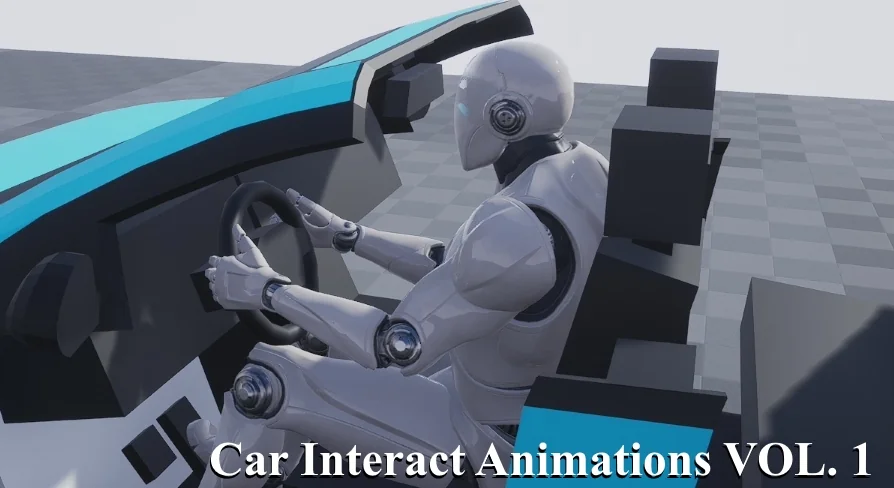
Animating a character entering a vehicle, settling into the seat, and transitioning into a driving state requires a sequence of precise movements that align with the car interior. Without a dedicated set of interactions, developers often face the task of blending separate clips together manually, hoping the hands align with the door handle and the steering wheel. Car Interact Animations Vol. 1 addresses this production bottleneck by providing a dedicated suite of character movements tailored for in-car actions.
Driver and Passenger Entry and Exit Flows
The package contains dedicated enter and exit animations for both the driver and the passenger. This division covers the basic spatial requirements of a vehicle interior, where a driver approaches the steering wheel and a passenger moves toward the opposite side of the cabin. Each role requires a different physical choreography, which is reflected in the provided motion sets.
Once inside the vehicle, the characters can transition into specific driver and passenger idle animations. These idles form the baseline state for the characters while the car is stationary or waiting at a traffic light. Having separate baseline states for both the driver and the passenger ensures that the non-driving character does not mirror the active driving motions, maintaining visual realism during moments of rest.
Active Driving Interactions and Steering Wheel Movements
When the vehicle is in motion, the package provides several clips to simulate the physical engagement of driving. Honking, gear changes, and steering wheel turns are included as discrete actions. These let creators trigger specific responses based on gameplay events, such as shifting gears during acceleration or turning the wheel in response to player input.
The animations also cover a look-back sequence. This is broken down into 3 distinct phases: Start, Loop, and End. Providing a looping segment allows the character to maintain a backward gaze for as long as the gameplay requires, such as reversing or monitoring traffic behind the vehicle. The start and end clips ensure the character transitions smoothly in and out of the default driving pose.
Dire Consequences: The 4 Death Animations
Open-world games often involve high-stakes scenarios, and the inclusion of 4 separate death animations accounts for character failure during driving sequences. These animations let creators depict different fatal outcomes while the character remains seated inside the vehicle. Having multiple variations prevents repetitiveness if the player fails a driving mission multiple times.
Integrating Animations with Open-World Gameplay
The entire collection consists of 26 individual car interaction animations. By grouping these movements together, the resource aims to support open-world games where interactions with cars are a core mechanic. The motions cover the spectrum of entering a parked car, idling behind the wheel, actively driving, checking surroundings, and meeting an abrupt end. The tags associated with the package reinforce this focus, categorizing the content under Vehicle, Car, Drivable, Industrial, Drive, and Simulation descriptors.
For teams building driving or simulation mechanics, a package structured around these specific vehicular interactions removes the need to adapt generic character movements to fit a car interior. The inclusion of separate flows for passengers, active driving gestures, and multi-stage look-back loops positions this animation set as a practical tool for populating open-world environments with believable vehicle occupants.
 Variety
 Variety
 Variety
 Variety