"95fdaf16012263fa"{"id":"1002308","slug":"bullet-hole-decals","title":"Bullet Hole Decals","category":"Damage \u0026 Grunge","engine":"4.24+,5.0+","assetVersion":"","engineVersion":"Engine Version: 4.24+,5.0+","tag":"Damage \u0026 Grunge","accent":"blue","visual":"mech","summary":"Bullet Hole Decals packs 170 impacts across 27 surface groups — asphalt, brick, metal, glass, flesh, wood — as normal, texture-plus-normal, and mesh decals.","platform":"Unreal Engine","indexPolicy":"index","publishedAt":"2026-11-06T06:11:21.207Z","updatedAt":"2026-11-06T06:11:21.207Z","sourceNotes":[],"fileContents":[],"compatibility":["Unreal Engine","Engine Version: 4.24+,5.0+"],"featuredImage":{"alt":"Bullet Hole Decals","src":"/wp-content/uploads/published/2026/11/77151664091c-816503d1-6faf-4052-b493-9d149adbb500-94ba69bd6b.webp"},"hasDownloadLink":true,"downloads":0,"terms":[{"taxonomy":"category","slug":"damage-and-grunge","name":"Damage \u0026 Grunge"}],"galleryImages":[{"src":"/wp-content/uploads/published/2026/11/c67e93d0bb3a-c68367d2-fbaf-4d6a-a43f-d36eea74aae4-1e93ddecaf.webp","alt":"Bullet Hole Decals"},{"src":"/wp-content/uploads/published/2026/11/cbfdb0b08c5a-525cc247-802d-4793-81bc-f33a5a3b37b2-d73fa2e860.webp","alt":"Bullet Hole Decals"},{"src":"/wp-content/uploads/published/2026/11/ff6924374cec-4b6502f8-1752-423d-b6f1-7a5627a42c4e-128cacd058.webp","alt":"Bullet Hole Decals"},{"src":"/wp-content/uploads/published/2026/11/df249f3aeba2-386631d6-48df-4c21-9224-702b5ff43467-a51f85f25f.webp","alt":"Bullet Hole Decals"},{"src":"/wp-content/uploads/published/2026/11/5e421f1fe834-51056e8b-d5e3-491f-9bc2-84c2174c6991-6a5bc70a9c.webp","alt":"Bullet Hole Decals"},{"src":"/wp-content/uploads/published/2026/11/4bb517b537ff-28fa6ecf-e12a-429a-af3e-b97e4d05e151-5bb99645d2.webp","alt":"Bullet Hole Decals"},{"src":"/wp-content/uploads/published/2026/11/172ec09e4ae9-a135f2b6-1f98-47a9-b94b-90c21db859b1-6b52200968.webp","alt":"Bullet Hole Decals"},{"src":"/wp-content/uploads/published/2026/11/c4ece0d1d98b-75b1360a-67b2-40b6-8765-4989912e8dfc-5546915b8f.webp","alt":"Bullet Hole Decals"},{"src":"/wp-content/uploads/published/2026/11/ce971cd4b182-0a27ca17-8f63-43ac-bccb-7defad0238bc-ec26311c6a.webp","alt":"Bullet Hole Decals"},{"src":"/wp-content/uploads/published/2026/11/1fe852b6b87a-b9ae8d14-d617-403d-a9d6-921418ce29d5-22be9c2b4d.webp","alt":"Bullet Hole Decals"}],"accessPanel":{"kind":"resource","title":"Get this resource","eyebrow":"Free resource","message":"3DCGHUB is the service provider for this listing. Access is fulfilled through the official publisher channel.","fileName":"Content.7z","safetyNote":"Resources are manually reviewed before listing to improve quality and reduce obvious risks.","actionLabel":"Get this resource","resourceType":"Resource archive","versions":[]},"contentHtml":"\u003ch2\u003eTwenty-seven surface categories, 170 impacts\u003c/h2\u003e\n\u003cp\u003eBullet Hole Decals is sorted by what gets hit, not by the weapon doing the hitting. The set is divided into 27 named surface groups, and twenty of them hold five decals each. The remaining seven — bricks, ceramics, concrete, cracks, hits, thin metal, and wood — carry ten apiece, which brings the total to 170 individual impacts.\u003c/p\u003e\n\u003cp\u003eThat spread covers hard architectural material first: bricks, concrete, ceramics, sheetrock, reinforced surfaces, rock, and asphalt. Metals follow in three separate groups. Glass appears three times over. Softer and more awkward targets get their own slots too — fabric, flesh, rubber, sand, dirt. A generic group and a ground group catch the cases where the underlying surface is not one of the named ones, and burnt, blasted, cracks, and scratches handle damage that reads as wear, scorch, or fracture rather than a clean entry wound.\u003c/p\u003e \u003ch2\u003eNormal decals, texture-plus-normal decals, and mesh-backed POM and bump materials\u003c/h2\u003e\n\u003cp\u003eThe package does not treat every surface the same way technically. Ten groups are plain normal decals — asphalt, bricks, concrete, cracks, dirt, generic, hits, rock, sand, and scratches — accounting for 70 of the 170. These are the lightest entries, detail laid over geometry that already exists in the scene.\u003c/p\u003e\n\u003cp\u003eTwelve groups pair a texture with a normal map: burnt, ceramics, fabric, flesh, metal armored, metal solid, metal thin, plastic, reinforced, rubber, sheetrock, and wood. That is 75 decals, the largest share of the set. The ground group uses a texture plus normal map decal, five of them.\u003c/p\u003e\n\u003cp\u003eTwo categories step further out of flat projection. Blasted is the only group supplied as POM materials with meshes — five mesh decals, where the parallax occlusion mapping gives the pitting and torn material a depth that a projected normal cannot. The three glass groups — bulletproof, common, and windshield — are bump materials with meshes, five each, fifteen in total.\u003c/p\u003e\n\u003cp\u003eThe practical effect is that the depth treatment follows the material. Concrete, brick, and rock get away with a normal decal because the surrounding geometry already sells the surface. Blasted metal and glass do not, so they arrive with their own mesh and their own shading model.\u003c/p\u003e \u003ch2\u003eMetal at three weights, glass in three kinds\u003c/h2\u003e\n\u003cp\u003eMetal Armored and Metal Solid each carry five texture-plus-normal decals. Metal Thin carries ten — double the variants of the heavier gauges. That weighting lines up with how sheet metal behaves under impact: thinner stock dents, tears, and deforms in more ways than a solid plate does, so it earns more options.\u003c/p\u003e\n\u003cp\u003eGlass is separated by what the pane is expected to withstand. Glass Bulletproof, Glass Common, and Glass Windshield hold five bump material mesh decals each. A windshield and a bulletproof pane do not fail the same way, and keeping them in distinct groups means a scene can use the right fracture pattern for the surface instead of a single generic glass break everywhere.\u003c/p\u003e \u003ch2\u003eCracks and scratches that never involve a projectile\u003c/h2\u003e\n\u003cp\u003eNot everything in the set is a bullet hole. Cracks contributes ten normal decals and Scratches contributes five, and both are reusable for abrasion, stress, and age rather than gunfire. Placed on a wall or a floor, they push a space toward looking used without implying combat.\u003c/p\u003e\n\u003cp\u003eThe Hits group is the clearest departure from firearms: ten normal decals split five axe and five knife. Melee damage has a different silhouette from a bullet strike, and having the two weapon types separated inside the group lets an environment artist match the mark to whatever actually hit the surface.\u003c/p\u003e\n\u003cp\u003eBurnt and Blasted cover the other end of the damage spectrum — heat and blast rather than penetration. Burnt arrives as five texture-plus-normal decals; Blasted as five POM mesh decals. Between them, a scene can show a surface that was scorched or blown apart instead of pierced.\u003c/p\u003e \u003ch2\u003eFlesh, blood, and the 4K blood element\u003c/h2\u003e\n\u003cp\u003eFlesh is one of the twelve texture-plus-normal groups, with five decals. Blood is handled as a customizable 4K element, which matters for close-range impact reads where the surrounding surface is a character rather than a wall. It sits alongside fabric and rubber in the softer end of the coverage — materials that absorb an impact differently from concrete or steel.\u003c/p\u003e \u003ch2\u003eWhat the coverage is set up to handle\u003c/h2\u003e\n\u003cp\u003eCombat spaces are the obvious fit. A shooter that fires at brick, concrete, drywall, three gauges of metal, three kinds of glass, wood, plastic, and flesh within the same level needs a hit response for each, and the per-material grouping maps directly onto that requirement. A team that would otherwise stretch one hole texture across every surface in a level has a separate option for each instead.\u003c/p\u003e\n\u003cp\u003eBeyond gunfire, the set supports damage states and set dressing. Cracks and scratches age a room. Burnt and blasted marks back up a story beat about something that already happened there. Axe and knife hits give a melee-focused scene its own vocabulary. Ground, generic, and the softer materials fill in the edges — asphalt and dirt outdoors, sand and rock in terrain, fabric and rubber on props.\u003c/p\u003e\n\u003cp\u003eThe three-tier structure also gives a scene some control over cost and fidelity. Normal decals carry the broadest surface coverage at the lightest weight. Texture-plus-normal groups add a colour and roughness read on top. The mesh-backed POM and bump entries are reserved for the two cases where depth is genuinely needed: blasted surfaces and glass. A level does not have to run everything at the heaviest setting to look complete.\u003c/p\u003e\n\u003cp\u003eEnvironment and level artists dressing combat zones will get the most from it, particularly those working on shooters where the surface mix changes constantly and a single decal sheet would flatten the whole space. Anyone who needs a small, deliberate library of melee marks, cracks, or scorch damage will find those sitting in the same set, separated cleanly enough to pull out on their own.\u003c/p\u003e\n\n\u003ch2\u003eExplore Similar Assets\u003c/h2\u003e\n\u003cul\u003e\n\u003cli\u003e\u003ca href=\"https://3dcghub.com/concrete-damage-decals/\" rel=\"noopener noreferrer\"\u003eConcrete Damage Decals\u003c/a\u003e\u003c/li\u003e\n\u003cli\u003e\u003ca href=\"https://3dcghub.com/bullet-impact-decals-vol-1-concrete/\" rel=\"noopener noreferrer\"\u003eBullet Impact Decals Vol. 1 - Concrete\u003c/a\u003e\u003c/li\u003e\n\u003cli\u003e\u003ca href=\"https://3dcghub.com/bullet-impact-decals-vol-4-plaster/\" rel=\"noopener noreferrer\"\u003eBullet Impact Decals Vol. 4 - Plaster\u003c/a\u003e\u003c/li\u003e\n\u003cli\u003e\u003ca href=\"https://3dcghub.com/blood/\" rel=\"noopener noreferrer\"\u003eBlood\u003c/a\u003e\u003c/li\u003e\n\u003cli\u003e\u003ca href=\"https://3dcghub.com/bullet-impact-decals-vol-2-metal/\" rel=\"noopener noreferrer\"\u003eBullet Impact Decals Vol. 2 - Metal\u003c/a\u003e\u003c/li\u003e\n\u003c/ul\u003e","contentTextLength":6127,"navigation":{"current":60,"total":4291,"previous":{"id":"1002309","slug":"cargo-delivery-inventory-system","title":"Cargo Delivery Inventory System","category":"Gameplay Features","platform":"Unreal Engine","updatedAt":"2026-11-06T06:12:19.870Z"},"next":{"id":"1002307","slug":"battle-royale-air-drop","title":"Battle Royale - Air Drop","category":"Gameplay Features","platform":"Unreal Engine","updatedAt":"2026-11-06T06:10:17.528Z"}},"relatedResources":[{"id":"12487","slug":"concrete-damage-decals","title":"Concrete Damage Decals","category":"Damage \u0026 Grunge","engine":"5.0+","assetVersion":"Engine version: 5.0+","engineVersion":"5.0","tag":"Damage \u0026 Grunge","accent":"blue","visual":"luts","summary":"Enhance your 3D environments with this comprehensive collection of 42 PBR concrete damage decals. This pack includes bullet holes, cracks, and worn textures to add immediate realism to any scene.","platform":"Unreal Engine","indexPolicy":"index","publishedAt":"2026-03-07T12:35:20.000Z","updatedAt":"2026-04-19T15:47:53.000Z","sourceNotes":[],"fileContents":[],"compatibility":["Unreal Engine","Engine version: 5.0+"],"featuredImage":{"alt":"Concrete Damage Decals","src":"https://3dcghub.com/wp-content/uploads/2026/03/89fb573f-d243-4446-a754-4963a4a2bbca.webp"},"hasDownloadLink":true,"downloads":3},{"id":"12454","slug":"bullet-impact-decals-vol-1-concrete","title":"Bullet Impact Decals Vol. 1 - Concrete","category":"Damage \u0026 Grunge","engine":"5.1+","assetVersion":"Engine version: 5.1+","engineVersion":"5.1","tag":"Damage \u0026 Grunge","accent":"blue","visual":"luts","summary":"Enhance your project with Bullet Impact Decals Vol. 1 - Concrete. This pack features realistic bullet damage with customizable depth effects and easy drag-and-drop implementation.","platform":"Unreal Engine","indexPolicy":"noindex","publishedAt":"2026-03-07T12:29:43.000Z","updatedAt":"2026-04-19T15:47:56.000Z","sourceNotes":[],"fileContents":[],"compatibility":["Unreal Engine","Engine version: 5.1+"],"featuredImage":{"alt":"Bullet Impact Decals Vol. 1 - Concrete","src":"https://3dcghub.com/wp-content/uploads/2026/03/dbdbc58d-5a93-4ae2-a81b-93895a615145.webp"},"hasDownloadLink":true,"downloads":2},{"id":"12466","slug":"bullet-impact-decals-vol-4-plaster","title":"Bullet Impact Decals Vol. 4 - Plaster","category":"Damage \u0026 Grunge","engine":"5.1+","assetVersion":"Engine version: 5.1+","engineVersion":"5.1","tag":"Damage \u0026 Grunge","accent":"blue","visual":"luts","summary":"Enhance your project with Bullet Impact Decals Vol. 4 - Plaster. This pack features parallax occlusion mapping for ultra-realistic depth and fully customizable impact effects.","platform":"Unreal Engine","indexPolicy":"index","publishedAt":"2026-03-07T12:33:16.000Z","updatedAt":"2026-04-19T15:47:54.000Z","sourceNotes":[],"fileContents":[],"compatibility":["Unreal Engine","Engine version: 5.1+"],"featuredImage":{"alt":"Bullet Impact Decals Vol. 4 - Plaster","src":"https://3dcghub.com/wp-content/uploads/2026/03/d8c240f2-f2c6-4a5a-ac62-70821e7874f3.webp"},"hasDownloadLink":true,"downloads":0}]}
Damage & Grunge
Bullet Hole Decals
Bullet Hole Decals packs 170 impacts across 27 surface groups — asphalt, brick, metal, glass, flesh, wood — as normal, texture-plus-normal, and mesh decals.
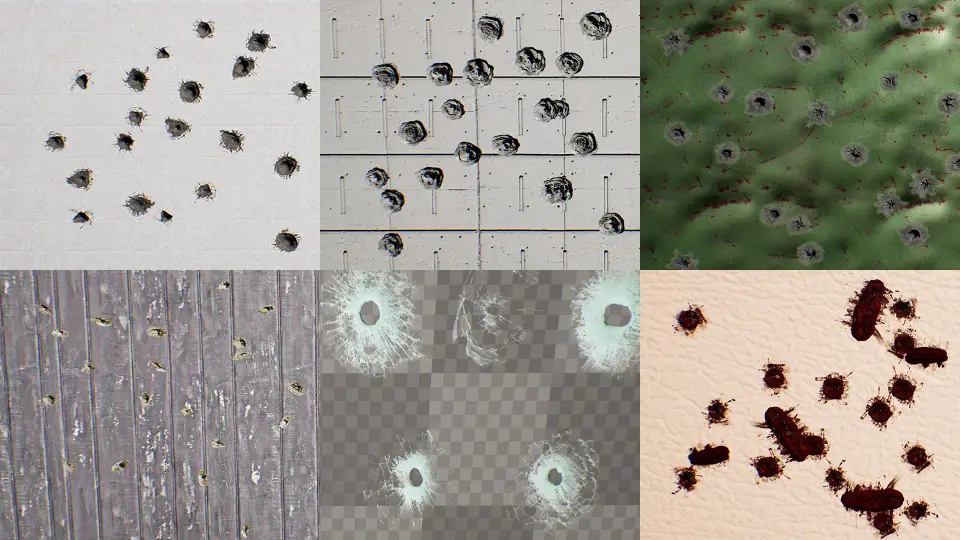
Bullet Hole Decals is sorted by what gets hit, not by the weapon doing the hitting. The set is divided into 27 named surface groups, and twenty of them hold five decals each. The remaining seven — bricks, ceramics, concrete, cracks, hits, thin metal, and wood — carry ten apiece, which brings the total to 170 individual impacts.
That spread covers hard architectural material first: bricks, concrete, ceramics, sheetrock, reinforced surfaces, rock, and asphalt. Metals follow in three separate groups. Glass appears three times over. Softer and more awkward targets get their own slots too — fabric, flesh, rubber, sand, dirt. A generic group and a ground group catch the cases where the underlying surface is not one of the named ones, and burnt, blasted, cracks, and scratches handle damage that reads as wear, scorch, or fracture rather than a clean entry wound.
Normal decals, texture-plus-normal decals, and mesh-backed POM and bump materials
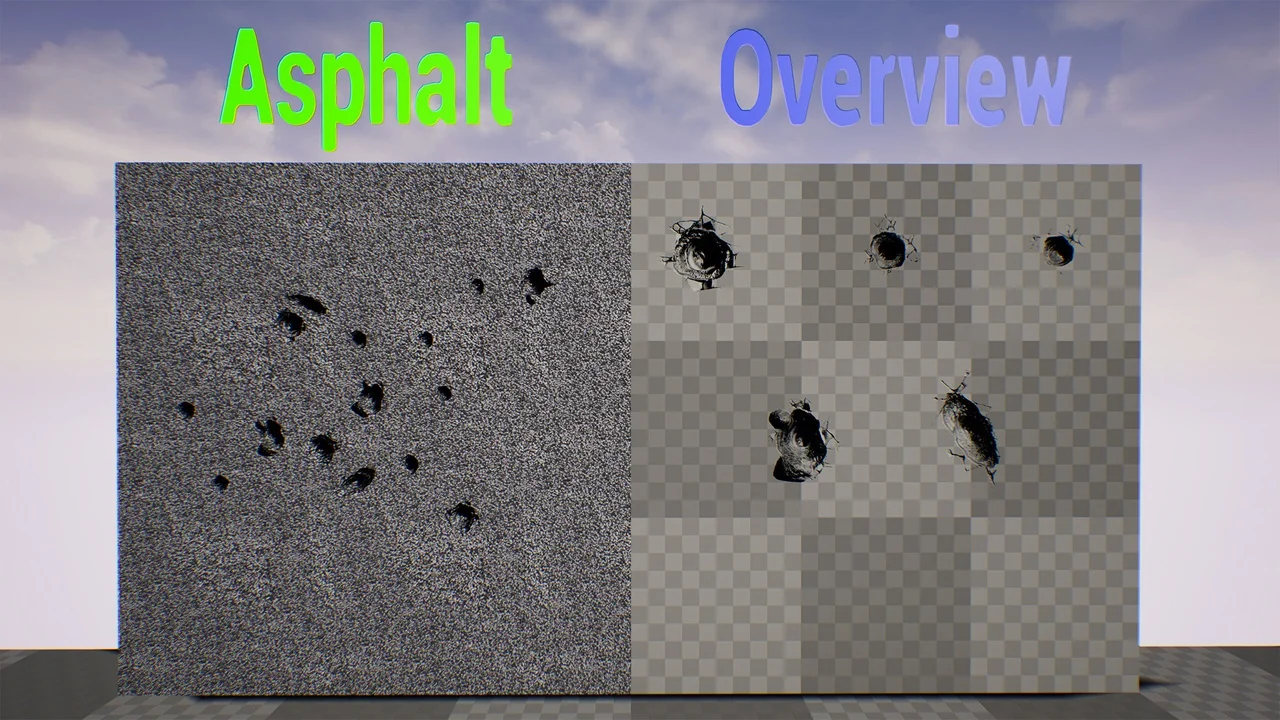
The package does not treat every surface the same way technically. Ten groups are plain normal decals — asphalt, bricks, concrete, cracks, dirt, generic, hits, rock, sand, and scratches — accounting for 70 of the 170. These are the lightest entries, detail laid over geometry that already exists in the scene.
Twelve groups pair a texture with a normal map: burnt, ceramics, fabric, flesh, metal armored, metal solid, metal thin, plastic, reinforced, rubber, sheetrock, and wood. That is 75 decals, the largest share of the set. The ground group uses a texture plus normal map decal, five of them.
Two categories step further out of flat projection. Blasted is the only group supplied as POM materials with meshes — five mesh decals, where the parallax occlusion mapping gives the pitting and torn material a depth that a projected normal cannot. The three glass groups — bulletproof, common, and windshield — are bump materials with meshes, five each, fifteen in total.
The practical effect is that the depth treatment follows the material. Concrete, brick, and rock get away with a normal decal because the surrounding geometry already sells the surface. Blasted metal and glass do not, so they arrive with their own mesh and their own shading model.
Metal at three weights, glass in three kinds
Metal Armored and Metal Solid each carry five texture-plus-normal decals. Metal Thin carries ten — double the variants of the heavier gauges. That weighting lines up with how sheet metal behaves under impact: thinner stock dents, tears, and deforms in more ways than a solid plate does, so it earns more options.
Glass is separated by what the pane is expected to withstand. Glass Bulletproof, Glass Common, and Glass Windshield hold five bump material mesh decals each. A windshield and a bulletproof pane do not fail the same way, and keeping them in distinct groups means a scene can use the right fracture pattern for the surface instead of a single generic glass break everywhere.
Cracks and scratches that never involve a projectile
Not everything in the set is a bullet hole. Cracks contributes ten normal decals and Scratches contributes five, and both are reusable for abrasion, stress, and age rather than gunfire. Placed on a wall or a floor, they push a space toward looking used without implying combat.
The Hits group is the clearest departure from firearms: ten normal decals split five axe and five knife. Melee damage has a different silhouette from a bullet strike, and having the two weapon types separated inside the group lets an environment artist match the mark to whatever actually hit the surface.
Burnt and Blasted cover the other end of the damage spectrum — heat and blast rather than penetration. Burnt arrives as five texture-plus-normal decals; Blasted as five POM mesh decals. Between them, a scene can show a surface that was scorched or blown apart instead of pierced.
Flesh, blood, and the 4K blood element
Flesh is one of the twelve texture-plus-normal groups, with five decals. Blood is handled as a customizable 4K element, which matters for close-range impact reads where the surrounding surface is a character rather than a wall. It sits alongside fabric and rubber in the softer end of the coverage — materials that absorb an impact differently from concrete or steel.
What the coverage is set up to handle
Combat spaces are the obvious fit. A shooter that fires at brick, concrete, drywall, three gauges of metal, three kinds of glass, wood, plastic, and flesh within the same level needs a hit response for each, and the per-material grouping maps directly onto that requirement. A team that would otherwise stretch one hole texture across every surface in a level has a separate option for each instead.
Beyond gunfire, the set supports damage states and set dressing. Cracks and scratches age a room. Burnt and blasted marks back up a story beat about something that already happened there. Axe and knife hits give a melee-focused scene its own vocabulary. Ground, generic, and the softer materials fill in the edges — asphalt and dirt outdoors, sand and rock in terrain, fabric and rubber on props.
The three-tier structure also gives a scene some control over cost and fidelity. Normal decals carry the broadest surface coverage at the lightest weight. Texture-plus-normal groups add a colour and roughness read on top. The mesh-backed POM and bump entries are reserved for the two cases where depth is genuinely needed: blasted surfaces and glass. A level does not have to run everything at the heaviest setting to look complete.
Environment and level artists dressing combat zones will get the most from it, particularly those working on shooters where the surface mix changes constantly and a single decal sheet would flatten the whole space. Anyone who needs a small, deliberate library of melee marks, cracks, or scorch damage will find those sitting in the same set, separated cleanly enough to pull out on their own.
 Damage & Grunge
 Damage & Grunge
 Damage & Grunge
 Damage & Grunge