"a7cfa646d0d8ae55"{"id":"1000779","slug":"beefy-bass-niagara-fish-system","title":"Beefy Bass (Niagara Fish System)","category":"Procedural Systems","engine":"4.26+,5.0+","assetVersion":"","engineVersion":"Engine Version: 4.26+,5.0+","tag":"Procedural Systems","accent":"blue","visual":"mech","summary":"Unreal 5.2 Niagara fish system with five freshwater species, reusable stylized materials, and five flocking behavior modes for populating water environments.","platform":"Unreal Engine","publishedAt":"2026-07-29T15:47:27.384Z","updatedAt":"2026-07-29T15:47:27.384Z","sourceNotes":[],"fileContents":[],"compatibility":["Unreal Engine","Engine Version: 4.26+,5.0+"],"featuredImage":{"alt":"Beefy Bass (Niagara Fish System)","src":"/wp-content/uploads/published/2026/07/8b74a6c2ec35-48c0ff12-97e7-440c-86be-4f6286f215e3-dc328a73ef.webp"},"hasDownloadLink":true,"downloads":2,"terms":[{"taxonomy":"category","slug":"procedural-systems","name":"Procedural Systems"}],"galleryImages":[{"src":"/wp-content/uploads/published/2026/07/638cf63d0c00-5141f096-94c2-4922-82f0-558a2f14bfe3-bb7121e54c.webp","alt":"Beefy Bass (Niagara Fish System)"},{"src":"/wp-content/uploads/published/2026/07/b1780d9a3f42-4201375c-fdd7-4517-8961-6360ae969424-32c3afb921.webp","alt":"Beefy Bass (Niagara Fish System)"},{"src":"/wp-content/uploads/published/2026/07/4c971bb7ebd3-c2b41ddf-9a9b-451c-b650-ca7f57925af2-08ef5cc00b.webp","alt":"Beefy Bass (Niagara Fish System)"},{"src":"/wp-content/uploads/published/2026/07/bd7b2611c1c2-cd4c905e-d3e2-4eed-890c-01bf09f6badd-6a4e5467ed.webp","alt":"Beefy Bass (Niagara Fish System)"}],"accessPanel":{"kind":"resource","title":"Download this resource","eyebrow":"Free Download","message":"Log in or create a free account to start your download.","fileName":"Content.7z","safetyNote":"Resources are manually reviewed before listing to improve quality and reduce obvious risks.","actionLabel":"Download Free","resourceType":"Resource archive"},"contentHtml":"\u003cp\u003eStylized water environments need believable aquatic life. A scene might call for fish drifting along a riverbed, scattering when a player wades too close, or circling in formation to suggest an ecosystem. \u003cem\u003eBeefy Bass\u003c/em\u003e is structured through exactly these situations, bringing five freshwater species into Unreal Engine 5.2 via a Niagara-driven flocking framework.\u003c/p\u003e\n\n\u003ch2\u003eFive Freshwater Species for Stylized Environments\u003c/h2\u003e\n\u003cp\u003eThe pack collects five distinct freshwater fish—Bass, Bluegill, Trout, Salmon, and Pike—each intended to thrive in a stylized visual context. These species can populate ponds, lakes, and river systems without demanding photorealistic treatment.\u003c/p\u003e\n\n\u003cp\u003eWhat connects them visually is a shared material approach. A single reusable material supports low-poly shading for clean silhouettes and flat surface reads, World Position Offset (WPO) for procedural swimming motion baked directly into the material, Fresnel rim highlights for readable edges underwater or at grazing angles, and exposed color parameters for quick tone adjustments.\u003c/p\u003e\n\n\u003cp\u003eThe material system is two-tiered. Each fish has its own Material Instance, which can be tuned individually when a scene demands per-species variation. A master Material Instance also allows global control, so color shifts or animation tweaks can ripple across every fish type at once without manually editing each instance.\u003c/p\u003e\n\n\u003cp\u003eThat structure lets creators maintain consistent stylized rendering across all five species while still leaving room for localized differences.\u003c/p\u003e\n\n\u003ch2\u003eNiagara's Flocking Framework and Behavior Functionality\u003c/h2\u003e\n\u003cp\u003eAt the core of the pack is a Niagara-based flocking Blueprint system that governs how fish groups move and respond within a level. The system is exposed through the \u003ccode\u003eInitialFlightType\u003c/code\u003e enum variable on each flocking Blueprint, which selects one of five behavior modes.\u003c/p\u003e\n\n\u003cp\u003eFive selector options break down into distinct movement paradigms:\u003c/p\u003e\n\n\u003cul\u003e\n \u003cli\u003e\u003cstrong\u003ePerching:\u003c/strong\u003e Fish swim toward a designated resting point and idle there. The take-off behavior is triggered when initiated, making this useful for semi-static pools where fish pause near rocks or riverbed features.\u003c/li\u003e\n \u003cli\u003e\u003cstrong\u003eFlocking Point:\u003c/strong\u003e Fish maintain constant swimming along randomized paths within a bounded volume. The \u003ccode\u003eFlockingPointBoundaryBox\u003c/code\u003e tool Blueprint defines the movement range, producing an “always swimming” feel for open water areas.\u003c/li\u003e\n \u003cli\u003e\u003cstrong\u003eSpline Path:\u003c/strong\u003e Fish follow a pre-defined spline route defined by the \u003ccode\u003ePath\u003c/code\u003e tool Blueprint. This supports choreographed migration scenes along specific river or coastal routes.\u003c/li\u003e\n \u003cli\u003e\u003cstrong\u003eFree Roam:\u003c/strong\u003e Fish remain idle until approached, then swim only to avoid players or intruders. This reactive behavior is suited for ponds or shallow water zones where player interaction triggers scatter behavior.\u003c/li\u003e\n \u003cli\u003e\u003cstrong\u003eFollow Intruder:\u003c/strong\u003e The inverse of avoidance—fish actively swim toward the nearest intruder, enabling predator-like or investigative behavior sequences.\u003c/li\u003e\n\u003c/ul\u003e\n\n\u003cp\u003eThough the Blueprint terminology in the pack references flight, designers should note that the system is fully applied to aquatic contexts. The same flocking logic extends naturally into underwater motion, where fish navigate, perch, scatter, and group rather than birds flying through open air.\u003c/p\u003e\n\n\u003ch2\u003eBlueprint Tools for Scene Placement\u003c/h2\u003e\n\u003cp\u003eTwo tool Blueprints explicitly support layout and path control. The \u003ccode\u003eFlockingPointBoundaryBox\u003c/code\u003e tool Blueprint fixes a containment volume where fish operating in Flocking Point mode can randomly wander. The \u003ccode\u003ePath\u003c/code\u003e tool Blueprint constructs the spline geometry that fish in Spline Path mode follow. Both integrate with the main flocking Blueprint, allowing designers to drop behavior volumes and routed corridors into a level without manually coding motion buffers.\u003c/p\u003e\n\n\u003cp\u003eThe pack recommends opening the \u003ccode\u003eMap_NiagaraFlockExample\u003c/code\u003e level as a starting point. This example map demonstrates how the Blueprints, tool volumes, and behavior enums interact spatially, offering a working setup that can be deconstructed and adapted into new scenes.\u003c/p\u003e\n\n\u003ch2\u003eCompatibility with Beefy Blackbirds\u003c/h2\u003e\n\u003cp\u003eThe Niagara fish system carries explicit compatibility with \u003cem\u003eBeefy Blackbirds (Niagara Bird System)\u003c/em\u003e. The link is structural: both packs share the same flocking Blueprint architecture, behavior enum system, and flight-type methodology. The fish system essentially ports the established bird behavior logic into underwater scenarios.\u003c/p\u003e\n\n\u003cp\u003eFor creators who already use the bird system, fish will adhere to familiar setup patterns: selector variables, behavior modes named with flight terminology, and shared concepts like perching and flock point boundaries. For those evaluating the fish system independently, the compatibility indicates a tested, cross-validated framework instead of a one-purpose script built in isolation.\u003c/p\u003e\n\n\u003ch2\u003eCollision, Wildlife, and Stylized Scene Integration\u003c/h2\u003e\n\u003cp\u003eStylized nature scenes often require wildlife that reads clearly without leaning on heavy realism. \u003cem\u003eBeefy Bass\u003c/em\u003e fits that demand by combining low-poly-compatible materials, Fresnel rim definitions that keep fish readable against water, and collision-aware behavior modes that let wildlife react to player presence without complex AI wiring.\u003c/p\u003e\n\n\u003cp\u003eTags attached to the pack—including \u003cem\u003eLock\u003c/em\u003e, \u003cem\u003eSystem\u003c/em\u003e, \u003cem\u003eFish\u003c/em\u003e, \u003cem\u003eLowpoly\u003c/em\u003e, \u003cem\u003eNiagara\u003c/em\u003e, \u003cem\u003eScript\u003c/em\u003e, \u003cem\u003eNature\u003c/em\u003e, \u003cem\u003eCollision\u003c/em\u003e, \u003cem\u003eWildlife\u003c/em\u003e, \u003cem\u003eStylized\u003c/em\u003e, \u003cem\u003eBlueprint\u003c/em\u003e, and \u003cem\u003eParticle\u003c/em\u003e—reinforce this positioning. The wildlife system carries collision awareness through modes like Free Roam and Follow Intruder, where player proximity directly triggers behavior state changes. Niagara drives the particle-based flocking behavior, while Blueprints handle the scene-level control and behavior selection.\u003c/p\u003e\n\n\u003cp\u003eA scene populated with idle bass that flee on approach, trout that roam within a bounded lake volume, and pike that track player movement creates layered life without hand-keyed animation per fish.\u003c/p\u003e\n\n\u003ch2\u003eWhere Beefy Bass Fits in a Stylized Production Pipeline\u003c/h2\u003e\n\u003cp\u003eProduction pipelines that can benefit include stylized RPG environments with lakes and rivers, exploration games where water bodies need movement to avoid feeling static, and narrative scenes where fish behavior supports a specific beat—migration along a defined spline, scatter on player approach, or predator pursuit.\u003c/p\u003e\n\n\u003cp\u003eThe two-tiered material system lets art directors lock a global stylized look via the master instance, while scene-level tuning remains possible on each fish type. The five behavior enum values give level designers direct control over wildlife tone: peaceful, chaotic, reactive, or aggressive. The Blueprint tool volume approach allows placement without manual spline coding, lowering the cost of populating multiple water bodies across a game level.\u003c/p\u003e\n\n\u003cp\u003eThe strongest fit is for teams or solo developers working in Unreal Engine 5.2 who need charged stylized aquatic wildlife without building custom AI or procedural animation systems from scratch. Compatibility with the \u003cem\u003eBeefy Blackbirds\u003c/em\u003e system means existing bird behavior knowledge transfers directly, framing this as an aquatic extension rather than a detached learning investment.\u003c/p\u003e\n\n\u003ch2\u003eContinue Browsing Similar Packs\u003c/h2\u003e\n\u003cul\u003e\n\u003cli\u003e\u003ca href=\"https://3dcghub.com/fluid-flux/\" title=\"Fluid Flux\"\u003eFluid Flux\u003c/a\u003e\u003c/li\u003e\n\u003cli\u003e\u003ca href=\"https://3dcghub.com/water-fountain/\" title=\"Water Fountain\"\u003eWater Fountain\u003c/a\u003e\u003c/li\u003e\n\u003cli\u003e\u003ca href=\"https://3dcghub.com/infinity-weather/\" title=\"Infinity Weather\"\u003eInfinity Weather\u003c/a\u003e\u003c/li\u003e\n\u003cli\u003e\u003ca href=\"https://3dcghub.com/easy-rain/\" title=\"Easy Rain\"\u003eEasy Rain\u003c/a\u003e\u003c/li\u003e\n\u003cli\u003e\u003ca href=\"https://3dcghub.com/beefy-water-hole-water-system/\" title=\"Beefy Water Hole (Water System)\"\u003eBeefy Water Hole (Water System)\u003c/a\u003e\u003c/li\u003e\n\u003c/ul\u003e","contentTextLength":7069,"navigation":{"current":475,"total":3167,"previous":{"id":"1000780","slug":"48-hdri-alien-places","title":"48 HDRI Alien Places","category":"Outdoors","platform":"Unreal Engine","updatedAt":"2026-07-29T15:59:08.453Z"},"next":{"id":"1000778","slug":"aztec-weapon-pack","title":"Aztec Weapon Pack","category":"Weapons \u0026 Combat","platform":"Unreal Engine","updatedAt":"2026-07-29T15:45:28.399Z"}},"relatedResources":[{"id":"11402","slug":"fluid-flux","title":"Fluid Flux","category":"Procedural Systems","engine":"4.26+,5.0+","assetVersion":"Engine version: 4.26+,5.0+","engineVersion":"Asset Version:2.2 - 3.0.4","tag":"Procedural Systems","accent":"blue","visual":"city","summary":"Fluid Flux is a powerful tool for real-time shallow water simulation and high-quality surface rendering. It features a GPU-friendly implementation designed for efficiency and visual fidelity in modern game projects.","platform":"Unreal Engine","publishedAt":"2026-03-05T17:11:44.000Z","updatedAt":"2026-04-19T15:48:12.000Z","sourceNotes":[],"fileContents":[],"compatibility":["Unreal Engine","Engine version: 4.26+,5.0+","Asset Version: 2.2 - 3.0.4"],"featuredImage":{"alt":"Fluid Flux","src":"https://3dcghub.com/wp-content/uploads/2026/03/1fe4696d-28ca-47a0-87e1-8b8daa320977.webp"},"hasDownloadLink":true,"downloads":12},{"id":"11617","slug":"water-fountain","title":"Water Fountain","category":"Procedural Systems","engine":"4.26+,5.0+","assetVersion":"Engine version: 4.26+,5.0+","engineVersion":"4.16","tag":"Procedural Systems","accent":"blue","visual":"animation","summary":"Enhance your environments with a versatile Water Fountain system designed for ease of use. This asset features customizable Blueprints, Niagara particle support, and over 40 pre-configured examples.","platform":"Unreal Engine","publishedAt":"2026-03-05T18:02:46.000Z","updatedAt":"2026-04-19T15:48:09.000Z","sourceNotes":[],"fileContents":[],"compatibility":["Unreal Engine","Engine version: 4.26+,5.0+"],"featuredImage":{"alt":"Water Fountain","src":"https://3dcghub.com/wp-content/uploads/2026/03/ee9e2d5b-0d88-43da-947c-568b07fe30f9.webp"},"hasDownloadLink":true,"downloads":4},{"id":"11436","slug":"infinity-weather","title":"Infinity Weather","category":"Procedural Systems","engine":"5.4+","assetVersion":"Engine version: 5.4+","engineVersion":"4.23","tag":"Procedural Systems","accent":"blue","visual":"audio","summary":"Enhance your project with Infinity Weather, a robust system for realistic environmental effects. It features advanced displacement, dynamic skies, and a complete footstep system.","platform":"Unreal Engine","publishedAt":"2026-03-05T17:18:31.000Z","updatedAt":"2026-04-19T15:48:12.000Z","sourceNotes":[],"fileContents":[],"compatibility":["Unreal Engine","Engine version: 5.4+"],"featuredImage":{"alt":"Infinity Weather","src":"https://3dcghub.com/wp-content/uploads/2026/03/3bc5c887-7265-4714-a69c-802add0e7f33.webp"},"hasDownloadLink":true,"downloads":1}]}
Procedural Systems
Beefy Bass (Niagara Fish System)
Unreal 5.2 Niagara fish system with five freshwater species, reusable stylized materials, and five flocking behavior modes for populating water environments.
Stylized water environments need believable aquatic life. A scene might call for fish drifting along a riverbed, scattering when a player wades too close, or circling in formation to suggest an ecosystem. Beefy Bass is structured through exactly these situations, bringing five freshwater species into Unreal Engine 5.2 via a Niagara-driven flocking framework.
Five Freshwater Species for Stylized Environments
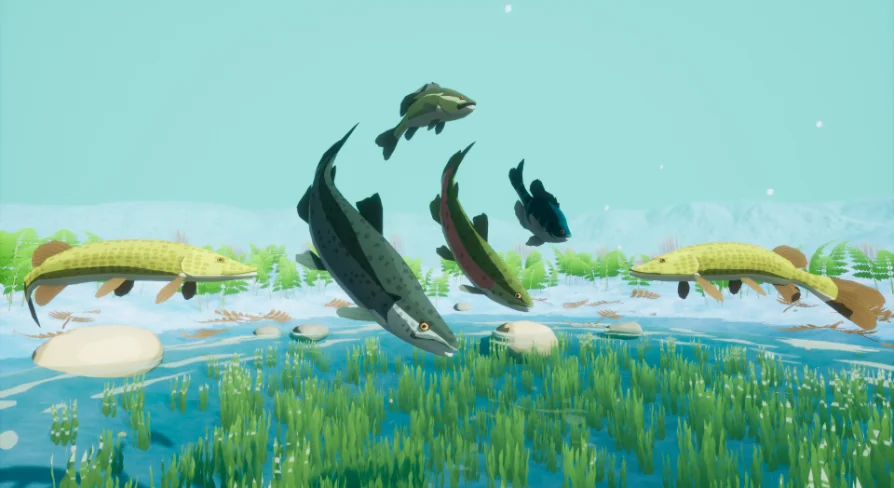
The pack collects five distinct freshwater fish—Bass, Bluegill, Trout, Salmon, and Pike—each intended to thrive in a stylized visual context. These species can populate ponds, lakes, and river systems without demanding photorealistic treatment.
What connects them visually is a shared material approach. A single reusable material supports low-poly shading for clean silhouettes and flat surface reads, World Position Offset (WPO) for procedural swimming motion baked directly into the material, Fresnel rim highlights for readable edges underwater or at grazing angles, and exposed color parameters for quick tone adjustments.
The material system is two-tiered. Each fish has its own Material Instance, which can be tuned individually when a scene demands per-species variation. A master Material Instance also allows global control, so color shifts or animation tweaks can ripple across every fish type at once without manually editing each instance.
That structure lets creators maintain consistent stylized rendering across all five species while still leaving room for localized differences.
Niagara's Flocking Framework and Behavior Functionality
At the core of the pack is a Niagara-based flocking Blueprint system that governs how fish groups move and respond within a level. The system is exposed through the InitialFlightType enum variable on each flocking Blueprint, which selects one of five behavior modes.
Five selector options break down into distinct movement paradigms:
Perching: Fish swim toward a designated resting point and idle there. The take-off behavior is triggered when initiated, making this useful for semi-static pools where fish pause near rocks or riverbed features.
Flocking Point: Fish maintain constant swimming along randomized paths within a bounded volume. The FlockingPointBoundaryBox tool Blueprint defines the movement range, producing an “always swimming” feel for open water areas.
Spline Path: Fish follow a pre-defined spline route defined by the Path tool Blueprint. This supports choreographed migration scenes along specific river or coastal routes.
Free Roam: Fish remain idle until approached, then swim only to avoid players or intruders. This reactive behavior is suited for ponds or shallow water zones where player interaction triggers scatter behavior.
Follow Intruder: The inverse of avoidance—fish actively swim toward the nearest intruder, enabling predator-like or investigative behavior sequences.
Though the Blueprint terminology in the pack references flight, designers should note that the system is fully applied to aquatic contexts. The same flocking logic extends naturally into underwater motion, where fish navigate, perch, scatter, and group rather than birds flying through open air.
Blueprint Tools for Scene Placement
Two tool Blueprints explicitly support layout and path control. The FlockingPointBoundaryBox tool Blueprint fixes a containment volume where fish operating in Flocking Point mode can randomly wander. The Path tool Blueprint constructs the spline geometry that fish in Spline Path mode follow. Both integrate with the main flocking Blueprint, allowing designers to drop behavior volumes and routed corridors into a level without manually coding motion buffers.
The pack recommends opening the Map_NiagaraFlockExample level as a starting point. This example map demonstrates how the Blueprints, tool volumes, and behavior enums interact spatially, offering a working setup that can be deconstructed and adapted into new scenes.
Compatibility with Beefy Blackbirds
The Niagara fish system carries explicit compatibility with Beefy Blackbirds (Niagara Bird System). The link is structural: both packs share the same flocking Blueprint architecture, behavior enum system, and flight-type methodology. The fish system essentially ports the established bird behavior logic into underwater scenarios.
For creators who already use the bird system, fish will adhere to familiar setup patterns: selector variables, behavior modes named with flight terminology, and shared concepts like perching and flock point boundaries. For those evaluating the fish system independently, the compatibility indicates a tested, cross-validated framework instead of a one-purpose script built in isolation.
Collision, Wildlife, and Stylized Scene Integration
Stylized nature scenes often require wildlife that reads clearly without leaning on heavy realism. Beefy Bass fits that demand by combining low-poly-compatible materials, Fresnel rim definitions that keep fish readable against water, and collision-aware behavior modes that let wildlife react to player presence without complex AI wiring.
Tags attached to the pack—including Lock, System, Fish, Lowpoly, Niagara, Script, Nature, Collision, Wildlife, Stylized, Blueprint, and Particle—reinforce this positioning. The wildlife system carries collision awareness through modes like Free Roam and Follow Intruder, where player proximity directly triggers behavior state changes. Niagara drives the particle-based flocking behavior, while Blueprints handle the scene-level control and behavior selection.
A scene populated with idle bass that flee on approach, trout that roam within a bounded lake volume, and pike that track player movement creates layered life without hand-keyed animation per fish.
Where Beefy Bass Fits in a Stylized Production Pipeline
Production pipelines that can benefit include stylized RPG environments with lakes and rivers, exploration games where water bodies need movement to avoid feeling static, and narrative scenes where fish behavior supports a specific beat—migration along a defined spline, scatter on player approach, or predator pursuit.
The two-tiered material system lets art directors lock a global stylized look via the master instance, while scene-level tuning remains possible on each fish type. The five behavior enum values give level designers direct control over wildlife tone: peaceful, chaotic, reactive, or aggressive. The Blueprint tool volume approach allows placement without manual spline coding, lowering the cost of populating multiple water bodies across a game level.
The strongest fit is for teams or solo developers working in Unreal Engine 5.2 who need charged stylized aquatic wildlife without building custom AI or procedural animation systems from scratch. Compatibility with the Beefy Blackbirds system means existing bird behavior knowledge transfers directly, framing this as an aquatic extension rather than a detached learning investment.
 Procedural Systems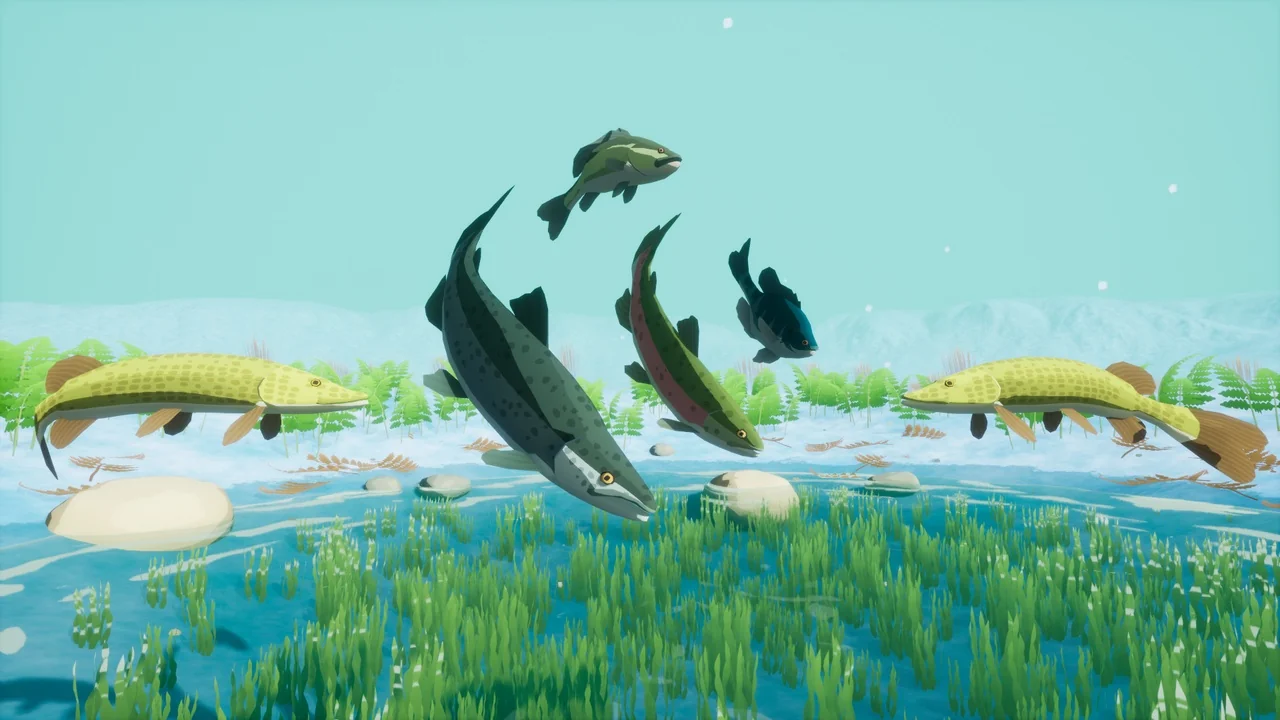
 Procedural Systems
 Procedural Systems
 Procedural Systems