"c68a05d5e51405b3"{"id":"1001922","slug":"assetsville-town","title":"Assetsville Town","category":"Towns \u0026 Villages","engine":"4.26+,5.0+","assetVersion":"","engineVersion":"Engine Version: 4.26+,5.0+","tag":"Towns \u0026 Villages","accent":"blue","visual":"mech","summary":"Explore Assetsville Town, a low-poly Unreal Engine pack with 800+ modular assets, characters, vehicles, and seamless interior-to-exterior building systems.","platform":"Unreal Engine","publishedAt":"2026-10-22T11:58:16.065Z","updatedAt":"2026-10-22T11:58:16.065Z","sourceNotes":[],"fileContents":[],"compatibility":["Unreal Engine","Engine Version: 4.26+,5.0+"],"featuredImage":{"alt":"Assetsville Town","src":"/wp-content/uploads/published/2026/10/c68527ffa0a0-c1e80f10-bd7a-4788-a3e7-daecca730d44-5b4248338e.webp"},"hasDownloadLink":true,"downloads":0,"terms":[{"taxonomy":"category","slug":"towns-and-villages","name":"Towns \u0026 Villages"}],"galleryImages":[{"src":"/wp-content/uploads/published/2026/10/10e18190f295-dcc99a01-f904-4b4c-ae8f-22c1ac3cdf99-98045a2fb1.webp","alt":"Assetsville Town"},{"src":"/wp-content/uploads/published/2026/10/5df0f1a810ec-f2f40053-c06c-495b-a2b8-8a22c6266903-66957b53d4.webp","alt":"Assetsville Town"},{"src":"/wp-content/uploads/published/2026/10/4e936d7988f3-8b8f4a4d-7b5d-42c0-a6ba-511b5b08a5d6-eec1f71bee.webp","alt":"Assetsville Town"},{"src":"/wp-content/uploads/published/2026/10/f17ba79e2cb4-4b4ad48a-b7f7-4ca5-90a5-4aa05be9bbc4-75c6f23f57.webp","alt":"Assetsville Town"},{"src":"/wp-content/uploads/published/2026/10/ff8b38f64b1b-2e1c0eac-b23a-4be1-891f-552b14d1b620-1fb3d9bc86.webp","alt":"Assetsville Town"},{"src":"/wp-content/uploads/published/2026/10/4cbf03fa3ca5-45aee6e8-2b61-4059-84b1-6d334b3b8b0c-1320a2979c.webp","alt":"Assetsville Town"},{"src":"/wp-content/uploads/published/2026/10/d810b45d4c73-3c1fe4c9-1eac-4dd8-9bb4-82313024c2de-8e4049e277.webp","alt":"Assetsville Town"},{"src":"/wp-content/uploads/published/2026/10/85189813a819-52414b6b-38fb-4294-9082-c59fa3f199c7-f2ad2277d9.webp","alt":"Assetsville Town"},{"src":"/wp-content/uploads/published/2026/10/275e67bac0de-efa5f153-0e96-4218-af05-313fa366d68d-513a25686d.webp","alt":"Assetsville Town"},{"src":"/wp-content/uploads/published/2026/10/4fd32114eb94-9c58f9be-2710-4a13-8532-906e4001414c-fd2f576796.webp","alt":"Assetsville Town"}],"accessPanel":{"kind":"resource","title":"Download this resource","eyebrow":"Free Download","message":"Log in or create a free account to start your download.","fileName":"Assetsville Town.7z","safetyNote":"Resources are manually reviewed before listing to improve quality and reduce obvious risks.","actionLabel":"Download Free","resourceType":"Resource archive"},"contentHtml":"\u003ch2\u003eAssembling American Town Environments with the Modular Building Tileset\u003c/h2\u003e\n\u003cp\u003eConstructing believable suburban and urban layouts with low-poly geometry requires architectural components that snap together cleanly without visual gaps. Assetsville Town addresses this by centering its environment workflow around a modular building tileset. Instead of restricting designers to solid, decorative building shells, the tileset is engineered to accommodate both exterior facades and traversable indoor rooms in a single unified system.\u003c/p\u003e\n\u003cp\u003eLevel designers can assemble residential blocks, storefronts, and municipal structures by combining wall sections, roofs, doorways, and flooring tiles. Because the components are built to align seamlessly, transitioning between an outdoor street corner and an indoor room avoids misaligned seams or light leakage. This modularity allows teams targeting an American town aesthetic to create varied architectural silhouettes across a level without producing repetitive streetscapes or modeling individual structures from scratch.\u003c/p\u003e \u003ch2\u003eInterior and Exterior Lighting Pipelines in Unreal Engine\u003c/h2\u003e\n\u003cp\u003eLighting low-poly environments poses distinct challenges depending on whether a project relies on static computation or real-time rendering. The geometry across the Assetsville Town collection is constructed to accommodate both baked lightmaps and fully dynamic light settings within Unreal Engine.\u003c/p\u003e\n\u003cp\u003eWhen deploying static lighting, the modular tileset components maintain clean seams across adjoining surfaces. This prevents artifacting and unnatural light bleed at the intersections where exterior walls, ceilings, and interior partitions meet. For projects utilizing dynamic directional lights, day-night cycles, or movable interior fixtures, the surface geometry responds consistently without exposing unexpected backface issues or inverted shading. Having structural meshes that adapt to both lighting approaches ensures that teams can choose their performance profile based on platform demands rather than asset limitations.\u003c/p\u003e \u003ch2\u003ePopulating Levels with Characters, Vehicles, and Props\u003c/h2\u003e\n\u003cp\u003eA convincing town environment requires more than standalone architectural shells; it requires a living context. Assetsville Town encompasses over 800 models created by 3D artists with game development background, covering everything required to turn empty modular rooms and vacant roadways into an inhabited settlement.\u003c/p\u003e\n\u003cp\u003eThe asset collection includes street-level infrastructure, architectural elements, functional props, town vehicles, and specialized objects such as weapons. By supplying assets across multiple functional categories under a consistent low-poly art direction, the pack removes the visual disparity that occurs when sourcing elements from mismatched libraries. Vehicles can be staged along curb sections, parked in driveways, or positioned as scene set dressing, while interior spaces can be outfitted using domestic and commercial furnishings directly aligned with the proportions of the modular wall and floor tiles.\u003c/p\u003e \u003ch2\u003eCharacter Setup with the UE4 Third Person Template\u003c/h2\u003e\n\u003cp\u003eIntegrating playable figures and background pedestrians into an environment early in production prevents scale drift and clarifies spatial flow. Assetsville Town includes dedicated character assets configured to work alongside the standard UE4 Third Person Template.\u003c/p\u003e\n\u003cp\u003eConnecting the assets into the template workflow gives teams immediate functional access to third-person locomotion, camera framing, and collision response inside newly blocked-out town sectors. Designers can test doorway clearances, ceiling heights, street widths, and vehicle scale against an active character controller immediately after snapping modular tiles together. This direct link to Unreal Engine's core character systems accelerates the transition from greyboxing architectural footprints to testing playable spatial mechanics.\u003c/p\u003e \u003ch2\u003eSeries Continuity and Assetsville Town 2 Compatibility\u003c/h2\u003e\n\u003cp\u003eAs the foundational entry in a low-poly series for Unreal Engine, the original Assetsville Town establishes the visual guidelines, spatial scale, and modular standards carried forward in the ecosystem. The set maintains compatibility with Assetsville Town 2 - Modular County, allowing teams to expand initial urban or suburban center maps into broader county, rural, or regional settings.\u003c/p\u003e\n\u003cp\u003eBecause the grid proportions, materials, and stylistic conventions remain unified across both packs, level designers can connect municipal zones to surrounding county environments without visual jarring. For developers building indie titles set across larger American landscapes with limited production bandwidth, this continuity ensures that modular buildings, road networks, character models, and vehicle assets function as a singular, coherent environment toolkit throughout production.\u003c/p\u003e\n\n\u003ch2\u003eMore From The Same Workflow\u003c/h2\u003e\n\u003cul\u003e\n\u003cli\u003e\u003ca href=\"https://3dcghub.com/polygon-goblin-war-camp/\" title=\"POLYGON - Goblin War Camp\"\u003ePOLYGON - Goblin War Camp\u003c/a\u003e\u003c/li\u003e\n\u003cli\u003e\u003ca href=\"https://3dcghub.com/modular-medieval-asset-pack-low-poly-buildings-street-assets-by-drcg/\" title=\"Modular Medieval Asset Pack (Low Poly, Buildings, Street Assets by DrCG)\"\u003eModular Medieval Asset Pack (Low Poly, Buildings, Street Assets by DrCG)\u003c/a\u003e\u003c/li\u003e\n\u003cli\u003e\u003ca href=\"https://3dcghub.com/assetsville-town-2-modular-county/\" title=\"Assetsville Town 2 - Modular County\"\u003eAssetsville Town 2 - Modular County\u003c/a\u003e\u003c/li\u003e\n\u003cli\u003e\u003ca href=\"https://3dcghub.com/suburb-neighborhood-house-pack-modular/\" title=\"Suburb Neighborhood House Pack (Modular)\"\u003eSuburb Neighborhood House Pack (Modular)\u003c/a\u003e\u003c/li\u003e\n\u003cli\u003e\u003ca href=\"https://3dcghub.com/stylized-countryside-stylized-stylised-country-country-side-road-lowpoly-3d/\" title=\"Stylized Countryside ( Stylized Stylised Country Country Side Road Lowpoly 3d )\"\u003eStylized Countryside ( Stylized Stylised Country Country Side Road Lowpoly 3d )\u003c/a\u003e\u003c/li\u003e\n\u003c/ul\u003e","contentTextLength":5105,"navigation":{"current":3,"total":3860,"previous":{"id":"1001923","slug":"medieval-village-rustic-fantasy-settlement-environment","title":"Medieval Village – Rustic Fantasy Settlement Environment","category":"Medieval","platform":"Unreal Engine","updatedAt":"2026-10-22T11:59:25.455Z"},"next":{"id":"1001921","slug":"yellow-parrot-restaurant-restaurant-cafe-pub-diner-bar-dining-kitchen-parrot","title":"Yellow Parrot Restaurant ( Restaurant Cafe Pub Diner Bar Dining Kitchen Parrot )","category":"Interior","platform":"Unreal Engine","updatedAt":"2026-10-22T11:57:33.244Z"}},"relatedResources":[{"id":"1000199","slug":"polygon-goblin-war-camp","title":"POLYGON - Goblin War Camp","category":"Towns \u0026 Villages","engine":"4.26+,5.0+","assetVersion":"","engineVersion":"Engine Version: 4.26+,5.0+","tag":"Towns \u0026 Villages","accent":"blue","visual":"mech","summary":"A stylized swamp stronghold pack with 600+ blueprints, 15 rigged characters, war camp buildings, props, weapons, FX, and a demo scene.","platform":"Unreal Engine","publishedAt":"2026-06-23T11:24:33.942Z","updatedAt":"2026-06-23T11:24:33.942Z","sourceNotes":[],"fileContents":[],"compatibility":["Unreal Engine","Engine Version: 4.26+,5.0+"],"featuredImage":{"alt":"POLYGON - Goblin War Camp","src":"/wp-content/uploads/published/2026/06/ed918f3dbe1d-156e1b13-64f9-46db-a4f2-d9f67fae7972-c52baae97f.webp"},"hasDownloadLink":true,"downloads":5},{"id":"1000433","slug":"modular-medieval-asset-pack-low-poly-buildings-street-assets-by-drcg","title":"Modular Medieval Asset Pack (Low Poly, Buildings, Street Assets by DrCG)","category":"Towns \u0026 Villages","engine":"4.26+,5.0+","assetVersion":"","engineVersion":"Engine Version: 4.26+,5.0+","tag":"Towns \u0026 Villages","accent":"blue","visual":"mech","summary":"A stylized low-poly medieval village kit with 128 modular meshes, 13 prefab buildings, and street assets for Unreal Engine game, AR, VR, and mobile projects.","platform":"Unreal Engine","publishedAt":"2026-07-10T20:02:37.352Z","updatedAt":"2026-07-10T20:02:37.352Z","sourceNotes":[],"fileContents":[],"compatibility":["Unreal Engine","Engine Version: 4.26+,5.0+"],"featuredImage":{"alt":"Modular Medieval Asset Pack (Low Poly, Buildings, Street Assets by DrCG)","src":"/wp-content/uploads/published/2026/07/cb7199c17557-ecdabd2c-6413-49d4-9904-2ab7514b71c4-86b4987b52.webp"},"hasDownloadLink":true,"downloads":0},{"id":"7018","slug":"assetsville-town-2-modular-county","title":"Assetsville Town 2 - Modular County","category":"Cities","engine":"4.26+,5.0+","assetVersion":"Engine version: 4.26+,5.0+","engineVersion":"4.26","tag":"Cities","accent":"blue","visual":"city","summary":"Create expansive and detailed urban environments with ease using this modular county pack. It features advanced blueprints for roads, parcels, and vehicles to speed up your workflow.","platform":"Unreal Engine","publishedAt":"2026-02-20T16:51:03.000Z","updatedAt":"2026-04-19T15:56:04.000Z","sourceNotes":[],"fileContents":[],"compatibility":["Unreal Engine","Engine version: 4.26+,5.0+"],"featuredImage":{"alt":"Assetsville Town 2 - Modular County","src":"https://3dcghub.com/wp-content/uploads/2026/02/998c76a0-64c0-4175-a23c-9aeb7cec59f3.webp"},"hasDownloadLink":true,"downloads":0}]}
Towns & Villages
Assetsville Town
Explore Assetsville Town, a low-poly Unreal Engine pack with 800+ modular assets, characters, vehicles, and seamless interior-to-exterior building systems.
Assembling American Town Environments with the Modular Building Tileset
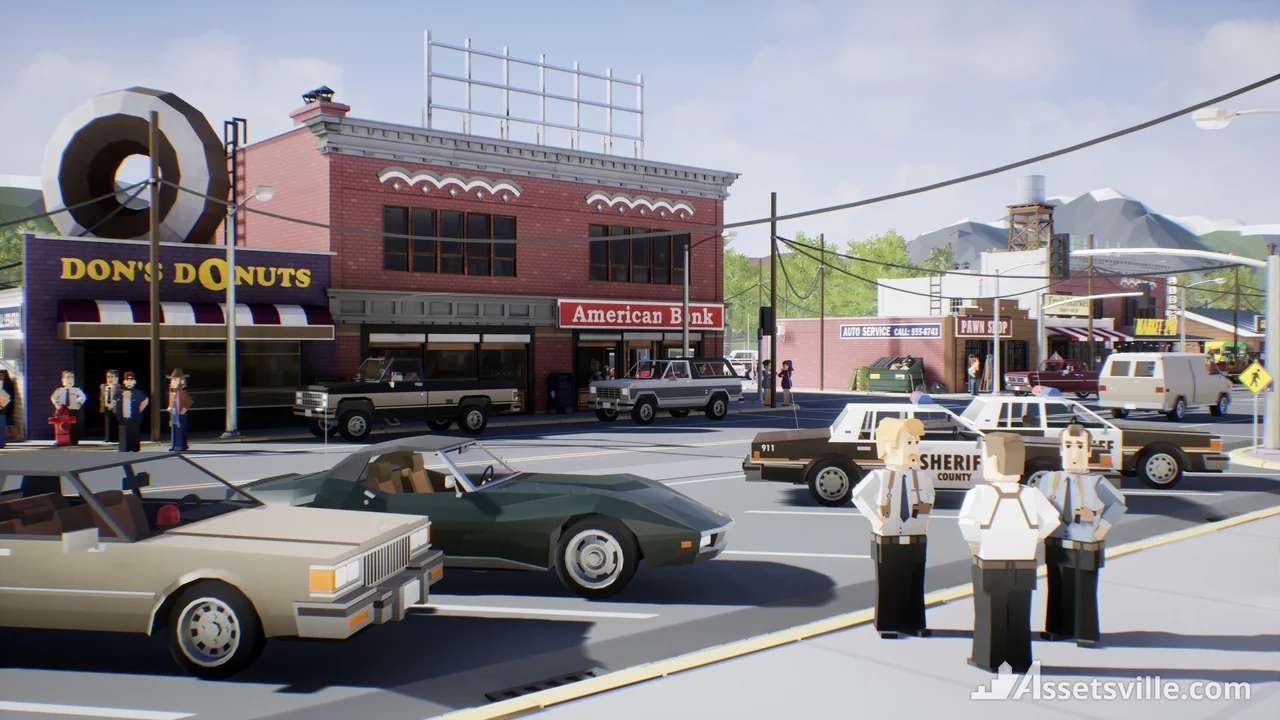
Constructing believable suburban and urban layouts with low-poly geometry requires architectural components that snap together cleanly without visual gaps. Assetsville Town addresses this by centering its environment workflow around a modular building tileset. Instead of restricting designers to solid, decorative building shells, the tileset is engineered to accommodate both exterior facades and traversable indoor rooms in a single unified system.
Level designers can assemble residential blocks, storefronts, and municipal structures by combining wall sections, roofs, doorways, and flooring tiles. Because the components are built to align seamlessly, transitioning between an outdoor street corner and an indoor room avoids misaligned seams or light leakage. This modularity allows teams targeting an American town aesthetic to create varied architectural silhouettes across a level without producing repetitive streetscapes or modeling individual structures from scratch.
Interior and Exterior Lighting Pipelines in Unreal Engine
Lighting low-poly environments poses distinct challenges depending on whether a project relies on static computation or real-time rendering. The geometry across the Assetsville Town collection is constructed to accommodate both baked lightmaps and fully dynamic light settings within Unreal Engine.
When deploying static lighting, the modular tileset components maintain clean seams across adjoining surfaces. This prevents artifacting and unnatural light bleed at the intersections where exterior walls, ceilings, and interior partitions meet. For projects utilizing dynamic directional lights, day-night cycles, or movable interior fixtures, the surface geometry responds consistently without exposing unexpected backface issues or inverted shading. Having structural meshes that adapt to both lighting approaches ensures that teams can choose their performance profile based on platform demands rather than asset limitations.
Populating Levels with Characters, Vehicles, and Props
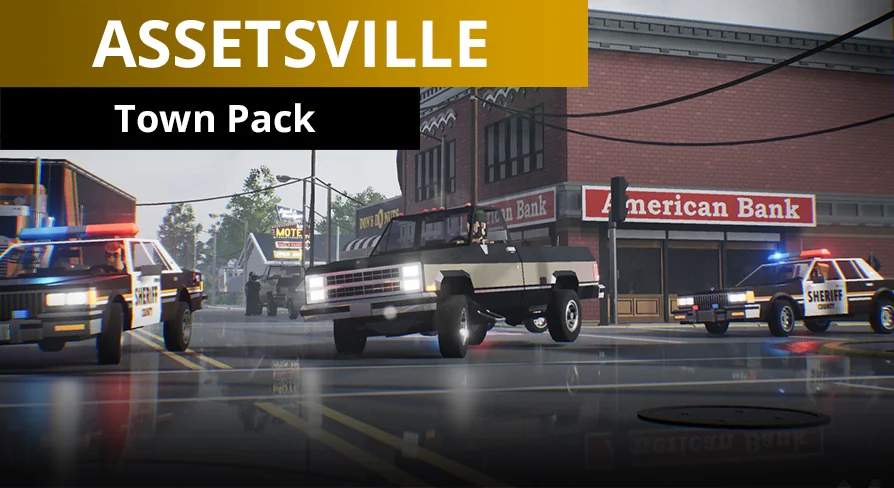
A convincing town environment requires more than standalone architectural shells; it requires a living context. Assetsville Town encompasses over 800 models created by 3D artists with game development background, covering everything required to turn empty modular rooms and vacant roadways into an inhabited settlement.
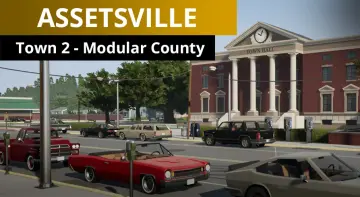
The asset collection includes street-level infrastructure, architectural elements, functional props, town vehicles, and specialized objects such as weapons. By supplying assets across multiple functional categories under a consistent low-poly art direction, the pack removes the visual disparity that occurs when sourcing elements from mismatched libraries. Vehicles can be staged along curb sections, parked in driveways, or positioned as scene set dressing, while interior spaces can be outfitted using domestic and commercial furnishings directly aligned with the proportions of the modular wall and floor tiles.
Character Setup with the UE4 Third Person Template
Integrating playable figures and background pedestrians into an environment early in production prevents scale drift and clarifies spatial flow. Assetsville Town includes dedicated character assets configured to work alongside the standard UE4 Third Person Template.
Connecting the assets into the template workflow gives teams immediate functional access to third-person locomotion, camera framing, and collision response inside newly blocked-out town sectors. Designers can test doorway clearances, ceiling heights, street widths, and vehicle scale against an active character controller immediately after snapping modular tiles together. This direct link to Unreal Engine's core character systems accelerates the transition from greyboxing architectural footprints to testing playable spatial mechanics.
Series Continuity and Assetsville Town 2 Compatibility
As the foundational entry in a low-poly series for Unreal Engine, the original Assetsville Town establishes the visual guidelines, spatial scale, and modular standards carried forward in the ecosystem. The set maintains compatibility with Assetsville Town 2 - Modular County, allowing teams to expand initial urban or suburban center maps into broader county, rural, or regional settings.
Because the grid proportions, materials, and stylistic conventions remain unified across both packs, level designers can connect municipal zones to surrounding county environments without visual jarring. For developers building indie titles set across larger American landscapes with limited production bandwidth, this continuity ensures that modular buildings, road networks, character models, and vehicle assets function as a singular, coherent environment toolkit throughout production.
 Towns & Villages
 Towns & Villages
 Towns & Villages
 Cities