"0148f1904a9b0d16"{"id":"1002614","slug":"arachnid-boss","title":"Arachnid Boss","category":"Characters \u0026 Creatures","engine":"4.18+,5.0+","assetVersion":"","engineVersion":"Engine Version: 4.18+,5.0+","tag":"Characters","accent":"blue","visual":"character","summary":"An in-depth look at the Arachnid Boss asset, featuring lowpoly creature design, high-quality animations, script support, and animation blueprint integration.","platform":"Unreal Engine","indexPolicy":"index","publishedAt":"2026-11-14T09:09:20.446Z","updatedAt":"2026-11-14T09:09:20.446Z","sourceNotes":[],"fileContents":[],"compatibility":["Unreal Engine","Engine Version: 4.18+,5.0+"],"featuredImage":{"alt":"Arachnid Boss","src":"/wp-content/uploads/published/2026/11/69f0f72f7463-cbe1d471-cb29-49e7-aacb-534be13a7634-d5a2ed85db.webp"},"hasDownloadLink":true,"downloads":0,"terms":[{"taxonomy":"category","slug":"characters-and-creatures","name":"Characters \u0026 Creatures"}],"galleryImages":[{"src":"/wp-content/uploads/published/2026/11/0278267748ac-ad2c5d6f-c8c4-46b8-a09f-5ddf79875b1b-f5dbcbf25f.webp","alt":"Arachnid Boss"},{"src":"/wp-content/uploads/published/2026/11/706c65700235-a6d1a186-c4eb-4330-9e4f-093399d751a8-8aaf19c89f.webp","alt":"Arachnid Boss"},{"src":"/wp-content/uploads/published/2026/11/e704122407d3-8a282e75-0bbc-4c8d-ad1f-34b22cfae1a4-b6c18650d4.webp","alt":"Arachnid Boss"}],"accessPanel":{"kind":"resource","title":"Get this resource","eyebrow":"Free resource","message":"Download this resource in your browser.","fileName":"Content.7z","safetyNote":"Resources are manually reviewed before listing to improve quality and reduce obvious risks.","actionLabel":"Get this resource","resourceType":"Resource archive","versions":[]},"contentHtml":"\u003ch2\u003eSubterranean Menace in High-Stakes Arenas\u003c/h2\u003e\n\u003cp\u003eDeep underground chambers, desolate alien hives, and decrepit fantasy ruins share a common need for encounters that completely alter the player's spatial awareness. When a massive creature forces its way out of the dirt, the battlefield shifts instantly from standard exploration into survival mode. The Arachnid Boss centers entirely on this dramatic entrance, realized as a huge hostile entity that crawls out of the earth to dominate combat zones. Rather than existing merely as static scenery or a patrol creature wandering fixed paths, it establishes immediate narrative urgency the moment the soil breaks and its limbs emerge into view.\u003c/p\u003e\n\u003cp\u003eScale plays an essential role in dictating player tension. A creature operating at this magnitude requires distinct physical presence to read cleanly across an arena. Because it is conceived as a super boss, the sheer visual mass provides instant feedback about threat level, giving designers a ready-made capstone challenge for dungeon culminations, planetary expeditions, or infested military installations.\u003c/p\u003e \u003ch2\u003eStaging the Arachnid Boss Across Horror and Sci-Fi Settings\u003c/h2\u003e\n\u003cp\u003eMulti-genre flexibility allows this creature to step into wildly differing thematic roles without losing thematic punch. Within dark fantasy titles, an enormous arachnid entity naturally assumes the identity of a brood matriarch, deep cavern guardian, or ancient subterranean beast awakened by encroaching adventurers. The archetypal dread associated with multi-legged insectoid horrors makes it a formidable adversary at the bottom of a labyrinth or within forgotten tombs.\u003c/p\u003e\n\u003cp\u003eSwitching from arcane crypts to harsh extraterrestrial terrain transforms the creature into a deadly alien predator. Science-fiction titles frequently demand hostile native fauna that makes unfamiliar planets feel untamable and dangerous. In this capacity, the emergence sequence implies hunting behavior, where the beast lies dormant beneath the regolith, waiting for seismic vibrations from exploration teams or mechanized units before bursting through the crust.\u003c/p\u003e\n\u003cp\u003eHorror productions leverage these exact same qualities to generate claustrophobia and helplessness. A monster that circumvents traditional doorway entries and level boundaries by burrowing upward subverts typical player safety zones. Confined research bunkers, fungal cave networks, or abandoned mining stations become significantly more terrifying when the floor itself is susceptible to being breached by an aggressive beast.\u003c/p\u003e \u003ch2\u003eLowpoly Construction Geared for FPS Devices\u003c/h2\u003e\n\u003cp\u003eBalancing substantial physical scale against real-time performance is a constant challenge when orchestrating large-scale boss fights. The Arachnid Boss incorporates a lowpoly construction pipeline, directly addressing the rendering constraints inherent in high-intensity action games. By maintaining a clean, conservative polygon profile, the asset prioritizes engine throughput, ensuring that the creature's colossal frame does not place an unmanageable burden on the rendering pipeline.\u003c/p\u003e\n\u003cp\u003eThis lightweight approach is specifically validated by its compatibility profile for FPS devices. First-person shooter platforms and performance-sensitive hardware demand consistent framerates to preserve responsive aiming, fast evasion maneuvers, and accurate spatial audio. When a giant boss charges across the player's immediate field of view, dips in performance can immediately disorient the user and ruin the mechanical fairness of an encounter. The asset’s efficient lowpoly foundation leaves generous headroom for environmental particle effects, debris chunks from ground breaches, dynamic lighting, and rapid weapon feedback without compromising fluidity.\u003c/p\u003e \u003ch2\u003eAnimation Blueprint Logic for an Arachnid Boss Encounter\u003c/h2\u003e\n\u003cp\u003eRaw visual assets cannot function as credible threats without fluid motion, and the model addresses this through high-quality character animations supported by dedicated technical frameworks. Multi-limbed insectoid movement presents unique challenges in game production; unnatural limb articulation or sliding feet can quickly ruin player immersion. Here, the character animations are crafted to communicate weight, momentum, and predatory aggression at scale.\u003c/p\u003e\n\u003cp\u003eIntegration with an Animation Blueprint forms the technical spine of the creature’s runtime behavior. An Animation Blueprint allows gameplay systems to dynamically transition between the subterranean crawl-out sequence, aggressive pursuit locomotion, heavy strike combos, directional hit responses, and death states. Having this animation framework intact reduces the overhead needed to construct complex state machines, allowing character controllers to cleanly interpret positional and rotational shifts.\u003c/p\u003e\n\u003cp\u003ePaired with script functionality, the creature operates as more than just a skeletal mesh. Script logic coordinates the mechanical phases of the fight, controlling when the monster surfaces, how it tracks targets, and how it switches behavioral routines based on combat flow. This programmatic coordination enables seamless transitions between environmental stealth beneath the ground and explosive combat engagements on the surface.\u003c/p\u003e \u003ch2\u003eStructuring the Super Boss Combat Flow\u003c/h2\u003e\n\u003cp\u003eDesigning a memorable super boss battle demands careful choreography between asset capabilities and arena design. Because the emergence mechanism is central to the creature's identity, encounter spaces can be structured around anticipation. Designers can signal danger through subtle atmospheric audio, screen tremors, or shifting debris before triggering the script that commands the beast to burst from the ground.\u003c/p\u003e\n\u003cp\u003eOnce surfaced, the creature's broad footprint naturally dictates player movement patterns. In first-person setups, players must continually circle and reposition to maintain visibility on the massive body while dodging limb sweeps or lunging attacks. The lowpoly geometry ensures that close-quarters encounters remain visually clear, allowing combatants to identify tells in the creature's high-quality animations and react accordingly. When defeated, the transition back to stillness completes an intense narrative arc within the encounter space, delivering a self-contained, mechanically demanding boss battle ready to slot into diverse game architectures.\u003c/p\u003e\n\n\u003ch2\u003eMore From The Same Workflow\u003c/h2\u003e\n\u003cul\u003e\n\u003cli\u003e\u003ca href=\"https://3dcghub.com/arachnid/\" rel=\"noopener noreferrer\"\u003eArachnid\u003c/a\u003e\u003c/li\u003e\n\u003cli\u003e\u003ca href=\"https://3dcghub.com/big-zombie/\" rel=\"noopener noreferrer\"\u003eBig Zombie\u003c/a\u003e\u003c/li\u003e\n\u003cli\u003e\u003ca href=\"https://3dcghub.com/spideeye/\" rel=\"noopener noreferrer\"\u003eSpideEye\u003c/a\u003e\u003c/li\u003e\n\u003cli\u003e\u003ca href=\"https://3dcghub.com/armored-stone-golem-dark-fantasy-boss/\" rel=\"noopener noreferrer\"\u003eArmored Stone Golem - Dark Fantasy Boss\u003c/a\u003e\u003c/li\u003e\n\u003cli\u003e\u003ca href=\"https://3dcghub.com/blackmoon-boss-pack-2-20-models-characters-weapons-and-items/\" rel=\"noopener noreferrer\"\u003eBlackMoon BOSS PACK 2 - 20+ Models Characters, Weapons and Items\u003c/a\u003e\u003c/li\u003e\n\u003c/ul\u003e","contentTextLength":6458,"navigation":{"current":27,"total":4543,"previous":{"id":"1002615","slug":"pbr-creature-hunter","title":"PBR Creature Hunter","category":"Characters \u0026 Creatures","platform":"Unreal Engine","updatedAt":"2026-11-14T09:10:13.472Z"},"next":{"id":"1002613","slug":"xcc-quinn","title":"XCC Quinn","category":"Characters \u0026 Creatures","platform":"Unreal Engine","updatedAt":"2026-11-14T08:09:22.392Z"}},"relatedResources":[{"id":"1002505","slug":"arachnid","title":"Arachnid","category":"Characters \u0026 Creatures","engine":"4.18+,5.0+","assetVersion":"","engineVersion":"Engine Version: 4.18+,5.0+","tag":"Characters","accent":"blue","visual":"character","summary":"Explore the Arachnid character asset, an enemy built for mass attacks in horror and fantasy games with Animationblueprint and 56 creature animations.","platform":"Unreal Engine","indexPolicy":"index","publishedAt":"2026-11-13T08:13:22.983Z","updatedAt":"2026-11-13T08:13:22.983Z","sourceNotes":[],"fileContents":[],"compatibility":["Unreal Engine","Engine Version: 4.18+,5.0+"],"featuredImage":{"alt":"Arachnid","src":"/wp-content/uploads/published/2026/11/f4213c72188c-de0c6f20-ce0b-4f74-9eeb-3519a507c475-106966dfd5.webp"},"hasDownloadLink":true,"downloads":0},{"id":"1774","slug":"big-zombie","title":"Big Zombie","category":"Characters \u0026 Creatures","engine":"4.26+,5.0+","assetVersion":"Engine version: 4.26+,5.0+","engineVersion":"4.19","tag":"Characters","accent":"blue","visual":"character","summary":"Enhance your horror game with this modular Big Zombie boss model. Featuring 4K textures, dismemberment support, and Epic Skeleton compatibility for UE4 and UE5.","platform":"Unreal Engine","indexPolicy":"noindex","publishedAt":"2026-02-06T21:50:27.000Z","updatedAt":"2026-04-19T15:58:29.000Z","sourceNotes":[],"fileContents":[],"compatibility":["Unreal Engine","Engine version: 4.26+,5.0+"],"featuredImage":{"alt":"Big Zombie","src":"https://3dcghub.com/wp-content/uploads/2026/02/008aa7bf-894c-45d8-947a-4f0e7817b9ee.webp"},"hasDownloadLink":true,"downloads":5},{"id":"3571","slug":"spideeye","title":"SpideEye","category":"Characters \u0026 Creatures","engine":"4.26+,5.0+","assetVersion":"Engine version: 4.26+,5.0+","engineVersion":"4.18","tag":"Characters","accent":"blue","visual":"character","summary":"Enhance your game with SpideEye, a low-poly arachnid featuring 3 color variations and PBR textures. Perfect for horror and fantasy projects. Learn more!","platform":"Unreal Engine","indexPolicy":"noindex","publishedAt":"2026-02-09T08:35:52.000Z","updatedAt":"2026-04-19T15:57:36.000Z","sourceNotes":[],"fileContents":[],"compatibility":["Unreal Engine","Engine version: 4.26+,5.0+"],"featuredImage":{"alt":"SpideEye","src":"https://3dcghub.com/wp-content/uploads/2026/02/67c5cc5d-594b-483d-b81a-14000bc9f0f7.webp"},"hasDownloadLink":true,"downloads":0}]}
Characters
Arachnid Boss
An in-depth look at the Arachnid Boss asset, featuring lowpoly creature design, high-quality animations, script support, and animation blueprint integration.
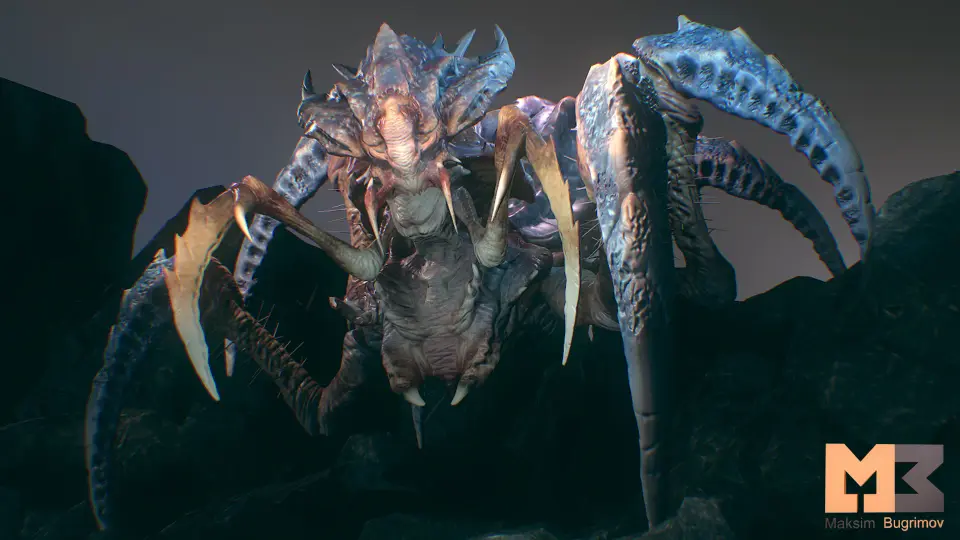
Deep underground chambers, desolate alien hives, and decrepit fantasy ruins share a common need for encounters that completely alter the player's spatial awareness. When a massive creature forces its way out of the dirt, the battlefield shifts instantly from standard exploration into survival mode. The Arachnid Boss centers entirely on this dramatic entrance, realized as a huge hostile entity that crawls out of the earth to dominate combat zones. Rather than existing merely as static scenery or a patrol creature wandering fixed paths, it establishes immediate narrative urgency the moment the soil breaks and its limbs emerge into view.
Scale plays an essential role in dictating player tension. A creature operating at this magnitude requires distinct physical presence to read cleanly across an arena. Because it is conceived as a super boss, the sheer visual mass provides instant feedback about threat level, giving designers a ready-made capstone challenge for dungeon culminations, planetary expeditions, or infested military installations.
Staging the Arachnid Boss Across Horror and Sci-Fi Settings
Multi-genre flexibility allows this creature to step into wildly differing thematic roles without losing thematic punch. Within dark fantasy titles, an enormous arachnid entity naturally assumes the identity of a brood matriarch, deep cavern guardian, or ancient subterranean beast awakened by encroaching adventurers. The archetypal dread associated with multi-legged insectoid horrors makes it a formidable adversary at the bottom of a labyrinth or within forgotten tombs.
Switching from arcane crypts to harsh extraterrestrial terrain transforms the creature into a deadly alien predator. Science-fiction titles frequently demand hostile native fauna that makes unfamiliar planets feel untamable and dangerous. In this capacity, the emergence sequence implies hunting behavior, where the beast lies dormant beneath the regolith, waiting for seismic vibrations from exploration teams or mechanized units before bursting through the crust.
Horror productions leverage these exact same qualities to generate claustrophobia and helplessness. A monster that circumvents traditional doorway entries and level boundaries by burrowing upward subverts typical player safety zones. Confined research bunkers, fungal cave networks, or abandoned mining stations become significantly more terrifying when the floor itself is susceptible to being breached by an aggressive beast.
Lowpoly Construction Geared for FPS Devices
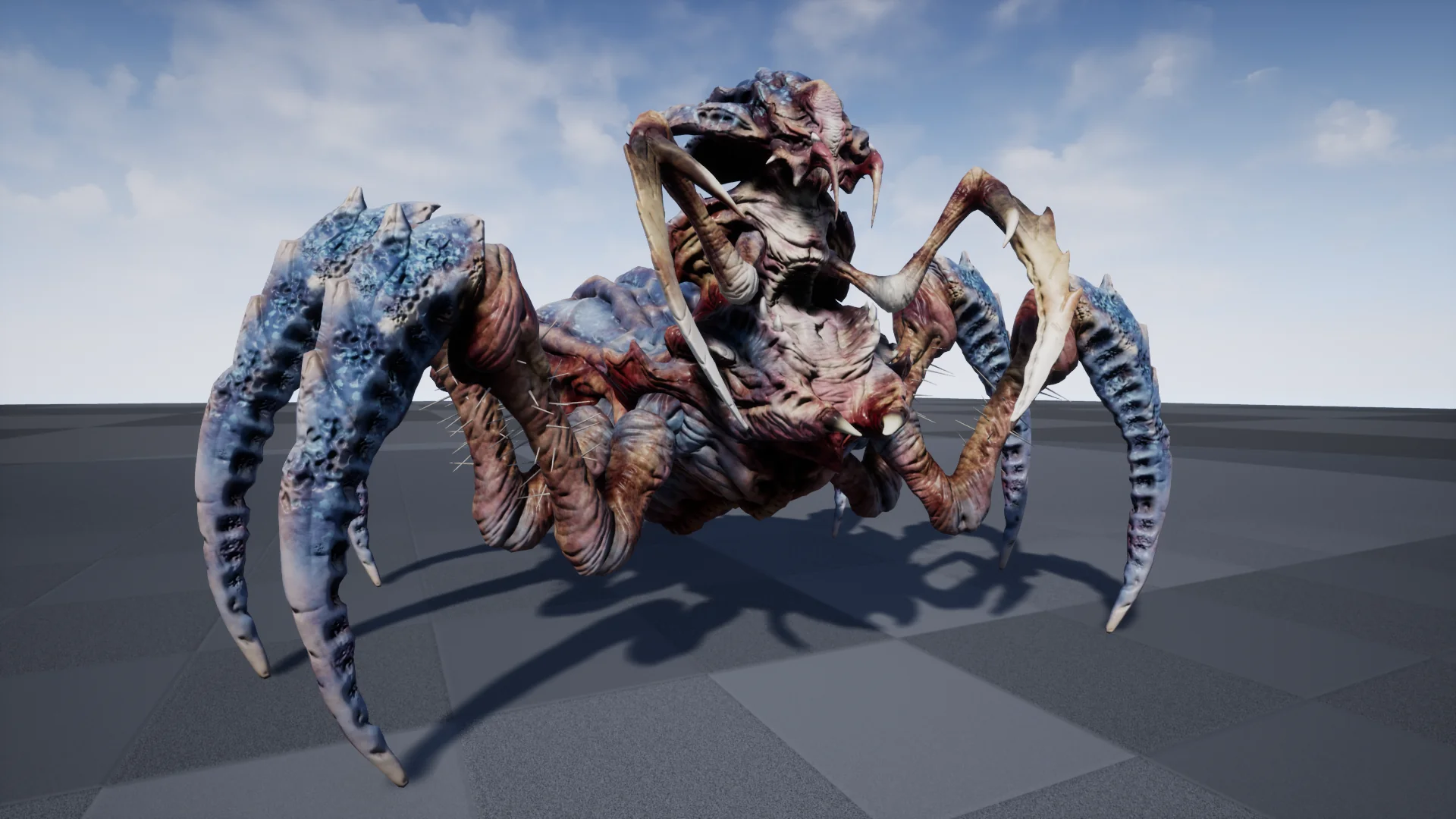
Balancing substantial physical scale against real-time performance is a constant challenge when orchestrating large-scale boss fights. The Arachnid Boss incorporates a lowpoly construction pipeline, directly addressing the rendering constraints inherent in high-intensity action games. By maintaining a clean, conservative polygon profile, the asset prioritizes engine throughput, ensuring that the creature's colossal frame does not place an unmanageable burden on the rendering pipeline.
This lightweight approach is specifically validated by its compatibility profile for FPS devices. First-person shooter platforms and performance-sensitive hardware demand consistent framerates to preserve responsive aiming, fast evasion maneuvers, and accurate spatial audio. When a giant boss charges across the player's immediate field of view, dips in performance can immediately disorient the user and ruin the mechanical fairness of an encounter. The asset’s efficient lowpoly foundation leaves generous headroom for environmental particle effects, debris chunks from ground breaches, dynamic lighting, and rapid weapon feedback without compromising fluidity.
Animation Blueprint Logic for an Arachnid Boss Encounter
Raw visual assets cannot function as credible threats without fluid motion, and the model addresses this through high-quality character animations supported by dedicated technical frameworks. Multi-limbed insectoid movement presents unique challenges in game production; unnatural limb articulation or sliding feet can quickly ruin player immersion. Here, the character animations are crafted to communicate weight, momentum, and predatory aggression at scale.
Integration with an Animation Blueprint forms the technical spine of the creature’s runtime behavior. An Animation Blueprint allows gameplay systems to dynamically transition between the subterranean crawl-out sequence, aggressive pursuit locomotion, heavy strike combos, directional hit responses, and death states. Having this animation framework intact reduces the overhead needed to construct complex state machines, allowing character controllers to cleanly interpret positional and rotational shifts.
Paired with script functionality, the creature operates as more than just a skeletal mesh. Script logic coordinates the mechanical phases of the fight, controlling when the monster surfaces, how it tracks targets, and how it switches behavioral routines based on combat flow. This programmatic coordination enables seamless transitions between environmental stealth beneath the ground and explosive combat engagements on the surface.
Structuring the Super Boss Combat Flow
Designing a memorable super boss battle demands careful choreography between asset capabilities and arena design. Because the emergence mechanism is central to the creature's identity, encounter spaces can be structured around anticipation. Designers can signal danger through subtle atmospheric audio, screen tremors, or shifting debris before triggering the script that commands the beast to burst from the ground.
Once surfaced, the creature's broad footprint naturally dictates player movement patterns. In first-person setups, players must continually circle and reposition to maintain visibility on the massive body while dodging limb sweeps or lunging attacks. The lowpoly geometry ensures that close-quarters encounters remain visually clear, allowing combatants to identify tells in the creature's high-quality animations and react accordingly. When defeated, the transition back to stillness completes an intense narrative arc within the encounter space, delivering a self-contained, mechanically demanding boss battle ready to slot into diverse game architectures.
 Characters
 Characters
 Characters
 Characters