"7e6fc58c410f2894"{"id":"1001619","slug":"anon-s-dialogue-system","title":"Anon's Dialogue System","category":"Dialog Systems","engine":"4.17+,5.0+","assetVersion":"","engineVersion":"Engine Version: 4.17+,5.0+","tag":"Dialog Systems","accent":"blue","visual":"mech","summary":"Explore Anon's Dialogue System, a modular dialogue framework supporting Blueprint and data table setups with Anon's Usable System compatibility.","platform":"Unreal Engine","publishedAt":"2026-10-13T01:48:36.473Z","updatedAt":"2026-10-13T01:48:36.473Z","sourceNotes":[],"fileContents":[],"compatibility":["Unreal Engine","Engine Version: 4.17+,5.0+"],"featuredImage":{"alt":"Anon's Dialogue System","src":"/wp-content/uploads/published/2026/10/edd5d1d9fec7-bfb61f77-a2aa-49e7-9629-7fe56a358b69-e0766cfc9d.webp"},"hasDownloadLink":true,"downloads":1,"terms":[{"taxonomy":"category","slug":"dialog-systems","name":"Dialog Systems"}],"galleryImages":[{"src":"/wp-content/uploads/published/2026/10/9a6d3c1ef731-1797e0f8-7a82-454f-b19a-d3a9a52fdf0f-83112be1d6.webp","alt":"Anon's Dialogue System"},{"src":"/wp-content/uploads/published/2026/10/4d325528215c-dff0c8da-2e2e-4aea-b118-78a374eedc46-96305740e0.webp","alt":"Anon's Dialogue System"},{"src":"/wp-content/uploads/published/2026/10/0b44c4295415-75b59fa0-e7ee-48ab-88c8-e4af1381aac6-b5259c97a5.webp","alt":"Anon's Dialogue System"},{"src":"/wp-content/uploads/published/2026/10/8669e9334ced-a2db9b4d-1882-4b97-90b7-f7f57670b3ab-283835abe7.webp","alt":"Anon's Dialogue System"},{"src":"/wp-content/uploads/published/2026/10/5a9ecb38a128-465676a1-2b04-4f02-9703-dd85cd387faf-1c00d6652f.webp","alt":"Anon's Dialogue System"},{"src":"/wp-content/uploads/published/2026/10/15f8202e05f2-7fa1d30d-8282-40ef-96e2-92dcae28b1c9-bed15cb137.webp","alt":"Anon's Dialogue System"},{"src":"/wp-content/uploads/published/2026/10/7e3c637d4162-d06fe094-bbe6-4564-ab4a-8d99565e078c-4a84233bdf.webp","alt":"Anon's Dialogue System"},{"src":"/wp-content/uploads/published/2026/10/4771dcef7cc9-7a2c2504-e631-40a4-80b5-b5c13b1ab85f-7f23c1f512.webp","alt":"Anon's Dialogue System"},{"src":"/wp-content/uploads/published/2026/10/fe8ea9d5f37b-301c017a-6cb7-41b1-95d6-fe8192865308-011ed8bcf8.webp","alt":"Anon's Dialogue System"},{"src":"/wp-content/uploads/published/2026/10/961db61ecac3-b585c3b9-540c-4eed-9769-ebf47f2e33b4-99590510c4.webp","alt":"Anon's Dialogue System"}],"accessPanel":{"kind":"resource","title":"Download this resource","eyebrow":"Free Download","message":"Log in or create a free account to start your download.","fileName":"Content.7z","safetyNote":"Resources are manually reviewed before listing to improve quality and reduce obvious risks.","actionLabel":"Download Free","resourceType":"Resource archive"},"contentHtml":"\u003cp\u003eWhen a player walks up to an in-game character, the underlying conversation mechanic must bridge text delivery, state handling, and interaction flow smoothly. Anon's Dialogue System provides an approachable, clear infrastructure for establishing spoken sequences and narrative interactions across game environments. Geared directly toward game designers, the toolkit avoids rigid development paths by providing two parallel authoring setups, letting developers select the pipeline that best suits their technical comfort and production speed.\u003c/p\u003e \u003ch2\u003eManaging Character Conversations Through Blueprints and Data Tables\u003c/h2\u003e\n\u003cp\u003eDialogue management typically pulls creators in two distinct directions. Some prefer writing conversation trees directly in visual nodes to maintain immediate control over logic gates and flow triggers, while others favor externalized, tabular spreadsheets that keep text lines clean, searchable, and separate from gameplay scripts. Anon's Dialogue System addresses both needs by supporting Blueprint graphs and data tables equally.\u003c/p\u003e \u003cp\u003eWorking within data tables allows narrative teams and designers to organize conversation IDs, speaker assignments, and line sequences in row-by-row spreadsheets. This structure minimizes clutter within visual scripting graphs and makes bulk editing of conversation lines simple. When adjustments to speech sequences or character responses are needed, rows can be revised or rearranged without having to rewire logic pins.\u003c/p\u003e \u003cp\u003eFor teams that favor an entirely visual authoring environment, direct Blueprint support allows designers to build conversation logic straight inside node graphs. This pathway proves advantageous when dialogue must tie closely to rapid gameplay variables, custom actor events, or immediate conditional statements. Because the system embraces both paradigms, designers are not forced into an unfamiliar workflow. Anyone comfortable mapping dialogue using spreadsheet records can do so, while visual scripters can build straight inside node logic.\u003c/p\u003e \u003ch2\u003eModular Dialogue System Implementation\u003c/h2\u003e\n\u003cp\u003eA core element of any character-driven conversation framework is modularity. Dialogue sequences rarely function as isolated scripts; they belong to an ongoing cycle of player exploration, character presence, and reactive narrative states. Built with a modular foundation, the system separates the conversation structure into decoupled pieces that can be assigned across various characters within a project.\u003c/p\u003e \u003cp\u003eThis modular construction prevents the dialogue mechanism from becoming hardcoded into a single character class or static pawn. Whether an interaction belongs to a major quest-giver, a background non-player character delivering ambient lines, or an interactive environmental entity, the underlying logic remains reusable. Dialogue components can be introduced into existing character frameworks without forcing teams to rebuild their foundational player controllers or base character classes from the ground up.\u003c/p\u003e \u003cp\u003eDecoupled structures also simplify iterative expansion. When developing games with multiple branching dialogue paths or numerous unique actors, maintaining isolated dialogue nodes ensures that changes applied to one character interaction do not cascade into errors across the rest of the game world.\u003c/p\u003e \u003ch2\u003eCompatibility with Anon's Usable System\u003c/h2\u003e\n\u003cp\u003eDialogue sequences do not occur in a vacuum; they depend on interaction prompts to initiate contact between players and non-player characters. Anon's Dialogue System is specifically compatible with Anon's Usable System, creating a clean bridge between world interaction and conversational logic.\u003c/p\u003e \u003cp\u003eIn standard gameplay situations, player input triggers an interaction trace or overlap check. When linked with Anon's Usable System, a target actor designated as usable can immediately pass control over to the dialogue system upon engagement. The player transitions into a dialogue state, conversational options or sequential lines trigger according to the defined Blueprint or data table instructions, and control returns once the interaction ends. This compatibility saves designers from writing bespoke handoff scripts between proximity interactables and conversational user interfaces.\u003c/p\u003e \u003ch2\u003eAuthoring Conversations for Game Designers\u003c/h2\u003e\n\u003cp\u003eCreating interactive stories often reveals friction between technical game engineering and creative scenario design. When conversation pipelines require complex code adjustments for every new script adjustment, content iteration slows dramatically. Anon's Dialogue System centers on clear and easy setup routines, allowing game designers to implement functioning conversations without extensive technical barriers.\u003c/p\u003e \u003cp\u003eBy keeping both data tables and Blueprints viable from the start, individual project members can work where their productivity is highest. Narrative writers or level designers can draft and review massive tables of interactive dialogue, while technical designers wire specific event-driven branches into the Blueprint layer. The package then offers a straightforward, accessible dialogue solution that adapts to the designer rather than demanding that the designer adapt to it.\u003c/p\u003e\n\n\u003ch2\u003eRelated Resources Worth Checking\u003c/h2\u003e\n\u003cul\u003e\n\u003cli\u003e\u003ca href=\"https://3dcghub.com/grab-component-system/\" title=\"Grab Component System\"\u003eGrab Component System\u003c/a\u003e\u003c/li\u003e\n\u003cli\u003e\u003ca href=\"https://3dcghub.com/dialogue-plugin/\" title=\"Dialogue Plugin\"\u003eDialogue Plugin\u003c/a\u003e\u003c/li\u003e\n\u003cli\u003e\u003ca href=\"https://3dcghub.com/ogs-dialogue-quest-master/\" title=\"OGS - Dialogue \u0026amp; Quest Master\"\u003eOGS - Dialogue \u0026amp; Quest Master\u003c/a\u003e\u003c/li\u003e\n\u003cli\u003e\u003ca href=\"https://3dcghub.com/hero-character-voices-warrior-voice-pack/\" title=\"Hero Character Voices: Warrior Voice Pack\"\u003eHero Character Voices: Warrior Voice Pack\u003c/a\u003e\u003c/li\u003e\n\u003cli\u003e\u003ca href=\"https://3dcghub.com/dialogue-anims/\" title=\"Dialogue Anims\"\u003eDialogue Anims\u003c/a\u003e\u003c/li\u003e\n\u003c/ul\u003e","contentTextLength":5292,"navigation":{"current":64,"total":3618,"previous":{"id":"1001620","slug":"arcade-space-shooter-template","title":"Arcade Space Shooter Template","category":"Shooter","platform":"Unreal Engine","updatedAt":"2026-10-13T01:49:33.678Z"},"next":{"id":"1001618","slug":"abandoned-place","title":"Abandoned Place","category":"Abandoned","platform":"Unreal Engine","updatedAt":"2026-10-13T01:48:05.949Z"}},"relatedResources":[{"id":"10377","slug":"grab-component-system","title":"Grab Component System","category":"Dialog Systems","engine":"4.26+,5.0+","assetVersion":"Engine version: 4.26+,5.0+","engineVersion":"4.24","tag":"Dialog Systems","accent":"blue","visual":"city","summary":"The Grab Component System offers a flexible, 100% Blueprint-based solution for object interactions. It supports custom grab types, unique animations, and allows external entities like enemies to grab the player character.","platform":"Unreal Engine","publishedAt":"2026-03-03T15:12:19.000Z","updatedAt":"2026-04-19T15:50:03.000Z","sourceNotes":[],"fileContents":[],"compatibility":["Unreal Engine","Engine version: 4.26+,5.0+"],"featuredImage":{"alt":"Grab Component System","src":"https://3dcghub.com/wp-content/uploads/2026/03/2fc8470d-14ce-43c6-ae5b-7278a77e3c82.webp"},"hasDownloadLink":true,"downloads":0},{"id":"13636","slug":"dialogue-plugin","title":"Dialogue Plugin","category":"Dialog Systems","engine":"1.5","assetVersion":"Engine version: 5.2 - 5.3,5.6","engineVersion":"Asset Version:1.5","tag":"Dialog Systems","accent":"blue","visual":"mech","summary":"The Dialogue Plugin is a robust tool for Unreal Engine 5 that simplifies the creation of branching conversations. With a custom node-based editor and optional AI integration, it provides a professional solution for narrative-driven games.","platform":"Unreal Engine","publishedAt":"2026-03-11T09:23:26.000Z","updatedAt":"2026-06-18T22:58:59.169Z","sourceNotes":[],"fileContents":[],"compatibility":["Unreal Engine","Engine version: 5.2 - 5.3,5.6","Asset Version:1.5"],"featuredImage":{"alt":"Dialogue Plugin","src":"https://3dcghub.com/wp-content/uploads/2026/03/936120c3-4bdc-4cff-88bf-810e4facaedd.webp"},"hasDownloadLink":true,"downloads":0},{"id":"27100","slug":"ogs-dialogue-quest-master","title":"OGS - Dialogue \u0026 Quest Master","category":"Dialog Systems","engine":"5.5 - 5.6","assetVersion":"Engine version: 5.5 - 5.6","engineVersion":"Asset Version:2.1.3","tag":"Dialog Systems","accent":"blue","visual":"mech","summary":"Dialogue \u0026 Quest Master turns Unreal Engine 5 into a structured workspace for interactive stories, quests, and cinematic conversations. It brings dialogue editing, quest logic, statistics, and save handling into one extensible framework built with C++ and B...","platform":"Unreal Engine","publishedAt":"2026-04-21T10:12:23.000Z","updatedAt":"2026-04-21T10:12:25.000Z","sourceNotes":[],"fileContents":[],"compatibility":["Unreal Engine","Engine version: 5.5 - 5.6","Asset Version: 2.1.3"],"featuredImage":{"alt":"OGS - Dialogue \u0026 Quest Master","src":"https://3dcghub.com/wp-content/uploads/2026/04/48a41fb58a32_582b3097-a5c8-4066-8891-d6d8924e4ecc-4.webp"},"hasDownloadLink":true,"downloads":1}]}
Dialog Systems
Anon's Dialogue System
Explore Anon's Dialogue System, a modular dialogue framework supporting Blueprint and data table setups with Anon's Usable System compatibility.
Category:Unreal Engine,Dialog SystemsPlatform: Unreal EngineEngine Version: 4.17+,5.0+Published: Oct 13, 2026
Dialog Systems
Resource overview
When a player walks up to an in-game character, the underlying conversation mechanic must bridge text delivery, state handling, and interaction flow smoothly. Anon's Dialogue System provides an approachable, clear infrastructure for establishing spoken sequences and narrative interactions across game environments. Geared directly toward game designers, the toolkit avoids rigid development paths by providing two parallel authoring setups, letting developers select the pipeline that best suits their technical comfort and production speed.
Managing Character Conversations Through Blueprints and Data Tables
Dialogue management typically pulls creators in two distinct directions. Some prefer writing conversation trees directly in visual nodes to maintain immediate control over logic gates and flow triggers, while others favor externalized, tabular spreadsheets that keep text lines clean, searchable, and separate from gameplay scripts. Anon's Dialogue System addresses both needs by supporting Blueprint graphs and data tables equally.
Working within data tables allows narrative teams and designers to organize conversation IDs, speaker assignments, and line sequences in row-by-row spreadsheets. This structure minimizes clutter within visual scripting graphs and makes bulk editing of conversation lines simple. When adjustments to speech sequences or character responses are needed, rows can be revised or rearranged without having to rewire logic pins.
For teams that favor an entirely visual authoring environment, direct Blueprint support allows designers to build conversation logic straight inside node graphs. This pathway proves advantageous when dialogue must tie closely to rapid gameplay variables, custom actor events, or immediate conditional statements. Because the system embraces both paradigms, designers are not forced into an unfamiliar workflow. Anyone comfortable mapping dialogue using spreadsheet records can do so, while visual scripters can build straight inside node logic.
Modular Dialogue System Implementation
A core element of any character-driven conversation framework is modularity. Dialogue sequences rarely function as isolated scripts; they belong to an ongoing cycle of player exploration, character presence, and reactive narrative states. Built with a modular foundation, the system separates the conversation structure into decoupled pieces that can be assigned across various characters within a project.
This modular construction prevents the dialogue mechanism from becoming hardcoded into a single character class or static pawn. Whether an interaction belongs to a major quest-giver, a background non-player character delivering ambient lines, or an interactive environmental entity, the underlying logic remains reusable. Dialogue components can be introduced into existing character frameworks without forcing teams to rebuild their foundational player controllers or base character classes from the ground up.
Decoupled structures also simplify iterative expansion. When developing games with multiple branching dialogue paths or numerous unique actors, maintaining isolated dialogue nodes ensures that changes applied to one character interaction do not cascade into errors across the rest of the game world.
Compatibility with Anon's Usable System
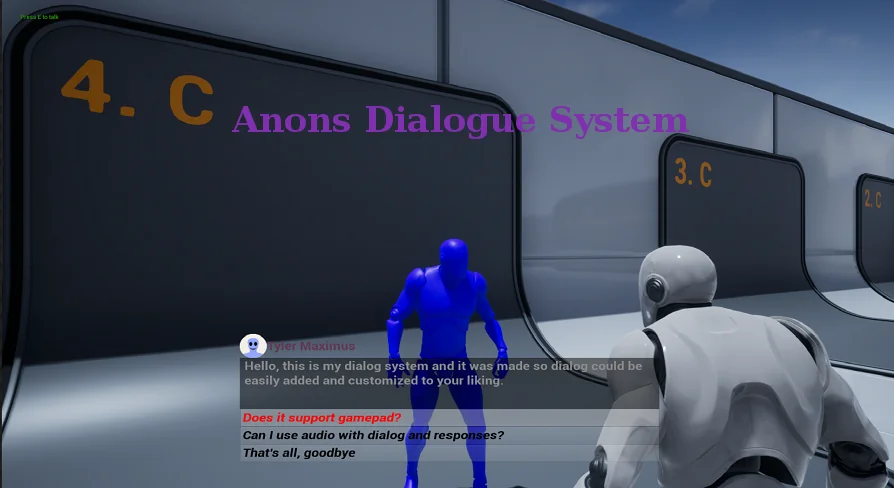
Dialogue sequences do not occur in a vacuum; they depend on interaction prompts to initiate contact between players and non-player characters. Anon's Dialogue System is specifically compatible with Anon's Usable System, creating a clean bridge between world interaction and conversational logic.
In standard gameplay situations, player input triggers an interaction trace or overlap check. When linked with Anon's Usable System, a target actor designated as usable can immediately pass control over to the dialogue system upon engagement. The player transitions into a dialogue state, conversational options or sequential lines trigger according to the defined Blueprint or data table instructions, and control returns once the interaction ends. This compatibility saves designers from writing bespoke handoff scripts between proximity interactables and conversational user interfaces.
Authoring Conversations for Game Designers
Creating interactive stories often reveals friction between technical game engineering and creative scenario design. When conversation pipelines require complex code adjustments for every new script adjustment, content iteration slows dramatically. Anon's Dialogue System centers on clear and easy setup routines, allowing game designers to implement functioning conversations without extensive technical barriers.
By keeping both data tables and Blueprints viable from the start, individual project members can work where their productivity is highest. Narrative writers or level designers can draft and review massive tables of interactive dialogue, while technical designers wire specific event-driven branches into the Blueprint layer. The package then offers a straightforward, accessible dialogue solution that adapts to the designer rather than demanding that the designer adapt to it.
 Dialog Systems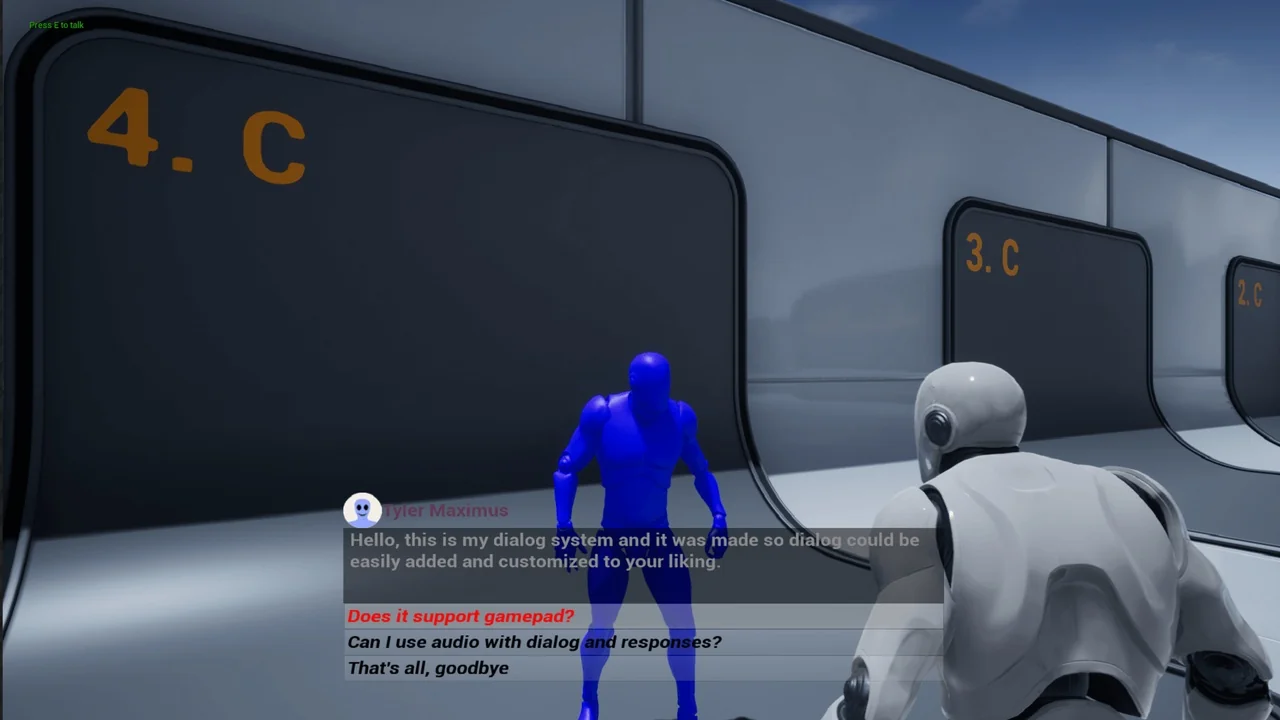
 Dialog Systems
 Dialog Systems
 Dialog Systems