"5da73d49ff33a5b1"{"id":"1002377","slug":"aki-stylized-character","title":"Aki - Stylized Character","category":"Characters \u0026 Creatures","engine":"4.21+,5.0+","assetVersion":"","engineVersion":"Engine Version: 4.21+,5.0+","tag":"Characters","accent":"blue","visual":"character","summary":"Technical analysis of Aki - Stylized Character, covering its 19 locomotion and combat animations, modular underwear mesh, dual material variants, and setup.","platform":"Unreal Engine","indexPolicy":"index","publishedAt":"2026-11-10T03:53:51.987Z","updatedAt":"2026-11-10T03:53:51.987Z","sourceNotes":[],"fileContents":[],"compatibility":["Unreal Engine","Engine Version: 4.21+,5.0+"],"featuredImage":{"alt":"Aki - Stylized Character","src":"/wp-content/uploads/published/2026/11/02ec53fb1f60-779ae982-d073-4ffd-b3c5-26fe24c6f288-dd9d13dffd.webp"},"hasDownloadLink":true,"downloads":0,"terms":[{"taxonomy":"category","slug":"characters-and-creatures","name":"Characters \u0026 Creatures"}],"galleryImages":[{"src":"/wp-content/uploads/published/2026/11/03f0864770a0-3123bc56-b943-4066-8b5e-f43cc20fc438-da05e724f0.webp","alt":"Aki - Stylized Character"},{"src":"/wp-content/uploads/published/2026/11/dadbca2796f7-a906d074-f148-4bba-8e00-e7eed1d4b770-60f96ad279.webp","alt":"Aki - Stylized Character"},{"src":"/wp-content/uploads/published/2026/11/70a76a295a71-839722bd-9e59-4b4c-b92c-65f23e665fd3-a8ed9d3cd5.webp","alt":"Aki - Stylized Character"},{"src":"/wp-content/uploads/published/2026/11/ef176cff7207-be044f16-a6f3-4eb9-9902-6c6380960ade-da129a6dd4.webp","alt":"Aki - Stylized Character"},{"src":"/wp-content/uploads/published/2026/11/947b40a65252-041c1ce2-12fb-4f0d-8143-19dc45329c04-53d48a423f.webp","alt":"Aki - Stylized Character"},{"src":"/wp-content/uploads/published/2026/11/91ed59abed26-5f4b9385-7563-4da7-893f-21769ab593ee-446e20da55.webp","alt":"Aki - Stylized Character"},{"src":"/wp-content/uploads/published/2026/11/5186071bfc1b-5c7cd2cf-42c6-4bd6-a1cd-8b625efd1f33-adb58d6090.webp","alt":"Aki - Stylized Character"},{"src":"/wp-content/uploads/published/2026/11/db82eca70afa-c5282efc-a281-497c-8acc-d66f87285251-e4a5476322.webp","alt":"Aki - Stylized Character"},{"src":"/wp-content/uploads/published/2026/11/3bf65be3f440-a7efed77-9ae6-40b9-8a7c-efd01701d5c6-f9293337e8.webp","alt":"Aki - Stylized Character"},{"src":"/wp-content/uploads/published/2026/11/2438497705e8-cb5e21ca-ccd4-4376-a0ce-a02a3ac6c1f3-8b9de6d83e.webp","alt":"Aki - Stylized Character"}],"accessPanel":{"kind":"resource","title":"Get this resource","eyebrow":"Free resource","message":"Download this resource in your browser.","fileName":"Content.7z","safetyNote":"Resources are manually reviewed before listing to improve quality and reduce obvious risks.","actionLabel":"Get this resource","resourceType":"Resource archive","versions":[]},"contentHtml":"\u003cp\u003eExecuting smooth directional transitions and weapon states requires a deliberate blend of skeletal animations, clean mesh rigging, and material management. Aki - Stylized Character approaches real-time navigation and combat through a focused framework of directional locomotion clips, staged aerial movement, armed and unarmed offensive sequences, and distinct material setups. Built for fantasy environments, RPG systems, and MOBA hero architectures, the male figure balances lowpoly stylized aesthetics with foundational gameplay scripting support.\u003c/p\u003e \u003ch2\u003eLocomotion Mechanics and Directional Movement for Aki\u003c/h2\u003e \u003cp\u003eResponsive navigation depends heavily on directional variety. Rather than relying entirely on procedural hip turning or basic single-direction loops, this character incorporates specific ground navigation files that account for forward angles. The locomotion set includes walk_f, walk_fl, and walk_fr alongside their high-speed counterparts: run_f, run_fl, and run_fr. Splitting forward steps into distinct forward-left and forward-right variations allows blend spaces to calculate realistic weight shifting when a player banks into gentle turns without breaking momentum.\u003c/p\u003e \u003cp\u003eVertical traversal is divided into four distinct phases to handle varying jump outcomes:\u003c/p\u003e\n\u003cul\u003e \u003cli\u003e\u003cstrong\u003eJump_start:\u003c/strong\u003e Captures the anticipatory compression and ground push-off.\u003c/li\u003e \u003cli\u003e\u003cstrong\u003eJump_air:\u003c/strong\u003e Loops smoothly while tracking falling velocity or peak jump arcs.\u003c/li\u003e \u003cli\u003e\u003cstrong\u003eJump_land:\u003c/strong\u003e Accommodates full stops where all horizontal momentum ceases upon impact.\u003c/li\u003e \u003cli\u003e\u003cstrong\u003eJump_land_run:\u003c/strong\u003e Absorbs vertical force while transferring kinetic energy straight back into active forward sprinting.\u003c/li\u003e\n\u003c/ul\u003e \u003cp\u003eSeparating the landing animation into a stationary variant and a running variant prevents jarring foot-sliding bugs when a character strikes the ground mid-sprint. It allows the movement state machine to cleanly branch into either standard ground locomotion or an idle stance based directly on current horizontal velocity inputs.\u003c/p\u003e \u003ch2\u003eCombat Chains and Attack Failure States in Aki\u003c/h2\u003e \u003cp\u003eAction mechanics in fantasy RPGs and MOBAs frequently toggle between peaceful navigation and active engagements. Aki provides explicit animations to govern this transition through dedicated equip and unequip sequences. These clips handle the hand-to-socket item transfers required when shifting a hero from travel states into combat readiness, ensuring weapons do not simply snap into sockets without visual justification.\u003c/p\u003e \u003cp\u003eOffensive actions are organized across two primary stances: armed and unarmed. In an armed stance, attack_armed_01 and attack_armed_02 offer standard strike strings suitable for combo chaining or alternating swing profiles. When weapons are sheathed, attack_unarmed_01 and attack_unarmed_02 supply physical strikes, enabling bare-handed brawling, tavern skirmishes, or early-game progression before primary weaponry is collected.\u003c/p\u003e \u003cp\u003eA notable technical inclusion is the presence of dedicated failure animations: attack_armed_fail and attack_unarmed_fail. Typical character packs often leave combat failure logic unaddressed, forcing developers to rely on generic hit reactions. The inclusion of dedicated failure clips enables gameplay systems to explicitly visualize deflected blows, parried attacks, broken weapon strikes, out-of-stamina fumbles, or missed timing windows. Having both armed and unarmed failure animations gives combat state machines the exact visual feedback needed to communicate combat interruptions cleanly to the player.\u003c/p\u003e \u003ch2\u003eMesh Modularity and Underwear Layering\u003c/h2\u003e \u003cp\u003eThe mesh structure follows lowpoly optimization standards suitable for performance-critical contexts like top-down MOBAs or large-scale RPGs where multiple entities occupy the screen at once. An update to the geometry added a dedicated underwear mesh, establishing an essential foundation for modular equipment pipelines. By detaching outer garments from the core anatomy and providing a modeled base layer, the character can accommodate equipment swapping, armor un-equipping, and multi-tier gear progression systems without exposing hollow geometry or requiring complex mesh slicing.\u003c/p\u003e \u003cp\u003eThe human male proportions remain intentionally stylized, pairing bold shapes and clean silhouettes with low polygonal density. This stylized approach ensures readability at distance, particularly under isometric cameras or dynamic action framing, where intricate realistic details often blur together into visual noise.\u003c/p\u003e \u003ch2\u003eTexturing Strategy and Dual Material Variants\u003c/h2\u003e \u003cp\u003eSurfacing is handled through a streamlined PBR asset collection consisting of five textures paired with two materials. Rather than overwhelming draw calls with bloated texture sets, the resource organizes its UV mapping to allow visual variety through two distinct material color configurations. These alternate color setups permit instant differentiation for alternate teams in competitive MOBA scenarios, faction-specific NPC variations in quest hubs, or basic player customization choices in character selection menus.\u003c/p\u003e \u003cp\u003eThe PBR workflow guarantees that skin tones, stylized clothing surfaces, and underlying layers respond consistently to diverse lighting setups, from bright stylized outdoor environments to high-contrast dungeon lighting. The compact footprint of five textures across two materials also ensures rapid memory streaming and minimal runtime overhead.\u003c/p\u003e \u003ch2\u003eAnimation Blueprint Integration and Character Pairing\u003c/h2\u003e \u003cp\u003eThe inclusion of Animation Blueprint support bridges raw animation assets and runtime player interaction. With the 19 animation clips mapped into logical states—idle, directional walking, running, vertical jumping stages, armed attacks, unarmed attacks, weapon toggling, and attack failure interruptions—the skeletal structure can be wired directly into game scripting frameworks. Transitions between armed and unarmed modes can be tied directly to inventory variables, while failure clips hook into block, parry, or stamina-depletion gameplay events.\u003c/p\u003e \u003cp\u003eFrom an aesthetic and technical perspective, the asset shares explicit compatibility with Stylized Character - Girl. This matching styling allows development teams to implement cohesive male and female hero rosters, dual protagonist setups, or complementary faction units that share unified proportions, texture handling, and art direction across the entire production.\u003c/p\u003e\n\n\u003ch2\u003eMore From The Same Workflow\u003c/h2\u003e\n\u003cul\u003e\n\u003cli\u003e\u003ca href=\"https://3dcghub.com/yuko-stylized-character/\" rel=\"noopener noreferrer\"\u003eYuko - Stylized Character\u003c/a\u003e\u003c/li\u003e\n\u003cli\u003e\u003ca href=\"https://3dcghub.com/animated-stylized-wizard/\" rel=\"noopener noreferrer\"\u003eAnimated Stylized Wizard\u003c/a\u003e\u003c/li\u003e\n\u003cli\u003e\u003ca href=\"https://3dcghub.com/unlit-stylized-military-characters/\" rel=\"noopener noreferrer\"\u003eUnlit Stylized Military Characters\u003c/a\u003e\u003c/li\u003e\n\u003cli\u003e\u003ca href=\"https://3dcghub.com/millie-schoolgirl/\" rel=\"noopener noreferrer\"\u003eMillie Schoolgirl\u003c/a\u003e\u003c/li\u003e\n\u003cli\u003e\u003ca href=\"https://3dcghub.com/shaman-girl-modular/\" rel=\"noopener noreferrer\"\u003eShaman Girl Modular\u003c/a\u003e\u003c/li\u003e\n\u003c/ul\u003e","contentTextLength":6445,"navigation":{"current":43,"total":4340,"previous":{"id":"1002378","slug":"android-robot","title":"Android Robot","category":"Characters \u0026 Creatures","platform":"Unreal Engine","updatedAt":"2026-11-10T03:54:44.127Z"},"next":{"id":"1002376","slug":"yuko-stylized-character","title":"Yuko - Stylized Character","category":"Characters \u0026 Creatures","platform":"Unreal Engine","updatedAt":"2026-11-09T18:46:24.480Z"}},"relatedResources":[{"id":"1002376","slug":"yuko-stylized-character","title":"Yuko - Stylized Character","category":"Characters \u0026 Creatures","engine":"4.21+,5.0+","assetVersion":"","engineVersion":"Engine Version: 4.21+,5.0+","tag":"Characters","accent":"blue","visual":"character","summary":"Yuko is a stylized low-poly fantasy heroine with 19 animations, armed and unarmed attacks, jump and locomotion states, PBR materials, and an underwear mesh.","platform":"Unreal Engine","indexPolicy":"index","publishedAt":"2026-11-09T18:46:24.480Z","updatedAt":"2026-11-09T18:46:24.480Z","sourceNotes":[],"fileContents":[],"compatibility":["Unreal Engine","Engine Version: 4.21+,5.0+"],"featuredImage":{"alt":"Yuko - Stylized Character","src":"/wp-content/uploads/published/2026/11/8bb2ba81acd4-a3722cc0-2412-4993-a5cd-bd762b6043d4-539eb9d852.webp"},"hasDownloadLink":true,"downloads":0},{"id":"1001425","slug":"animated-stylized-wizard","title":"Animated Stylized Wizard","category":"Characters \u0026 Creatures","engine":"4.18+,5.0+","assetVersion":"","engineVersion":"Engine Version: 4.18+,5.0+","tag":"Characters","accent":"blue","visual":"character","summary":"Explore the Animated Stylized Wizard featuring a handpainted game-ready model, 70 animations, 14 character texture variations, and matched staff weapons.","platform":"Unreal Engine","indexPolicy":"index","publishedAt":"2026-10-07T06:00:07.988Z","updatedAt":"2026-10-07T06:00:07.988Z","sourceNotes":[],"fileContents":[],"compatibility":["Unreal Engine","Engine Version: 4.18+,5.0+"],"featuredImage":{"alt":"Animated Stylized Wizard","src":"/wp-content/uploads/published/2026/10/3509b7d14a4a-ca8d0d8e-9c9c-48f2-b020-6f6572cff412-d78d80b38a.webp"},"hasDownloadLink":true,"downloads":0},{"id":"1000902","slug":"unlit-stylized-military-characters","title":"Unlit Stylized Military Characters","category":"Characters \u0026 Creatures","engine":"4.26+,5.0+","assetVersion":"","engineVersion":"Engine Version: 4.26+,5.0+","tag":"Characters","accent":"blue","visual":"character","summary":"A bundle of unlit stylized military characters with toon material options, Epic skeleton compatibility, modular and standalone models, and a small texture footp","platform":"Unreal Engine","indexPolicy":"index","publishedAt":"2026-08-06T05:08:45.276Z","updatedAt":"2026-08-06T05:08:45.276Z","sourceNotes":[],"fileContents":[],"compatibility":["Unreal Engine","Engine Version: 4.26+,5.0+"],"featuredImage":{"alt":"Unlit Stylized Military Characters","src":"/wp-content/uploads/published/2026/08/fb48ecc224ed-9b72a340-637d-48b8-b18a-37118a2716f8-92ba26cd04.webp"},"hasDownloadLink":true,"downloads":4}]}
Characters
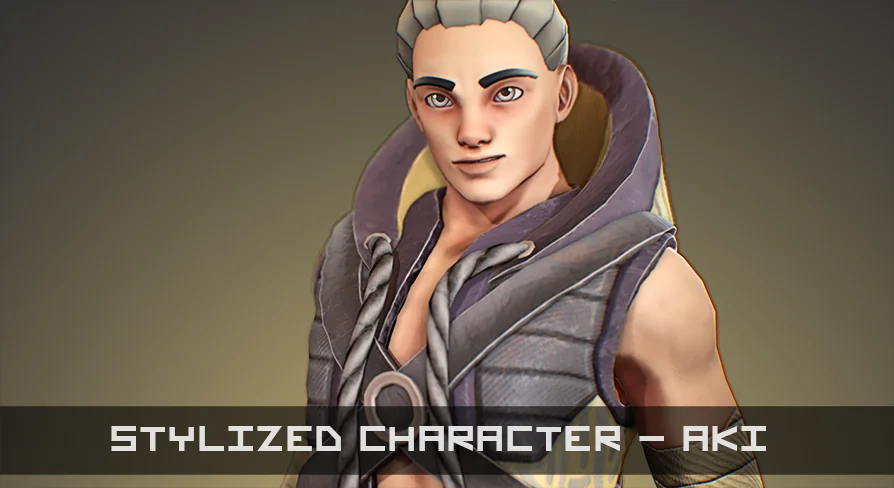
Aki - Stylized Character
Technical analysis of Aki - Stylized Character, covering its 19 locomotion and combat animations, modular underwear mesh, dual material variants, and setup.
Executing smooth directional transitions and weapon states requires a deliberate blend of skeletal animations, clean mesh rigging, and material management. Aki - Stylized Character approaches real-time navigation and combat through a focused framework of directional locomotion clips, staged aerial movement, armed and unarmed offensive sequences, and distinct material setups. Built for fantasy environments, RPG systems, and MOBA hero architectures, the male figure balances lowpoly stylized aesthetics with foundational gameplay scripting support.
Locomotion Mechanics and Directional Movement for Aki
Responsive navigation depends heavily on directional variety. Rather than relying entirely on procedural hip turning or basic single-direction loops, this character incorporates specific ground navigation files that account for forward angles. The locomotion set includes walk_f, walk_fl, and walk_fr alongside their high-speed counterparts: run_f, run_fl, and run_fr. Splitting forward steps into distinct forward-left and forward-right variations allows blend spaces to calculate realistic weight shifting when a player banks into gentle turns without breaking momentum.
Vertical traversal is divided into four distinct phases to handle varying jump outcomes:
Jump_start: Captures the anticipatory compression and ground push-off.
Jump_air: Loops smoothly while tracking falling velocity or peak jump arcs.
Jump_land: Accommodates full stops where all horizontal momentum ceases upon impact.
Jump_land_run: Absorbs vertical force while transferring kinetic energy straight back into active forward sprinting.
Separating the landing animation into a stationary variant and a running variant prevents jarring foot-sliding bugs when a character strikes the ground mid-sprint. It allows the movement state machine to cleanly branch into either standard ground locomotion or an idle stance based directly on current horizontal velocity inputs.
Combat Chains and Attack Failure States in Aki
Action mechanics in fantasy RPGs and MOBAs frequently toggle between peaceful navigation and active engagements. Aki provides explicit animations to govern this transition through dedicated equip and unequip sequences. These clips handle the hand-to-socket item transfers required when shifting a hero from travel states into combat readiness, ensuring weapons do not simply snap into sockets without visual justification.
Offensive actions are organized across two primary stances: armed and unarmed. In an armed stance, attack_armed_01 and attack_armed_02 offer standard strike strings suitable for combo chaining or alternating swing profiles. When weapons are sheathed, attack_unarmed_01 and attack_unarmed_02 supply physical strikes, enabling bare-handed brawling, tavern skirmishes, or early-game progression before primary weaponry is collected.
A notable technical inclusion is the presence of dedicated failure animations: attack_armed_fail and attack_unarmed_fail. Typical character packs often leave combat failure logic unaddressed, forcing developers to rely on generic hit reactions. The inclusion of dedicated failure clips enables gameplay systems to explicitly visualize deflected blows, parried attacks, broken weapon strikes, out-of-stamina fumbles, or missed timing windows. Having both armed and unarmed failure animations gives combat state machines the exact visual feedback needed to communicate combat interruptions cleanly to the player.
Mesh Modularity and Underwear Layering
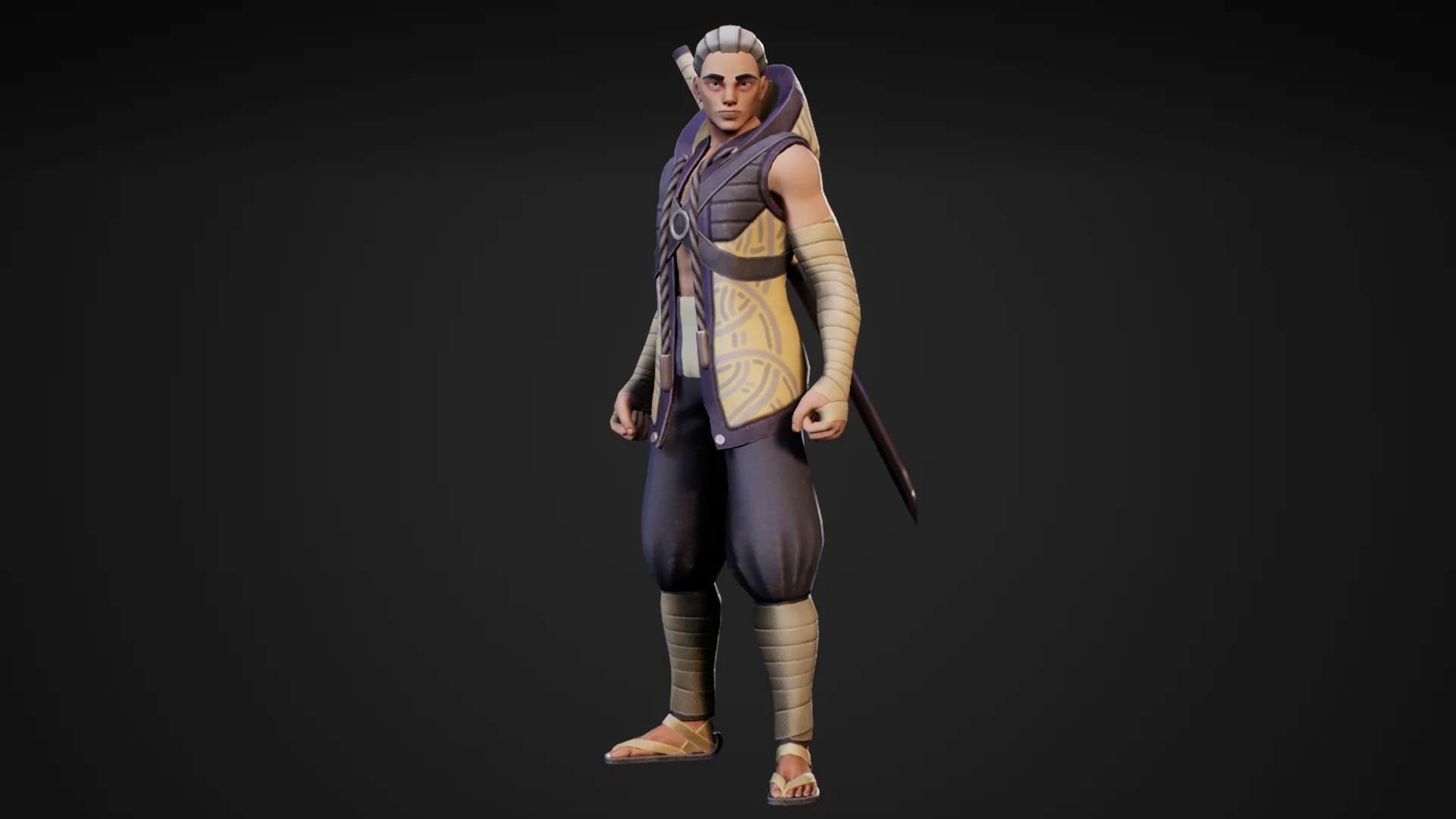
The mesh structure follows lowpoly optimization standards suitable for performance-critical contexts like top-down MOBAs or large-scale RPGs where multiple entities occupy the screen at once. An update to the geometry added a dedicated underwear mesh, establishing an essential foundation for modular equipment pipelines. By detaching outer garments from the core anatomy and providing a modeled base layer, the character can accommodate equipment swapping, armor un-equipping, and multi-tier gear progression systems without exposing hollow geometry or requiring complex mesh slicing.
The human male proportions remain intentionally stylized, pairing bold shapes and clean silhouettes with low polygonal density. This stylized approach ensures readability at distance, particularly under isometric cameras or dynamic action framing, where intricate realistic details often blur together into visual noise.
Texturing Strategy and Dual Material Variants
Surfacing is handled through a streamlined PBR asset collection consisting of five textures paired with two materials. Rather than overwhelming draw calls with bloated texture sets, the resource organizes its UV mapping to allow visual variety through two distinct material color configurations. These alternate color setups permit instant differentiation for alternate teams in competitive MOBA scenarios, faction-specific NPC variations in quest hubs, or basic player customization choices in character selection menus.
The PBR workflow guarantees that skin tones, stylized clothing surfaces, and underlying layers respond consistently to diverse lighting setups, from bright stylized outdoor environments to high-contrast dungeon lighting. The compact footprint of five textures across two materials also ensures rapid memory streaming and minimal runtime overhead.
Animation Blueprint Integration and Character Pairing
The inclusion of Animation Blueprint support bridges raw animation assets and runtime player interaction. With the 19 animation clips mapped into logical states—idle, directional walking, running, vertical jumping stages, armed attacks, unarmed attacks, weapon toggling, and attack failure interruptions—the skeletal structure can be wired directly into game scripting frameworks. Transitions between armed and unarmed modes can be tied directly to inventory variables, while failure clips hook into block, parry, or stamina-depletion gameplay events.
From an aesthetic and technical perspective, the asset shares explicit compatibility with Stylized Character - Girl. This matching styling allows development teams to implement cohesive male and female hero rosters, dual protagonist setups, or complementary faction units that share unified proportions, texture handling, and art direction across the entire production.
 Characters
 Characters
 Characters
 Characters