"b00678cacce53329"{"id":"1002770","slug":"advancedmagicfx19","title":"AdvancedMagicFX19","category":"Spells \u0026 Combat","engine":"4.20+,5.0+","assetVersion":"","engineVersion":"Engine Version: 4.20+,5.0+","tag":"Spells \u0026 Combat","accent":"blue","visual":"mech","summary":"Technical implementation and visual effects breakdown for AdvancedMagicFX19 in Unreal Engine, covering Niagara, Cascade LODs, and core magic types.","platform":"Unreal Engine","indexPolicy":"index","publishedAt":"2026-11-20T06:48:43.575Z","updatedAt":"2026-11-20T06:48:43.575Z","sourceNotes":[],"fileContents":[],"compatibility":["Unreal Engine","Engine Version: 4.20+,5.0+"],"featuredImage":{"alt":"AdvancedMagicFX19","src":"/wp-content/uploads/published/2026/11/fc04ac9d1351-8563e9fe-e5f1-45e8-9d4d-fab5bf30d4db-5fb0d1d352.webp"},"fileSizeBytes":61213163,"hasDownloadLink":true,"downloads":0,"terms":[{"taxonomy":"category","slug":"spells-and-combat","name":"Spells \u0026 Combat"}],"galleryImages":[{"src":"/wp-content/uploads/published/2026/11/a7ed160a6053-ae0a685f-138e-4ebb-a968-e7f02c0832c4-ed329d1bc8.webp","alt":"AdvancedMagicFX19"},{"src":"/wp-content/uploads/published/2026/11/a894f0933bd9-8fdd483d-bda3-4f84-8cd6-54fc3abb6073-ae0c5eb63c.webp","alt":"AdvancedMagicFX19"},{"src":"/wp-content/uploads/published/2026/11/450ab1899723-64842f84-2975-4650-a48b-f40a873f80b5-309308c7f1.webp","alt":"AdvancedMagicFX19"},{"src":"/wp-content/uploads/published/2026/11/2fdc43bead2f-5feb6f4b-d852-4b5b-b305-e43deb3e6114-bf8104db2d.webp","alt":"AdvancedMagicFX19"}],"accessPanel":{"kind":"resource","title":"Get this resource","safetyNote":"Resources are manually reviewed before listing to improve quality and reduce obvious risks.","fileName":"Content.7z","resourceType":"Resource archive","versions":[]},"contentHtml":"\u003cp\u003eImplementing real-time spell systems requires a clear understanding of particle architectures, engine compatibility, and performance scaling. AdvancedMagicFX19 addresses these implementation demands by providing a multi-element collection of magical visual effects built across both modern and legacy Unreal Engine frameworks. Integrating the package into a project pipeline involves choosing between the updated NiagaraFX framework or the legacy Cascade particle setup, depending on the engine version and visual pipeline target of the host project.\u003c/p\u003e \u003ch2\u003eIntegrating AdvancedMagicFX19 Across Unreal Engine Pipelines\u003c/h2\u003e\n\u003cp\u003eDeployment begins with identifying the target engine version and preferred particle runtime. AdvancedMagicFX19 supports Unreal Engine from version 4.26 onward for its Niagara implementation, allowing developers to modernize their magical combat encounters using modern simulation graphs. For projects running on builds from UE4.26 onwards that intend to leverage the NiagaraFX version, enabling and verifying the Cascade To Niagara plugin within the engine settings is an essential setup step.\u003c/p\u003e\n\u003cp\u003eThe Cascade To Niagara plugin bridges the architectural divide between Unreal's legacy emitter pipeline and the newer programmable simulation stack. When migrating assets or managing projects that feature both emitter types, having the plugin active ensures that internal module mappings, translation logic, and parameter bindings remain functional across the project workspace. Teams working with earlier engine baselines or established Cascade pipelines can bypass the Niagara conversion process and directly employ the native Cascade variations provided within the package.\u003c/p\u003e \u003ch2\u003eAdvancedMagicFX19 Particle Systems: Cascade, Niagara, and Plugin Setup\u003c/h2\u003e\n\u003cp\u003eMaintaining visual parity across two particle frameworks is a core operational consideration for AdvancedMagicFX19. The package includes versions optimized for Cascade as well as builds structured for NiagaraFX. Each framework brings a distinct workflow to the developer's content browser and level viewport.\u003c/p\u003e\n\u003cp\u003eIn the Niagara configuration, effects benefit from the flexible data-driven workflows introduced in UE4.26 and subsequent engine iterations. The emitters take advantage of modular script execution, dynamic parameter passing, and unified simulation loops. This setup simplifies parameter tuning when binding spell scales, spawn rates, or velocity curves to gameplay events, character animation notify cues, or blueprint collision triggers.\u003c/p\u003e\n\u003cp\u003eIn the Cascade configuration, the package relies on traditional modular stacks. The key technical advantage present in the Cascade iteration of these effects is the inclusion of dedicated particle LODs. Level of Detail systems inside Cascade allow developers to configure distance-based performance tiers, adjusting emitter complexity, particle density, and render passes as emitters move further from the active player camera. This makes the Cascade setup immediately functional for scenes with demanding frame rate budgets or hardware targets with constrained fill rate capacities.\u003c/p\u003e \u003ch2\u003eSpell Archetypes: Fireball, Shuriken, and Sludge Effects\u003c/h2\u003e\n\u003cp\u003eThe visual roster within AdvancedMagicFX19 spans a distinct set of elemental behaviors, categorized by kinetic spell paths, surface-bound impacts, and high-energy projectiles. The package groups these into focused gameplay types, including fireball bursts, shuriken-style spinning projectiles, viscous sludge effects, and general fire magic.\u003c/p\u003e\n\u003cp\u003eThe fireball effects represent high-velocity, high-luminance kinetic magic. Built to support impact bursts, travel trails, and detonation phases, these assets provide the visual signature required for ranged offensive spellcasting. Emitters within this category handle bright core intensity, trailing heat signatures, and burst debris upon collision, communicating impact force instantly to the player.\u003c/p\u003e\n\u003cp\u003eThe shuriken effects offer a different mechanical profile, translating rotational geometry and sharp energy arcs into projectile magic. These assets suit rapid-fire spell sequences, stylized ninja techniques, or mystical blade arts where angular motion and focused particle trails dictate the spell silhouette. Their directional velocity and spin parameters allow them to be linked cleanly to tracking projectiles or linear trace paths.\u003c/p\u003e\n\u003cp\u003eSludge effects introduce organic, viscous magical behavior to balance out the high-velocity fire and blade archetypes. Instead of rapid dissipation and burning embers, sludge emitters focus on heavier droplets, ground clinging splatters, and bubbling surfaces. This makes them suitable for hazard fields, decay spells, poison damage zones, or debuff indicators where visual weight and lingering spatial presence take priority over explosive kinetic bursts.\u003c/p\u003e \u003ch2\u003eCascade Particle LOD Architecture and Performance Considerations\u003c/h2\u003e\n\u003cp\u003eOptimizing real-time VFX for variable combat densities hinges on how gracefully emitters shed rendering costs at range. AdvancedMagicFX19 integrates particle LODs across its Cascade effects to manage this operational burden during active gameplay.\u003c/p\u003e\n\u003cp\u003eParticle LODs function by setting threshold distances at which the engine switches to reduced-complexity versions of the emitter. At close range, full particle counts, secondary sub-emitters, intricate collision modules, and detailed alpha blend steps are fully realized. As the camera retreats, intermediate and distant LOD levels drop secondary sparks, simplify velocity calculations, and scale down maximum concurrent particle counts. This preserves frame stability during hectic encounters where dozens of fireballs, shurikens, or sludge pools trigger simultaneously across the screen.\u003c/p\u003e\n\u003cp\u003eWhen deploying these effects in multiplayer arenas or large open environments, verifying LOD switch distances inside the Cascade particle editor helps match visual fidelity to screen coverage. By pairing distance-based module culling with the innate modularity of the package, developers can establish clean performance ceilings without manually stripping emitters for distant combatants.\u003c/p\u003e \u003ch2\u003eKY_magic Production Readiness and Implementation Takeaways\u003c/h2\u003e\n\u003cp\u003eAdvancedMagicFX19 sits within the broader KY_magic series of visual effects, presenting an established aesthetic direction tailored for action-oriented fantasy games. The assets are constructed to communicate magic states with high clarity, combining distinct color temperatures, punchy launch phases, and legible trail paths.\u003c/p\u003e\n\u003cp\u003eChoosing between the NiagaraFX and Cascade variations ultimately depends on production requirements. Teams leveraging modern Unreal workflows benefit from the Niagara version on UE4.26 and newer, unlocking Niagara's scriptable emitter stacks via the Cascade To Niagara plugin. Teams prioritizing out-of-the-box distance optimization via particle LODs can implement the Cascade assets directly. With its balanced spread of fireball projectiles, shuriken blades, and sludge zones, the asset set offers a practical foundation for combat encounters requiring diverse, responsive spellcasting.\u003c/p\u003e\n\n\u003ch2\u003eRelated Resources Worth Checking\u003c/h2\u003e\n\u003cul\u003e\n\u003cli\u003e\u003ca href=\"https://3dcghub.com/stylized-vfx-lightning/\" rel=\"noopener noreferrer\"\u003eStylized VFX - Lightning\u003c/a\u003e\u003c/li\u003e\n\u003cli\u003e\u003ca href=\"https://3dcghub.com/niagara-muzzle-flash-and-ejection-vfx-muzzle-flash-gun-vfx-bullet-vfx/\" rel=\"noopener noreferrer\"\u003eNiagara Muzzle Flash \u0026amp; Ejection VFX (Muzzle Flash, Gun VFX, Bullet VFX)\u003c/a\u003e\u003c/li\u003e\n\u003cli\u003e\u003ca href=\"https://3dcghub.com/niagara-toon-projectiles-2/\" rel=\"noopener noreferrer\"\u003eNiagara Toon Projectiles 2\u003c/a\u003e\u003c/li\u003e\n\u003cli\u003e\u003ca href=\"https://3dcghub.com/advancedmagicfx18/\" rel=\"noopener noreferrer\"\u003eAdvancedMagicFX18\u003c/a\u003e\u003c/li\u003e\n\u003cli\u003e\u003ca href=\"https://3dcghub.com/advancedmagicfx16/\" rel=\"noopener noreferrer\"\u003eAdvancedMagicFX16\u003c/a\u003e\u003c/li\u003e\n\u003c/ul\u003e","contentTextLength":7245,"navigation":{"current":110,"total":4797,"previous":{"id":"1002771","slug":"aoe-magic-abilities-vol-1","title":"AoE Magic Abilities Vol. 1","category":"Variety","platform":"Unreal Engine","updatedAt":"2026-11-20T06:49:44.012Z"},"next":{"id":"1002769","slug":"advancedmagicfx18","title":"AdvancedMagicFX18","category":"Spells \u0026 Combat","platform":"Unreal Engine","updatedAt":"2026-11-20T06:47:54.152Z"}},"relatedResources":[{"id":"1002282","slug":"stylized-vfx-lightning","title":"Stylized VFX - Lightning","category":"Spells \u0026 Combat","engine":"4.26+,5.0+","assetVersion":"","engineVersion":"Engine Version: 4.26+,5.0+","tag":"Spells \u0026 Combat","accent":"blue","visual":"mech","summary":"Explore 70 unique stylized lightning VFX built with optimized Sub UV materials for rapid drag-and-drop scene staging and electric combat gameplay.","platform":"Unreal Engine","indexPolicy":"index","publishedAt":"2026-10-29T16:58:48.449Z","updatedAt":"2026-10-29T16:58:48.449Z","sourceNotes":[],"fileContents":[],"compatibility":["Unreal Engine","Engine Version: 4.26+,5.0+"],"featuredImage":{"alt":"Stylized VFX - Lightning","src":"/wp-content/uploads/published/2026/10/619a1b1e94e4-6f0ab4a7-5e66-4219-a0bd-6f1369979f8d-60a39083c1.webp"},"fileSizeBytes":9856152,"hasDownloadLink":true,"downloads":3},{"id":"1002131","slug":"niagara-muzzle-flash-and-ejection-vfx-muzzle-flash-gun-vfx-bullet-vfx","title":"Niagara Muzzle Flash \u0026 Ejection VFX (Muzzle Flash, Gun VFX, Bullet VFX)","category":"Spells \u0026 Combat","engine":"4.25+,5.0+","assetVersion":"","engineVersion":"Engine Version: 4.25+,5.0+","tag":"Spells \u0026 Combat","accent":"blue","visual":"mech","summary":"Explore Niagara Muzzle Flash \u0026 Ejection VFX, featuring 17 particle systems across 5 weapon classes with realistic muzzle flashes and bullet shell ejections.","platform":"Unreal Engine","indexPolicy":"index","publishedAt":"2026-10-29T09:12:22.074Z","updatedAt":"2026-10-29T09:12:22.074Z","sourceNotes":[],"fileContents":[],"compatibility":["Unreal Engine","Engine Version: 4.25+,5.0+"],"featuredImage":{"alt":"Niagara Muzzle Flash \u0026 Ejection VFX (Muzzle Flash, Gun VFX, Bullet VFX)","src":"/wp-content/uploads/published/2026/10/31a727bcc5b7-e1a79014-146f-40db-a58b-c05ead407923-cec126815f.webp"},"fileSizeBytes":232616178,"hasDownloadLink":true,"downloads":3},{"id":"1001542","slug":"niagara-toon-projectiles-2","title":"Niagara Toon Projectiles 2","category":"Spells \u0026 Combat","engine":"4.27+,5.0+","assetVersion":"","engineVersion":"Engine Version: 4.27+,5.0+","tag":"Spells \u0026 Combat","accent":"blue","visual":"mech","summary":"A close look at Niagara Toon Projectiles 2, featuring 15 stylized projectiles, paired hit and flash effects, distance spawning, and child blueprints.","platform":"Unreal Engine","indexPolicy":"index","publishedAt":"2026-10-09T17:35:04.454Z","updatedAt":"2026-10-09T17:35:04.454Z","sourceNotes":[],"fileContents":[],"compatibility":["Unreal Engine","Engine Version: 4.27+,5.0+"],"featuredImage":{"alt":"Niagara Toon Projectiles 2","src":"/wp-content/uploads/published/2026/10/ad84b8acd4a4-a2f1f772-720f-4ee9-9458-9f0a74d9748a-8844d17f77.webp"},"fileSizeBytes":84582552,"hasDownloadLink":true,"downloads":5}]}
Resource screenshots
1 / 4
Join our channel
Follow 3DCGHUB on Telegram for new resource drops, migration updates, and community notices.
Implementing real-time spell systems requires a clear understanding of particle architectures, engine compatibility, and performance scaling. AdvancedMagicFX19 addresses these implementation demands by providing a multi-element collection of magical visual effects built across both modern and legacy Unreal Engine frameworks. Integrating the package into a project pipeline involves choosing between the updated NiagaraFX framework or the legacy Cascade particle setup, depending on the engine version and visual pipeline target of the host project.
Integrating AdvancedMagicFX19 Across Unreal Engine Pipelines
Deployment begins with identifying the target engine version and preferred particle runtime. AdvancedMagicFX19 supports Unreal Engine from version 4.26 onward for its Niagara implementation, allowing developers to modernize their magical combat encounters using modern simulation graphs. For projects running on builds from UE4.26 onwards that intend to leverage the NiagaraFX version, enabling and verifying the Cascade To Niagara plugin within the engine settings is an essential setup step.
The Cascade To Niagara plugin bridges the architectural divide between Unreal's legacy emitter pipeline and the newer programmable simulation stack. When migrating assets or managing projects that feature both emitter types, having the plugin active ensures that internal module mappings, translation logic, and parameter bindings remain functional across the project workspace. Teams working with earlier engine baselines or established Cascade pipelines can bypass the Niagara conversion process and directly employ the native Cascade variations provided within the package.
AdvancedMagicFX19 Particle Systems: Cascade, Niagara, and Plugin Setup
Maintaining visual parity across two particle frameworks is a core operational consideration for AdvancedMagicFX19. The package includes versions optimized for Cascade as well as builds structured for NiagaraFX. Each framework brings a distinct workflow to the developer's content browser and level viewport.
In the Niagara configuration, effects benefit from the flexible data-driven workflows introduced in UE4.26 and subsequent engine iterations. The emitters take advantage of modular script execution, dynamic parameter passing, and unified simulation loops. This setup simplifies parameter tuning when binding spell scales, spawn rates, or velocity curves to gameplay events, character animation notify cues, or blueprint collision triggers.
In the Cascade configuration, the package relies on traditional modular stacks. The key technical advantage present in the Cascade iteration of these effects is the inclusion of dedicated particle LODs. Level of Detail systems inside Cascade allow developers to configure distance-based performance tiers, adjusting emitter complexity, particle density, and render passes as emitters move further from the active player camera. This makes the Cascade setup immediately functional for scenes with demanding frame rate budgets or hardware targets with constrained fill rate capacities.
Spell Archetypes: Fireball, Shuriken, and Sludge Effects
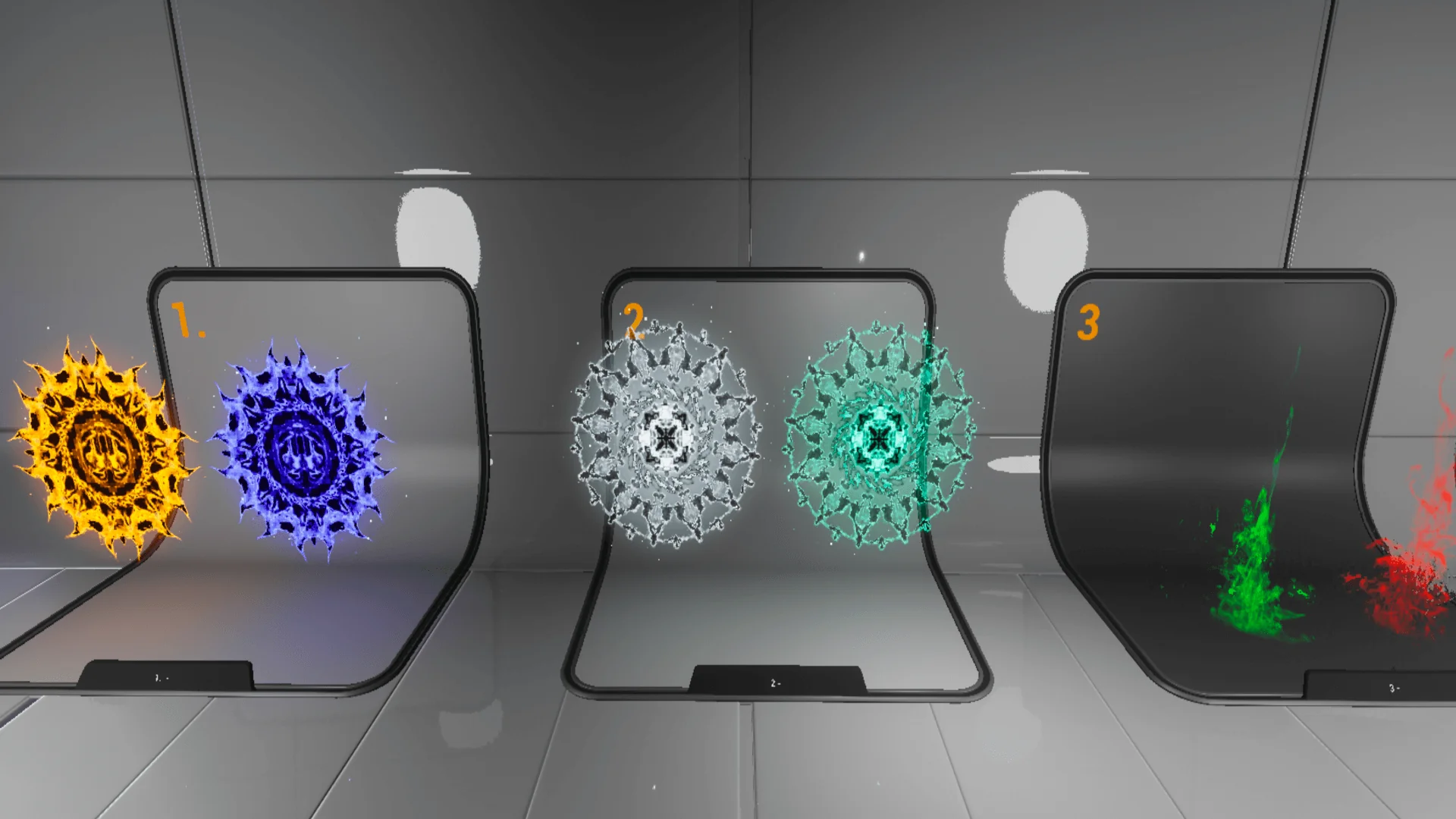
The visual roster within AdvancedMagicFX19 spans a distinct set of elemental behaviors, categorized by kinetic spell paths, surface-bound impacts, and high-energy projectiles. The package groups these into focused gameplay types, including fireball bursts, shuriken-style spinning projectiles, viscous sludge effects, and general fire magic.
The fireball effects represent high-velocity, high-luminance kinetic magic. Built to support impact bursts, travel trails, and detonation phases, these assets provide the visual signature required for ranged offensive spellcasting. Emitters within this category handle bright core intensity, trailing heat signatures, and burst debris upon collision, communicating impact force instantly to the player.
The shuriken effects offer a different mechanical profile, translating rotational geometry and sharp energy arcs into projectile magic. These assets suit rapid-fire spell sequences, stylized ninja techniques, or mystical blade arts where angular motion and focused particle trails dictate the spell silhouette. Their directional velocity and spin parameters allow them to be linked cleanly to tracking projectiles or linear trace paths.
Sludge effects introduce organic, viscous magical behavior to balance out the high-velocity fire and blade archetypes. Instead of rapid dissipation and burning embers, sludge emitters focus on heavier droplets, ground clinging splatters, and bubbling surfaces. This makes them suitable for hazard fields, decay spells, poison damage zones, or debuff indicators where visual weight and lingering spatial presence take priority over explosive kinetic bursts.
Cascade Particle LOD Architecture and Performance Considerations
Optimizing real-time VFX for variable combat densities hinges on how gracefully emitters shed rendering costs at range. AdvancedMagicFX19 integrates particle LODs across its Cascade effects to manage this operational burden during active gameplay.
Particle LODs function by setting threshold distances at which the engine switches to reduced-complexity versions of the emitter. At close range, full particle counts, secondary sub-emitters, intricate collision modules, and detailed alpha blend steps are fully realized. As the camera retreats, intermediate and distant LOD levels drop secondary sparks, simplify velocity calculations, and scale down maximum concurrent particle counts. This preserves frame stability during hectic encounters where dozens of fireballs, shurikens, or sludge pools trigger simultaneously across the screen.
When deploying these effects in multiplayer arenas or large open environments, verifying LOD switch distances inside the Cascade particle editor helps match visual fidelity to screen coverage. By pairing distance-based module culling with the innate modularity of the package, developers can establish clean performance ceilings without manually stripping emitters for distant combatants.
KY_magic Production Readiness and Implementation Takeaways
AdvancedMagicFX19 sits within the broader KY_magic series of visual effects, presenting an established aesthetic direction tailored for action-oriented fantasy games. The assets are constructed to communicate magic states with high clarity, combining distinct color temperatures, punchy launch phases, and legible trail paths.
Choosing between the NiagaraFX and Cascade variations ultimately depends on production requirements. Teams leveraging modern Unreal workflows benefit from the Niagara version on UE4.26 and newer, unlocking Niagara's scriptable emitter stacks via the Cascade To Niagara plugin. Teams prioritizing out-of-the-box distance optimization via particle LODs can implement the Cascade assets directly. With its balanced spread of fireball projectiles, shuriken blades, and sludge zones, the asset set offers a practical foundation for combat encounters requiring diverse, responsive spellcasting.
 Spells & Combat
 Spells & Combat
 Spells & Combat