"ee989f9ed9d4794c"{"id":"1001715","slug":"abandoned-factory-buildings-day-night-scene","title":"Abandoned Factory Buildings - Day/Night Scene","category":"Industrial","engine":"4.26+,5.0+","assetVersion":"","engineVersion":"Engine Version: 4.26+,5.0+","tag":"Industrial","accent":"blue","visual":"mech","summary":"A production-ready industrial district pack featuring 430+ photogrammetry-based assets, day and night setups, and optimization for UE4 and UE5.","platform":"Unreal Engine","publishedAt":"2026-10-19T15:04:55.064Z","updatedAt":"2026-10-19T15:04:55.064Z","sourceNotes":[],"fileContents":[],"compatibility":["Unreal Engine","Engine Version: 4.26+,5.0+"],"featuredImage":{"alt":"Abandoned Factory Buildings - Day/Night Scene","src":"/wp-content/uploads/published/2026/10/a41efb1fe363-e2ba3b96-b618-4a53-9078-0c2793e6971c-078968e1e3.webp"},"hasDownloadLink":true,"downloads":0,"terms":[{"taxonomy":"category","slug":"industrial","name":"Industrial"}],"galleryImages":[{"src":"/wp-content/uploads/published/2026/10/c6c03a416dd6-87ddcb1e-a883-4337-8206-a0a76fa51db5-c45523040d.webp","alt":"Abandoned Factory Buildings - Day/Night Scene"},{"src":"/wp-content/uploads/published/2026/10/76ec6b11ba07-90292e10-d974-4ee7-ad4e-162b10190b8c-1ed265d287.webp","alt":"Abandoned Factory Buildings - Day/Night Scene"},{"src":"/wp-content/uploads/published/2026/10/509e0d7f6074-1cfc2813-2c55-4036-ac59-1086f5339db2-4233e88a98.webp","alt":"Abandoned Factory Buildings - Day/Night Scene"},{"src":"/wp-content/uploads/published/2026/10/7b9f74734560-da5c42b8-a334-4c23-ac88-749e8ab23d54-9d662517a8.webp","alt":"Abandoned Factory Buildings - Day/Night Scene"},{"src":"/wp-content/uploads/published/2026/10/6d2405ccbbf8-77abc345-dd08-475b-be81-b1231ed00728-a662250468.webp","alt":"Abandoned Factory Buildings - Day/Night Scene"},{"src":"/wp-content/uploads/published/2026/10/b7e7fcea219f-5d31a20f-0a95-4839-8cc8-8a5c7ee661f7-19980b2d25.webp","alt":"Abandoned Factory Buildings - Day/Night Scene"},{"src":"/wp-content/uploads/published/2026/10/c6fb9c2f7d7e-64449243-dd20-4f8a-8de5-b33d7cf849fd-0d80ac7b11.webp","alt":"Abandoned Factory Buildings - Day/Night Scene"},{"src":"/wp-content/uploads/published/2026/10/a47199ea2a1b-343f030e-ef6a-408a-bdde-9cc891f68bb1-381bcee99a.webp","alt":"Abandoned Factory Buildings - Day/Night Scene"},{"src":"/wp-content/uploads/published/2026/10/e774972a7d48-28f58bb5-20cb-4b26-aa46-7025b993b6f4-0c375c41ac.webp","alt":"Abandoned Factory Buildings - Day/Night Scene"}],"accessPanel":{"kind":"resource","title":"Download this resource","eyebrow":"Free Download","message":"Log in or create a free account to start your download.","fileName":"Content.7z","safetyNote":"Resources are manually reviewed before listing to improve quality and reduce obvious risks.","actionLabel":"Download Free","resourceType":"Resource archive"},"contentHtml":"\u003ch2\u003eConstructing Industrial Districts and Gritty Urban Decay\u003c/h2\u003e\u003cp\u003eIndustrial settings require a dense layering of structural wear, structural debris, and modular infrastructure to feel authentic. Abandoned Factory Buildings - Day/Night Scene provides the structural pieces and ground-level clutter necessary to stage deserted manufacturing sites, decaying suburban perimeters, or ruined urban compounds. Projects driven by survival mechanics, narrative exploration, tactical shooters, or atmospheric cinematic sequences require consistent surface decay across every facade and walkway.\u003c/p\u003e\u003cp\u003eThe environment establishes an industrial district centered around an aging manufacturing facility. Instead of relying on uniform surfaces, the layout breaks apart clean lines with damaged modular elevations, scattered refuse, and weathered utilities. Setting up an expansive exterior zone demands both macro-level silhouettes—such as towering brick facades and overhead network piping—and micro-level scatter like discarded pallets and trash bags. Having both asset tiers working together allows level designers to block out warehouse complexes and perimeter yards without visual repetition.\u003c/p\u003e\u003ch2\u003ePhotogrammetry Assets and Modular Elevations in Unreal Engine\u003c/h2\u003e\u003cp\u003eCapturing the genuine irregularity of ruined brickwork and crumbling concrete is difficult with traditional hand-modeling alone. Most assets within this collection originate from photogrammetry capture, preserving authentic fractures, rough mortar, surface pockmarks, and realistic weather staining. Raw scans, however, are notoriously heavy and irregular. To make them production-viable, these scanned meshes were retopologized, optimized, and hand-tweaked to function smoothly within real-time game pipelines across Unreal Engine 4 and Unreal Engine 5.\u003c/p\u003e\u003cp\u003eThe package contains over 430 assets dedicated to structural composition and scene expansion. Central to the construction workflow are modular elevations that snap together to form multi-story factory exteriors, loading docks, and warehouse walls. These building blocks are supplemented by smaller industrial elements:\u003c/p\u003e\u003cul\u003e\u003cli\u003eIndividual brick elements and broken masonry piles to break up ground lines\u003c/li\u003e\u003cli\u003eIndustrial pipe runs and structural steel components showing realistic corrosion\u003c/li\u003e\u003cli\u003eWooden shipping pallets in various states of wear\u003c/li\u003e\u003cli\u003eTrash bags and scattered debris made for natural ground-level accumulation\u003c/li\u003e\u003cli\u003eConcrete foundations and weathered architectural supports\u003c/li\u003e\u003c/ul\u003e\u003cp\u003eBecause the individual pieces share a consistent visual language rooted in real-world surface data, artists can easily expand the boundaries of the scene or construct entirely custom industrial configurations without assets clashing in texture resolution or geometric fidelity.\u003c/p\u003e\u003ch2\u003eBalancing Lumen and Static Lighting Across Day and Night Setups\u003c/h2\u003e\u003cp\u003eLighting dictates the tone of industrial decay. The collection features two complete lighting configurations: a crisp daytime setup and a high-contrast night scene. Both lighting scenarios are built to demonstrate different atmospheric qualities of the district, giving teams immediate visual reference points for various project states.\u003c/p\u003e\u003cp\u003eThe environment is configured to support both dynamic Lumen lighting workflows and traditional static light baking. For teams targeting next-generation rendering pipelines in modern engines, the Lumen integration handles indirect bounces and diffuse shading across complex surfaces like recessed brick joints and exposed pipe networks in real time. For productions with fixed performance budgets or pipelines relying on lightmaps, the preconfigured static lighting setup provides clean shadow bakes and dependable ambient occlusion.\u003c/p\u003e\u003cp\u003eSwitching between day and night lighting reveals different architectural layers. Strong sunlight highlights the surface texture of the photogrammetry scans, casting sharp geometric shadows through structural frameworks. The night scenario shifts the emphasis to localized light sources, heavy shadows, and atmospheric contrast across the damp industrial yards.\u003c/p\u003e\u003ch2\u003eTechnical Scalability and Measured Real-Time Performance\u003c/h2\u003e\u003cp\u003eLarge-scale modular environments often struggle with draw calls and geometry overhead if prop placement is not carefully managed. This district environment focuses heavily on engine performance alongside visual complexity. In engine benchmarking, the detailed scene achieved 260 frames per second at Full HD resolution (1080p) using High scalability settings on a test system configured with an AMD Ryzen 9 processor, an NVIDIA RTX 4080 graphics card, 64GB of RAM, and solid-state storage.\u003c/p\u003e\u003cp\u003eDelivering high framerates in dense environments requires clean collision setups, balanced level-of-detail transitions, and tightly managed material passes. The package integrates into a professional development pipeline by including native Blueprints, real-time visual effects (VFX), integrated ambient audio, and detailed technical documentation. Having blueprints and supporting audio assets preconfigured allows teams to evaluate the space as an interactive game level immediately rather than assembling technical systems from scratch.\u003c/p\u003e\u003ch2\u003eEvolution from Base Factory Compounds to Accessible Interiors\u003c/h2\u003e\u003cp\u003eA production environment must grow alongside the needs of world builders. While the original release supplied a fully functional, production-ready exterior core, subsequent updates expanded both the asset count and the structural utility of the environment:\u003c/p\u003e\u003cul\u003e\u003cli\u003e\u003cstrong\u003eV1.1 Optimization Pass:\u003c/strong\u003e Focused on performance tuning across meshes and scene draw calls to streamline rendering efficiency.\u003c/li\u003e\u003cli\u003e\u003cstrong\u003eV1.2 Asset Expansion:\u003c/strong\u003e Introduced more than 80 new static meshes derived from the existing art set, broadening the palette of structural variations and industrial scatter without disrupting the established aesthetic.\u003c/li\u003e\u003cli\u003e\u003cstrong\u003eV1.3 Day Map with Simple Interiors:\u003c/strong\u003e Added a newly updated daytime map incorporating accessible, simple building interiors to transition gameplay naturally between exterior factory yards and indoor spaces.\u003c/li\u003e\u003c/ul\u003e\u003cp\u003eThe progression toward including interior spaces addresses a common challenge in modular environments, where closed facades restrict gameplay pathing. Simple interiors allow level designers to route combat encounters, loot placements, or narrative beats through the factory buildings rather than confining action solely to the streets and alleyways.\u003c/p\u003e\u003ch2\u003eProduction Teams That Benefit Most from This Industrial Kit\u003c/h2\u003e\u003cp\u003eEnvironment artists and technical level designers seeking an immediate, technically sound foundation for industrial zones gain the most utility from this package. Solo developers and small teams often lack the time and equipment required to scan, clean, and optimize hundreds of photogrammetry-grade props. Having 430+ pre-optimized elements—complete with day and night lighting maps, performance-tested blueprints, and working audio—bypasses weeks of raw asset production.\u003c/p\u003e\u003cp\u003eLevel designers prototyping abandoned urban settings, industrial facilities, or quarantined perimeters can immediately deploy the modular elevations to outline flow, using the included trash, pallets, and pipe systems to provide authentic visual clutter. Because the technical pipeline accommodates both modern dynamic Lumen systems and performance-conscious static lighting, the collection adapts equally well to high-end cinematic stages and competitive, frame-rate-critical real-time titles.\u003c/p\u003e\n\n\u003ch2\u003eMore From The Same Workflow\u003c/h2\u003e\n\u003cul\u003e\n\u003cli\u003e\u003ca href=\"https://3dcghub.com/abandoned-industrial-factory-environment-abandoned-industrial-factory-3d/\" title=\"Abandoned Industrial Factory Environment ( Abandoned Industrial Factory 3D )\"\u003eAbandoned Industrial Factory Environment ( Abandoned Industrial Factory 3D )\u003c/a\u003e\u003c/li\u003e\n\u003cli\u003e\u003ca href=\"https://3dcghub.com/industrial-factory-factory-warehouse-industrial-factory-modular-factory/\" title=\"Industrial Factory (Factory, Warehouse, Industrial Factory, Modular Factory)\"\u003eIndustrial Factory (Factory, Warehouse, Industrial Factory, Modular Factory)\u003c/a\u003e\u003c/li\u003e\n\u003cli\u003e\u003ca href=\"https://3dcghub.com/warehouse-abandoned-factory-district/\" title=\"Warehouse - Abandoned Factory District\"\u003eWarehouse - Abandoned Factory District\u003c/a\u003e\u003c/li\u003e\n\u003cli\u003e\u003ca href=\"https://3dcghub.com/factory-district/\" title=\"Factory District\"\u003eFactory District\u003c/a\u003e\u003c/li\u003e\n\u003cli\u003e\u003ca href=\"https://3dcghub.com/quarry-environment-industrial-factory-area-quarry-factory-factory-area/\" title=\"Quarry Environment ( Industrial Factory Area , Quarry Factory , Factory area )\"\u003eQuarry Environment ( Industrial Factory Area , Quarry Factory , Factory area )\u003c/a\u003e\u003c/li\u003e\n\u003c/ul\u003e","contentTextLength":7668,"navigation":{"current":10,"total":3660,"previous":{"id":"1001716","slug":"a-c-s-u-specter","title":"A.C.S.U. \"Specter\"","category":"Mechanical \u0026 Robots","platform":"Unreal Engine","updatedAt":"2026-10-19T15:22:49.792Z"},"next":{"id":"11974","slug":"definitive-fps-kit","title":"DEFINITIVE FPS KIT","category":"Shooter","platform":"Unreal Engine","updatedAt":"2026-10-16T06:54:06.998Z"}},"relatedResources":[{"id":"1001699","slug":"abandoned-industrial-factory-environment-abandoned-industrial-factory-3d","title":"Abandoned Industrial Factory Environment ( Abandoned Industrial Factory 3D )","category":"Industrial","engine":"5.2+","assetVersion":"","engineVersion":"Engine Version: 5.2+","tag":"Industrial","accent":"blue","visual":"city","summary":"Explore the Abandoned Industrial Factory Environment, featuring 180 game-ready meshes, Lumen lighting support, and the Ultimate Level Art Tool.","platform":"Unreal Engine","publishedAt":"2026-10-14T13:28:27.773Z","updatedAt":"2026-10-14T13:28:27.773Z","sourceNotes":[],"fileContents":[],"compatibility":["Unreal Engine","Engine Version: 5.2+"],"featuredImage":{"alt":"Abandoned Industrial Factory Environment ( Abandoned Industrial Factory 3D )","src":"/wp-content/uploads/published/2026/10/4542d5ed6110-f0bb63a1-32f1-4adc-992d-9875eb15bad2-deb57c934b.webp"},"hasDownloadLink":true,"downloads":2},{"id":"1001480","slug":"industrial-factory-factory-warehouse-industrial-factory-modular-factory","title":"Industrial Factory (Factory, Warehouse, Industrial Factory, Modular Factory)","category":"Industrial","engine":"5.3+","assetVersion":"","engineVersion":"Engine Version: 5.3+","tag":"Industrial","accent":"blue","visual":"mech","summary":"Explore the Industrial Factory modular environment pack featuring enterable buildings, PCG tools, pipe splines, photorealistic foliage, and Lumen support.","platform":"Unreal Engine","publishedAt":"2026-10-08T08:48:14.024Z","updatedAt":"2026-10-08T08:48:14.024Z","sourceNotes":[],"fileContents":[],"compatibility":["Unreal Engine","Engine Version: 5.3+"],"featuredImage":{"alt":"Industrial Factory (Factory, Warehouse, Industrial Factory, Modular Factory)","src":"/wp-content/uploads/published/2026/10/8695f35bdde3-414ac376-dfdd-4242-b070-6fc74e11ac78-0894952941.webp"},"hasDownloadLink":true,"downloads":0},{"id":"1001161","slug":"warehouse-abandoned-factory-district","title":"Warehouse - Abandoned Factory District","category":"Industrial","engine":"4.27,5.0+","assetVersion":"","engineVersion":"Engine Version: 4.27,5.0+","tag":"Industrial","accent":"blue","visual":"mech","summary":"Warehouse - Abandoned Factory District delivers over 1,000 industrial assets, functional motion blueprints, audio, and photogrammetry detailing.","platform":"Unreal Engine","publishedAt":"2026-09-11T09:39:32.707Z","updatedAt":"2026-09-11T09:39:32.707Z","sourceNotes":[],"fileContents":[],"compatibility":["Unreal Engine","Engine Version: 4.27,5.0+"],"featuredImage":{"alt":"Warehouse - Abandoned Factory District","src":"/wp-content/uploads/published/2026/09/0d31143c8102-96fa8327-2ea3-4f37-ac7e-addb57c90780-9c79c1476e.webp"},"hasDownloadLink":true,"downloads":4}]}
Industrial
Abandoned Factory Buildings - Day/Night Scene
A production-ready industrial district pack featuring 430+ photogrammetry-based assets, day and night setups, and optimization for UE4 and UE5.
Category:Unreal Engine,IndustrialPlatform: Unreal EngineEngine Version: 4.26+,5.0+Published: Oct 19, 2026
Industrial
Resource overview
Constructing Industrial Districts and Gritty Urban Decay
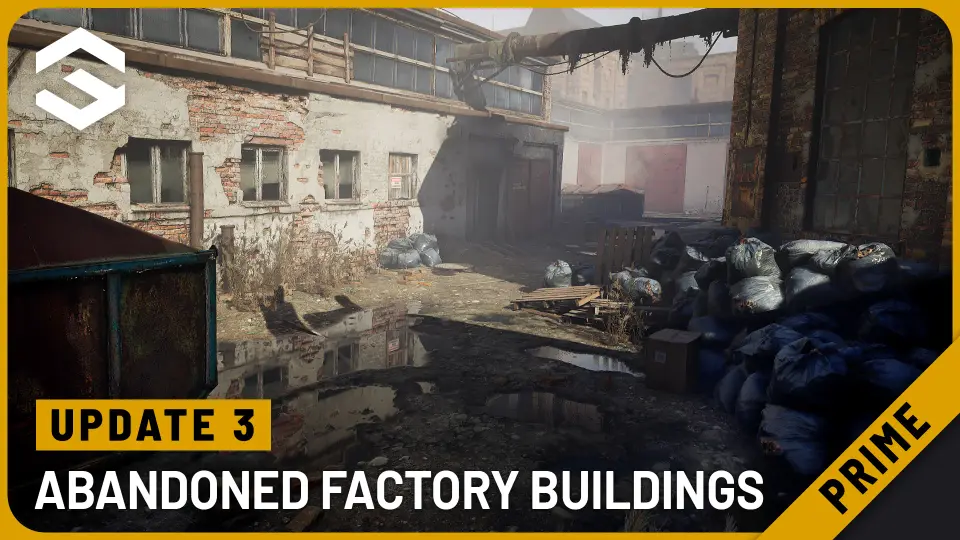
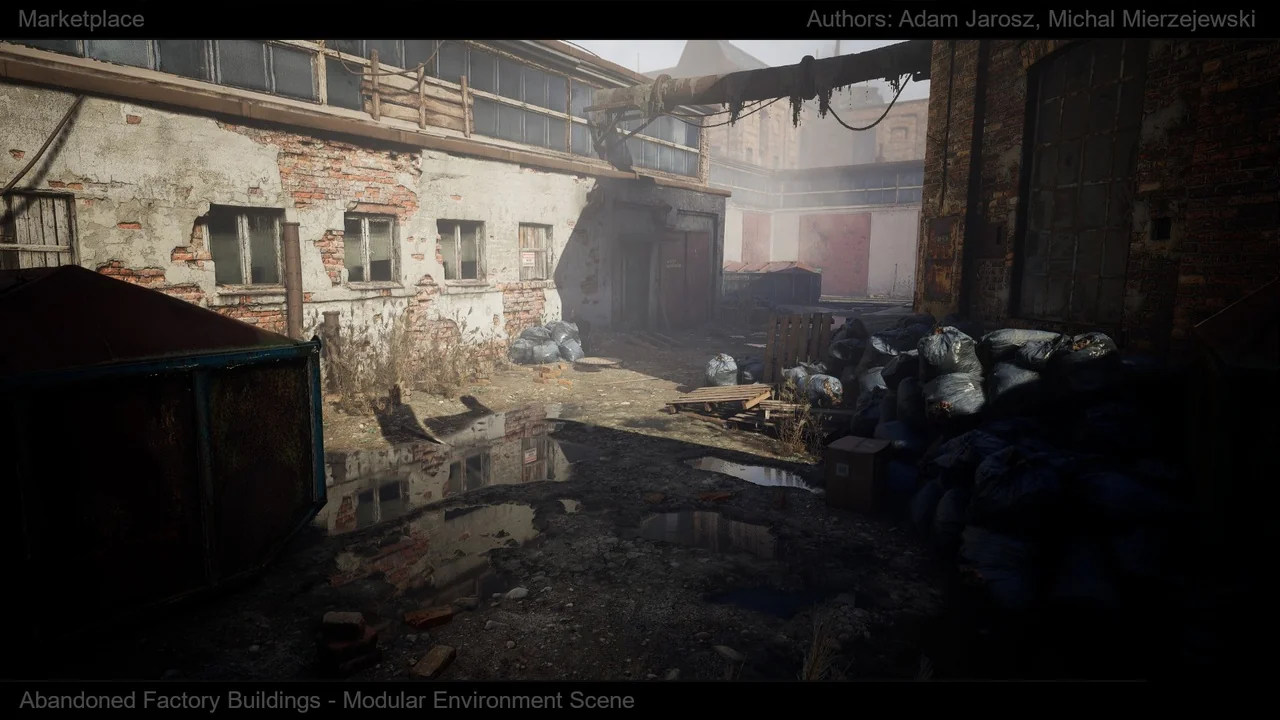
Industrial settings require a dense layering of structural wear, structural debris, and modular infrastructure to feel authentic. Abandoned Factory Buildings - Day/Night Scene provides the structural pieces and ground-level clutter necessary to stage deserted manufacturing sites, decaying suburban perimeters, or ruined urban compounds. Projects driven by survival mechanics, narrative exploration, tactical shooters, or atmospheric cinematic sequences require consistent surface decay across every facade and walkway.
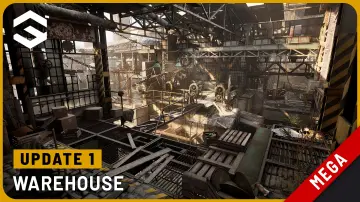
The environment establishes an industrial district centered around an aging manufacturing facility. Instead of relying on uniform surfaces, the layout breaks apart clean lines with damaged modular elevations, scattered refuse, and weathered utilities. Setting up an expansive exterior zone demands both macro-level silhouettes—such as towering brick facades and overhead network piping—and micro-level scatter like discarded pallets and trash bags. Having both asset tiers working together allows level designers to block out warehouse complexes and perimeter yards without visual repetition.
Photogrammetry Assets and Modular Elevations in Unreal Engine
Capturing the genuine irregularity of ruined brickwork and crumbling concrete is difficult with traditional hand-modeling alone. Most assets within this collection originate from photogrammetry capture, preserving authentic fractures, rough mortar, surface pockmarks, and realistic weather staining. Raw scans, however, are notoriously heavy and irregular. To make them production-viable, these scanned meshes were retopologized, optimized, and hand-tweaked to function smoothly within real-time game pipelines across Unreal Engine 4 and Unreal Engine 5.
The package contains over 430 assets dedicated to structural composition and scene expansion. Central to the construction workflow are modular elevations that snap together to form multi-story factory exteriors, loading docks, and warehouse walls. These building blocks are supplemented by smaller industrial elements:
Individual brick elements and broken masonry piles to break up ground lines
Industrial pipe runs and structural steel components showing realistic corrosion
Wooden shipping pallets in various states of wear
Trash bags and scattered debris made for natural ground-level accumulation
Concrete foundations and weathered architectural supports
Because the individual pieces share a consistent visual language rooted in real-world surface data, artists can easily expand the boundaries of the scene or construct entirely custom industrial configurations without assets clashing in texture resolution or geometric fidelity.
Balancing Lumen and Static Lighting Across Day and Night Setups
Lighting dictates the tone of industrial decay. The collection features two complete lighting configurations: a crisp daytime setup and a high-contrast night scene. Both lighting scenarios are built to demonstrate different atmospheric qualities of the district, giving teams immediate visual reference points for various project states.
The environment is configured to support both dynamic Lumen lighting workflows and traditional static light baking. For teams targeting next-generation rendering pipelines in modern engines, the Lumen integration handles indirect bounces and diffuse shading across complex surfaces like recessed brick joints and exposed pipe networks in real time. For productions with fixed performance budgets or pipelines relying on lightmaps, the preconfigured static lighting setup provides clean shadow bakes and dependable ambient occlusion.
Switching between day and night lighting reveals different architectural layers. Strong sunlight highlights the surface texture of the photogrammetry scans, casting sharp geometric shadows through structural frameworks. The night scenario shifts the emphasis to localized light sources, heavy shadows, and atmospheric contrast across the damp industrial yards.
Technical Scalability and Measured Real-Time Performance
Large-scale modular environments often struggle with draw calls and geometry overhead if prop placement is not carefully managed. This district environment focuses heavily on engine performance alongside visual complexity. In engine benchmarking, the detailed scene achieved 260 frames per second at Full HD resolution (1080p) using High scalability settings on a test system configured with an AMD Ryzen 9 processor, an NVIDIA RTX 4080 graphics card, 64GB of RAM, and solid-state storage.
Delivering high framerates in dense environments requires clean collision setups, balanced level-of-detail transitions, and tightly managed material passes. The package integrates into a professional development pipeline by including native Blueprints, real-time visual effects (VFX), integrated ambient audio, and detailed technical documentation. Having blueprints and supporting audio assets preconfigured allows teams to evaluate the space as an interactive game level immediately rather than assembling technical systems from scratch.
Evolution from Base Factory Compounds to Accessible Interiors
A production environment must grow alongside the needs of world builders. While the original release supplied a fully functional, production-ready exterior core, subsequent updates expanded both the asset count and the structural utility of the environment:
V1.1 Optimization Pass: Focused on performance tuning across meshes and scene draw calls to streamline rendering efficiency.
V1.2 Asset Expansion: Introduced more than 80 new static meshes derived from the existing art set, broadening the palette of structural variations and industrial scatter without disrupting the established aesthetic.
V1.3 Day Map with Simple Interiors: Added a newly updated daytime map incorporating accessible, simple building interiors to transition gameplay naturally between exterior factory yards and indoor spaces.
The progression toward including interior spaces addresses a common challenge in modular environments, where closed facades restrict gameplay pathing. Simple interiors allow level designers to route combat encounters, loot placements, or narrative beats through the factory buildings rather than confining action solely to the streets and alleyways.
Production Teams That Benefit Most from This Industrial Kit
Environment artists and technical level designers seeking an immediate, technically sound foundation for industrial zones gain the most utility from this package. Solo developers and small teams often lack the time and equipment required to scan, clean, and optimize hundreds of photogrammetry-grade props. Having 430+ pre-optimized elements—complete with day and night lighting maps, performance-tested blueprints, and working audio—bypasses weeks of raw asset production.
Level designers prototyping abandoned urban settings, industrial facilities, or quarantined perimeters can immediately deploy the modular elevations to outline flow, using the included trash, pallets, and pipe systems to provide authentic visual clutter. Because the technical pipeline accommodates both modern dynamic Lumen systems and performance-conscious static lighting, the collection adapts equally well to high-end cinematic stages and competitive, frame-rate-critical real-time titles.
 Industrial
 Industrial
 Industrial
 Industrial