"031373f479d9561a"{"id":"1000217","slug":"abandoned-building","title":"Abandoned Building","category":"Abandoned","engine":"4.26+,5.0+","assetVersion":"","engineVersion":"Engine Version: 4.26+,5.0+","tag":"Abandoned","accent":"blue","visual":"mech","summary":"A detailed look at the customizable environment materials and structural elements designed for constructing visually distinct abandoned levels.","platform":"Unreal Engine","publishedAt":"2026-06-26T09:59:54.284Z","updatedAt":"2026-06-26T11:58:33.227Z","sourceNotes":[],"fileContents":[],"compatibility":["Unreal Engine","Engine Version: 4.26+,5.0+"],"featuredImage":{"alt":"Abandoned Building","src":"/wp-content/uploads/published/2026/06/9fa72c80892b-e4c2255c-8407-48e1-9e6e-181b4e8a265f-68d77d2b51.webp"},"hasDownloadLink":true,"downloads":0,"terms":[{"taxonomy":"category","slug":"abandoned","name":"Abandoned"}],"galleryImages":[{"src":"/wp-content/uploads/published/2026/06/b04337d9f8e7-a14b76eb-9fbf-4a0b-8974-e95dbec8ef12-ca0b6ea362.webp","alt":"Abandoned Building"},{"src":"/wp-content/uploads/published/2026/06/45954210d7f8-54c8ff0e-b19a-4d93-ab52-4a095786fdc4-dbe782aa0e.webp","alt":"Abandoned Building"},{"src":"/wp-content/uploads/published/2026/06/4ad9eca76c09-2aa3afbc-33e3-489a-bc62-76da5f5579b6-7e50e34ae3.webp","alt":"Abandoned Building"},{"src":"/wp-content/uploads/published/2026/06/399790636a0c-c977fadd-986a-46d8-b6b7-9ccb68113e8d-b60d6c1cb1.webp","alt":"Abandoned Building"},{"src":"/wp-content/uploads/published/2026/06/c7ba613a4463-dcf4f88d-6a65-42f2-a9f9-867299535474-f8880675fa.webp","alt":"Abandoned Building"}],"accessPanel":{"kind":"resource","title":"Download this resource","eyebrow":"Free Download","message":"Log in or create a free account to start your download.","fileName":"Content.7z","safetyNote":"Resources are manually reviewed before listing to improve quality and reduce obvious risks.","actionLabel":"Download Free","resourceType":"Resource archive"},"contentHtml":"\u003cp\u003eEstablishing the atmosphere of an abandoned setting relies heavily on the behavior of its surfaces. Rather than relying on static, pre-weathered meshes that easily betray repeating patterns, the Abandoned Building environment is driven entirely by a highly flexible material pipeline. The entire level is structured through a centralized system that dictates how decay, grime, and structural wear manifest across the scene. By shifting the focus from individual texture maps to a comprehensive shader network, environment artists can ensure that no two sections of the environment share the exact same weathering patterns, even when using the same underlying structural geometry.\u003c/p\u003e \u003ch2\u003eUnified Master Material Architecture\u003c/h2\u003e\n\u003cp\u003eThe foundation of the environment is a fully customizable master material. In level design, utilizing a unified master material for primary architectural elements streamlines the entire visual pipeline. Instead of managing dozens of isolated shaders for different parts of a structure, the environment routes its primary surfaces through this single, highly configurable material graph.\u003c/p\u003e\n\u003cp\u003eThis approach allows for sweeping global adjustments or highly targeted localized changes. Because all major elements of the Abandoned Building share this foundational logic, the entire level maintains strict visual consistency. The lighting responds uniformly to the roughness and normal data across the scene, and any changes made to the master material propagate cleanly through the environment. This centralized control gives developers the ability to rapidly iterate on the visual identity of the level, adjusting the overall severity of the decay or the specific color palettes of the architectural elements without needing to rebuild materials from scratch.\u003c/p\u003e \u003ch2\u003eThree-Layer Alpha Mask Blending\u003c/h2\u003e\n\u003cp\u003eThe core mechanism driving the visual variety of the environment is a three-layer system controlled by alpha masks. This setup is specifically designed to replicate the complex, overlapping accumulation of materials found in neglected spaces. An alpha mask uses grayscale values to dictate exactly where different layers of a material are visible, effectively blending distinct surface properties together on a single mesh.\u003c/p\u003e\n\u003cp\u003eIn the context of this environment, a three-layer system provides a massive amount of depth. An artist can establish a clean structural base layer, overlay a secondary layer of peeling paint or structural damage, and cap it with a third layer of accumulated dirt, rust, or organic buildup. Because these transitions are driven by alpha masks rather than baked directly into a single texture file, the blending remains sharp and highly editable. Developers can manipulate the masks to push the dirt higher up a wall, expand the spread of rot on a floorboard, or adjust the density of grime on a surface. This layered approach is what actively prevents the environment from looking artificial or repetitive, allowing for granular control over how the passage of time is represented in the scene.\u003c/p\u003e \u003ch2\u003eSurface Customization Across Walls and Floors\u003c/h2\u003e\n\u003cp\u003eThe three-layer master material is applied directly to the most prominent architectural features of the level, starting with the walls and floors. In any interior environment, walls take up the majority of the screen space, making tiling textures immediately obvious to the viewer. By leveraging the alpha mask layers, the walls in the Abandoned Building can be heavily customized. A single wall mesh can be duplicated multiple times along a corridor, but by adjusting the material parameters, each instance can display completely different damage patterns, stains, and peeling surfaces.\u003c/p\u003e\n\u003cp\u003eFloors receive the same level of material customization. In a decaying structure, floors accumulate debris, water damage, and heavy wear from past foot traffic. The material system allows the floor surfaces to transition naturally from relatively intact sections near the center of a room to heavily damaged and grime-covered areas near the corners or under broken ceilings. This ensures that the ground the player navigates feels grounded in the reality of the abandoned setting, with localized wear and tear that makes each room feel distinctly affected by its environment.\u003c/p\u003e \u003ch2\u003eWeathering Wooden Elements and Glasses\u003c/h2\u003e\n\u003cp\u003eBeyond the primary concrete or plaster surfaces, the master material system is explicitly tailored to handle wooden elements and glass. Wooden structural supports, floorboards, and framing require specific types of weathering to look convincing. Wood rots, splinters, and loses its finish over time. The three-layer setup allows developers to blend raw, exposed wood grain with remnants of old paint or heavy water stains, giving wooden elements a tactile, deteriorating quality.\u003c/p\u003e\n\u003cp\u003eGlasses—often a challenging material to integrate into decaying environments—are also managed through this customizable pipeline. In an abandoned setting, glass is rarely entirely transparent. It accumulates thick layers of dust, gets stained by rain, and becomes opaque with grime. The material system provides the tools necessary to blend transparency with these heavy dirt layers. This allows for windows or glass partitions that obscure vision, filter light dynamically, and contribute heavily to the claustrophobic or neglected atmosphere of the building. Just like the solid structural components, the glass elements can be tweaked so that every pane exhibits unique smudges and weathering patterns.\u003c/p\u003e \u003ch2\u003eDesigning the Abandoned Level Environment\u003c/h2\u003e\n\u003cp\u003eAll of these technical material features serve the primary goal of constructing a cohesive level. The ability to easily change materials in multiple ways is what makes the environment viable for large-scale exploration. When building a complete level, repetition is the greatest enemy of immersion. If a player walks through three rooms and notices the exact same stain on the floor or the same broken plaster on the wall, the illusion of a real, decaying space is broken.\u003c/p\u003e\n\u003cp\u003eBecause the master material is built specifically to ensure that each element looks totally different, environment artists can focus on the layout and flow of the level rather than hiding repeating assets. The combination of customizable walls, floors, wood, and glass means that the structural blocks of the building can be rearranged endlessly, with the material layers doing the heavy lifting to differentiate them. The package then offers a robust toolkit for generating an authentic, atmospheric abandoned level where the environment itself tells the story of its own decay.\u003c/p\u003e\n\n\u003ch2\u003eMore From The Same Workflow\u003c/h2\u003e\n\u003cul\u003e\n\u003cli\u003e\u003ca href=\"https://3dcghub.com/abandoned-russian-building/\" title=\"Abandoned Russian Building\"\u003eAbandoned Russian Building\u003c/a\u003e\u003c/li\u003e\n\u003cli\u003e\u003ca href=\"https://3dcghub.com/highschool-restroom/\" title=\"HighSchool Restroom\"\u003eHighSchool Restroom\u003c/a\u003e\u003c/li\u003e\n\u003cli\u003e\u003ca href=\"https://3dcghub.com/abandoned-shed/\" title=\"Abandoned shed\"\u003eAbandoned shed\u003c/a\u003e\u003c/li\u003e\n\u003cli\u003e\u003ca href=\"https://3dcghub.com/highschool-classroom/\" title=\"HighSchool Classroom\"\u003eHighSchool Classroom\u003c/a\u003e\u003c/li\u003e\n\u003cli\u003e\u003ca href=\"https://3dcghub.com/abandoned-mansion-_-fully-modular-asset-pack/\" title=\"Abandoned Mansion _ Fully Modular Asset Pack\"\u003eAbandoned Mansion _ Fully Modular Asset Pack\u003c/a\u003e\u003c/li\u003e\n\u003c/ul\u003e","contentTextLength":6704,"navigation":{"current":1131,"total":3223,"previous":{"id":"1000219","slug":"armored-beetle-pack","title":"Armored Beetle Pack","category":"Insects","platform":"Unreal Engine","updatedAt":"2026-06-26T13:37:10.021Z"},"next":{"id":"1000218","slug":"ancient-towns","title":"Ancient Towns","category":"Cities","platform":"Unreal Engine","updatedAt":"2026-06-26T11:56:44.091Z"}},"relatedResources":[{"id":"1001038","slug":"abandoned-factory-industrial-railway-zone-update-v-2","title":"ABANDONED FACTORY / Industrial railway zone (Update V.2)","category":"Abandoned","engine":"4.27,5.0+","assetVersion":"","engineVersion":"Engine Version: 4.27,5.0+","tag":"Abandoned","accent":"blue","visual":"mech","summary":"The V.2 update brings two pre-assembled levels, modular enterable factory buildings, vertex-painted ground materials, and a LOD-to-Nanite workflow.","platform":"Unreal Engine","publishedAt":"2026-08-27T10:13:05.620Z","updatedAt":"2026-08-27T10:13:05.620Z","sourceNotes":[],"fileContents":[],"compatibility":["Unreal Engine","Engine Version: 4.27,5.0+"],"featuredImage":{"alt":"ABANDONED FACTORY / Industrial railway zone (Update V.2)","src":"/wp-content/uploads/published/2026/08/4a5ab4769ce7-cb2ebff5-ca80-4b1b-bd0b-146d6ce653c8-80d800d987.webp"},"hasDownloadLink":true,"downloads":3},{"id":"1000243","slug":"abandoned-chapel","title":"Abandoned Chapel","category":"Abandoned","engine":"4.26+,5.0+","assetVersion":"","engineVersion":"Engine Version: 4.26+,5.0+","tag":"Abandoned","accent":"blue","visual":"mech","summary":"A collection of 164 static meshes for building an abandoned chapel and surrounding cemetery, featuring separated architecture and detailed interior props.","platform":"Unreal Engine","publishedAt":"2026-06-30T19:50:40.071Z","updatedAt":"2026-06-30T19:50:40.071Z","sourceNotes":[],"fileContents":[],"compatibility":["Unreal Engine","Engine Version: 4.26+,5.0+"],"featuredImage":{"alt":"Abandoned Chapel","src":"/wp-content/uploads/published/2026/06/c9ae0ab84df5-bbef4edb-ea24-45e6-ba34-59dd0c795c45-10bd2cfbb9.webp"},"hasDownloadLink":true,"downloads":0},{"id":"27242","slug":"abandoned-russian-building","title":"Abandoned Russian Building","category":"Abandoned","engine":"4.26+,5.0+","assetVersion":"Engine version: 4.26+,5.0+","engineVersion":" ","tag":"Abandoned","accent":"blue","visual":"city","summary":"A decaying Soviet-era building gives horror scenes a bleak, enclosed place to unfold. The interior takes priority, while exterior pieces stay in the background, and the lighting setup is meant to stay baked if the scene is used in UE5.","platform":"Unreal Engine","publishedAt":"2026-04-23T04:12:10.000Z","updatedAt":"2026-04-23T04:12:13.000Z","sourceNotes":[],"fileContents":[],"compatibility":["Unreal Engine","Engine version: 4.26+,5.0+"],"featuredImage":{"alt":"Abandoned Russian Building","src":"https://3dcghub.com/wp-content/uploads/2026/04/134773e64463_c0be0b90-da6c-4324-9f0a-924af8ec2bc4.webp"},"hasDownloadLink":true,"downloads":6}]}
Abandoned
Abandoned Building
A detailed look at the customizable environment materials and structural elements designed for constructing visually distinct abandoned levels.
Category:Unreal Engine,AbandonedPlatform: Unreal EngineEngine Version: 4.26+,5.0+Published: Jun 26, 2026
Abandoned
Resource overview
Establishing the atmosphere of an abandoned setting relies heavily on the behavior of its surfaces. Rather than relying on static, pre-weathered meshes that easily betray repeating patterns, the Abandoned Building environment is driven entirely by a highly flexible material pipeline. The entire level is structured through a centralized system that dictates how decay, grime, and structural wear manifest across the scene. By shifting the focus from individual texture maps to a comprehensive shader network, environment artists can ensure that no two sections of the environment share the exact same weathering patterns, even when using the same underlying structural geometry.
Unified Master Material Architecture
The foundation of the environment is a fully customizable master material. In level design, utilizing a unified master material for primary architectural elements streamlines the entire visual pipeline. Instead of managing dozens of isolated shaders for different parts of a structure, the environment routes its primary surfaces through this single, highly configurable material graph.
This approach allows for sweeping global adjustments or highly targeted localized changes. Because all major elements of the Abandoned Building share this foundational logic, the entire level maintains strict visual consistency. The lighting responds uniformly to the roughness and normal data across the scene, and any changes made to the master material propagate cleanly through the environment. This centralized control gives developers the ability to rapidly iterate on the visual identity of the level, adjusting the overall severity of the decay or the specific color palettes of the architectural elements without needing to rebuild materials from scratch.
Three-Layer Alpha Mask Blending
The core mechanism driving the visual variety of the environment is a three-layer system controlled by alpha masks. This setup is specifically designed to replicate the complex, overlapping accumulation of materials found in neglected spaces. An alpha mask uses grayscale values to dictate exactly where different layers of a material are visible, effectively blending distinct surface properties together on a single mesh.
In the context of this environment, a three-layer system provides a massive amount of depth. An artist can establish a clean structural base layer, overlay a secondary layer of peeling paint or structural damage, and cap it with a third layer of accumulated dirt, rust, or organic buildup. Because these transitions are driven by alpha masks rather than baked directly into a single texture file, the blending remains sharp and highly editable. Developers can manipulate the masks to push the dirt higher up a wall, expand the spread of rot on a floorboard, or adjust the density of grime on a surface. This layered approach is what actively prevents the environment from looking artificial or repetitive, allowing for granular control over how the passage of time is represented in the scene.
Surface Customization Across Walls and Floors
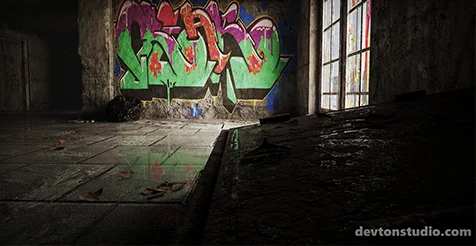
The three-layer master material is applied directly to the most prominent architectural features of the level, starting with the walls and floors. In any interior environment, walls take up the majority of the screen space, making tiling textures immediately obvious to the viewer. By leveraging the alpha mask layers, the walls in the Abandoned Building can be heavily customized. A single wall mesh can be duplicated multiple times along a corridor, but by adjusting the material parameters, each instance can display completely different damage patterns, stains, and peeling surfaces.
Floors receive the same level of material customization. In a decaying structure, floors accumulate debris, water damage, and heavy wear from past foot traffic. The material system allows the floor surfaces to transition naturally from relatively intact sections near the center of a room to heavily damaged and grime-covered areas near the corners or under broken ceilings. This ensures that the ground the player navigates feels grounded in the reality of the abandoned setting, with localized wear and tear that makes each room feel distinctly affected by its environment.
Weathering Wooden Elements and Glasses
Beyond the primary concrete or plaster surfaces, the master material system is explicitly tailored to handle wooden elements and glass. Wooden structural supports, floorboards, and framing require specific types of weathering to look convincing. Wood rots, splinters, and loses its finish over time. The three-layer setup allows developers to blend raw, exposed wood grain with remnants of old paint or heavy water stains, giving wooden elements a tactile, deteriorating quality.
Glasses—often a challenging material to integrate into decaying environments—are also managed through this customizable pipeline. In an abandoned setting, glass is rarely entirely transparent. It accumulates thick layers of dust, gets stained by rain, and becomes opaque with grime. The material system provides the tools necessary to blend transparency with these heavy dirt layers. This allows for windows or glass partitions that obscure vision, filter light dynamically, and contribute heavily to the claustrophobic or neglected atmosphere of the building. Just like the solid structural components, the glass elements can be tweaked so that every pane exhibits unique smudges and weathering patterns.
Designing the Abandoned Level Environment
All of these technical material features serve the primary goal of constructing a cohesive level. The ability to easily change materials in multiple ways is what makes the environment viable for large-scale exploration. When building a complete level, repetition is the greatest enemy of immersion. If a player walks through three rooms and notices the exact same stain on the floor or the same broken plaster on the wall, the illusion of a real, decaying space is broken.
Because the master material is built specifically to ensure that each element looks totally different, environment artists can focus on the layout and flow of the level rather than hiding repeating assets. The combination of customizable walls, floors, wood, and glass means that the structural blocks of the building can be rearranged endlessly, with the material layers doing the heavy lifting to differentiate them. The package then offers a robust toolkit for generating an authentic, atmospheric abandoned level where the environment itself tells the story of its own decay.
 Abandoned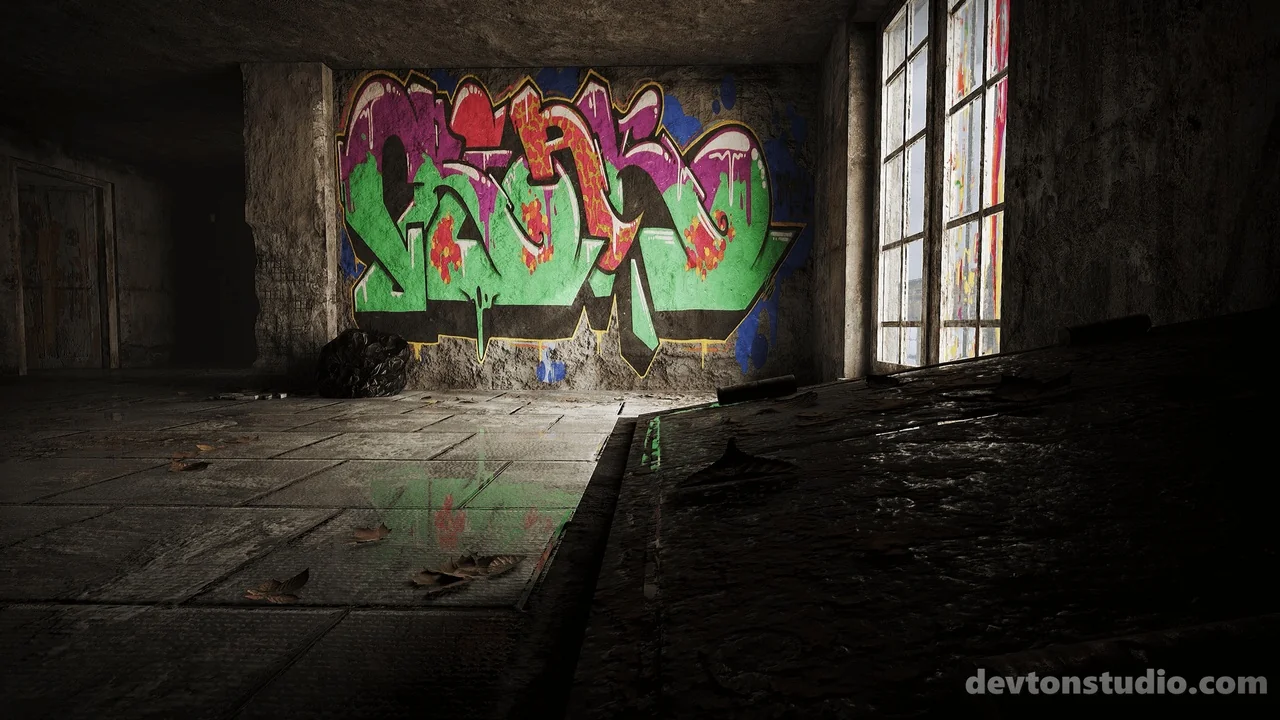
 Abandoned
 Abandoned
 Abandoned