"c68a05d5e51405b3"{"id":"1001855","slug":"6-versions-apc-military-vehicle","title":"6 Versions APC Military Vehicle","category":"Guns","engine":"4.24+,5.0+","assetVersion":"","engineVersion":"Engine Version: 4.24+,5.0+","tag":"Guns","accent":"blue","visual":"mech","summary":"Examine the 6 Versions APC Military Vehicle package, featuring a Russian BTR70 with 6 camouflage and solid paint schemes, 10 blueprints, and Lumen support.","platform":"Unreal Engine","publishedAt":"2026-10-22T10:35:31.256Z","updatedAt":"2026-10-22T10:35:31.256Z","sourceNotes":[],"fileContents":[],"compatibility":["Unreal Engine","Engine Version: 4.24+,5.0+"],"featuredImage":{"alt":"6 Versions APC Military Vehicle","src":"/wp-content/uploads/published/2026/10/a4ebf57d161a-685dc58a-a9eb-40b8-9125-90f1a5727389-4b5615b659.webp"},"hasDownloadLink":true,"downloads":0,"terms":[{"taxonomy":"category","slug":"guns","name":"Guns"}],"galleryImages":[{"src":"/wp-content/uploads/published/2026/10/d621347706a6-b769b6ad-0b5e-4957-a0bf-5a5ff3be755d-dec3b35777.webp","alt":"6 Versions APC Military Vehicle"},{"src":"/wp-content/uploads/published/2026/10/a014543ba687-8180bf58-e31f-45cb-b9a5-706dc7832c75-a11dbec133.webp","alt":"6 Versions APC Military Vehicle"},{"src":"/wp-content/uploads/published/2026/10/17780f986478-bad3ee58-662b-4750-a7e5-06430d82cc9e-e19062cc75.webp","alt":"6 Versions APC Military Vehicle"},{"src":"/wp-content/uploads/published/2026/10/d2b64a00c186-4c533517-3db8-4655-bf12-f04b214e71a4-6ca24ed8c3.webp","alt":"6 Versions APC Military Vehicle"},{"src":"/wp-content/uploads/published/2026/10/7a002b0003c5-f3cfb3df-b8f8-4a7a-b1de-4c8ad98acc38-39a9479f52.webp","alt":"6 Versions APC Military Vehicle"},{"src":"/wp-content/uploads/published/2026/10/574390b2ee91-879c7a5e-bdc9-44e8-b55d-fa585f473eba-eebbe803d7.webp","alt":"6 Versions APC Military Vehicle"},{"src":"/wp-content/uploads/published/2026/10/fc798ad4069b-631c7966-5488-47ed-b012-b7680dae801b-8751cbf072.webp","alt":"6 Versions APC Military Vehicle"},{"src":"/wp-content/uploads/published/2026/10/94269318976f-b9a44a46-810f-4f07-9659-7e20431208e8-ad09cf7ec7.webp","alt":"6 Versions APC Military Vehicle"},{"src":"/wp-content/uploads/published/2026/10/6c84d2fca05e-f2a229b9-820d-4963-b447-08c24d118f22-802253bb7c.webp","alt":"6 Versions APC Military Vehicle"},{"src":"/wp-content/uploads/published/2026/10/cdc4a6861b93-ef7e4dda-f187-4073-8f66-158759d0348b-ca937338ac.webp","alt":"6 Versions APC Military Vehicle"}],"accessPanel":{"kind":"resource","title":"Download this resource","eyebrow":"Free Download","message":"Log in or create a free account to start your download.","fileName":"Content.7z","safetyNote":"Resources are manually reviewed before listing to improve quality and reduce obvious risks.","actionLabel":"Download Free","resourceType":"Resource archive"},"contentHtml":"\u003cp\u003eStationing an armored personnel carrier inside a virtual conflict zone demands specific surface adaptations to match terrain, lighting conditions, and operational roles. The Russian BTR70 APC package centers on this armored personnel carrier, providing six distinct operational finishes suited for varying battlefields. Rather than scattering disparate geometry across separate files, the package concentrates its armored personnel carrier design into a single mesh foundation supported by dedicated blueprint instances, materials, and textures.\u003c/p\u003e \u003ch2\u003eBTR70 APC Variations Across Combat Environments\u003c/h2\u003e\n\u003cp\u003eThe package provides six distinct variations of the Russian BTR70 armored personnel carrier. Each variation alters the exterior treatment of the hull, turret, and running gear to suit specific operational theaters, environmental conditions, and strategic roles.\u003c/p\u003e \u003cp\u003eThe green forest camo variation pairs dark greens and complementary earth tones to conceal the vehicle within temperate woodland zones, dense foliage, and overgrown road networks. When positioned among trees, brush, or forest trails, this camouflage scheme breaks up the boxy silhouette of the armored hull against natural backdrops.\u003c/p\u003e \u003cp\u003eThe beige urban camo variation uses disrupted geometric or multi-tonal desert patterns calibrated for shattered concrete, brick dust, and arid urban centers. In street-to-street combat, industrial compounds, or dry settlement perimeters, this finish matches surrounding architectural debris and pale earth.\u003c/p\u003e \u003cp\u003eThe solid green finish provides the classic factory and field coat standard for military convoys. This universal livery functions across standard frontline logistics, checkpoint security, supply runs, and mechanized infantry maneuvers through open rural fields.\u003c/p\u003e \u003cp\u003eThe solid beige finish strips away pattern disruptions in favor of a single dry-climate tone. It fits arid staging zones, barren desert expanses, sun-bleached outposts, and dust-swept border corridors where complex camouflage patterns offer little advantage over uniform pale coloration.\u003c/p\u003e \u003cp\u003eThe solid white finish prepares the armored vehicle for sub-zero operations, tundra crossings, and snowbound battlefields. In winter warfare scenes, standard olive or desert tones stand out sharply against snow drifts; the white material variation preserves concealment across frostbitten terrain.\u003c/p\u003e \u003cp\u003eThe solid black finish serves specialized tactical roles, nighttime movement, or low-visibility operations. Black military vehicle surfaces provide dramatic visual contrast under direct spotlights or blend cleanly into shadow-heavy nocturnal ambushes and secure compound perimeters.\u003c/p\u003e \u003ch2\u003eCamouflage Schemes and PBR Surface Finishes\u003c/h2\u003e\n\u003cp\u003eVisual fidelity across all six vehicle configurations relies on physically based rendering standards. The package includes twenty textures mapped across fifteen materials and material instances, ensuring surfaces respond accurately to shifting environmental light.\u003c/p\u003e \u003cp\u003eMatte combat paints, metallic armor plating, rubberized wheel treads, and specialized vehicle hardware maintain appropriate roughness and metallic values. The twenty textures supply the necessary albedo, normal, and surface mask detail required to convey hard-surface armor plating without demanding excessive texture memory pools.\u003c/p\u003e \u003cp\u003eThe material architecture uses fifteen materials and material instances. This hierarchy allows the single vehicle mesh to swap between forest camouflage, urban camouflage, solid green, solid beige, solid white, and solid black without rebuilding shader networks. Material instances streamline surface changes by referencing shared master properties while pointing to their respective twenty texture maps.\u003c/p\u003e \u003ch2\u003eMesh Efficiency, Blueprints, and Material Hierarchy\u003c/h2\u003e\n\u003cp\u003eManaging system resources during large-scale combat simulations requires tight asset construction. The entire vehicle package operates from a single core mesh. Confining the vehicle geometry to one mesh keeps draw calls minimal, simplifies Level of Detail management, and ensures consistent physical boundaries regardless of the livery applied.\u003c/p\u003e \u003cp\u003eWhile the visual structure relies on a single mesh, the package supplies ten separate blueprints. These ten blueprints provide ready-to-use configurations within the engine. Developers can drop specific vehicle presets into a level without manually wiring mesh components to material instances. Having ten blueprints gives scene designers immediate access to distinct vehicle setups, operational presets, and scene-ready vehicle actors straight out of the content browser.\u003c/p\u003e \u003ch2\u003eStaging Armored Personnel Carriers in Lumen Scenes\u003c/h2\u003e\n\u003cp\u003eDesigned to integrate with modern lighting pipelines such as Lumen, the surfaces of the BTR70 respond to real-time global illumination and dynamic bounced light. Lumen calculations register the angles of the sloped armor, cast precise ambient occlusion beneath the eight wheel hubs, and accurately bounce colored light off surrounding terrain onto the vehicle hull.\u003c/p\u003e \u003cp\u003eIn woodland battle scenes, indirect green light reflecting off tree canopies washes naturally over the green forest camo hull. In harsh desert environments, high-intensity sunlight bounces upward from sand into the beige undercarriage, producing believable environmental integration without baked lightmaps.\u003c/p\u003e \u003cp\u003eThe optimized vehicle mesh and PBR texture maps prevent visual noise or light-leaking artifacts under real-time ray tracing and software Lumen tracking. This reliable illumination response makes the vehicle suitable for dynamic day-night cycles, moving convoy sequences, and interior hangar displays where lighting shifts continuously.\u003c/p\u003e \u003ch2\u003eWorkflow Integration for Military Vehicle Setups\u003c/h2\u003e\n\u003cp\u003eThe Russian BTR70 package serves projects that require authentic military transport hardware across a broad range of operational theaters. Because the six variations cover woodland, urban, desert, snow, night, and standard garrison finishes, background dressing across disparate levels can use the same vehicle asset without visual repetition.\u003c/p\u003e \u003cp\u003eLevel designers can populate forward operating bases with solid green supply convoys, arrange abandoned beige urban camo carriers in shattered city squares, and position white winter variants across frozen mountain passes. The ten blueprints allow teams to place these variations rapidly, while the compact footprint of one mesh and twenty textures keeps memory overhead controlled across dense real-time scenes.\u003c/p\u003e\n\n\u003ch2\u003eExplore Similar Assets\u003c/h2\u003e\n\u003cul\u003e\n\u003cli\u003e\u003ca href=\"https://3dcghub.com/scifi-military-car/\" title=\"SciFi Military Car\"\u003eSciFi Military Car\u003c/a\u003e\u003c/li\u003e\n\u003cli\u003e\u003ca href=\"https://3dcghub.com/battle-tank-military-pack/\" title=\"Battle Tank Military Pack\"\u003eBattle Tank Military Pack\u003c/a\u003e\u003c/li\u003e\n\u003cli\u003e\u003ca href=\"https://3dcghub.com/military-boat-rigged-bp-controllable-w-skins-military-boat-boats-soldier/\" title=\"Military Boat - Rigged/BP Controllable W/Skins ( Military Boat Boats Soldier )\"\u003eMilitary Boat - Rigged/BP Controllable W/Skins ( Military Boat Boats Soldier )\u003c/a\u003e\u003c/li\u003e\n\u003cli\u003e\u003ca href=\"https://3dcghub.com/military-truck-rigged-bp-controllable-military-truck-army-drivable-car-3d/\" title=\"Military Truck - Rigged/BP Controllable ( Military Truck Army Drivable Car 3D )\"\u003eMilitary Truck - Rigged/BP Controllable ( Military Truck Army Drivable Car 3D )\u003c/a\u003e\u003c/li\u003e\n\u003cli\u003e\u003ca href=\"https://3dcghub.com/stylized-military-base/\" title=\"Stylized Military Base\"\u003eStylized Military Base\u003c/a\u003e\u003c/li\u003e\n\u003c/ul\u003e","contentTextLength":6660,"navigation":{"current":70,"total":3860,"previous":{"id":"1001856","slug":"abandoned-playground","title":"Abandoned Playground","category":"Streets \u0026 Construction","platform":"Unreal Engine","updatedAt":"2026-10-22T10:36:12.069Z"},"next":{"id":"1001854","slug":"09-cloth-materials","title":"09 Cloth Materials","category":"Variety","platform":"Unreal Engine","updatedAt":"2026-10-22T10:34:49.927Z"}},"relatedResources":[{"id":"1001759","slug":"scifi-military-car","title":"SciFi Military Car","category":"Military","engine":"4.26+,5.0+","assetVersion":"","engineVersion":"Engine Version: 4.26+,5.0+","tag":"Military","accent":"blue","visual":"mech","summary":"Explore the SciFi Military Car blueprint featuring functional suspension, weapon aiming animations, modular roof attachments, and customizable materials.","platform":"Unreal Engine","publishedAt":"2026-10-20T03:05:07.620Z","updatedAt":"2026-10-20T03:05:07.620Z","sourceNotes":[],"fileContents":[],"compatibility":["Unreal Engine","Engine Version: 4.26+,5.0+"],"featuredImage":{"alt":"SciFi Military Car","src":"/wp-content/uploads/published/2026/10/77eacbe5ab3a-3e0207af-e2b5-456c-9e82-38c00ebdc4ca-2706391c6d.webp"},"hasDownloadLink":true,"downloads":0},{"id":"1000280","slug":"battle-tank-military-pack","title":"Battle Tank Military Pack","category":"Military","engine":"4.27,5.0+","assetVersion":"","engineVersion":"Engine Version: 4.27,5.0+","tag":"Military","accent":"blue","visual":"mech","summary":"Construct high-impact tactical simulations using modular armored tanks, deployable fortifications, and rugged environmental props optimized for AAA pipelines.","platform":"Unreal Engine","publishedAt":"2026-07-03T05:22:07.290Z","updatedAt":"2026-07-03T05:22:07.290Z","sourceNotes":[],"fileContents":[],"compatibility":["Unreal Engine","Engine Version: 4.27,5.0+"],"featuredImage":{"alt":"Battle Tank Military Pack","src":"/wp-content/uploads/published/2026/07/8352dd1b6421-2f18283a-22a7-477a-9dd9-f03b0f474235-cb6a81c4bc.webp"},"hasDownloadLink":true,"downloads":0},{"id":"28204","slug":"military-boat-rigged-bp-controllable-w-skins-military-boat-boats-soldier","title":"Military Boat - Rigged/BP Controllable W/Skins ( Military Boat Boats Soldier )","category":"Vehicles \u0026 Transportation","engine":"4.26+,5.0+","assetVersion":"Engine version: 4.26+,5.0+","engineVersion":"","tag":"Vehicles","accent":"blue","visual":"audio","summary":"Military Boat – Rigged/BP Controllable W/Skins brings a drivable military watercraft into Unreal Engine with a setup that already includes assets, maps, and materials. Its rigged and Blueprint-based structure gives artists and developers a clear starting po...","platform":"Unreal Engine","publishedAt":"2026-05-06T13:56:55.000Z","updatedAt":"2026-05-06T13:56:56.000Z","sourceNotes":[],"fileContents":[],"compatibility":["Unreal Engine","Engine version: 4.26+,5.0+"],"featuredImage":{"alt":"Military Boat - Rigged/BP Controllable W/Skins ( Military Boat Boats Soldier )","src":"https://3dcghub.com/wp-content/uploads/2026/05/293c1dc006da_32830d07-e5b5-4939-b7ff-4caf04bcfd06.webp"},"hasDownloadLink":true,"downloads":2}]}
Guns
6 Versions APC Military Vehicle
Examine the 6 Versions APC Military Vehicle package, featuring a Russian BTR70 with 6 camouflage and solid paint schemes, 10 blueprints, and Lumen support.
Category:Unreal Engine,GunsPlatform: Unreal EngineEngine Version: 4.24+,5.0+Published: Oct 22, 2026
Guns
Resource overview
Stationing an armored personnel carrier inside a virtual conflict zone demands specific surface adaptations to match terrain, lighting conditions, and operational roles. The Russian BTR70 APC package centers on this armored personnel carrier, providing six distinct operational finishes suited for varying battlefields. Rather than scattering disparate geometry across separate files, the package concentrates its armored personnel carrier design into a single mesh foundation supported by dedicated blueprint instances, materials, and textures.
BTR70 APC Variations Across Combat Environments
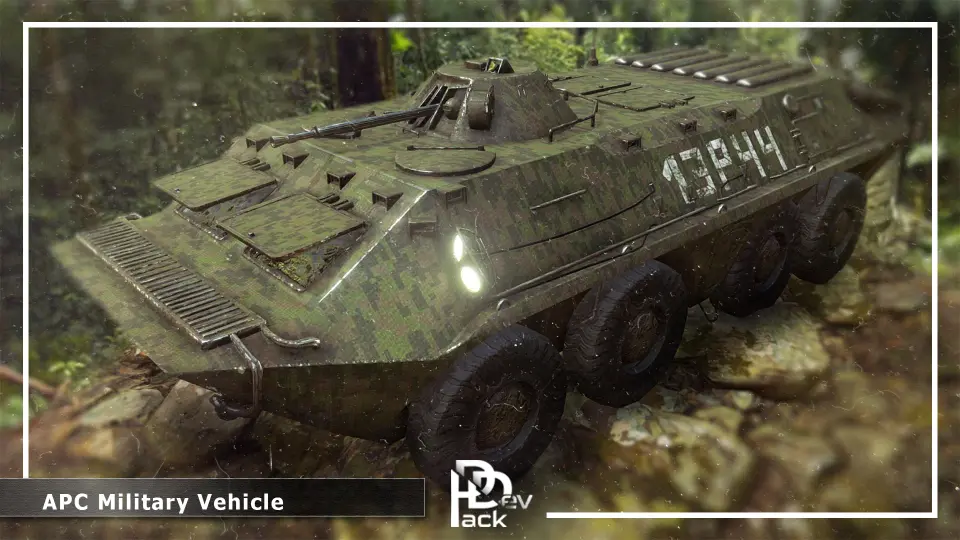
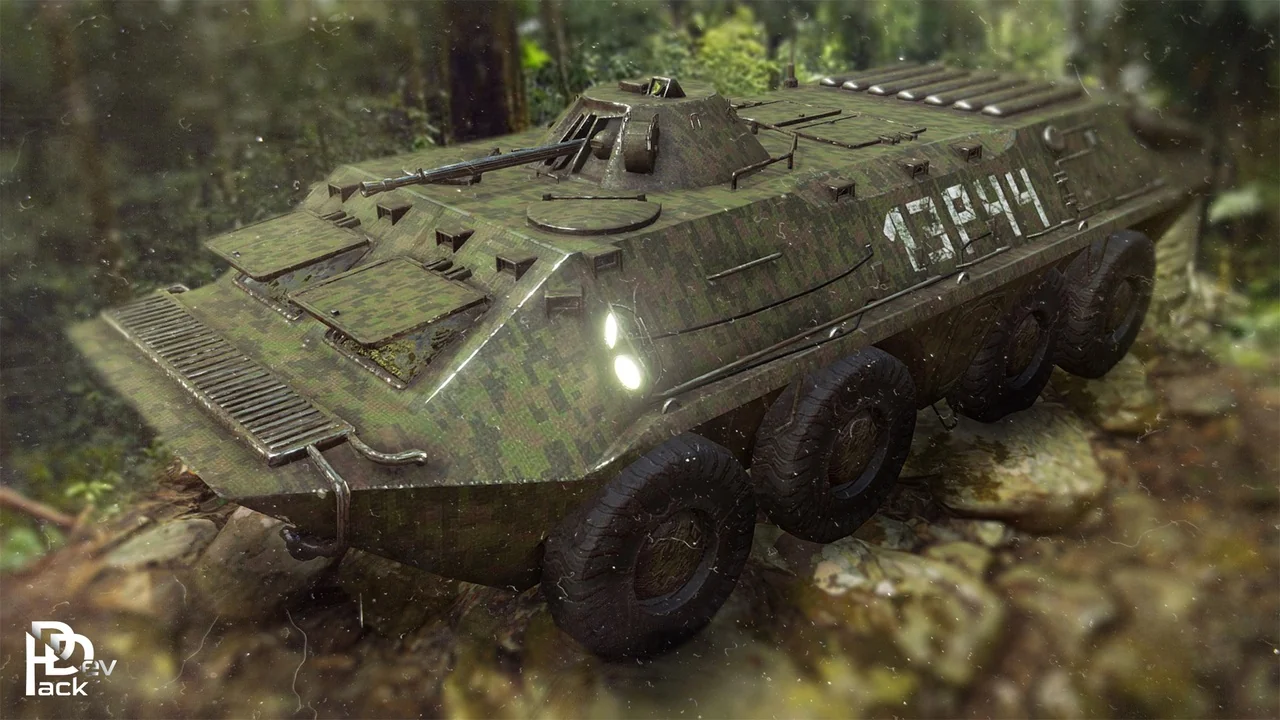
The package provides six distinct variations of the Russian BTR70 armored personnel carrier. Each variation alters the exterior treatment of the hull, turret, and running gear to suit specific operational theaters, environmental conditions, and strategic roles.
The green forest camo variation pairs dark greens and complementary earth tones to conceal the vehicle within temperate woodland zones, dense foliage, and overgrown road networks. When positioned among trees, brush, or forest trails, this camouflage scheme breaks up the boxy silhouette of the armored hull against natural backdrops.
The beige urban camo variation uses disrupted geometric or multi-tonal desert patterns calibrated for shattered concrete, brick dust, and arid urban centers. In street-to-street combat, industrial compounds, or dry settlement perimeters, this finish matches surrounding architectural debris and pale earth.
The solid green finish provides the classic factory and field coat standard for military convoys. This universal livery functions across standard frontline logistics, checkpoint security, supply runs, and mechanized infantry maneuvers through open rural fields.
The solid beige finish strips away pattern disruptions in favor of a single dry-climate tone. It fits arid staging zones, barren desert expanses, sun-bleached outposts, and dust-swept border corridors where complex camouflage patterns offer little advantage over uniform pale coloration.
The solid white finish prepares the armored vehicle for sub-zero operations, tundra crossings, and snowbound battlefields. In winter warfare scenes, standard olive or desert tones stand out sharply against snow drifts; the white material variation preserves concealment across frostbitten terrain.
The solid black finish serves specialized tactical roles, nighttime movement, or low-visibility operations. Black military vehicle surfaces provide dramatic visual contrast under direct spotlights or blend cleanly into shadow-heavy nocturnal ambushes and secure compound perimeters.
Camouflage Schemes and PBR Surface Finishes
Visual fidelity across all six vehicle configurations relies on physically based rendering standards. The package includes twenty textures mapped across fifteen materials and material instances, ensuring surfaces respond accurately to shifting environmental light.
Matte combat paints, metallic armor plating, rubberized wheel treads, and specialized vehicle hardware maintain appropriate roughness and metallic values. The twenty textures supply the necessary albedo, normal, and surface mask detail required to convey hard-surface armor plating without demanding excessive texture memory pools.
The material architecture uses fifteen materials and material instances. This hierarchy allows the single vehicle mesh to swap between forest camouflage, urban camouflage, solid green, solid beige, solid white, and solid black without rebuilding shader networks. Material instances streamline surface changes by referencing shared master properties while pointing to their respective twenty texture maps.
Mesh Efficiency, Blueprints, and Material Hierarchy
Managing system resources during large-scale combat simulations requires tight asset construction. The entire vehicle package operates from a single core mesh. Confining the vehicle geometry to one mesh keeps draw calls minimal, simplifies Level of Detail management, and ensures consistent physical boundaries regardless of the livery applied.
While the visual structure relies on a single mesh, the package supplies ten separate blueprints. These ten blueprints provide ready-to-use configurations within the engine. Developers can drop specific vehicle presets into a level without manually wiring mesh components to material instances. Having ten blueprints gives scene designers immediate access to distinct vehicle setups, operational presets, and scene-ready vehicle actors straight out of the content browser.
Staging Armored Personnel Carriers in Lumen Scenes
Designed to integrate with modern lighting pipelines such as Lumen, the surfaces of the BTR70 respond to real-time global illumination and dynamic bounced light. Lumen calculations register the angles of the sloped armor, cast precise ambient occlusion beneath the eight wheel hubs, and accurately bounce colored light off surrounding terrain onto the vehicle hull.
In woodland battle scenes, indirect green light reflecting off tree canopies washes naturally over the green forest camo hull. In harsh desert environments, high-intensity sunlight bounces upward from sand into the beige undercarriage, producing believable environmental integration without baked lightmaps.
The optimized vehicle mesh and PBR texture maps prevent visual noise or light-leaking artifacts under real-time ray tracing and software Lumen tracking. This reliable illumination response makes the vehicle suitable for dynamic day-night cycles, moving convoy sequences, and interior hangar displays where lighting shifts continuously.
Workflow Integration for Military Vehicle Setups
The Russian BTR70 package serves projects that require authentic military transport hardware across a broad range of operational theaters. Because the six variations cover woodland, urban, desert, snow, night, and standard garrison finishes, background dressing across disparate levels can use the same vehicle asset without visual repetition.
Level designers can populate forward operating bases with solid green supply convoys, arrange abandoned beige urban camo carriers in shattered city squares, and position white winter variants across frozen mountain passes. The ten blueprints allow teams to place these variations rapidly, while the compact footprint of one mesh and twenty textures keeps memory overhead controlled across dense real-time scenes.
 Guns
 Military
 Military
 Vehicles