"7b46a695175d8694"{"id":"1000406","slug":"ucreate-sci-fi-base-outpost","title":"UCreate - Sci fi Base Outpost","category":"Sci-Fi","engine":"5.1+","assetVersion":"","engineVersion":"Engine Version: 5.1+","tag":"Sci-Fi","accent":"blue","visual":"mech","summary":"A detailed breakdown of the UCreate - Sci fi Base Outpost, featuring a 2x2km exoplanetary landscape, optimized modular architecture, and photoscanned rocks.","platform":"Unreal Engine","publishedAt":"2026-07-08T10:11:42.399Z","updatedAt":"2026-07-08T10:11:42.399Z","sourceNotes":[],"fileContents":[],"compatibility":["Unreal Engine","Engine Version: 5.1+"],"featuredImage":{"alt":"UCreate - Sci fi Base Outpost","src":"/wp-content/uploads/published/2026/07/db2c2c32d7d8-587b03c8-5497-4010-8b44-94d7518e65ff-6482b71bde.webp"},"hasDownloadLink":true,"downloads":0,"terms":[{"taxonomy":"category","slug":"sci-fi","name":"Sci-Fi"}],"galleryImages":[{"src":"/wp-content/uploads/published/2026/07/b51d51c057f2-11acb241-39df-4da5-8611-667c8ef42897-a14d7ee600.webp","alt":"UCreate - Sci fi Base Outpost"},{"src":"/wp-content/uploads/published/2026/07/44e02795d1a6-d91792ce-6df4-4d4f-b456-e5e33d2b35d2-994bea60e0.webp","alt":"UCreate - Sci fi Base Outpost"},{"src":"/wp-content/uploads/published/2026/07/7cf3c22b9e9f-6ca11946-99dc-488d-9fbb-a38f19ce819f-6342203399.webp","alt":"UCreate - Sci fi Base Outpost"},{"src":"/wp-content/uploads/published/2026/07/c67031c264bd-3ab9a453-0446-475a-b401-f8f7a199223a-da348020c5.webp","alt":"UCreate - Sci fi Base Outpost"},{"src":"/wp-content/uploads/published/2026/07/795cee3ea6d7-2cb40825-acbf-44ef-9eeb-4b216fc7b8d6-506c98402c.webp","alt":"UCreate - Sci fi Base Outpost"},{"src":"/wp-content/uploads/published/2026/07/fd115f0b17be-dd60c018-0bd2-44ac-923d-918a25d3b217-e85d352c42.webp","alt":"UCreate - Sci fi Base Outpost"},{"src":"/wp-content/uploads/published/2026/07/fc706760af77-cc2e3007-e705-4b79-bd94-24403551beed-17348ca606.webp","alt":"UCreate - Sci fi Base Outpost"},{"src":"/wp-content/uploads/published/2026/07/017da24ce2c1-f430ee4e-b2a6-47c0-b704-4ef8bc8de939-d447a01893.webp","alt":"UCreate - Sci fi Base Outpost"},{"src":"/wp-content/uploads/published/2026/07/ddb89e800e52-d6d63b19-b557-4457-af2b-eb35a612abb2-b037193090.webp","alt":"UCreate - Sci fi Base Outpost"},{"src":"/wp-content/uploads/published/2026/07/200ede37dca4-1196fd42-f6af-47e8-abd8-f79fe6dcf265-b6e8538d85.webp","alt":"UCreate - Sci fi Base Outpost"}],"accessPanel":{"kind":"resource","title":"Download this resource","eyebrow":"Free Download","message":"Log in or create a free account to start your download.","fileName":"Content.7z","safetyNote":"Resources are manually reviewed before listing to improve quality and reduce obvious risks.","actionLabel":"Download Free","resourceType":"Resource archive"},"contentHtml":"\u003cp\u003eConstructing believable, large-scale exoplanetary environments requires balancing expansive visual horizons with up-close texture fidelity and strict rendering budgets. The UCreate - Sci fi Base Outpost addresses these production challenges by providing a massive 2x2km playable landscape integrated with highly optimized modular architecture and unique photogrammetry assets. Rather than relying on generic terrain generation, the environment is built to mimic a harsh, barren alien world, complete with industrial outpost structures and a sprawling cosmos backdrop.\u003c/p\u003e \u003cp\u003eThe foundation of the project rests on its terrain scale and atmospheric framing, utilizing specific structural techniques to push the perceived boundaries of the level far beyond its actual physical limits.\u003c/p\u003e \u003ch2\u003eSimulating Exoplanetary Terrain on a 2x2km Landscape\u003c/h2\u003e \u003cp\u003eThe core playable area consists of a 2x2km landscape, offering a massive footprint for exploration, vehicle traversal, or sprawling futuristic base construction. To ensure the world does not feel artificially enclosed by the limits of the terrain mesh, the environment utilizes three distant mountain meshes placed strategically around the perimeter. These background elements stretch the landscape visually, creating the illusion of a continuous, endless barren planet without the performance overhead of rendering fully detailed, navigable terrain for miles in every direction.\u003c/p\u003e \u003cp\u003eAbove this desolate environment, the sky is defined by a detailed galactic rim and stars panorama. This cosmic backdrop, credited to ESO/S. Brunier under CC attribution, anchors the realistic space setting and complements the harsh planetary surface below.\u003c/p\u003e \u003ch2\u003ePhotoscanned Geological Assets and Procedural Placement\u003c/h2\u003e \u003cp\u003ePopulating a massive 2x2km area by hand is inefficient, so the environment relies on a hybrid approach to asset distribution. The landscape is scattered with geological formations using procedural spawners, which handle the bulk of the environmental dressing. This automated scattering ensures natural, randomized coverage across the barren plains. For areas requiring specific art direction, such as pathways, points of interest, or the immediate surroundings of the base, the rocks are placed manually in key spots to guide player movement and frame the industrial architecture.\u003c/p\u003e \u003cp\u003eThe rocks themselves feature a highly specific visual identity designed to mimic an exoplanetary origin. Instead of standard stone surfaces, these assets are based on photogrammetry of rocks that were physically excavated from clay soil and dried in the sun. This unique physical sourcing gives the meshes a distinct, baked, and weathered appearance. The resulting cracked and dehydrated textures translate perfectly to an alien, dried-up world, providing a level of realistic, rugged detail that standard generic rock scans often lack. When scattered across the vast landscape, these distinctive formations establish a cohesive, harsh planetary ecosystem.\u003c/p\u003e \u003ch2\u003eMaterial Layering and Draw Call Optimization\u003c/h2\u003e \u003cp\u003eManaging performance in a large-scale open environment necessitates strict control over how materials are applied and rendered. Every asset in the pack that requires multiple materials utilizes a dedicated material layers system driven by vertex color masks. Instead of assigning multiple unique material IDs to different parts of a single mesh, this method blends textures within the shader itself based on vertex data.\u003c/p\u003e \u003cp\u003eThis technical approach ensures that the meshes maintain as few material slots as possible. By minimizing the number of material IDs, the system significantly reduces the number of draw calls required by the engine, securing maximum performance even when the screen is filled with dense rock clusters and complex architectural modules.\u003c/p\u003e \u003ch2\u003eTexturing the Modular Outpost Interiors and Exteriors\u003c/h2\u003e \u003cp\u003eThe futuristic outpost structures are built with a modular workflow, relying on highly optimized texture sets to maintain visual consistency while keeping memory footprints low. For the interior spaces of the dome and base modules, the architectural detailing is driven by just two trim sheets. These trim sheets provide all the necessary mechanical panels, structural beams, and technological accents without requiring unique textures for every individual wall or prop. These are coupled with three tileable materials to cover the bulk of the interior surfaces, allowing level designers to construct expansive, varied indoor environments while maintaining a strict, lightweight texture budget.\u003c/p\u003e \u003cp\u003eThe exterior of the outpost modules takes a different approach, tailored to simulate the constant weathering of a barren planet. The outside surfaces use a single base tileable material, but surface complexity is achieved through a multi-layered environmental blending system. A dirt version of the base material is applied using vertex painting, allowing developers to manually brush grime, wear, and tear into specific crevices or high-traffic areas. This manual control is combined with a layer of custom dirt masks and an automatic angle-based dust system. The angle-based logic dynamically applies dust accumulation to upward-facing normals, ensuring that the structures look realistically settled into the dusty, wind-swept landscape regardless of how they are rotated or placed.\u003c/p\u003e \u003ch2\u003eUnreal Engine Lumen and Spline Integration\u003c/h2\u003e \u003cp\u003eAs engine technology has advanced, the project has been updated to support modern lighting and layout tools. With Update 01, the environment fully supports Lumen lighting for Unreal Engine 5.0 and above. This integration allows the realistic textures, angle-based dust, and photoscanned rock formations to react accurately to dynamic global illumination and reflections, enhancing the stark, industrial atmosphere of the alien base.\u003c/p\u003e \u003cp\u003eUpdate 02 builds on this compatibility, ensuring that Spline Blueprints function smoothly with Unreal Engine 5.5. This allows developers to smoothly integrate spline-based tools for tasks like road generation, cable routing, or pipe placement across the sprawling 2x2km terrain.\u003c/p\u003e \u003cp\u003eThe UCreate - Sci fi Base Outpost fits seamlessly into productions requiring a highly optimized, realistic alien environment. By combining a sprawling procedural landscape with strict draw-call management and modular architecture, it provides a performant foundation for building expansive futuristic facilities on desolate, exoplanetary worlds.\u003c/p\u003e\n\n\u003ch2\u003eMore From The Same Workflow\u003c/h2\u003e\n\u003cul\u003e\n\u003cli\u003e\u003ca href=\"https://3dcghub.com/modular-sci-fi-base-indoor-outdoor-moon-theme/\" title=\"Modular Sci-Fi Base - Indoor Outdoor - Moon Theme\"\u003eModular Sci-Fi Base - Indoor Outdoor - Moon Theme\u003c/a\u003e\u003c/li\u003e\n\u003cli\u003e\u003ca href=\"https://3dcghub.com/survivor-girl-3-modular/\" title=\"Survivor Girl 3 (Modular)\"\u003eSurvivor Girl 3 (Modular)\u003c/a\u003e\u003c/li\u003e\n\u003cli\u003e\u003ca href=\"https://3dcghub.com/sci-fi-skyscrapers-buildings/\" title=\"Sci-Fi Skyscrapers Buildings\"\u003eSci-Fi Skyscrapers Buildings\u003c/a\u003e\u003c/li\u003e\n\u003cli\u003e\u003ca href=\"https://3dcghub.com/sci-fi-kitchen/\" title=\"Sci-Fi Kitchen\"\u003eSci-Fi Kitchen\u003c/a\u003e\u003c/li\u003e\n\u003cli\u003e\u003ca href=\"https://3dcghub.com/scifi-environment-offworld/\" title=\"SciFi Environment — \u0026#039;Offworld\u0026#039;\"\u003eSciFi Environment — \u0026#039;Offworld\u0026#039;\u003c/a\u003e\u003c/li\u003e\n\u003c/ul\u003e","contentTextLength":6586,"navigation":{"current":1215,"total":3481,"previous":{"id":"1000407","slug":"ultimate-archvis-kit","title":"Ultimate Archvis Kit","category":"Procedural Systems","platform":"Unreal Engine","updatedAt":"2026-07-08T11:46:44.936Z"},"next":{"id":"1000405","slug":"the-sabertooth","title":"The Sabertooth","category":"Characters \u0026 Creatures","platform":"Unreal Engine","updatedAt":"2026-07-08T08:32:48.014Z"}},"relatedResources":[{"id":"1001415","slug":"modular-sci-fi-base-indoor","title":"Modular Sci-Fi Base - Indoor","category":"Sci-Fi","engine":"5.0+","assetVersion":"","engineVersion":"Engine Version: 5.0+","tag":"Sci-Fi","accent":"blue","visual":"mech","summary":"Modular Sci-Fi Base - Indoor provides high-poly modular kitbash meshes, three-layer intelligent materials, 24 HDRIs, and UE5 Nanite and Lumen support.","platform":"Unreal Engine","publishedAt":"2026-10-05T06:56:56.578Z","updatedAt":"2026-10-05T06:56:56.578Z","sourceNotes":[],"fileContents":[],"compatibility":["Unreal Engine","Engine Version: 5.0+"],"featuredImage":{"alt":"Modular Sci-Fi Base - Indoor","src":"/wp-content/uploads/published/2026/10/f858274712b8-26646d9f-3d84-496a-abdb-954b1dabb97b-885f941928.webp"},"hasDownloadLink":true,"downloads":2},{"id":"1001538","slug":"modular-sci-fi-factory","title":"Modular Sci-Fi Factory","category":"Sci-Fi","engine":"5.4+","assetVersion":"","engineVersion":"Engine Version: 5.4+","tag":"Sci-Fi","accent":"blue","visual":"mech","summary":"Modular Sci-Fi Factory offers modular corridors, Nanite-ready structural assets, dynamic lighting blueprints, interactive doors, and streaming support.","platform":"Unreal Engine","publishedAt":"2026-10-09T17:31:14.791Z","updatedAt":"2026-10-09T17:31:14.791Z","sourceNotes":[],"fileContents":[],"compatibility":["Unreal Engine","Engine Version: 5.4+"],"featuredImage":{"alt":"Modular Sci-Fi Factory","src":"/wp-content/uploads/published/2026/10/71752fcf4ff9-328cf72a-860c-433d-8e09-20697f6e3ad5-c2124fab5f.webp"},"hasDownloadLink":true,"downloads":0},{"id":"1001456","slug":"showroom-level-kit-8","title":"Showroom Level Kit 8","category":"Sci-Fi","engine":"5.2+","assetVersion":"","engineVersion":"Engine Version: 5.2+","tag":"Sci-Fi","accent":"blue","visual":"mech","summary":"Build atmospheric sci-fi museums, product galleries, and research facilities with Showroom Level Kit 8, optimized for Unreal 5.2+, VR, and mobile.","platform":"Unreal Engine","publishedAt":"2026-10-08T00:58:31.083Z","updatedAt":"2026-10-08T00:58:31.083Z","sourceNotes":[],"fileContents":[],"compatibility":["Unreal Engine","Engine Version: 5.2+"],"featuredImage":{"alt":"Showroom Level Kit 8","src":"/wp-content/uploads/published/2026/10/febcd1ec3cd7-abada3a9-4474-4093-b2a5-794af68e84b5-054286aab9.webp"},"hasDownloadLink":true,"downloads":0}]}
Sci-Fi
UCreate - Sci fi Base Outpost
A detailed breakdown of the UCreate - Sci fi Base Outpost, featuring a 2x2km exoplanetary landscape, optimized modular architecture, and photoscanned rocks.
Constructing believable, large-scale exoplanetary environments requires balancing expansive visual horizons with up-close texture fidelity and strict rendering budgets. The UCreate - Sci fi Base Outpost addresses these production challenges by providing a massive 2x2km playable landscape integrated with highly optimized modular architecture and unique photogrammetry assets. Rather than relying on generic terrain generation, the environment is built to mimic a harsh, barren alien world, complete with industrial outpost structures and a sprawling cosmos backdrop.
The foundation of the project rests on its terrain scale and atmospheric framing, utilizing specific structural techniques to push the perceived boundaries of the level far beyond its actual physical limits.
Simulating Exoplanetary Terrain on a 2x2km Landscape
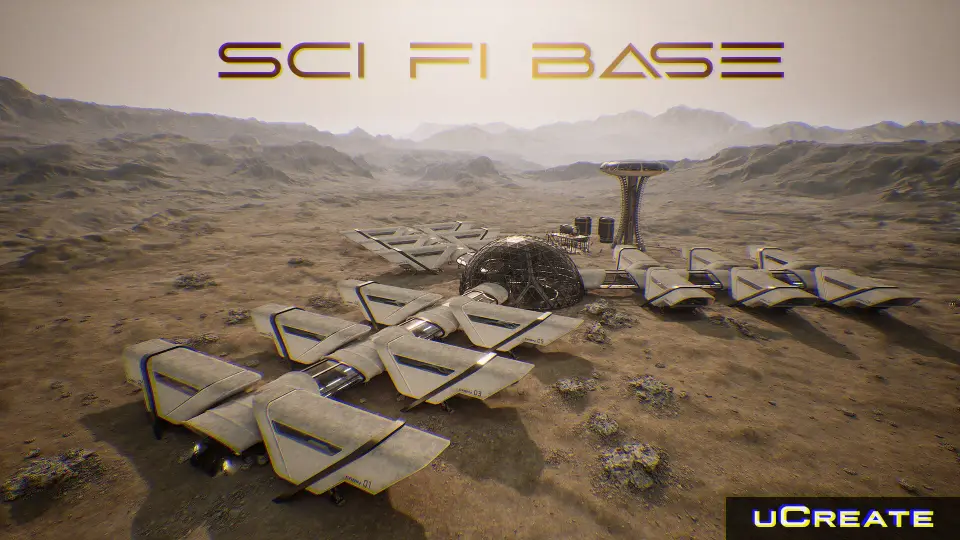
The core playable area consists of a 2x2km landscape, offering a massive footprint for exploration, vehicle traversal, or sprawling futuristic base construction. To ensure the world does not feel artificially enclosed by the limits of the terrain mesh, the environment utilizes three distant mountain meshes placed strategically around the perimeter. These background elements stretch the landscape visually, creating the illusion of a continuous, endless barren planet without the performance overhead of rendering fully detailed, navigable terrain for miles in every direction.
Above this desolate environment, the sky is defined by a detailed galactic rim and stars panorama. This cosmic backdrop, credited to ESO/S. Brunier under CC attribution, anchors the realistic space setting and complements the harsh planetary surface below.
Photoscanned Geological Assets and Procedural Placement
Populating a massive 2x2km area by hand is inefficient, so the environment relies on a hybrid approach to asset distribution. The landscape is scattered with geological formations using procedural spawners, which handle the bulk of the environmental dressing. This automated scattering ensures natural, randomized coverage across the barren plains. For areas requiring specific art direction, such as pathways, points of interest, or the immediate surroundings of the base, the rocks are placed manually in key spots to guide player movement and frame the industrial architecture.
The rocks themselves feature a highly specific visual identity designed to mimic an exoplanetary origin. Instead of standard stone surfaces, these assets are based on photogrammetry of rocks that were physically excavated from clay soil and dried in the sun. This unique physical sourcing gives the meshes a distinct, baked, and weathered appearance. The resulting cracked and dehydrated textures translate perfectly to an alien, dried-up world, providing a level of realistic, rugged detail that standard generic rock scans often lack. When scattered across the vast landscape, these distinctive formations establish a cohesive, harsh planetary ecosystem.
Material Layering and Draw Call Optimization
Managing performance in a large-scale open environment necessitates strict control over how materials are applied and rendered. Every asset in the pack that requires multiple materials utilizes a dedicated material layers system driven by vertex color masks. Instead of assigning multiple unique material IDs to different parts of a single mesh, this method blends textures within the shader itself based on vertex data.
This technical approach ensures that the meshes maintain as few material slots as possible. By minimizing the number of material IDs, the system significantly reduces the number of draw calls required by the engine, securing maximum performance even when the screen is filled with dense rock clusters and complex architectural modules.
Texturing the Modular Outpost Interiors and Exteriors
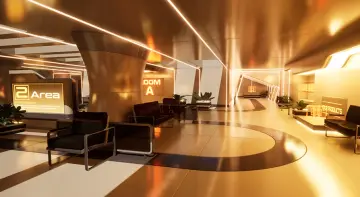
The futuristic outpost structures are built with a modular workflow, relying on highly optimized texture sets to maintain visual consistency while keeping memory footprints low. For the interior spaces of the dome and base modules, the architectural detailing is driven by just two trim sheets. These trim sheets provide all the necessary mechanical panels, structural beams, and technological accents without requiring unique textures for every individual wall or prop. These are coupled with three tileable materials to cover the bulk of the interior surfaces, allowing level designers to construct expansive, varied indoor environments while maintaining a strict, lightweight texture budget.
The exterior of the outpost modules takes a different approach, tailored to simulate the constant weathering of a barren planet. The outside surfaces use a single base tileable material, but surface complexity is achieved through a multi-layered environmental blending system. A dirt version of the base material is applied using vertex painting, allowing developers to manually brush grime, wear, and tear into specific crevices or high-traffic areas. This manual control is combined with a layer of custom dirt masks and an automatic angle-based dust system. The angle-based logic dynamically applies dust accumulation to upward-facing normals, ensuring that the structures look realistically settled into the dusty, wind-swept landscape regardless of how they are rotated or placed.
Unreal Engine Lumen and Spline Integration
As engine technology has advanced, the project has been updated to support modern lighting and layout tools. With Update 01, the environment fully supports Lumen lighting for Unreal Engine 5.0 and above. This integration allows the realistic textures, angle-based dust, and photoscanned rock formations to react accurately to dynamic global illumination and reflections, enhancing the stark, industrial atmosphere of the alien base.
Update 02 builds on this compatibility, ensuring that Spline Blueprints function smoothly with Unreal Engine 5.5. This allows developers to smoothly integrate spline-based tools for tasks like road generation, cable routing, or pipe placement across the sprawling 2x2km terrain.
The UCreate - Sci fi Base Outpost fits seamlessly into productions requiring a highly optimized, realistic alien environment. By combining a sprawling procedural landscape with strict draw-call management and modular architecture, it provides a performant foundation for building expansive futuristic facilities on desolate, exoplanetary worlds.
 Sci-Fi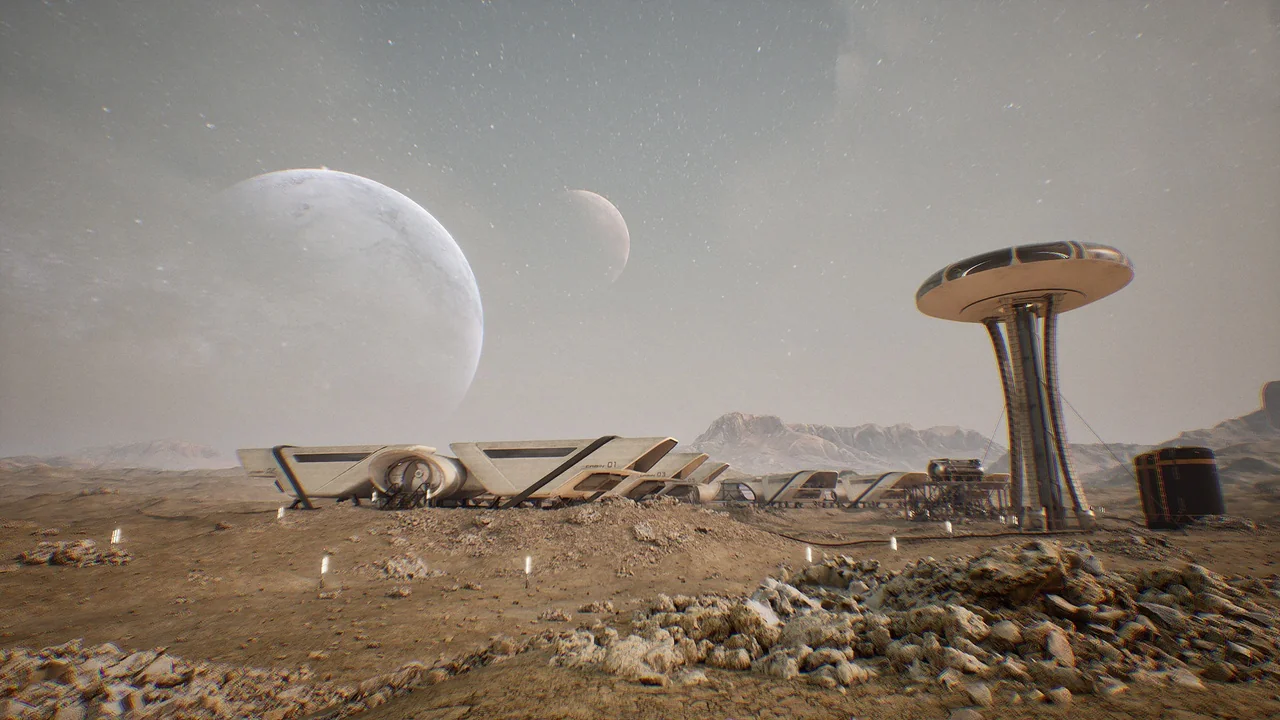
 Sci-Fi
 Sci-Fi
 Sci-Fi