"b00678cacce53329"{"id":"1002845","slug":"sword-auras","title":"Sword Auras","category":"Spells \u0026 Combat","engine":"4.26+,5.0+","assetVersion":"","engineVersion":"Engine Version: 4.26+,5.0+","tag":"Spells \u0026 Combat","accent":"blue","visual":"mech","summary":"Explore Sword Auras, a Niagara VFX package featuring 18 particle effects, customizable colors, weapon auras, and hit impacts for combat games.","platform":"Unreal Engine","indexPolicy":"index","publishedAt":"2026-11-20T12:27:45.695Z","updatedAt":"2026-11-20T12:27:45.695Z","sourceNotes":[],"fileContents":[],"compatibility":["Unreal Engine","Engine Version: 4.26+,5.0+"],"featuredImage":{"alt":"Sword Auras","src":"/wp-content/uploads/published/2026/11/7355eeddb105-ebce4e47-be30-4870-8b11-a66c2c15c0a4-6f5ce676d5.webp"},"fileSizeBytes":24024741,"hasDownloadLink":true,"downloads":0,"terms":[{"taxonomy":"category","slug":"spells-and-combat","name":"Spells \u0026 Combat"}],"galleryImages":[{"src":"/wp-content/uploads/published/2026/11/112a52a687de-f94075ce-6f15-4e12-a1f0-c84515110fd3-b21d02cca3.webp","alt":"Sword Auras"},{"src":"/wp-content/uploads/published/2026/11/86b13531924c-a9ad2c03-8f7c-4963-b5a3-f2ea318ef3c8-177e1f6ce8.webp","alt":"Sword Auras"},{"src":"/wp-content/uploads/published/2026/11/91edf6d24607-662d3cb5-d213-4289-b6b9-e2562480d2c0-54f25760f8.webp","alt":"Sword Auras"},{"src":"/wp-content/uploads/published/2026/11/11bc54273792-39388c28-3b53-4ed1-85c7-e81bc176ce81-124aaa4c80.webp","alt":"Sword Auras"},{"src":"/wp-content/uploads/published/2026/11/03008803ce41-e70dd2c6-23a8-4d85-b163-ce39ce5dca00-d43b87d182.webp","alt":"Sword Auras"},{"src":"/wp-content/uploads/published/2026/11/b0430904aa7b-5a1ed530-2521-48fa-a841-327b2661e5d7-2e02b96c35.webp","alt":"Sword Auras"},{"src":"/wp-content/uploads/published/2026/11/905307eb484c-39ac80a4-29da-4d2b-a1a5-20c86f83eebf-6916c6f27b.webp","alt":"Sword Auras"},{"src":"/wp-content/uploads/published/2026/11/de4fd2753c69-00ff6bc0-1227-4a0d-b184-69a77fd39b01-f8ef598cad.webp","alt":"Sword Auras"},{"src":"/wp-content/uploads/published/2026/11/b60215788bdc-65ab8eb5-d1b3-4d7a-9a6c-548e5b738aab-c1dd3612ef.webp","alt":"Sword Auras"},{"src":"/wp-content/uploads/published/2026/11/8ed601f36769-f7cfe4ab-d252-47d0-9d40-fd570c5e6f7c-ead27f3bb5.webp","alt":"Sword Auras"}],"accessPanel":{"kind":"resource","title":"Get this resource","safetyNote":"Resources are manually reviewed before listing to improve quality and reduce obvious risks.","fileName":"Content.7z","resourceType":"Resource archive","versions":[]},"contentHtml":"\u003ch2\u003eContextualizing Sword Auras in Action Combat\u003c/h2\u003e\u003cp\u003eMelee encounters in modern game design depend heavily on immediate, readable visual feedback. In action role-playing games, brawlers, and character-driven fantasy titles, a bladed weapon often needs to communicate more than just physical weight; it must signal active states, magical augmentations, and skill charges. The Sword Auras package targets this exact layer of production, supplying Niagara-based particle systems tailored specifically for swords and bladed weaponry. By establishing a luminous presence around the edge, spine, and tip of a weapon, these effects provide players with an unambiguous indication of augmented strength, elemental affinity, or pending special abilities.\u003c/p\u003e\u003cp\u003eThe package contains 18 total visual effects, which are shaped by 15 unique effect architectures. Within this roster, the visual workload is divided into 10 persistent sword auras and 8 responsive hit visual effects. This division between persistent and momentary phenomena addresses the full arc of a melee swing. An aura establishes anticipation as the weapon idles or cuts through the air, while the hit effect delivers the tactile resolution upon contact. Having both components inside a single collection enables a synchronized visual style where the ambient glow of the blade feels directly tied to the bursts of energy released on impact.\u003c/p\u003e\u003ch2\u003ePairing Sword Aura States with Impact Responses\u003c/h2\u003e\u003cp\u003eA persistent aura alone only solves half of the combat equation. If a sword bathed in magical energy strikes an enemy with only an unadorned physical sound or generic blood burst, the illusion of weapon empowerment breaks. The inclusion of 8 dedicated hit VFX ensures that combat designers can close this feedback loop immediately. When the blade reaches the peak of an attack arc and intersects with a target mesh, triggering a matching hit effect sells the transfer of kinetic and magical force.\u003c/p\u003e\u003cp\u003eThese hit effects act as localized bursts that can be aligned precisely at the point of contact. Because combat involves varying speeds—ranging from quick light strikes to heavy, wind-up swings—the balance between 10 continuous aura types and 8 hit responses allows designers to mix and match. A subtle, low-intensity sword aura can culminate in a sharp, compact hit burst, while a dense, high-energy aura can release an expansive shock of particles. This structural flexibility lets developers construct layered combat trees where basic attacks, secondary skills, and ultimate strikes each possess distinct visual weight without needing to design entirely new particle emitters from scratch.\u003c/p\u003e\u003ch2\u003eColor Customization Across Stylized and Realistic Worlds\u003c/h2\u003e\u003cp\u003eVisual style in game projects rarely adheres to a single static palette. A skill system might demand that a single sword technique evolves through ice, fire, lightning, or corrupt magic variants as a character progresses through an ability tree. Sword Auras incorporates customizable colors directly into its Niagara systems, giving artists and technical developers the ability to alter the chromatic profile of every effect in the collection.\u003c/p\u003e\u003cp\u003eAdjusting the color values allows the same fundamental Niagara architecture to fulfill diverse environmental and thematic requirements. A fiery orange tint can turn a continuous blade aura into an ignition enchantment suited for a barbarian archetype. Shifting that same effect into icy blues or pale cyans adapts it instantly for a frost-bound warrior or a precision duelist. Deep purples, crimsons, and sickly greens map naturally to necrotic, vampiric, or poison skills. Because the pack spans tags including fantasy, stylized, and realistic aesthetics, the underlying particle density and movement patterns retain their integrity whether pushed toward hyper-saturated arcade visuals or grounded, low-saturation medieval fantasy encounters.\u003c/p\u003e\u003ch2\u003eNiagara Systems Architecture and Practical Pipeline Setup\u003c/h2\u003e\u003cp\u003eBuilt completely as native Niagara Systems, the package is structured to integrate with standard character and weapon pipelines. Niagara offers real-time control over emitter parameters, particle lifetimes, velocity curves, and dynamic material bindings. This computational model ensures that the particles cling effectively to weapon geometry, flow along defined sockets, or drift naturally into trailing ribbons during aggressive animation swings.\u003c/p\u003e\u003cp\u003eImplementation is backed by an included guide and preview video demonstrations, which assist developers in understanding how the systems are organized and how to bind them to skeletal mesh sockets or animation notifies. When configuring an attack sequence in an animation montage, notifies can toggle the sword aura active state at the start of an attack frame and shut it off during recovery, while an additional notify or collision trace spawns the corresponding hit VFX at the exact hit location. While preview footage illustrates the package using established hero figures like Paragon's Kwang and Countess, those character assets are completely separate entities and are not included in the pack. The focus remains squarely on the modular Niagara particle systems, allowing developers to apply the effects to any custom sword, dagger, or weapon rig within their own pipelines.\u003c/p\u003e\u003ch2\u003eProject Scope and Creative Implementation\u003c/h2\u003e\u003cp\u003eSword Auras forms part of the broader Fateloom All-in-One VFX Essentials series, reflecting a focus on modular utility for game production. Projects developing skill trees, arena combat, boss encounter telegraphing, or dynamic weapon infusion mechanics can draw directly on the 10 aura variants and 8 impact variations to populate entire combat kits. Independent developers, VFX artists needing functional baselines, and gameplay programmers prototyping high-impact action mechanics benefit from having clean, production-ready particle frameworks that require no foundational particle building before playtesting can begin.\u003c/p\u003e\n\n\u003ch2\u003eContinue Browsing Similar Packs\u003c/h2\u003e\n\u003cul\u003e\n\u003cli\u003e\u003ca href=\"https://3dcghub.com/stylized-swordslinger-skill-set-niagara-vfx/\" rel=\"noopener noreferrer\"\u003eStylized Swordslinger Skill Set (Niagara Vfx)\u003c/a\u003e\u003c/li\u003e\n\u003cli\u003e\u003ca href=\"https://3dcghub.com/niagara-aura-pack/\" rel=\"noopener noreferrer\"\u003eNiagara Aura Pack\u003c/a\u003e\u003c/li\u003e\n\u003cli\u003e\u003ca href=\"https://3dcghub.com/m5-vfx-rpg1-sword-trails-niagara/\" rel=\"noopener noreferrer\"\u003eM5 VFX RPG1. Sword Trails(Niagara)\u003c/a\u003e\u003c/li\u003e\n\u003cli\u003e\u003ca href=\"https://3dcghub.com/advanced-magic-fx-10/\" rel=\"noopener noreferrer\"\u003eAdvanced Magic FX 10\u003c/a\u003e\u003c/li\u003e\n\u003cli\u003e\u003ca href=\"https://3dcghub.com/magic-aura-vfx/\" rel=\"noopener noreferrer\"\u003eMagic Aura VFX\u003c/a\u003e\u003c/li\u003e\n\u003c/ul\u003e","contentTextLength":6089,"navigation":{"current":35,"total":4797,"previous":{"id":"1002846","slug":"sword-fx","title":"Sword FX","category":"Spells \u0026 Combat","platform":"Unreal Engine","updatedAt":"2026-11-20T12:28:33.502Z"},"next":{"id":"1002844","slug":"super-powers","title":"Super Powers","category":"Gameplay Features","platform":"Unreal Engine","updatedAt":"2026-11-20T12:25:43.122Z"}},"relatedResources":[{"id":"1000893","slug":"stylized-swordslinger-skill-set-niagara-vfx","title":"Stylized Swordslinger Skill Set (Niagara Vfx)","category":"Spells \u0026 Combat","engine":"4.26+,5.0+","assetVersion":"","engineVersion":"Engine Version: 4.26+,5.0+","tag":"Spells \u0026 Combat","accent":"blue","visual":"mech","summary":"A Niagara VFX pack with 20 total effects for stylized sword combat: low and high level attacks, buffs, auras, hits, and trails. Built for anime-inspired swordsl","platform":"Unreal Engine","indexPolicy":"index","publishedAt":"2026-08-06T04:40:43.645Z","updatedAt":"2026-08-06T04:40:43.645Z","sourceNotes":[],"fileContents":[],"compatibility":["Unreal Engine","Engine Version: 4.26+,5.0+"],"featuredImage":{"alt":"Stylized Swordslinger Skill Set (Niagara Vfx)","src":"/wp-content/uploads/published/2026/08/2d97056246fe-6f85de2b-2b7d-4a74-b031-2e2c06d9adae-ee9baed368.webp"},"fileSizeBytes":21764395,"hasDownloadLink":true,"downloads":16},{"id":"1002846","slug":"sword-fx","title":"Sword FX","category":"Spells \u0026 Combat","engine":"4.26+,5.0+","assetVersion":"","engineVersion":"Engine Version: 4.26+,5.0+","tag":"Spells \u0026 Combat","accent":"blue","visual":"mech","summary":"A technical breakdown of Sword FX for Unreal Engine 4, detailing its Niagara particle systems, material-to-texture balance, and UE4 beta API considerations.","platform":"Unreal Engine","indexPolicy":"index","publishedAt":"2026-11-20T12:28:33.502Z","updatedAt":"2026-11-20T12:28:33.502Z","sourceNotes":[],"fileContents":[],"compatibility":["Unreal Engine","Engine Version: 4.26+,5.0+"],"featuredImage":{"alt":"Sword FX","src":"/wp-content/uploads/published/2026/11/f95ba3a1b099-b4cae4cf-5b4d-4506-90a9-e881af05b257-989139e5fc.webp"},"fileSizeBytes":25990406,"hasDownloadLink":true,"downloads":0},{"id":"1002815","slug":"niagara-aura-pack","title":"Niagara Aura Pack","category":"Spells \u0026 Combat","engine":"4.25+,5.0+","assetVersion":"","engineVersion":"Engine Version: 4.25+,5.0+","tag":"Spells \u0026 Combat","accent":"blue","visual":"mech","summary":"Explore the Niagara Aura Pack, featuring 12 stylized 3D magic auras with start, center, and end phases managed through a ready-made duration blueprint.","platform":"Unreal Engine","indexPolicy":"index","publishedAt":"2026-11-20T07:50:08.010Z","updatedAt":"2026-11-20T07:50:08.010Z","sourceNotes":[],"fileContents":[],"compatibility":["Unreal Engine","Engine Version: 4.25+,5.0+"],"featuredImage":{"alt":"Niagara Aura Pack","src":"/wp-content/uploads/published/2026/11/f2d1486878b7-fa032a8e-0e43-4ad9-bc69-3eaaf4877031-827f178a14.webp"},"fileSizeBytes":8502458,"hasDownloadLink":true,"downloads":0}]}
Resource screenshots
1 / 10
Join our channel
Follow 3DCGHUB on Telegram for new resource drops, migration updates, and community notices.
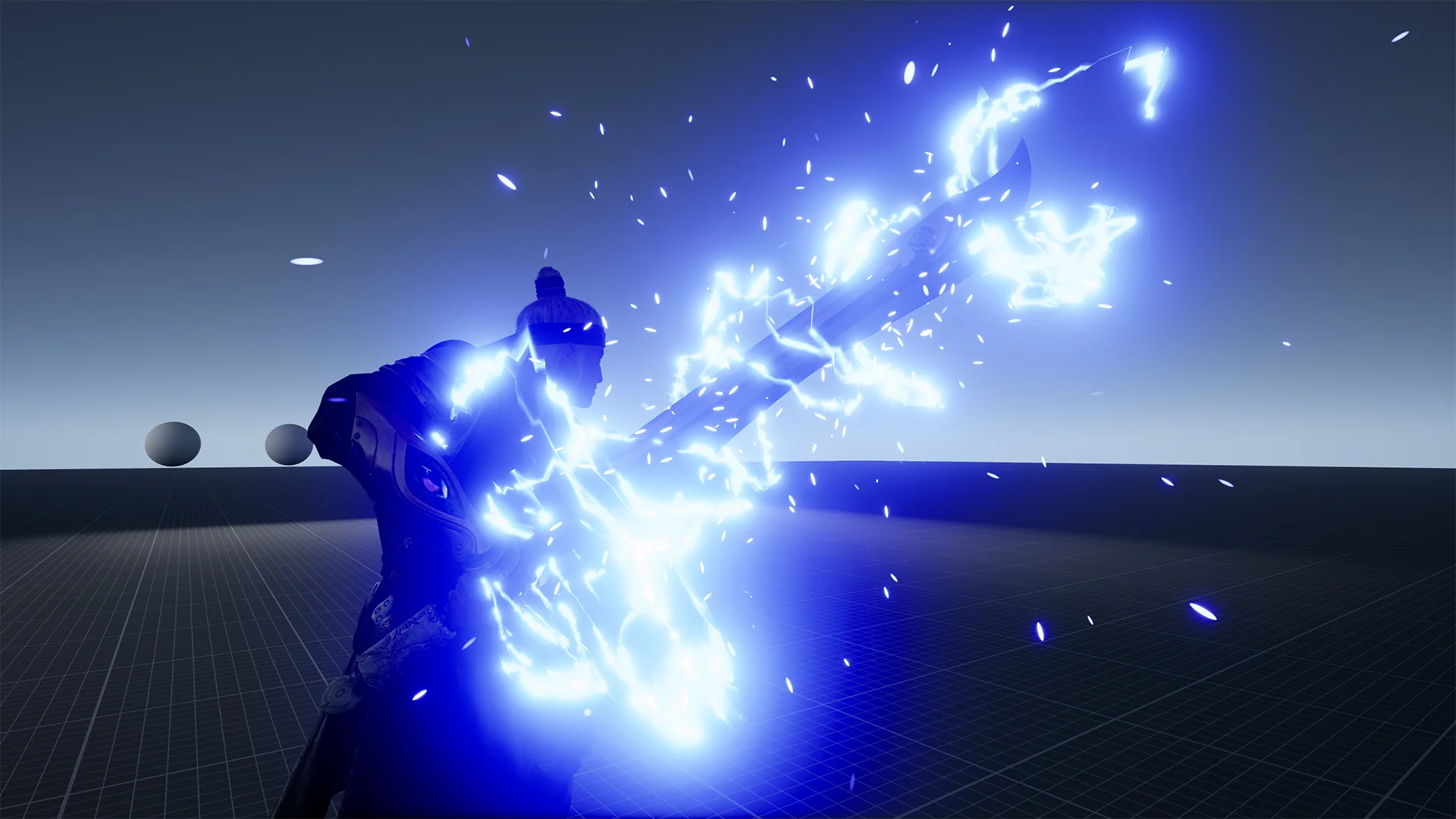
Melee encounters in modern game design depend heavily on immediate, readable visual feedback. In action role-playing games, brawlers, and character-driven fantasy titles, a bladed weapon often needs to communicate more than just physical weight; it must signal active states, magical augmentations, and skill charges. The Sword Auras package targets this exact layer of production, supplying Niagara-based particle systems tailored specifically for swords and bladed weaponry. By establishing a luminous presence around the edge, spine, and tip of a weapon, these effects provide players with an unambiguous indication of augmented strength, elemental affinity, or pending special abilities.
The package contains 18 total visual effects, which are shaped by 15 unique effect architectures. Within this roster, the visual workload is divided into 10 persistent sword auras and 8 responsive hit visual effects. This division between persistent and momentary phenomena addresses the full arc of a melee swing. An aura establishes anticipation as the weapon idles or cuts through the air, while the hit effect delivers the tactile resolution upon contact. Having both components inside a single collection enables a synchronized visual style where the ambient glow of the blade feels directly tied to the bursts of energy released on impact.
Pairing Sword Aura States with Impact Responses
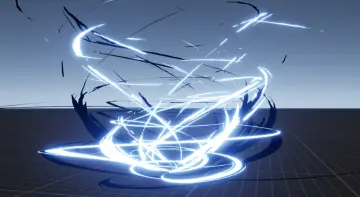
A persistent aura alone only solves half of the combat equation. If a sword bathed in magical energy strikes an enemy with only an unadorned physical sound or generic blood burst, the illusion of weapon empowerment breaks. The inclusion of 8 dedicated hit VFX ensures that combat designers can close this feedback loop immediately. When the blade reaches the peak of an attack arc and intersects with a target mesh, triggering a matching hit effect sells the transfer of kinetic and magical force.
These hit effects act as localized bursts that can be aligned precisely at the point of contact. Because combat involves varying speeds—ranging from quick light strikes to heavy, wind-up swings—the balance between 10 continuous aura types and 8 hit responses allows designers to mix and match. A subtle, low-intensity sword aura can culminate in a sharp, compact hit burst, while a dense, high-energy aura can release an expansive shock of particles. This structural flexibility lets developers construct layered combat trees where basic attacks, secondary skills, and ultimate strikes each possess distinct visual weight without needing to design entirely new particle emitters from scratch.
Color Customization Across Stylized and Realistic Worlds
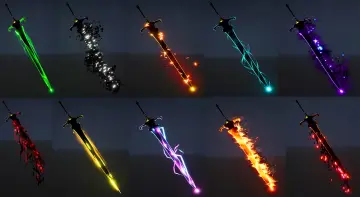
Visual style in game projects rarely adheres to a single static palette. A skill system might demand that a single sword technique evolves through ice, fire, lightning, or corrupt magic variants as a character progresses through an ability tree. Sword Auras incorporates customizable colors directly into its Niagara systems, giving artists and technical developers the ability to alter the chromatic profile of every effect in the collection.
Adjusting the color values allows the same fundamental Niagara architecture to fulfill diverse environmental and thematic requirements. A fiery orange tint can turn a continuous blade aura into an ignition enchantment suited for a barbarian archetype. Shifting that same effect into icy blues or pale cyans adapts it instantly for a frost-bound warrior or a precision duelist. Deep purples, crimsons, and sickly greens map naturally to necrotic, vampiric, or poison skills. Because the pack spans tags including fantasy, stylized, and realistic aesthetics, the underlying particle density and movement patterns retain their integrity whether pushed toward hyper-saturated arcade visuals or grounded, low-saturation medieval fantasy encounters.
Niagara Systems Architecture and Practical Pipeline Setup
Built completely as native Niagara Systems, the package is structured to integrate with standard character and weapon pipelines. Niagara offers real-time control over emitter parameters, particle lifetimes, velocity curves, and dynamic material bindings. This computational model ensures that the particles cling effectively to weapon geometry, flow along defined sockets, or drift naturally into trailing ribbons during aggressive animation swings.
Implementation is backed by an included guide and preview video demonstrations, which assist developers in understanding how the systems are organized and how to bind them to skeletal mesh sockets or animation notifies. When configuring an attack sequence in an animation montage, notifies can toggle the sword aura active state at the start of an attack frame and shut it off during recovery, while an additional notify or collision trace spawns the corresponding hit VFX at the exact hit location. While preview footage illustrates the package using established hero figures like Paragon's Kwang and Countess, those character assets are completely separate entities and are not included in the pack. The focus remains squarely on the modular Niagara particle systems, allowing developers to apply the effects to any custom sword, dagger, or weapon rig within their own pipelines.
Project Scope and Creative Implementation
Sword Auras forms part of the broader Fateloom All-in-One VFX Essentials series, reflecting a focus on modular utility for game production. Projects developing skill trees, arena combat, boss encounter telegraphing, or dynamic weapon infusion mechanics can draw directly on the 10 aura variants and 8 impact variations to populate entire combat kits. Independent developers, VFX artists needing functional baselines, and gameplay programmers prototyping high-impact action mechanics benefit from having clean, production-ready particle frameworks that require no foundational particle building before playtesting can begin.
 Spells & Combat
 Spells & Combat
 Spells & Combat