"efaa631e936fd3ee"{"id":"1002221","slug":"stylized-ruins","title":"Stylized Ruins","category":"Fantasy","engine":"4.25+,5.0+","assetVersion":"","engineVersion":"Engine Version: 4.25+,5.0+","tag":"Fantasy","accent":"blue","visual":"mech","summary":"Examine Stylized Ruins, a 37-model asset set featuring PBR shading, damaged fantasy architectural elements, and a ready-to-load desert ruins level.","platform":"Unreal Engine","publishedAt":"2026-10-29T15:20:38.841Z","updatedAt":"2026-10-29T15:20:38.841Z","sourceNotes":[],"fileContents":[],"compatibility":["Unreal Engine","Engine Version: 4.25+,5.0+"],"featuredImage":{"alt":"Stylized Ruins","src":"/wp-content/uploads/published/2026/10/0b10438b6604-58f29b0e-79a8-4e8d-8d9a-cf2979aa71d9-25c471ccd4.webp"},"hasDownloadLink":true,"downloads":0,"terms":[{"taxonomy":"category","slug":"fantasy","name":"Fantasy"}],"galleryImages":[{"src":"/wp-content/uploads/published/2026/10/5bf3d9fca0e6-4f252dde-3571-442e-8762-21f56a05c88d-6f96216b55.webp","alt":"Stylized Ruins"},{"src":"/wp-content/uploads/published/2026/10/8172e552ce25-84ce3e8f-f479-4150-860c-08cc932818b7-ea05e52c42.webp","alt":"Stylized Ruins"},{"src":"/wp-content/uploads/published/2026/10/ed07bf7f024e-83402b70-db9d-4a0c-aad7-558e8e8ce45b-26eec0dd10.webp","alt":"Stylized Ruins"},{"src":"/wp-content/uploads/published/2026/10/7639a98ebed8-12a931dd-4c10-481f-a927-8b5fe74b899e-47e5f5d42c.webp","alt":"Stylized Ruins"},{"src":"/wp-content/uploads/published/2026/10/24be1da2eab9-0ce44d37-458e-49f3-837d-27c07d32e8b7-bd497ae98f.webp","alt":"Stylized Ruins"},{"src":"/wp-content/uploads/published/2026/10/8b15da3c66b0-9508809e-9390-4c9a-9e3c-ba28ed47db1a-e8c6b8eb49.webp","alt":"Stylized Ruins"},{"src":"/wp-content/uploads/published/2026/10/319f40c106c1-2f37943e-0419-4a6c-9aa2-607f94dfa043-459eed3523.webp","alt":"Stylized Ruins"},{"src":"/wp-content/uploads/published/2026/10/f520a620954f-6eb43f00-7d2e-4eb0-9bb1-8c242cfb78b4-1ace5975bf.webp","alt":"Stylized Ruins"},{"src":"/wp-content/uploads/published/2026/10/55c3ec47a54c-ae4377ba-5b85-4a96-8046-47d0bfdb3f71-410b73a70b.webp","alt":"Stylized Ruins"},{"src":"/wp-content/uploads/published/2026/10/1f95f2b4bcbb-619036e4-bc7e-4130-bab7-8c91afeaaaec-b907bbdf4b.webp","alt":"Stylized Ruins"}],"accessPanel":{"kind":"resource","title":"Download this resource","eyebrow":"Free Download","message":"Log in or create a free account to start your download.","fileName":"Content.7z","safetyNote":"Resources are manually reviewed before listing to improve quality and reduce obvious risks.","actionLabel":"Download Free","resourceType":"Resource archive"},"contentHtml":"\u003ch2\u003eDeploying the Included Level for Immediate Scene Layout\u003c/h2\u003e\u003cp\u003eWorking with the Stylized Ruins package begins directly inside its included level. Rather than requiring manual placement of individual geometry from an unorganized directory, opening the pre-built environment immediately establishes the spatial relationships, scale, and intended lighting conditions for the collection. This pre-assembled scene demonstrates how the individual architectural fragments interlock, resting on terrain or sand while maintaining visual coherence across different vantage points.\u003c/p\u003e\u003cp\u003eThe pre-constructed stage serves as both a functional reference and an active sandbox. Designers can study the distribution of damaged elements, observe how the pieces sit against environmental backdrops, or extract prefabricated sub-assemblies straight into custom project maps. Because the environment is already assembled and lit, testing performance and framing requires zero preliminary mesh alignment.\u003c/p\u003e\u003ch2\u003eComponent Breakdown of the 37 Stylized Ruins Models\u003c/h2\u003e\u003cp\u003eThe core library consists of 37 distinct stylized ruins models. Each asset is shaped to reflect age, fantasy architecture, and physical decay, providing the necessary assets to frame doorways, structural remnants, foundational plinths, and collapsed boundaries. Instead of relying on pristinely cut masonry, the geometry emphasizes fractured corners, deep edge bevels, and surface damage characteristic of weathered fantasy ruins.\u003c/p\u003e\u003cp\u003eWith 37 assets at hand, the collection avoids unnecessary bloat while retaining enough variety to build complete structural complexes:\u003c/p\u003e\u003cul\u003e\u003cli\u003eUpright and fragmented pillars configured to denote decayed temples or fallen colonnades.\u003c/li\u003e\u003cli\u003eSegmented wall fragments featuring chipped masonry and uneven stone profiles.\u003c/li\u003e\u003cli\u003eCollapsed blocks and fallen architectural debris for ground scatter.\u003c/li\u003e\u003cli\u003eSupporting foundation pieces and stone thresholds to define traversal pathways.\u003c/li\u003e\u003c/ul\u003e\u003cp\u003eThese pieces function modularly. By rotating, sinking, and clustering individual models, level artists can prevent repetitive patterning across long exterior layouts without having to alter the base geometry.\u003c/p\u003e\u003ch2\u003ePBR Shading Across Damaged and Weathered Surfaces\u003c/h2\u003e\u003cp\u003eEvery asset within the 37-piece package utilizes physically based rendering (PBR) shading. Applying PBR workflows to stylized artwork ensures that exaggerated shapes and hand-sculpted stone details react believably to dynamic sunlight, localized torchlight, and harsh environmental reflections.\u003c/p\u003e\u003cp\u003eThe shading setup balances stylized color definition with modern material response. Diffuse channels define the stylized stone hues and sun-bleached tones, while roughness maps govern the dry, non-reflective quality typical of weathered stone. Normal mapping accentuates the carved cracks, broken corners, and pitted surfaces, allowing the low-overhead geometry to retain sharp silhouette definitions under shifting light angles. This unified PBR standard guarantees that bringing external props or alternative landscape textures into the scene will not disrupt the material harmony.\u003c/p\u003e\u003ch2\u003eConstructing a Stylized Desert Ruins Environment\u003c/h2\u003e\u003cp\u003eThe package focuses specifically on creating a stylized desert ruins environment. Arid environments impose specific aesthetic constraints: bright directional lighting, high exposure values, and heavy ambient illumination bounced from surrounding dunes or rock formations. The assets within this collection are tailored to survive these high-contrast lighting scenarios without washing out or losing their volumetric depth.\u003c/p\u003e\u003cp\u003eDamaged masonry profiles cast hard, readable shadows against sand planes, helping players identify navigable paths, cover points, and points of interest. Placing fractured pillars and half-buried wall sections against dunes creates clear visual markers for exploration-focused level layouts. Because the stone forms feature distinct fantasy stylization, they read clearly at middle and long distances across open, dust-filled vistas.\u003c/p\u003e\u003ch2\u003eFantasy Level Assembly and Spatial Variations\u003c/h2\u003e\u003cp\u003eFantasy projects frequently call for forgotten temples, abandoned shrines, and ancient monuments sunken into untamed wilderness or desert wastes. The ruined theme present across all 37 models provides the environmental vocabulary required for these specific narrative beats. Level designers can establish forgotten outposts or transition zones between open exploration plains and underground dungeon entrances using solely the pieces included in the set.\u003c/p\u003e\u003cp\u003eBecause the collection targets ruined architectural states, elements do not require precise snap-to-grid alignment. Walls can lean at irregular angles, broken flagstones can tilt into uneven sand, and fallen lintels can bridge gaps between standing pillars. This structural flexibility accelerates level blocking, enabling quick iteration during greybox and art-pass stages of level creation.\u003c/p\u003e\u003ch2\u003eProduction Integration and Deployment\u003c/h2\u003e\u003cp\u003eIncorporating Stylized Ruins into an active game pipeline presents minimal overhead due to the constrained model count and standardized material approach. Teams working on stylized adventure games, action RPGs, or top-down combat arenas can drop the package directly into their project hierarchy, review the included demonstration level for lighting benchmarks, and begin populating maps immediately. The combination of complete PBR shading and 37 targeted ruins assets makes the package a self-contained, dependable kit for staging decayed desert outposts and fantasy ruins.\u003c/p\u003e\n\n\u003ch2\u003eContinue Browsing Similar Packs\u003c/h2\u003e\n\u003cul\u003e\n\u003cli\u003e\u003ca href=\"https://3dcghub.com/stylized-lost-island/\" title=\"Stylized Lost Island\"\u003eStylized Lost Island\u003c/a\u003e\u003c/li\u003e\n\u003cli\u003e\u003ca href=\"https://3dcghub.com/stylized-dungeon-castle/\" title=\"Stylized Dungeon Castle\"\u003eStylized Dungeon Castle\u003c/a\u003e\u003c/li\u003e\n\u003cli\u003e\u003ca href=\"https://3dcghub.com/stylized-autumn-forest/\" title=\"Stylized Autumn Forest\"\u003eStylized Autumn Forest\u003c/a\u003e\u003c/li\u003e\n\u003cli\u003e\u003ca href=\"https://3dcghub.com/crumbling-ruins/\" title=\"Crumbling Ruins\"\u003eCrumbling Ruins\u003c/a\u003e\u003c/li\u003e\n\u003cli\u003e\u003ca href=\"https://3dcghub.com/fantasy-gothic-pack/\" title=\"Fantasy Gothic Pack\"\u003eFantasy Gothic Pack\u003c/a\u003e\u003c/li\u003e\n\u003c/ul\u003e","contentTextLength":5594,"navigation":{"current":64,"total":4209,"previous":{"id":"1002222","slug":"stylized-trees-asia-nature-environment","title":"Stylized Trees | Asia Nature Environment","category":"Fantasy","platform":"Unreal Engine","updatedAt":"2026-10-29T15:21:35.415Z"},"next":{"id":"1002220","slug":"stylized-newbie-weapons-pack","title":"Stylized Newbie Weapons Pack","category":"Weapons \u0026 Combat","platform":"Unreal Engine","updatedAt":"2026-10-29T15:19:27.771Z"}},"relatedResources":[{"id":"1001669","slug":"stylized-lost-island","title":"Stylized Lost Island","category":"Fantasy","engine":"4.20+,5.0+","assetVersion":"","engineVersion":"Engine Version: 4.20+,5.0+","tag":"Fantasy","accent":"blue","visual":"mech","summary":"Explore the Stylized Lost Island asset package, featuring focused props and materials designed for stylized fantasy landscapes and level creation.","platform":"Unreal Engine","publishedAt":"2026-10-13T15:12:03.566Z","updatedAt":"2026-10-13T15:12:03.566Z","sourceNotes":[],"fileContents":[],"compatibility":["Unreal Engine","Engine Version: 4.20+,5.0+"],"featuredImage":{"alt":"Stylized Lost Island","src":"/wp-content/uploads/published/2026/10/0599ec0aeabb-a3e61077-ca06-4318-b2d4-1997d7076fdf-36d65ef8fd.webp"},"hasDownloadLink":true,"downloads":1},{"id":"1001559","slug":"stylized-dungeon-castle","title":"Stylized Dungeon Castle","category":"Fantasy","engine":"4.26+,5.0+","assetVersion":"","engineVersion":"Engine Version: 4.26+,5.0+","tag":"Fantasy","accent":"blue","visual":"mech","summary":"Stylized Dungeon Castle provides a modular low-poly kit with PBR materials, custom material instances, and dozens of architectural parts and props.","platform":"Unreal Engine","publishedAt":"2026-10-10T03:50:13.480Z","updatedAt":"2026-10-10T03:50:13.480Z","sourceNotes":[],"fileContents":[],"compatibility":["Unreal Engine","Engine Version: 4.26+,5.0+"],"featuredImage":{"alt":"Stylized Dungeon Castle","src":"/wp-content/uploads/published/2026/10/d8153114fcbb-7ff92175-07be-40dc-92b8-59d8ec741b37-2e7c7e175f.webp"},"hasDownloadLink":true,"downloads":1},{"id":"1002216","slug":"stylized-autumn-forest","title":"Stylized Autumn Forest","category":"Fantasy","engine":"4.20+,5.0+","assetVersion":"","engineVersion":"Engine Version: 4.20+,5.0+","tag":"Fantasy","accent":"blue","visual":"mech","summary":"Construct stylized autumn forest environments featuring a riverside hut, designed for fantasy landscapes and readable game level layouts.","platform":"Unreal Engine","publishedAt":"2026-10-29T15:14:53.409Z","updatedAt":"2026-10-29T15:14:53.409Z","sourceNotes":[],"fileContents":[],"compatibility":["Unreal Engine","Engine Version: 4.20+,5.0+"],"featuredImage":{"alt":"Stylized Autumn Forest","src":"/wp-content/uploads/published/2026/10/59fc7d506f0b-f62b7cff-9eff-44f9-a709-bceb9a782671-b23bd41c97.webp"},"hasDownloadLink":true,"downloads":0}]}
Fantasy
Stylized Ruins
Examine Stylized Ruins, a 37-model asset set featuring PBR shading, damaged fantasy architectural elements, and a ready-to-load desert ruins level.
Category:Unreal Engine,FantasyPlatform: Unreal EngineEngine Version: 4.25+,5.0+Published: Oct 29, 2026
Fantasy
Resource overview
Deploying the Included Level for Immediate Scene Layout
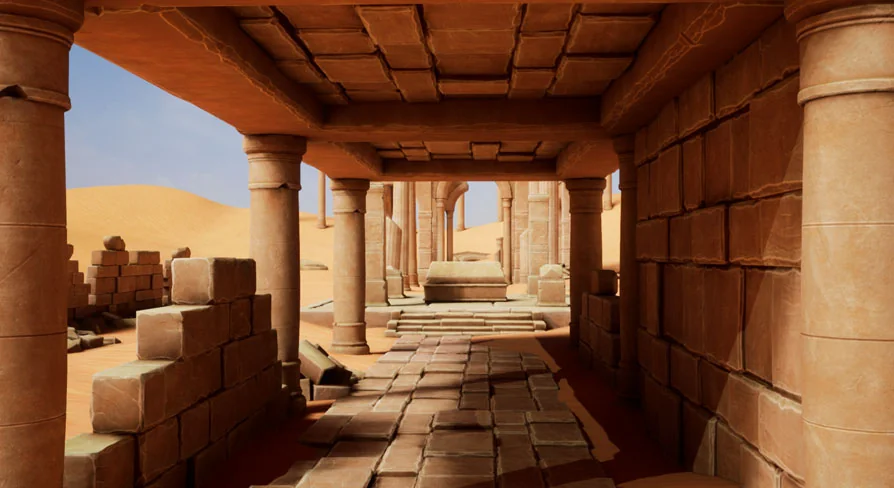
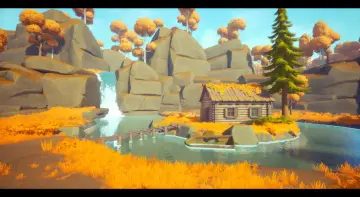
Working with the Stylized Ruins package begins directly inside its included level. Rather than requiring manual placement of individual geometry from an unorganized directory, opening the pre-built environment immediately establishes the spatial relationships, scale, and intended lighting conditions for the collection. This pre-assembled scene demonstrates how the individual architectural fragments interlock, resting on terrain or sand while maintaining visual coherence across different vantage points.
The pre-constructed stage serves as both a functional reference and an active sandbox. Designers can study the distribution of damaged elements, observe how the pieces sit against environmental backdrops, or extract prefabricated sub-assemblies straight into custom project maps. Because the environment is already assembled and lit, testing performance and framing requires zero preliminary mesh alignment.
Component Breakdown of the 37 Stylized Ruins Models
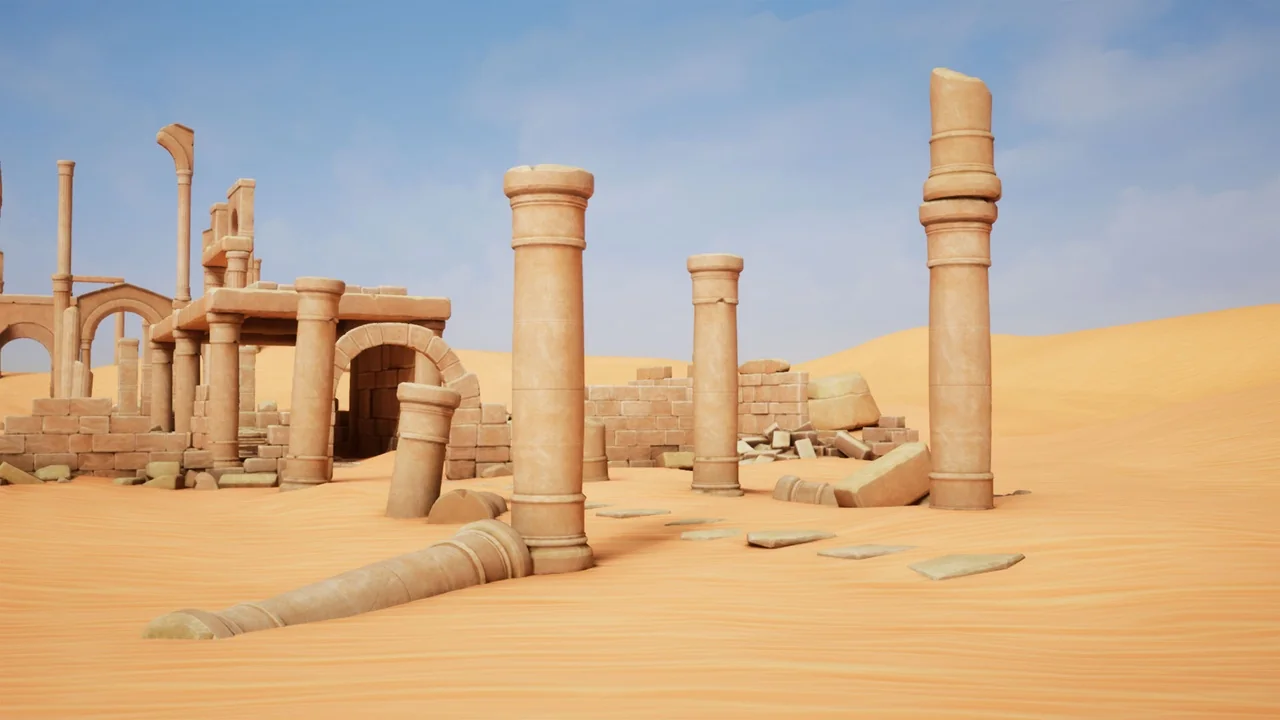
The core library consists of 37 distinct stylized ruins models. Each asset is shaped to reflect age, fantasy architecture, and physical decay, providing the necessary assets to frame doorways, structural remnants, foundational plinths, and collapsed boundaries. Instead of relying on pristinely cut masonry, the geometry emphasizes fractured corners, deep edge bevels, and surface damage characteristic of weathered fantasy ruins.
With 37 assets at hand, the collection avoids unnecessary bloat while retaining enough variety to build complete structural complexes:
Upright and fragmented pillars configured to denote decayed temples or fallen colonnades.
Segmented wall fragments featuring chipped masonry and uneven stone profiles.
Collapsed blocks and fallen architectural debris for ground scatter.
Supporting foundation pieces and stone thresholds to define traversal pathways.
These pieces function modularly. By rotating, sinking, and clustering individual models, level artists can prevent repetitive patterning across long exterior layouts without having to alter the base geometry.
PBR Shading Across Damaged and Weathered Surfaces
Every asset within the 37-piece package utilizes physically based rendering (PBR) shading. Applying PBR workflows to stylized artwork ensures that exaggerated shapes and hand-sculpted stone details react believably to dynamic sunlight, localized torchlight, and harsh environmental reflections.
The shading setup balances stylized color definition with modern material response. Diffuse channels define the stylized stone hues and sun-bleached tones, while roughness maps govern the dry, non-reflective quality typical of weathered stone. Normal mapping accentuates the carved cracks, broken corners, and pitted surfaces, allowing the low-overhead geometry to retain sharp silhouette definitions under shifting light angles. This unified PBR standard guarantees that bringing external props or alternative landscape textures into the scene will not disrupt the material harmony.
Constructing a Stylized Desert Ruins Environment
The package focuses specifically on creating a stylized desert ruins environment. Arid environments impose specific aesthetic constraints: bright directional lighting, high exposure values, and heavy ambient illumination bounced from surrounding dunes or rock formations. The assets within this collection are tailored to survive these high-contrast lighting scenarios without washing out or losing their volumetric depth.
Damaged masonry profiles cast hard, readable shadows against sand planes, helping players identify navigable paths, cover points, and points of interest. Placing fractured pillars and half-buried wall sections against dunes creates clear visual markers for exploration-focused level layouts. Because the stone forms feature distinct fantasy stylization, they read clearly at middle and long distances across open, dust-filled vistas.
Fantasy Level Assembly and Spatial Variations
Fantasy projects frequently call for forgotten temples, abandoned shrines, and ancient monuments sunken into untamed wilderness or desert wastes. The ruined theme present across all 37 models provides the environmental vocabulary required for these specific narrative beats. Level designers can establish forgotten outposts or transition zones between open exploration plains and underground dungeon entrances using solely the pieces included in the set.
Because the collection targets ruined architectural states, elements do not require precise snap-to-grid alignment. Walls can lean at irregular angles, broken flagstones can tilt into uneven sand, and fallen lintels can bridge gaps between standing pillars. This structural flexibility accelerates level blocking, enabling quick iteration during greybox and art-pass stages of level creation.
Production Integration and Deployment
Incorporating Stylized Ruins into an active game pipeline presents minimal overhead due to the constrained model count and standardized material approach. Teams working on stylized adventure games, action RPGs, or top-down combat arenas can drop the package directly into their project hierarchy, review the included demonstration level for lighting benchmarks, and begin populating maps immediately. The combination of complete PBR shading and 37 targeted ruins assets makes the package a self-contained, dependable kit for staging decayed desert outposts and fantasy ruins.
 Fantasy
 Fantasy
 Fantasy
 Fantasy