"1c2c8b66743036b4"{"id":"1001704","slug":"stealth-vision-bundle-34-presets","title":"Stealth Vision Bundle (34 Presets)","category":"Game Development Resource","engine":"5.1+","assetVersion":"","engineVersion":"Engine Version: 5.1+","tag":"Game Development R","accent":"blue","visual":"mech","summary":"Explore the Stealth Vision Bundle featuring consolidated night, thermal, and 5-channel x-ray vision components with over 30 preset materials.","platform":"Unreal Engine","publishedAt":"2026-10-14T17:08:00.984Z","updatedAt":"2026-10-14T17:08:00.984Z","sourceNotes":[],"fileContents":[],"compatibility":["Unreal Engine","Engine Version: 5.1+"],"featuredImage":{"alt":"Stealth Vision Bundle (34 Presets)","src":"/wp-content/uploads/published/2026/10/626244a4d9d1-c2cbb821-3aa9-49b0-b421-469511656230-b0892b5a09.webp"},"hasDownloadLink":true,"downloads":0,"terms":[],"galleryImages":[{"src":"/wp-content/uploads/published/2026/10/63631ede05fe-f43d7b1e-6390-401c-8d24-91a6b7773b1d-0a897f74ed.webp","alt":"Stealth Vision Bundle (34 Presets)"},{"src":"/wp-content/uploads/published/2026/10/9b1f9432624c-7bedf147-f5fb-4bdc-9279-a291f57251cf-5d021c82f2.webp","alt":"Stealth Vision Bundle (34 Presets)"},{"src":"/wp-content/uploads/published/2026/10/f50acd899d49-c0d35166-2a27-48f8-8092-bed2a879693e-9335fc6a43.webp","alt":"Stealth Vision Bundle (34 Presets)"},{"src":"/wp-content/uploads/published/2026/10/d8f660c1d717-5aa19a5b-3edf-4c8e-bdc0-983845e48b35-cfa51df26b.webp","alt":"Stealth Vision Bundle (34 Presets)"},{"src":"/wp-content/uploads/published/2026/10/f9be047a9426-45fe04a0-5e9f-4233-9ab8-eac5807bc04a-06df918899.webp","alt":"Stealth Vision Bundle (34 Presets)"},{"src":"/wp-content/uploads/published/2026/10/bb6798d5581e-9071f94d-f675-48cc-9eea-bc36dd9c011a-7e69a35e6c.webp","alt":"Stealth Vision Bundle (34 Presets)"},{"src":"/wp-content/uploads/published/2026/10/5f13325877aa-87f8d0e0-db31-4612-90d3-ad7aadab66a9-184daa5682.webp","alt":"Stealth Vision Bundle (34 Presets)"},{"src":"/wp-content/uploads/published/2026/10/7c048f251de7-e4424228-10b4-4905-94e9-b2d938234e2f-27a8b16807.webp","alt":"Stealth Vision Bundle (34 Presets)"},{"src":"/wp-content/uploads/published/2026/10/1f4bd7fcd789-44991596-bc5b-4f7b-a126-3ab84fbca7e9-f932a538da.webp","alt":"Stealth Vision Bundle (34 Presets)"}],"accessPanel":{"kind":"resource","title":"Download this resource","eyebrow":"Free Download","message":"Log in or create a free account to start your download.","fileName":"Stealth Vision Bundle (34 Presets).7z","safetyNote":"Resources are manually reviewed before listing to improve quality and reduce obvious risks.","actionLabel":"Download Free","resourceType":"Resource archive"},"contentHtml":"\u003ch2\u003eInfiltrating Low-Visibility Environments\u003c/h2\u003e\u003cp\u003eStealth games, tactical simulators, and survival horror titles frequently rely on shifts in sensory perception. Plunging an environment into absolute blackness creates immediate tension, but keeping gameplay functional requires giving the player specialized tools to interpret hostile spaces. In these game scenarios, switching between distinct optical spectrums—gathering ambient light in unlit corridors, reading heat signatures through dense foliage, or spotting movement through solid bulkheads—forms the backbone of player planning and tactical movement.\u003c/p\u003e\u003cp\u003eInstead of requiring independent systems for every sensory mechanic, the Stealth Vision Bundle delivers three distinct tactical modes: night vision, thermal imaging, and an x-ray identification mode. These systems operate through a streamlined workflow configured to eliminate long setup pipelines while providing extensive visual variation through a library of more than 30 preset materials.\u003c/p\u003e\u003ch2\u003eTactical Reconnaissance with the Night Vision Component\u003c/h2\u003e\u003cp\u003eMany games simulate night optical devices by attaching an invisible spotlight or point light to the player character camera. While this method illuminates nearby objects, it destroys authentic shadows, washes out foreground geometry, and creates an artificial cone of visibility that fails to feel like a real electronic light-amplification device.\u003c/p\u003e\u003cp\u003eThe Night Vision Component avoids this spotlight shortcut completely. It relies on a realistic post-process execution that dynamically manipulates camera exposure values. By adjusting exposure calculations directly, the system extracts available light from the scene to reveal dark environments in a natural manner. Surfaces distant from the character retain their ambient occlusion and contextual depth, mimicking the behavior of genuine light-amplification tubes and high-gain night optics. Whether walking through an unlit industrial basement or traversing open terrain under star cover, the scene responds to dark zones without generating artificial local light cones.\u003c/p\u003e\u003ch2\u003eThermal Vision Customization and Heat Detection\u003c/h2\u003e\u003cp\u003eThermal optical systems in tactical gameplay must immediately communicate biological presence, mechanical activity, and warm signatures against cold geometry. Visual clarity in digital thermography depends directly on edge definition and sensor grid resolution, both of which vary heavily depending on the grade of optic being simulated.\u003c/p\u003e\u003cp\u003eWithin this package, the Thermal Vision Component is configured to operate through dedicated, independent controls for digital sharpness and resolution quality. Rather than locking the camera into a single generic false-color lookup, developers can adjust how crisp the image edges appear and determine the internal resolution profile of the sensor feed. This makes it possible to recreate low-fi military cameras with blocky sensor fidelity, high-precision targeting scopes with sharp heat isolation, or specialized handheld sensors with unique grain and processing characteristics.\u003c/p\u003e\u003ch2\u003eFive-Channel Highlighting in the X-Ray Vision Component\u003c/h2\u003e\u003cp\u003eWall-penetrating radar, structural scanning, and enhanced target acquisition modes demand precise separation between different object categories. When scanning through surfaces, a player must quickly distinguish between threats, allies, neutral objectives, environmental hazards, and interactable loot.\u003c/p\u003e\u003cp\u003eThe X-Ray Vision Component fulfills this need with a flexible highlighting system featuring 5 separate color channels. Assigning items and characters across these distinct channels allows project teams to define a structured, readable visual language. Hostile targets can output on one channel, friendly squad members on a second, critical interactive consoles on a third, and structural markers on the remaining paths. Because the system includes an extensive set of over 30 material presets, customizing the scan patterns, surface opacities, and rim highlights across these 5 channels requires no low-level shader rewrites.\u003c/p\u003e\u003ch2\u003eConsolidated Setup across the Stealth Vision Bundle\u003c/h2\u003e\u003cp\u003eManaging multiple individual actor components for different vision modes can clutter player character blueprints and introduce messy logic when toggling between states. The Stealth Vision Bundle solves this by consolidating the Night Vision Component, Thermal Vision Component, and X-Ray Vision Component into a singular blueprint component.\u003c/p\u003e\u003cp\u003eWith all three toolsets housed in one component, toggling between standard vision, night amplification, thermal readouts, and x-ray scanning happens seamlessly. State transitions can be routed through clean input actions without needing complex arbitration logic between competing post-process volumes. The package is built with a plug-and-play setup mindset, allowing developers to add the component to an existing character, assign control inputs, and immediately begin using the visual modes.\u003c/p\u003e\u003cp\u003eImplementation is supported by a comprehensive main tutorial, a dedicated tutorial playlist, and specific guidance for Advanced Locomotion System v4 (ALS v4) character setups. Projects using the Pro First Person Horror Template can integrate the features directly via its 2.0 update. The package focuses strictly on logic, components, and material presets; any background environments or character meshes shown in demonstration media are purely illustrative and not included in the asset.\u003c/p\u003e\u003ch2\u003eProject Scenarios That Benefit Most\u003c/h2\u003e\u003cp\u003eDevelopers constructing tactical stealth games, military simulators, or slow-paced survival horror titles stand to gain the most from this collection. Building dynamic exposure-based night amplification, tunable digital thermal filters, and a multi-channel silhouette system from scratch involves significant technical overhead in post-process materials and rendering buffers.\u003c/p\u003e\u003cp\u003eBecause the collection combines all three systems into a unified component backed by 34 total presets, solo developers and small gameplay engineering teams can skip weeks of post-process prototyping. They gain immediate access to clean, switchable vision mechanics that slot directly into established character architectures.\u003c/p\u003e\n\n\u003ch2\u003eMore From The Same Workflow\u003c/h2\u003e\n\u003cul\u003e\n\u003cli\u003e\u003ca href=\"https://3dcghub.com/mega-magic-vfx-bundle/\" title=\"Mega Magic VFX Bundle\"\u003eMega Magic VFX Bundle\u003c/a\u003e\u003c/li\u003e\n\u003cli\u003e\u003ca href=\"https://3dcghub.com/tempest-ninja-shadows-series-stealth/\" title=\"Tempest Ninja - Shadows Series Stealth\"\u003eTempest Ninja - Shadows Series Stealth\u003c/a\u003e\u003c/li\u003e\n\u003cli\u003e\u003ca href=\"https://3dcghub.com/advanced-night-vision/\" title=\"Advanced Night Vision\"\u003eAdvanced Night Vision\u003c/a\u003e\u003c/li\u003e\n\u003cli\u003e\u003ca href=\"https://3dcghub.com/classic-vehicles-bundle-driveable-functional-classic-vehicles-car-cars-3d/\" title=\"Classic Vehicles Bundle / Driveable / Functional (Classic Vehicles Car Cars 3D)\"\u003eClassic Vehicles Bundle / Driveable / Functional (Classic Vehicles Car Cars 3D)\u003c/a\u003e\u003c/li\u003e\n\u003cli\u003e\u003ca href=\"https://3dcghub.com/vfx-bundle-2/\" title=\"VFX Bundle 2\"\u003eVFX Bundle 2\u003c/a\u003e\u003c/li\u003e\n\u003c/ul\u003e","contentTextLength":6348,"navigation":{"current":11,"total":3651,"previous":{"id":"1001705","slug":"stores-vol-1-shop-and-grocery-displays-nanite-and-low-poly","title":"Stores VOL.1 - Shop and Grocery Displays (Nanite \u0026 Low Poly)","category":"Game Development Resource","platform":"Unreal Engine","updatedAt":"2026-10-14T17:11:03.976Z"},"next":{"id":"1001703","slug":"spaceport-and-space-center-environment-kit","title":"Spaceport and Space Center Environment Kit","category":"Industrial","platform":"Unreal Engine","updatedAt":"2026-10-14T17:04:35.251Z"}},"relatedResources":[{"id":"1001189","slug":"mega-magic-vfx-bundle","title":"Mega Magic VFX Bundle","category":"Spells \u0026 Combat","engine":"5.0+","assetVersion":"","engineVersion":"Engine Version: 5.0+","tag":"Spells \u0026 Combat","accent":"blue","visual":"mech","summary":"Explore the Mega Magic VFX Bundle featuring 61 unique stylized visual effects, covering magic auras, defensive shields, and explosive attack spells.","platform":"Unreal Engine","publishedAt":"2026-09-17T06:44:28.385Z","updatedAt":"2026-09-17T06:44:28.385Z","sourceNotes":[],"fileContents":[],"compatibility":["Unreal Engine","Engine Version: 5.0+"],"featuredImage":{"alt":"Mega Magic VFX Bundle","src":"/wp-content/uploads/published/2026/09/01c1ab5194a0-31a84eec-fb18-455f-9cf4-27bc9436ceee-e5479c5fe0.webp"},"hasDownloadLink":true,"downloads":4},{"id":"27826","slug":"tempest-ninja-shadows-series-stealth","title":"Tempest Ninja - Shadows Series Stealth","category":"Humans","engine":"4.26+,5.0+","assetVersion":"Engine version: 4.26+,5.0+","engineVersion":"","tag":"Humans","accent":"blue","visual":"character","summary":"Tempest Ninja focuses on a ready-to-use stealth character setup for Unreal Engine skeleton workflows. The pack combines a rigged ninja, weapon props, material variation, textures, and a set of 28 ninja animations.","platform":"Unreal Engine","publishedAt":"2026-04-29T09:04:38.000Z","updatedAt":"2026-04-29T09:04:39.000Z","sourceNotes":[],"fileContents":[],"compatibility":["Unreal Engine","Engine version: 4.26+,5.0+"],"featuredImage":{"alt":"Tempest Ninja - Shadows Series Stealth","src":"https://3dcghub.com/wp-content/uploads/2026/04/a806b020e7e8_6006e1ca-2464-4e77-bfdd-907e5c41d32b.webp"},"hasDownloadLink":true,"downloads":0},{"id":"17015","slug":"advanced-night-vision","title":"Advanced Night Vision","category":"Variety","engine":"4.27,5.0+","assetVersion":"Engine version: 4.27,5.0+","engineVersion":"4.24","tag":"Variety","accent":"blue","visual":"luts","summary":"Enhance your project's atmosphere with Advanced Night Vision, a high-quality post-process material featuring modular customization and object highlighting capabilities.","platform":"Unreal Engine","publishedAt":"2026-03-13T13:28:21.000Z","updatedAt":"2026-04-19T15:43:38.000Z","sourceNotes":[],"fileContents":[],"compatibility":["Unreal Engine","Engine version: 4.27,5.0+"],"featuredImage":{"alt":"Advanced Night Vision","src":"https://3dcghub.com/wp-content/uploads/2026/03/ed66d7f0-f96c-4d81-b9e4-fc69089d4ae1.webp"},"hasDownloadLink":true,"downloads":0}]}
Game Development R
Stealth Vision Bundle (34 Presets)
Explore the Stealth Vision Bundle featuring consolidated night, thermal, and 5-channel x-ray vision components with over 30 preset materials.
Category:Unreal EnginePlatform: Unreal EngineEngine Version: 5.1+Published: Oct 14, 2026
Game Development R
Resource overview
Infiltrating Low-Visibility Environments
Stealth games, tactical simulators, and survival horror titles frequently rely on shifts in sensory perception. Plunging an environment into absolute blackness creates immediate tension, but keeping gameplay functional requires giving the player specialized tools to interpret hostile spaces. In these game scenarios, switching between distinct optical spectrums—gathering ambient light in unlit corridors, reading heat signatures through dense foliage, or spotting movement through solid bulkheads—forms the backbone of player planning and tactical movement.
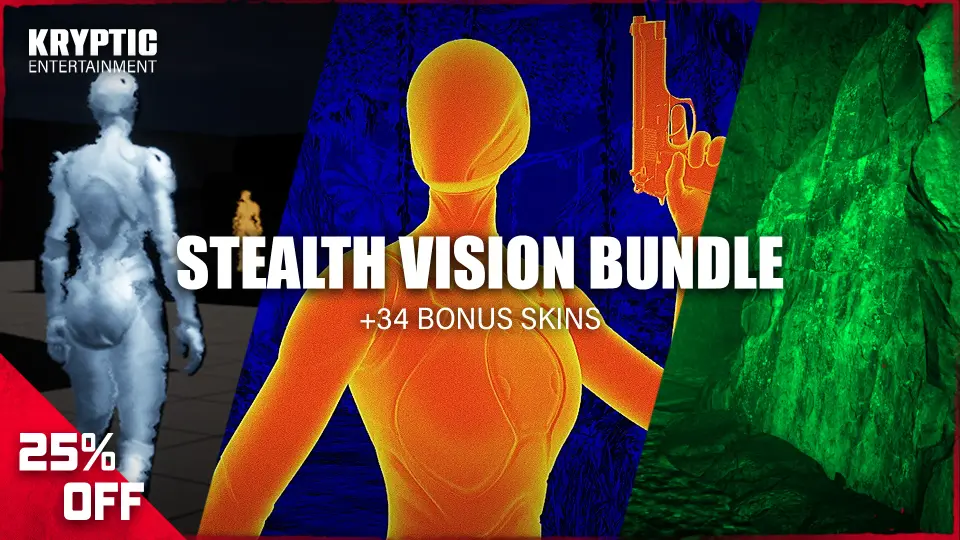
Instead of requiring independent systems for every sensory mechanic, the Stealth Vision Bundle delivers three distinct tactical modes: night vision, thermal imaging, and an x-ray identification mode. These systems operate through a streamlined workflow configured to eliminate long setup pipelines while providing extensive visual variation through a library of more than 30 preset materials.
Tactical Reconnaissance with the Night Vision Component
Many games simulate night optical devices by attaching an invisible spotlight or point light to the player character camera. While this method illuminates nearby objects, it destroys authentic shadows, washes out foreground geometry, and creates an artificial cone of visibility that fails to feel like a real electronic light-amplification device.
The Night Vision Component avoids this spotlight shortcut completely. It relies on a realistic post-process execution that dynamically manipulates camera exposure values. By adjusting exposure calculations directly, the system extracts available light from the scene to reveal dark environments in a natural manner. Surfaces distant from the character retain their ambient occlusion and contextual depth, mimicking the behavior of genuine light-amplification tubes and high-gain night optics. Whether walking through an unlit industrial basement or traversing open terrain under star cover, the scene responds to dark zones without generating artificial local light cones.
Thermal Vision Customization and Heat Detection
Thermal optical systems in tactical gameplay must immediately communicate biological presence, mechanical activity, and warm signatures against cold geometry. Visual clarity in digital thermography depends directly on edge definition and sensor grid resolution, both of which vary heavily depending on the grade of optic being simulated.
Within this package, the Thermal Vision Component is configured to operate through dedicated, independent controls for digital sharpness and resolution quality. Rather than locking the camera into a single generic false-color lookup, developers can adjust how crisp the image edges appear and determine the internal resolution profile of the sensor feed. This makes it possible to recreate low-fi military cameras with blocky sensor fidelity, high-precision targeting scopes with sharp heat isolation, or specialized handheld sensors with unique grain and processing characteristics.
Five-Channel Highlighting in the X-Ray Vision Component
Wall-penetrating radar, structural scanning, and enhanced target acquisition modes demand precise separation between different object categories. When scanning through surfaces, a player must quickly distinguish between threats, allies, neutral objectives, environmental hazards, and interactable loot.
The X-Ray Vision Component fulfills this need with a flexible highlighting system featuring 5 separate color channels. Assigning items and characters across these distinct channels allows project teams to define a structured, readable visual language. Hostile targets can output on one channel, friendly squad members on a second, critical interactive consoles on a third, and structural markers on the remaining paths. Because the system includes an extensive set of over 30 material presets, customizing the scan patterns, surface opacities, and rim highlights across these 5 channels requires no low-level shader rewrites.
Consolidated Setup across the Stealth Vision Bundle
Managing multiple individual actor components for different vision modes can clutter player character blueprints and introduce messy logic when toggling between states. The Stealth Vision Bundle solves this by consolidating the Night Vision Component, Thermal Vision Component, and X-Ray Vision Component into a singular blueprint component.
With all three toolsets housed in one component, toggling between standard vision, night amplification, thermal readouts, and x-ray scanning happens seamlessly. State transitions can be routed through clean input actions without needing complex arbitration logic between competing post-process volumes. The package is built with a plug-and-play setup mindset, allowing developers to add the component to an existing character, assign control inputs, and immediately begin using the visual modes.
Implementation is supported by a comprehensive main tutorial, a dedicated tutorial playlist, and specific guidance for Advanced Locomotion System v4 (ALS v4) character setups. Projects using the Pro First Person Horror Template can integrate the features directly via its 2.0 update. The package focuses strictly on logic, components, and material presets; any background environments or character meshes shown in demonstration media are purely illustrative and not included in the asset.
Project Scenarios That Benefit Most
Developers constructing tactical stealth games, military simulators, or slow-paced survival horror titles stand to gain the most from this collection. Building dynamic exposure-based night amplification, tunable digital thermal filters, and a multi-channel silhouette system from scratch involves significant technical overhead in post-process materials and rendering buffers.
Because the collection combines all three systems into a unified component backed by 34 total presets, solo developers and small gameplay engineering teams can skip weeks of post-process prototyping. They gain immediate access to clean, switchable vision mechanics that slot directly into established character architectures.
 Game Development R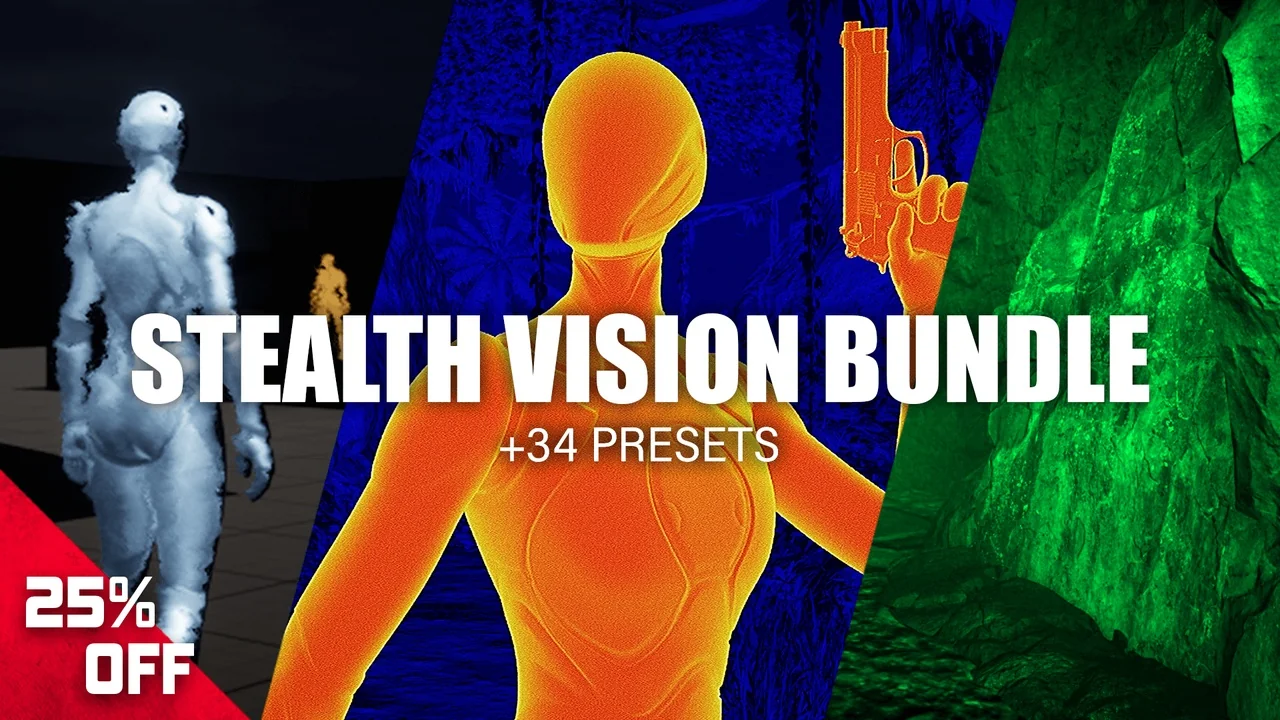
 Spells & Combat
 Humans
 Variety