"95fdaf16012263fa"{"id":"1002352","slug":"small-monster-sfx-3","title":"Small Monster SFX 3","category":"Sound Effects","engine":"4.13+,5.0+","assetVersion":"","engineVersion":"Engine Version: 4.13+,5.0+","tag":"Sound Effects","accent":"blue","visual":"mech","summary":"Small Monster SFX 3 is a sound pack for human-sized or smaller enemy creatures, with voice and effect audio aimed at RPG encounters and monster scenes.","platform":"Unreal Engine","indexPolicy":"index","publishedAt":"2026-11-06T06:59:24.195Z","updatedAt":"2026-11-06T06:59:24.195Z","sourceNotes":[],"fileContents":[],"compatibility":["Unreal Engine","Engine Version: 4.13+,5.0+"],"featuredImage":{"alt":"Small Monster SFX 3","src":"/wp-content/uploads/published/2026/11/b632973a08f1-a071e926-ff28-48ca-9ed2-55f750ab3a53-aa56800035.webp"},"hasDownloadLink":true,"downloads":0,"terms":[{"taxonomy":"category","slug":"sound-effects","name":"Sound Effects"}],"galleryImages":[{"src":"/wp-content/uploads/published/2026/11/3883dfa7d80f-043bde26-b7ec-4754-9e68-e4b370360f50-93f2043d5f.webp","alt":"Small Monster SFX 3"}],"accessPanel":{"kind":"resource","title":"Get this resource","eyebrow":"Free resource","message":"3DCGHUB is the service provider for this listing. Access is fulfilled through the official publisher channel.","fileName":"Content.7z","safetyNote":"Resources are manually reviewed before listing to improve quality and reduce obvious risks.","actionLabel":"Get this resource","resourceType":"Resource archive","versions":[]},"contentHtml":"\u003cp\u003eIn an RPG encounter, the enemy that stands no taller than the player can be the one that needs the most careful audio. A single grunt or hit cue is not enough to give it a personality. Small Monster SFX 3 addresses that scale directly: it is a sound pack intended for a small enemy creature, defined as human sized or less.\u003c/p\u003e\u003cp\u003eThe package is not a general library of monster roars. Its tags narrow the focus to sound, effect, voice, RPG, creature, pack, and monster. Those terms describe a collection focused on creature audio for role-playing game encounters, with both vocal and effect content represented.\u003c/p\u003e\u003ch2\u003eSmall Monster SFX 3: a creature audio set for human-scale enemies\u003c/h2\u003e\u003cp\u003eThe core purpose is straightforward. The sounds are meant to bring a small enemy creature to life in a game. That framing sets an upper bound on scale: the creature is human sized or less. The intended subject is already the small monster, so the pack's identity is tied to a specific body size rather than a broad monster category.\u003c/p\u003e\u003cp\u003eBecause the tags include both voice and effect, the set can be approached as two related layers. Voice covers the creature's vocal presence. Effect covers the non-vocal sound content. A small monster in an RPG encounter often needs both: a voice that carries the creature's presence, and effects that support its actions. The pack's name and tags point to that combined role.\u003c/p\u003e\u003ch2\u003eVoice and effect layers in the same monster pack\u003c/h2\u003e\u003cp\u003eThe tag set is short but useful. Sound and Effect describe the asset type. Voice points to creature vocalizations. Creature and Monster define the subject. Pack indicates a collection rather than a one-off. RPG places the likely context in role-playing games. Taken together, the tags describe a focused creature audio pack, not a broad foley library.\u003c/p\u003e\u003cp\u003eWithin that focus, voice and effect do different work. Voice gives the enemy a recognizable living presence. Effect fills in the non-vocal side of the creature's sound identity. For a small enemy, those two layers need to sit at the same scale. A voice that reads as human-sized or smaller can pair with effects that support the same body size. The human-sized-or-less scale is the through-line.\u003c/p\u003e\u003cp\u003eThe pack's title also does some organizational work. The number 3 in Small Monster SFX 3 indicates a series entry. For anyone who already knows the Small Monster SFX name, that numbering points to the same small-creature focus in another set. It also signals that the pack is not trying to be a universal monster library. The subject is small monsters, and the audio is shaped around that limit.\u003c/p\u003e\u003ch2\u003eWhere an RPG enemy encounter needs audible character\u003c/h2\u003e\u003cp\u003eRPG is one of the pack's tags, and the small-enemy focus maps naturally to encounters where the creature is not a towering boss. A human-sized or smaller enemy can appear as a recurring threat, a summoned creature, or a low-tier opponent. The sound set gives that enemy a vocal and effects layer without requiring a larger monster library.\u003c/p\u003e\u003cp\u003eBecause the creature is defined by size rather than a specific species, the pack can sit in different RPG settings. The same human-sized-or-smaller enemy might appear in a cave, a ruin, or a city underside. The audio job stays the same: make the creature feel alive at that scale. The pack does not depend on a named creature type to make sense. Its subject is the scale and the enemy role.\u003c/p\u003e\u003cp\u003eAn RPG encounter also benefits from consistency. If the small monster appears repeatedly, its voice and effects become part of its identity. A focused pack gives the sound designer a single source for that identity. The tags suggest exactly that kind of repeatable creature role. When the enemy returns in a later encounter, the same audio character can carry over.\u003c/p\u003e\u003ch2\u003eUsing the demo's background layer as a context check\u003c/h2\u003e\u003cp\u003eThe audio demo includes a background sound behind the creature audio. That detail is worth noting because it frames the sounds in context rather than as isolated files. A background layer can show how the creature sits against other audio, which is closer to how the pack will be used in a game scene.\u003c/p\u003e\u003cp\u003eFor a small enemy, context matters. The voice and effects need to be audible without overwhelming the rest of the mix. The demo's background bed gives a rough sense of that balance. Listeners can use the demo to judge whether the creature reads at the intended scale. The background layer is not the main subject, but it provides a scene-like frame.\u003c/p\u003e\u003cp\u003eThe demo gives the pack a practical listening context. A small monster's voice has to carry the creature's presence at that scale. The demo's background layer puts the creature audio in a mix, so the listener can focus on how the voice and effects occupy the same space.\u003c/p\u003e\u003ch2\u003eWho gets the most from a small-creature sound pack\u003c/h2\u003e\u003cp\u003eThe clearest fit is a project that already knows it needs a small enemy creature and wants a dedicated audio set for it. RPG developers are a natural audience, given the role-playing game framing, but the pack's subject is broader: any game with a human-sized-or-smaller monster that needs voice and effect audio. Sound designers who are building a creature's audible identity from scratch will find the pack's focus useful. So will teams that need to keep a small enemy consistent across encounters.\u003c/p\u003e\u003cp\u003eThe pack is less about a single dramatic cue and more about the complete presence of a small monster. Its usefulness comes from narrowing the subject: a creature that is human sized or less, with both voice and effect content, framed for RPG use. That makes it a practical choice for anyone who needs a small enemy to sound alive rather than generic.\u003c/p\u003e\n\n\u003ch2\u003eMore From The Same Workflow\u003c/h2\u003e\n\u003cul\u003e\n\u003cli\u003e\u003ca href=\"https://3dcghub.com/small-monster-sfx-2/\" rel=\"noopener noreferrer\"\u003eSmall Monster SFX 2\u003c/a\u003e\u003c/li\u003e\n\u003cli\u003e\u003ca href=\"https://3dcghub.com/small-monster-sfx-1/\" rel=\"noopener noreferrer\"\u003eSmall Monster SFX 1\u003c/a\u003e\u003c/li\u003e\n\u003cli\u003e\u003ca href=\"https://3dcghub.com/medium-monster-sfx-2/\" rel=\"noopener noreferrer\"\u003eMedium Monster SFX 2\u003c/a\u003e\u003c/li\u003e\n\u003cli\u003e\u003ca href=\"https://3dcghub.com/monster-within/\" rel=\"noopener noreferrer\"\u003eMonster Within\u003c/a\u003e\u003c/li\u003e\n\u003cli\u003e\u003ca href=\"https://3dcghub.com/female-zombie-voice-sound-effects/\" rel=\"noopener noreferrer\"\u003eFemale Zombie - Voice Sound Effects\u003c/a\u003e\u003c/li\u003e\n\u003c/ul\u003e","contentTextLength":5742,"navigation":{"current":16,"total":4291,"previous":{"id":"1002353","slug":"snowfall-vfx","title":"Snowfall VFX","category":"Variety","platform":"Unreal Engine","updatedAt":"2026-11-06T07:00:17.276Z"},"next":{"id":"1002351","slug":"small-monster-sfx-2","title":"Small Monster SFX 2","category":"Sound Effects","platform":"Unreal Engine","updatedAt":"2026-11-06T06:57:48.038Z"}},"relatedResources":[{"id":"1002351","slug":"small-monster-sfx-2","title":"Small Monster SFX 2","category":"Sound Effects","engine":"4.26+,5.0+","assetVersion":"","engineVersion":"Engine Version: 4.26+,5.0+","tag":"Sound Effects","accent":"blue","visual":"mech","summary":"Small Monster SFX 2 is an audio pack of creature sounds for human-sized or smaller enemies, with voice, effect, and RPG monster tags for game scenes.","platform":"Unreal Engine","indexPolicy":"index","publishedAt":"2026-11-06T06:57:48.038Z","updatedAt":"2026-11-06T06:57:48.038Z","sourceNotes":[],"fileContents":[],"compatibility":["Unreal Engine","Engine Version: 4.26+,5.0+"],"featuredImage":{"alt":"Small Monster SFX 2","src":"/wp-content/uploads/published/2026/11/80ce26c7545e-e6df0c10-66fa-43a7-832e-f0535f3de588-c2aa373f2f.webp"},"hasDownloadLink":true,"downloads":0},{"id":"1002350","slug":"small-monster-sfx-1","title":"Small Monster SFX 1","category":"Sound Effects","engine":"4.26+,5.0+","assetVersion":"","engineVersion":"Engine Version: 4.26+,5.0+","tag":"Sound Effects","accent":"blue","visual":"mech","summary":"Small Monster SFX 1 is an audio pack for fantasy and medieval games that need voice and effect sounds for a human-sized or smaller enemy creature.","platform":"Unreal Engine","indexPolicy":"index","publishedAt":"2026-11-06T06:56:51.474Z","updatedAt":"2026-11-06T06:56:51.474Z","sourceNotes":[],"fileContents":[],"compatibility":["Unreal Engine","Engine Version: 4.26+,5.0+"],"featuredImage":{"alt":"Small Monster SFX 1","src":"/wp-content/uploads/published/2026/11/191497025ab3-478c1778-2fb9-4df2-b4ca-b99ac6b94582-3d9f8fa399.webp"},"hasDownloadLink":true,"downloads":0},{"id":"1001894","slug":"medium-monster-sfx-2","title":"Medium Monster SFX 2","category":"Sound Effects","engine":"4.26+,5.0+","assetVersion":"","engineVersion":"Engine Version: 4.26+,5.0+","tag":"Sound Effects","accent":"blue","visual":"mech","summary":"Medium Monster SFX 2 provides realistic creature voice and sound effects designed for medieval fantasy enemies, trolls, and ogres up to four meters tall.","platform":"Unreal Engine","indexPolicy":"index","publishedAt":"2026-10-22T11:33:36.643Z","updatedAt":"2026-10-22T11:33:36.643Z","sourceNotes":[],"fileContents":[],"compatibility":["Unreal Engine","Engine Version: 4.26+,5.0+"],"featuredImage":{"alt":"Medium Monster SFX 2","src":"/wp-content/uploads/published/2026/10/d4acb5dffe80-7ca4663f-99cc-4791-891e-186907d63302-d34f55ae63.webp"},"hasDownloadLink":true,"downloads":0}]}
Sound Effects
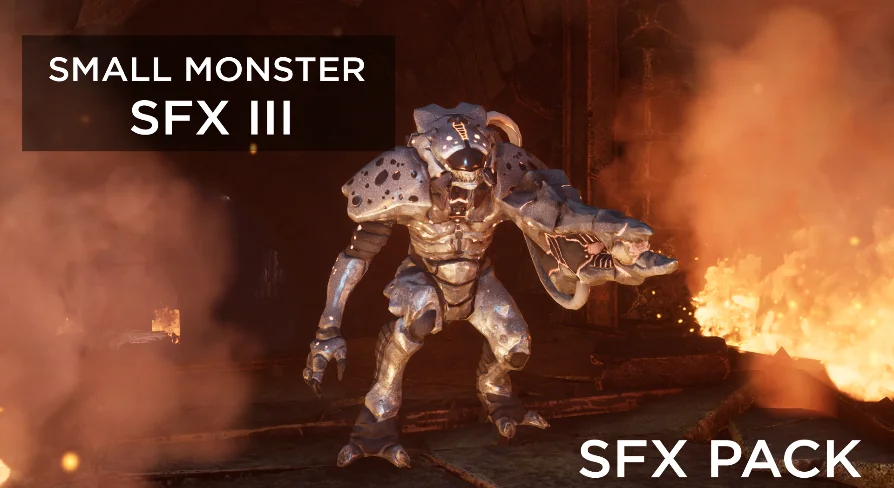
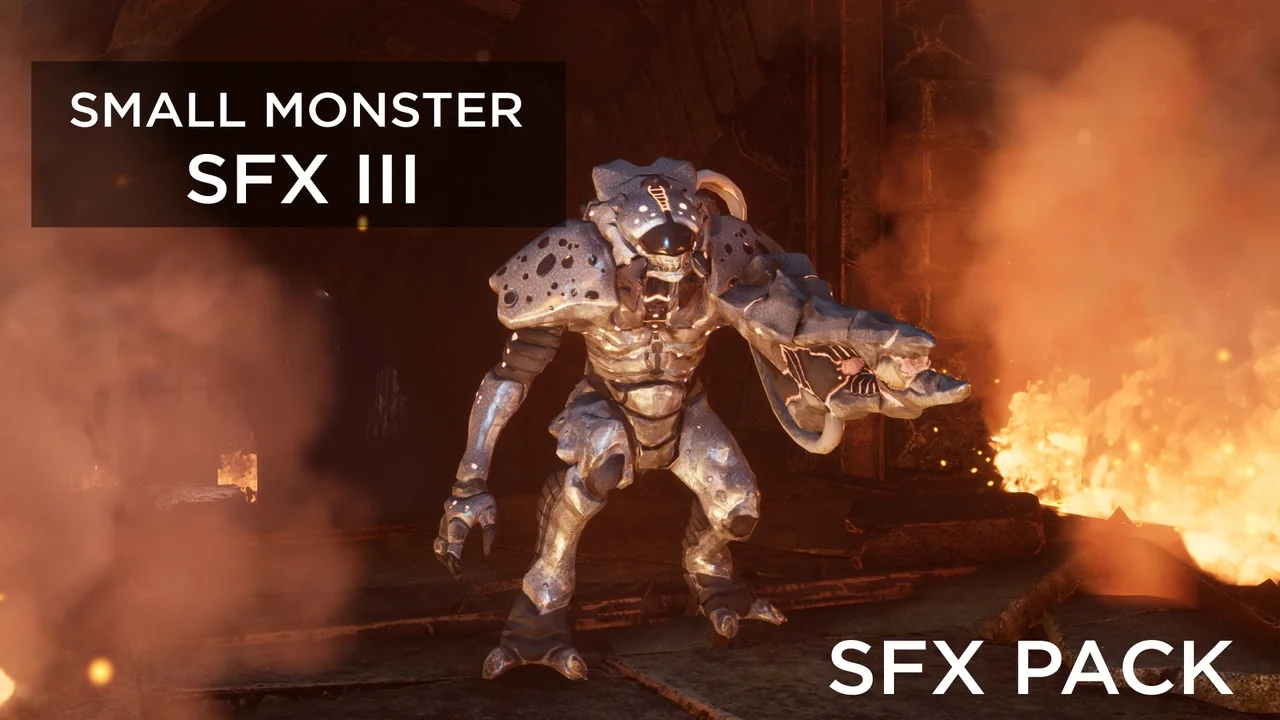
Small Monster SFX 3
Small Monster SFX 3 is a sound pack for human-sized or smaller enemy creatures, with voice and effect audio aimed at RPG encounters and monster scenes.
Category:Unreal Engine,Sound EffectsPlatform: Unreal EngineEngine Version: 4.13+,5.0+Published: Nov 6, 2026
Sound Effects
Resource overview
In an RPG encounter, the enemy that stands no taller than the player can be the one that needs the most careful audio. A single grunt or hit cue is not enough to give it a personality. Small Monster SFX 3 addresses that scale directly: it is a sound pack intended for a small enemy creature, defined as human sized or less.
The package is not a general library of monster roars. Its tags narrow the focus to sound, effect, voice, RPG, creature, pack, and monster. Those terms describe a collection focused on creature audio for role-playing game encounters, with both vocal and effect content represented.
Small Monster SFX 3: a creature audio set for human-scale enemies
The core purpose is straightforward. The sounds are meant to bring a small enemy creature to life in a game. That framing sets an upper bound on scale: the creature is human sized or less. The intended subject is already the small monster, so the pack's identity is tied to a specific body size rather than a broad monster category.
Because the tags include both voice and effect, the set can be approached as two related layers. Voice covers the creature's vocal presence. Effect covers the non-vocal sound content. A small monster in an RPG encounter often needs both: a voice that carries the creature's presence, and effects that support its actions. The pack's name and tags point to that combined role.
Voice and effect layers in the same monster pack
The tag set is short but useful. Sound and Effect describe the asset type. Voice points to creature vocalizations. Creature and Monster define the subject. Pack indicates a collection rather than a one-off. RPG places the likely context in role-playing games. Taken together, the tags describe a focused creature audio pack, not a broad foley library.
Within that focus, voice and effect do different work. Voice gives the enemy a recognizable living presence. Effect fills in the non-vocal side of the creature's sound identity. For a small enemy, those two layers need to sit at the same scale. A voice that reads as human-sized or smaller can pair with effects that support the same body size. The human-sized-or-less scale is the through-line.
The pack's title also does some organizational work. The number 3 in Small Monster SFX 3 indicates a series entry. For anyone who already knows the Small Monster SFX name, that numbering points to the same small-creature focus in another set. It also signals that the pack is not trying to be a universal monster library. The subject is small monsters, and the audio is shaped around that limit.
Where an RPG enemy encounter needs audible character
RPG is one of the pack's tags, and the small-enemy focus maps naturally to encounters where the creature is not a towering boss. A human-sized or smaller enemy can appear as a recurring threat, a summoned creature, or a low-tier opponent. The sound set gives that enemy a vocal and effects layer without requiring a larger monster library.
Because the creature is defined by size rather than a specific species, the pack can sit in different RPG settings. The same human-sized-or-smaller enemy might appear in a cave, a ruin, or a city underside. The audio job stays the same: make the creature feel alive at that scale. The pack does not depend on a named creature type to make sense. Its subject is the scale and the enemy role.
An RPG encounter also benefits from consistency. If the small monster appears repeatedly, its voice and effects become part of its identity. A focused pack gives the sound designer a single source for that identity. The tags suggest exactly that kind of repeatable creature role. When the enemy returns in a later encounter, the same audio character can carry over.
Using the demo's background layer as a context check
The audio demo includes a background sound behind the creature audio. That detail is worth noting because it frames the sounds in context rather than as isolated files. A background layer can show how the creature sits against other audio, which is closer to how the pack will be used in a game scene.
For a small enemy, context matters. The voice and effects need to be audible without overwhelming the rest of the mix. The demo's background bed gives a rough sense of that balance. Listeners can use the demo to judge whether the creature reads at the intended scale. The background layer is not the main subject, but it provides a scene-like frame.
The demo gives the pack a practical listening context. A small monster's voice has to carry the creature's presence at that scale. The demo's background layer puts the creature audio in a mix, so the listener can focus on how the voice and effects occupy the same space.
Who gets the most from a small-creature sound pack
The clearest fit is a project that already knows it needs a small enemy creature and wants a dedicated audio set for it. RPG developers are a natural audience, given the role-playing game framing, but the pack's subject is broader: any game with a human-sized-or-smaller monster that needs voice and effect audio. Sound designers who are building a creature's audible identity from scratch will find the pack's focus useful. So will teams that need to keep a small enemy consistent across encounters.
The pack is less about a single dramatic cue and more about the complete presence of a small monster. Its usefulness comes from narrowing the subject: a creature that is human sized or less, with both voice and effect content, framed for RPG use. That makes it a practical choice for anyone who needs a small enemy to sound alive rather than generic.
 Sound Effects
 Sound Effects
 Sound Effects
 Sound Effects