"177e4e4394b9ce1f"{"id":"1001600","slug":"shield-vfx-v2","title":"Shield VFX v2","category":"Spells \u0026 Combat","engine":"5.2+","assetVersion":"","engineVersion":"Engine Version: 5.2+","tag":"Spells \u0026 Combat","accent":"blue","visual":"mech","summary":"Explore Shield VFX v2, featuring 25 shield variations, 15 hit particle types, customizable meshes, Blueprint HP systems, and material damage reactions.","platform":"Unreal Engine","publishedAt":"2026-10-10T16:21:55.338Z","updatedAt":"2026-10-10T16:21:55.338Z","sourceNotes":[],"fileContents":[],"compatibility":["Unreal Engine","Engine Version: 5.2+"],"featuredImage":{"alt":"Shield VFX v2","src":"/wp-content/uploads/published/2026/10/3bd3bade1d15-b18e6b08-47d1-4cb6-8606-d737d073332c-43ca36ab24.webp"},"hasDownloadLink":true,"downloads":1,"terms":[{"taxonomy":"category","slug":"spells-and-combat","name":"Spells \u0026 Combat"}],"galleryImages":[{"src":"/wp-content/uploads/published/2026/10/a2271af47b4d-3000cc20-1768-409c-811b-410e3c91f377-7ba50ff640.webp","alt":"Shield VFX v2"},{"src":"/wp-content/uploads/published/2026/10/88fd2a68789c-04f69657-4236-4479-be1a-ec3dd3b1fb4e-870a1ec737.webp","alt":"Shield VFX v2"},{"src":"/wp-content/uploads/published/2026/10/6b4a067a2f68-139b404c-c214-42eb-9a59-44ddff14e372-37b02174aa.webp","alt":"Shield VFX v2"},{"src":"/wp-content/uploads/published/2026/10/28bb7b7dd850-7401ac9d-1d2a-4aa6-b979-45902cc82df8-d2cd2d6a50.webp","alt":"Shield VFX v2"},{"src":"/wp-content/uploads/published/2026/10/36042cbb0560-c8a39678-99f6-4fda-a2d3-ec9efad9ae54-a1c49d1793.webp","alt":"Shield VFX v2"},{"src":"/wp-content/uploads/published/2026/10/04060c12c0ec-e37758e4-c23e-4f0d-ab14-43531e9f2816-a9ac3639ae.webp","alt":"Shield VFX v2"},{"src":"/wp-content/uploads/published/2026/10/4c1634c44da8-dd0a8f8f-f375-4480-a776-e4df91006ab8-e237c05b65.webp","alt":"Shield VFX v2"},{"src":"/wp-content/uploads/published/2026/10/e7418f169dc3-c8ebb8ad-c160-4eca-88c8-e5e8b9dd972d-841f235ac0.webp","alt":"Shield VFX v2"},{"src":"/wp-content/uploads/published/2026/10/f354753401a1-95864a1a-2b1f-4cb2-8918-36c3a02de260-82b0eee43e.webp","alt":"Shield VFX v2"}],"accessPanel":{"kind":"resource","title":"Download this resource","eyebrow":"Free Download","message":"Log in or create a free account to start your download.","fileName":"Content.7z","safetyNote":"Resources are manually reviewed before listing to improve quality and reduce obvious risks.","actionLabel":"Download Free","resourceType":"Resource archive"},"contentHtml":"\u003cp\u003eProtective barriers in real-time combat demand clear visual communication the instant damage connects. Rather than relying on a static energy bubble, an interactive defensive effect must signal impacts, demonstrate structural wear, and reflect the thematic nature of the character or vehicle casting it. Shield VFX v2 addresses this requirement by supplying a full suite of defense barriers paired directly with responsive impact visual effects, health point readouts, and shader-driven reaction mechanisms.\u003c/p\u003e \u003ch2\u003e25 Shield Archetypes and Dedicated Hit Particles\u003c/h2\u003e\n\u003cp\u003eThe library provides 25 distinct kinds of shields alongside 15 dedicated hit particle systems. Rather than applying a single universal impact puff across completely different materials, shields possess their own corresponding hit particles to preserve stylistic consistency when projectiles or melee strikes connect.\u003c/p\u003e \u003cp\u003eThe visual themes span multiple gameplay aesthetics:\u003c/p\u003e\n\u003cul\u003e \u003cli\u003e\u003cstrong\u003eElemental Forces:\u003c/strong\u003e Water, Fire, and Lightning effects convey raw magical or environmental energy, supported by impact systems tailored to fluid or crackling dispersion. Sand variants further extend ground and earthy elemental presentations.\u003c/li\u003e \u003cli\u003e\u003cstrong\u003eHard-Light and Technological Barriers:\u003c/strong\u003e Dedicated Sci-fi and standard barrier motifs supply structured, digital defensive perimeters suited for spacecraft, turrets, and cybernetic units.\u003c/li\u003e \u003cli\u003e\u003cstrong\u003eStylized and Organic Forms:\u003c/strong\u003e Magical aesthetics, fragile Glass variants, and decorative Butterfly shield configurations provide distinct thematic signatures for specialized character abilities.\u003c/li\u003e\n\u003c/ul\u003e \u003cp\u003eBecause hit particles are paired with the barrier types, an impact against a Glass or Water shield disperses visual debris distinct from the energetic bursts produced by Fire or Sci-fi energy fields. This immediate feedback helps players instantly read impact locations during fast-paced skirmishes.\u003c/p\u003e \u003ch2\u003eBlueprint Damage Reaction and Hit Point Controls\u003c/h2\u003e\n\u003cp\u003eDefensive barriers require functional logic to communicate how much damage they can sustain before collapsing. Shield VFX v2 integrates core gameplay logic directly inside Blueprint assets, connecting incoming hits to tangible gameplay parameters rather than remaining purely cosmetic displays.\u003c/p\u003e \u003cp\u003eWithin the Blueprint implementation, developers can define and set explicit health point values. This numeric foundation dictates how the shield responds to combat pressure. Directly linked to this numeric system is an integrated health bar. Designers can modify both the color and dimensions of the health bar to match project-specific user interface guidelines, anchoring the status display directly above or alongside the active defensive barrier in world space.\u003c/p\u003e \u003ch2\u003eMaterial Flickering Logic and Visual Thresholds\u003c/h2\u003e\n\u003cp\u003eVisual deterioration in Shield VFX v2 is handled primarily through material-level functions rather than external script overhead. When damage is registered, the underlying material logic initiates an interactive damage reaction, providing real-time feedback across the surface of the barrier.\u003c/p\u003e \u003cp\u003eThe damage reaction setup includes several adjustable parameters:\u003c/p\u003e\n\u003cul\u003e \u003cli\u003e\u003cstrong\u003eFlicker Color Selection:\u003c/strong\u003e The flashing highlight color visible during hit registration can be tinted to contrast against the base shield tone, ensuring high visibility during intense combat scenes.\u003c/li\u003e \u003cli\u003e\u003cstrong\u003eFlicker Speed Modulation:\u003c/strong\u003e The rate of the impact strobe or pulsation can be quickened or slowed to match the cadence of incoming fire or the physical weight of the barrier.\u003c/li\u003e \u003cli\u003e\u003cstrong\u003eDamage Percentage Activation Threshold:\u003c/strong\u003e A dedicated percentage value parameter determines precisely when surface flickering begins. Shields can maintain visual stability during early hits and transition into unstable, rapid flickering only after total durability drops past a specific percentage threshold.\u003c/li\u003e\n\u003c/ul\u003e \u003ch2\u003eMesh Scaling, Animation Speed, and Particle Customization\u003c/h2\u003e\n\u003cp\u003eEvery defense effect in the collection is structured for visual adjustment so technical artists can match barriers to varying collision boundaries and actor silhouettes. Meshes are completely customizable, allowing users to swap default geometry for unique shields, spherical shells, rectangular deployment walls, or localized body auras.\u003c/p\u003e \u003cp\u003eColor palettes are exposed for straightforward tinting, enabling single shield archetypes to serve multiple team affiliations or power ranks through hue shifts. Animation playback speeds can be throttled or accelerated, giving creators the choice between sluggish, heavy force fields and energetic, rapidly oscillating shields. Furthermore, barrier size scales dynamically, accommodating small handheld personal shields up to massive vehicle or structural perimeter envelopes without breaking particle density or distorting surface shaders.\u003c/p\u003e \u003ch2\u003eGame Optimization and UEFN Pipeline Integration\u003c/h2\u003e\n\u003cp\u003eShield VFX v2 is constructed as an optimized asset ready for direct deployment in runtime game projects. Particle systems utilize Niagara logic to maintain high frame rates even when multiple barriers take simultaneous weapon impacts on screen. The combination of lightweight material calculations and structured particle counts ensures performance remains stable across crowded multiplayer encounters.\u003c/p\u003e \u003cp\u003eBeyond standard Unreal Engine game environments, the asset translates directly into Unreal Editor for Fortnite (UEFN) workflows. Creators adapting marketplace content for UEFN projects can implement these shields and impact particles using established asset migration methods. Whether supporting custom mini-game mechanics in UEFN or driving combat feedback in complete action titles, the modular combination of 25 shield styles, 15 hit bursts, and integrated Blueprint HP controls delivers a complete defense visualization pipeline.\u003c/p\u003e\n\n\u003ch2\u003eExplore Similar Assets\u003c/h2\u003e\n\u003cul\u003e\n\u003cli\u003e\u003ca href=\"https://3dcghub.com/mega-magic-vfx-bundle/\" title=\"Mega Magic VFX Bundle\"\u003eMega Magic VFX Bundle\u003c/a\u003e\u003c/li\u003e\n\u003cli\u003e\u003ca href=\"https://3dcghub.com/niagara-sword-and-shield/\" title=\"Niagara Sword And Shield\"\u003eNiagara Sword And Shield\u003c/a\u003e\u003c/li\u003e\n\u003cli\u003e\u003ca href=\"https://3dcghub.com/shields-vfx-pack/\" title=\"Shields VFX Pack\"\u003eShields VFX Pack\u003c/a\u003e\u003c/li\u003e\n\u003cli\u003e\u003ca href=\"https://3dcghub.com/magic-aura-vfx/\" title=\"Magic Aura VFX\"\u003eMagic Aura VFX\u003c/a\u003e\u003c/li\u003e\n\u003cli\u003e\u003ca href=\"https://3dcghub.com/shield-fx-responsive/\" title=\"Shield FX Responsive\"\u003eShield FX Responsive\u003c/a\u003e\u003c/li\u003e\n\u003c/ul\u003e","contentTextLength":5785,"navigation":{"current":14,"total":3551,"previous":{"id":"1001601","slug":"sourwood-trees-sourwood-trees-tree-nature-forest-vegetation-3d-prop-art","title":"Sourwood Trees ( Sourwood Trees Tree Nature Forest Vegetation 3D Prop Art )","category":"Nature \u0026 Plants","platform":"Unreal Engine","updatedAt":"2026-10-10T16:22:57.707Z"},"next":{"id":"1001599","slug":"mae-cobweb-collection-01","title":"MAE Cobweb Collection 01","category":"Tools, Objects \u0026 Decor","platform":"Unreal Engine","updatedAt":"2026-10-10T16:21:17.640Z"}},"relatedResources":[{"id":"1001189","slug":"mega-magic-vfx-bundle","title":"Mega Magic VFX Bundle","category":"Spells \u0026 Combat","engine":"5.0+","assetVersion":"","engineVersion":"Engine Version: 5.0+","tag":"Spells \u0026 Combat","accent":"blue","visual":"mech","summary":"Explore the Mega Magic VFX Bundle featuring 61 unique stylized visual effects, covering magic auras, defensive shields, and explosive attack spells.","platform":"Unreal Engine","publishedAt":"2026-09-17T06:44:28.385Z","updatedAt":"2026-09-17T06:44:28.385Z","sourceNotes":[],"fileContents":[],"compatibility":["Unreal Engine","Engine Version: 5.0+"],"featuredImage":{"alt":"Mega Magic VFX Bundle","src":"/wp-content/uploads/published/2026/09/01c1ab5194a0-31a84eec-fb18-455f-9cf4-27bc9436ceee-e5479c5fe0.webp"},"hasDownloadLink":true,"downloads":4},{"id":"16568","slug":"niagara-sword-and-shield","title":"Niagara Sword And Shield","category":"Spells \u0026 Combat","engine":"5.1+","assetVersion":"Engine version: 5.1+","engineVersion":"4.26","tag":"Spells \u0026 Combat","accent":"blue","visual":"city","summary":"Enhance your combat systems with the Niagara Sword And Shield asset pack. This collection includes nearly 100 high-quality visual effects for weapons and shields across three distinct art styles.","platform":"Unreal Engine","publishedAt":"2026-03-12T17:27:34.000Z","updatedAt":"2026-04-19T15:44:32.000Z","sourceNotes":[],"fileContents":[],"compatibility":["Unreal Engine","Engine version: 5.1+"],"featuredImage":{"alt":"Niagara Sword And Shield","src":"https://3dcghub.com/wp-content/uploads/2026/03/08b5776f-f295-4cd6-93db-d4c82c0b68e2.webp"},"hasDownloadLink":true,"downloads":3},{"id":"1001455","slug":"shields-vfx-pack","title":"Shields VFX Pack","category":"Spells \u0026 Combat","engine":"4.26+,5.0+","assetVersion":"","engineVersion":"Engine Version: 4.26+,5.0+","tag":"Spells \u0026 Combat","accent":"blue","visual":"mech","summary":"Shields VFX Pack provides 20 modular Blueprint shield effects featuring custom mesh materials, Niagara systems, hit reactions, and appear-dissolve controls.","platform":"Unreal Engine","publishedAt":"2026-10-08T00:58:02.008Z","updatedAt":"2026-10-08T00:58:02.008Z","sourceNotes":[],"fileContents":[],"compatibility":["Unreal Engine","Engine Version: 4.26+,5.0+"],"featuredImage":{"alt":"Shields VFX Pack","src":"/wp-content/uploads/published/2026/10/1409c9a08421-967c5e64-77e9-43c1-b32c-6bc881cf5ce4-d3ea0e1f69.webp"},"hasDownloadLink":true,"downloads":0}]}
Spells & Combat
Shield VFX v2
Explore Shield VFX v2, featuring 25 shield variations, 15 hit particle types, customizable meshes, Blueprint HP systems, and material damage reactions.
Protective barriers in real-time combat demand clear visual communication the instant damage connects. Rather than relying on a static energy bubble, an interactive defensive effect must signal impacts, demonstrate structural wear, and reflect the thematic nature of the character or vehicle casting it. Shield VFX v2 addresses this requirement by supplying a full suite of defense barriers paired directly with responsive impact visual effects, health point readouts, and shader-driven reaction mechanisms.
25 Shield Archetypes and Dedicated Hit Particles
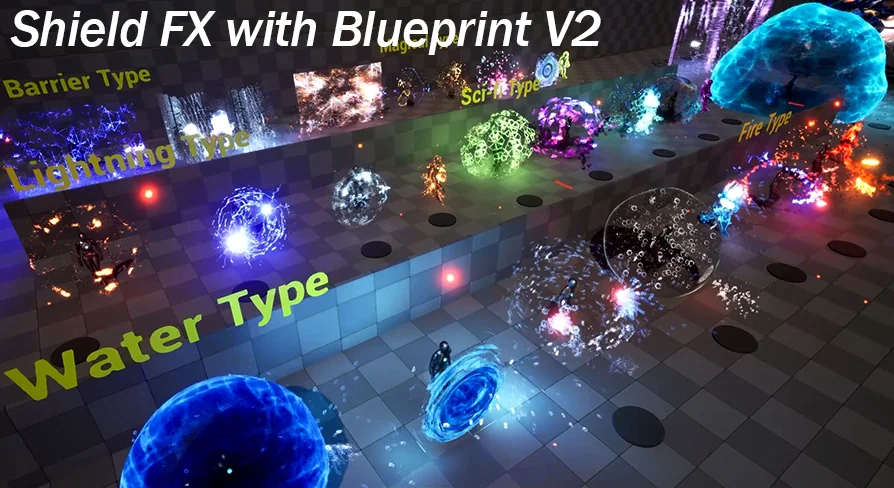
The library provides 25 distinct kinds of shields alongside 15 dedicated hit particle systems. Rather than applying a single universal impact puff across completely different materials, shields possess their own corresponding hit particles to preserve stylistic consistency when projectiles or melee strikes connect.
The visual themes span multiple gameplay aesthetics:
Elemental Forces: Water, Fire, and Lightning effects convey raw magical or environmental energy, supported by impact systems tailored to fluid or crackling dispersion. Sand variants further extend ground and earthy elemental presentations.
Hard-Light and Technological Barriers: Dedicated Sci-fi and standard barrier motifs supply structured, digital defensive perimeters suited for spacecraft, turrets, and cybernetic units.
Stylized and Organic Forms: Magical aesthetics, fragile Glass variants, and decorative Butterfly shield configurations provide distinct thematic signatures for specialized character abilities.
Because hit particles are paired with the barrier types, an impact against a Glass or Water shield disperses visual debris distinct from the energetic bursts produced by Fire or Sci-fi energy fields. This immediate feedback helps players instantly read impact locations during fast-paced skirmishes.
Blueprint Damage Reaction and Hit Point Controls
Defensive barriers require functional logic to communicate how much damage they can sustain before collapsing. Shield VFX v2 integrates core gameplay logic directly inside Blueprint assets, connecting incoming hits to tangible gameplay parameters rather than remaining purely cosmetic displays.
Within the Blueprint implementation, developers can define and set explicit health point values. This numeric foundation dictates how the shield responds to combat pressure. Directly linked to this numeric system is an integrated health bar. Designers can modify both the color and dimensions of the health bar to match project-specific user interface guidelines, anchoring the status display directly above or alongside the active defensive barrier in world space.
Material Flickering Logic and Visual Thresholds
Visual deterioration in Shield VFX v2 is handled primarily through material-level functions rather than external script overhead. When damage is registered, the underlying material logic initiates an interactive damage reaction, providing real-time feedback across the surface of the barrier.
The damage reaction setup includes several adjustable parameters:
Flicker Color Selection: The flashing highlight color visible during hit registration can be tinted to contrast against the base shield tone, ensuring high visibility during intense combat scenes.
Flicker Speed Modulation: The rate of the impact strobe or pulsation can be quickened or slowed to match the cadence of incoming fire or the physical weight of the barrier.
Damage Percentage Activation Threshold: A dedicated percentage value parameter determines precisely when surface flickering begins. Shields can maintain visual stability during early hits and transition into unstable, rapid flickering only after total durability drops past a specific percentage threshold.
Mesh Scaling, Animation Speed, and Particle Customization
Every defense effect in the collection is structured for visual adjustment so technical artists can match barriers to varying collision boundaries and actor silhouettes. Meshes are completely customizable, allowing users to swap default geometry for unique shields, spherical shells, rectangular deployment walls, or localized body auras.
Color palettes are exposed for straightforward tinting, enabling single shield archetypes to serve multiple team affiliations or power ranks through hue shifts. Animation playback speeds can be throttled or accelerated, giving creators the choice between sluggish, heavy force fields and energetic, rapidly oscillating shields. Furthermore, barrier size scales dynamically, accommodating small handheld personal shields up to massive vehicle or structural perimeter envelopes without breaking particle density or distorting surface shaders.
Game Optimization and UEFN Pipeline Integration
Shield VFX v2 is constructed as an optimized asset ready for direct deployment in runtime game projects. Particle systems utilize Niagara logic to maintain high frame rates even when multiple barriers take simultaneous weapon impacts on screen. The combination of lightweight material calculations and structured particle counts ensures performance remains stable across crowded multiplayer encounters.
Beyond standard Unreal Engine game environments, the asset translates directly into Unreal Editor for Fortnite (UEFN) workflows. Creators adapting marketplace content for UEFN projects can implement these shields and impact particles using established asset migration methods. Whether supporting custom mini-game mechanics in UEFN or driving combat feedback in complete action titles, the modular combination of 25 shield styles, 15 hit bursts, and integrated Blueprint HP controls delivers a complete defense visualization pipeline.
 Spells & Combat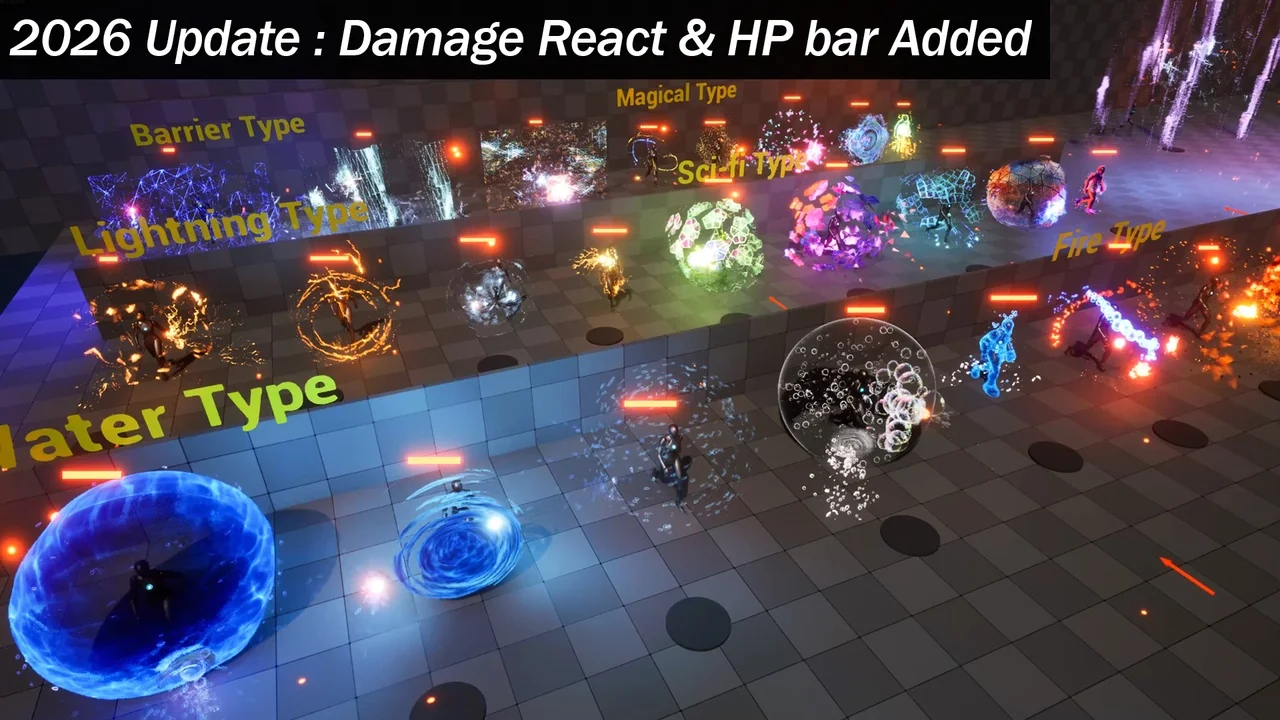
 Spells & Combat
 Spells & Combat
 Spells & Combat