"95fdaf16012263fa"{"id":"1002345","slug":"rusty-beams","title":"Rusty Beams","category":"Bridges","engine":"4.18+,5.0+","assetVersion":"","engineVersion":"Engine Version: 4.18+,5.0+","tag":"Bridges","accent":"blue","visual":"mech","summary":"Rusty Beams bundles old I-beams, C-beams, roof beams, brackets, floor panels, stairs, and scaffolding assets with material instances for rust or old paint.","platform":"Unreal Engine","indexPolicy":"index","publishedAt":"2026-11-06T06:52:24.913Z","updatedAt":"2026-11-06T06:52:24.913Z","sourceNotes":[],"fileContents":[],"compatibility":["Unreal Engine","Engine Version: 4.18+,5.0+"],"featuredImage":{"alt":"Rusty Beams","src":"/wp-content/uploads/published/2026/11/75e306bf0a14-2e4d758f-014e-419c-bb84-8b468052d2e4-506d4e64dd.webp"},"hasDownloadLink":true,"downloads":0,"terms":[{"taxonomy":"category","slug":"bridges","name":"Bridges"}],"galleryImages":[{"src":"/wp-content/uploads/published/2026/11/5cd3af85ba43-5bff2bc6-d10f-4e74-8613-26553caf183d-6823568022.webp","alt":"Rusty Beams"},{"src":"/wp-content/uploads/published/2026/11/53e4f07b9ddd-ed3132d4-0ec2-4afb-a479-bb1fd90d7cc4-d38ff8af7b.webp","alt":"Rusty Beams"},{"src":"/wp-content/uploads/published/2026/11/fbe294ae46b2-54ee0f39-4a34-432f-8ce3-ddf2fc602504-3762cfc5a1.webp","alt":"Rusty Beams"},{"src":"/wp-content/uploads/published/2026/11/0954d1c8f9d4-2c52389b-d1cd-4689-8923-c518274f7e72-9d9bfbe253.webp","alt":"Rusty Beams"},{"src":"/wp-content/uploads/published/2026/11/b96691ad1c96-b29e5c63-9f8d-4f77-a6d5-5700e2f85b48-193fe025fd.webp","alt":"Rusty Beams"},{"src":"/wp-content/uploads/published/2026/11/7d9ac71a160e-af96b878-5a86-4400-b2d3-ac11ad8312b1-227d03497c.webp","alt":"Rusty Beams"},{"src":"/wp-content/uploads/published/2026/11/d0e01558bb9a-0e16a453-df5b-446c-b4b4-fa5ee470011c-d702de25fe.webp","alt":"Rusty Beams"},{"src":"/wp-content/uploads/published/2026/11/afd9253f4641-d39af06e-b416-4bf5-ab05-012a049cfbca-39504f9a96.webp","alt":"Rusty Beams"},{"src":"/wp-content/uploads/published/2026/11/cb2d61689ecc-b811d2fa-10b8-4654-bdb7-53e5b89f501a-9c67c8d2d4.webp","alt":"Rusty Beams"},{"src":"/wp-content/uploads/published/2026/11/93580d6d779e-1bad2821-659b-411b-885c-34f8e62cf134-42a5c7b3d9.webp","alt":"Rusty Beams"}],"accessPanel":{"kind":"resource","title":"Get this resource","eyebrow":"Free resource","message":"3DCGHUB is the service provider for this listing. Access is fulfilled through the official publisher channel.","fileName":"Content.7z","safetyNote":"Resources are manually reviewed before listing to improve quality and reduce obvious risks.","actionLabel":"Get this resource","resourceType":"Resource archive","versions":[]},"contentHtml":"\u003cp\u003eA bridge span or an abandoned factory interior needs structural pieces that look aged but still assemble into something plausible. Rusty Beams addresses that gap with a set of old rusty beams, brackets, and floor pieces that can be combined into bridge work, factory frames, construction-site clutter, or background structure. The visual target is not clean steel. It is the kind of rusted, old-paint surface that reads as years of exposure.\u003c/p\u003e \u003ch2\u003eAssembling Bridge Spans and Factory Frames from I-Beams and C-Beams\u003c/h2\u003e\n\u003cp\u003eThe beam selection starts with three beam types and a roof beam. The named list includes i-beam wide, i-beam, c-beam, and roof beams, which gives a scene builder more than one silhouette for vertical supports, horizontal runs, and overhead structure. A wide I-beam can carry the visual weight of a bridge or a factory bay. A C-beam can act as a narrower edge, a rail, or a secondary support. Roof beams sit above the main frame and help close the top of an interior.\u003c/p\u003e\n\u003cp\u003eBecause the pieces are separate, they can be mixed rather than used as a single fixed structure. That flexibility suits old bridges, abandoned factories, and construction sites, where beams rarely appear in a tidy grid. The same beam shapes can be repeated to build a long span, broken into shorter runs, or left as partial frames that suggest a structure in progress or one that has partly come down. The result can blend into a background or take a more central role in a scene that depends on industrial structure.\u003c/p\u003e \u003ch2\u003eBrackets in Low and High Poly for Joints That Read\u003c/h2\u003e\n\u003cp\u003eConnections are where a beam kit either holds together or looks like loose parts. Rusty Beams includes two brackets in its core set, with a right-angle bracket and a flat T-bracket named among the pieces. An added group brings four types of joining brackets, each available in a low-poly and a high-poly version. That range lets a builder choose simpler geometry for background work and denser geometry for joints that sit closer to the camera.\u003c/p\u003e\n\u003cp\u003eThe bracket count also supports different assembly habits. A right-angle bracket can mark a corner where a vertical support meets a horizontal beam. A flat T-bracket can sit at a junction where one run meets another. With four joining bracket types in low and high poly, the set can be used to build frames that look connected rather than merely placed next to each other. For construction-site scenes, exposed brackets can become part of the detail. In a factory interior, they can reinforce the sense that the structure was assembled from standard parts.\u003c/p\u003e \u003ch2\u003eMaterial Instances for Old Paint or Straight Rust\u003c/h2\u003e\n\u003cp\u003eEach beam has a material instance. That is the main control point for the look of the set. A beam can be pushed toward an old paint finish with a color selection, or left as a rusty beam without the paint treatment. The same geometry can therefore serve a bridge with faded industrial paint, a factory frame with rust only, or a construction site where different beams have aged in different ways.\u003c/p\u003e\n\u003cp\u003eColor selection matters when the beams need to sit inside an existing palette. Old paint does not have to mean a single default color. The material instance allows a chosen color to be applied to the old paint look, so a scene can carry a consistent accent across several beams or separate one structure from another. Rust-only beams provide the opposite option: a more direct aged surface without the painted layer. Used together, the two approaches can break up repetition across a long bridge or a large factory wall.\u003c/p\u003e \u003ch2\u003eFloor Panels, Stairs, and Scaffolding in Abandoned Interiors\u003c/h2\u003e\n\u003cp\u003eStructural beams are only part of the set. Rusty Beams also includes a floor beam, a flat floor panel, stairs, and two flooring and wall types. Those pieces turn the kit from a frame-only collection into something that can shape a walkable or visually layered interior. A flat floor panel can close a gap between beams. A floor beam can sit under that panel as visible support. Stairs add a change in level, which is useful in factory interiors, construction sites, and any scene that needs vertical movement.\u003c/p\u003e\n\u003cp\u003eScaffolding assets extend the same industrial vocabulary. They can be used around a construction site, placed against a factory wall, or grouped with beams to suggest temporary work. The two flooring and wall types give another surface option, so the set can move from open structural frames to enclosed or semi-enclosed spaces. In an abandoned factory, those surfaces can separate work areas or create platforms. On a bridge, they can support the deck or form part of the surrounding structure. The named pieces work as a kit: beams provide the frame, brackets provide the joints, and floor, stair, and scaffolding elements fill in the parts that make the structure feel usable.\u003c/p\u003e \u003ch2\u003eWhere Rusty Beams Fits in a Scene Build\u003c/h2\u003e\n\u003cp\u003eRusty Beams is suited to old bridges, abandoned factories, construction sites, and backgrounds that need structural detail without becoming the focus. The set reads as realistic and old, with rust as the common surface and scaffolding as part of the industrial vocabulary. It can also serve apocalyptic scenes where structures are aged and partly stripped back. A background bridge can use a few wide I-beams and a roof beam. A factory interior can use C-beams, brackets, floor panels, and stairs to build a more involved space. A construction site can lean on scaffolding and joining brackets to suggest assembly.\u003c/p\u003e\n\u003cp\u003eFor a production, Rusty Beams works as a structural kit that can be brought in early to establish scale and then refined through material instances and bracket choices. The low-poly and high-poly bracket versions allow the same joint language to appear at different levels of detail. The old-paint or rust-only material instances make it possible to carry one set across multiple scenes without every beam looking identical. Use it when the set dressing needs to carry structural logic, not just surface rust.\u003c/p\u003e\n\n\u003ch2\u003eContinue Browsing Similar Packs\u003c/h2\u003e\n\u003cul\u003e\n\u003cli\u003e\u003ca href=\"https://3dcghub.com/decay-oil-drums-district-rusty-industrial-slum/\" rel=\"noopener noreferrer\"\u003eDecay: Oil Drums District - [Rusty Industrial Slum]\u003c/a\u003e\u003c/li\u003e\n\u003cli\u003e\u003ca href=\"https://3dcghub.com/wooden-bridges-optimized/\" rel=\"noopener noreferrer\"\u003eWooden Bridges Optimized\u003c/a\u003e\u003c/li\u003e\n\u003cli\u003e\u003ca href=\"https://3dcghub.com/cellar-materials/\" rel=\"noopener noreferrer\"\u003eCellar Materials\u003c/a\u003e\u003c/li\u003e\n\u003cli\u003e\u003ca href=\"https://3dcghub.com/skills-vfx/\" rel=\"noopener noreferrer\"\u003eSkills VFX\u003c/a\u003e\u003c/li\u003e\n\u003cli\u003e\u003ca href=\"https://3dcghub.com/magic-beams/\" rel=\"noopener noreferrer\"\u003eMagic Beams\u003c/a\u003e\u003c/li\u003e\n\u003c/ul\u003e","contentTextLength":6081,"navigation":{"current":23,"total":4291,"previous":{"id":"1002346","slug":"scalability-settings-umg-widget","title":"Scalability Settings UMG Widget","category":"Procedural Systems","platform":"Unreal Engine","updatedAt":"2026-11-06T06:53:24.102Z"},"next":{"id":"1002344","slug":"runtime-screenshot-pro","title":"Runtime Screenshot Pro","category":"Game Development Resource","platform":"Unreal Engine","updatedAt":"2026-11-06T06:51:09.717Z"}},"relatedResources":[{"id":"6871","slug":"decay-oil-drums-district-rusty-industrial-slum","title":"Decay: Oil Drums District - [Rusty Industrial Slum]","category":"Apocalyptic / Post-apocalyptic","engine":"5.1+","assetVersion":"Engine version: 5.1+","engineVersion":"5.1","tag":"Apocalyptic","accent":"blue","visual":"city","summary":"Transform your game environments with a massive collection of over 450 industrial assets. This pack features smart shaders and blueprint tools to help you build realistic, weathered slums and wastelands.","platform":"Unreal Engine","indexPolicy":"index","publishedAt":"2026-02-20T15:48:34.000Z","updatedAt":"2026-04-19T15:56:06.000Z","sourceNotes":[],"fileContents":[],"compatibility":["Unreal Engine","Engine version: 5.1+"],"featuredImage":{"alt":"Decay: Oil Drums District - [Rusty Industrial Slum]","src":"https://3dcghub.com/wp-content/uploads/2026/02/9e2ac79e-b21a-487e-99d8-39ff14d9ba83.webp"},"hasDownloadLink":true,"downloads":1},{"id":"1186","slug":"wooden-bridges-optimized","title":"Wooden Bridges Optimized","category":"Bridges","engine":"4.26+,5.0+","assetVersion":"Engine version: 4.26+,5.0+","engineVersion":"4.26","tag":"Bridges","accent":"blue","visual":"character","summary":"Enhance your game with highly optimized wooden and rope bridges. Featuring HISM technology and full Blueprint customization for seamless Unreal Engine integrati","platform":"Unreal Engine","indexPolicy":"index","publishedAt":"2026-02-06T16:56:40.000Z","updatedAt":"2026-04-19T15:58:12.000Z","sourceNotes":[],"fileContents":[],"compatibility":["Unreal Engine","Engine version: 4.26+,5.0+"],"featuredImage":{"alt":"Wooden Bridges Optimized","src":"https://3dcghub.com/wp-content/uploads/2026/02/fd88231d-beaa-4ceb-9650-75bd957ad2c7.png"},"hasDownloadLink":true,"downloads":1},{"id":"12301","slug":"cellar-materials","title":"Cellar Materials","category":"Building \u0026 Human-made","engine":"4.26+,5.0+","assetVersion":"Engine version: 4.26+,5.0+","engineVersion":"4.19","tag":"Building","accent":"blue","visual":"luts","summary":"Enhance your underground environments with this collection of 24 Cellar Materials. Featuring a mix of concrete, metal, and brick, these assets provide a gritty, realistic aesthetic for any digital scene.","platform":"Unreal Engine","indexPolicy":"index","publishedAt":"2026-03-07T12:13:43.000Z","updatedAt":"2026-04-19T15:48:00.000Z","sourceNotes":[],"fileContents":[],"compatibility":["Unreal Engine","Engine version: 4.26+,5.0+"],"featuredImage":{"alt":"Cellar Materials","src":"https://3dcghub.com/wp-content/uploads/2026/03/e2a191d0-6413-4508-9e2f-b4e2d911c38c.webp"},"hasDownloadLink":true,"downloads":0}]}
Bridges
Rusty Beams
Rusty Beams bundles old I-beams, C-beams, roof beams, brackets, floor panels, stairs, and scaffolding assets with material instances for rust or old paint.
Category:Unreal Engine,BridgesPlatform: Unreal EngineEngine Version: 4.18+,5.0+Published: Nov 6, 2026
Bridges
Resource overview
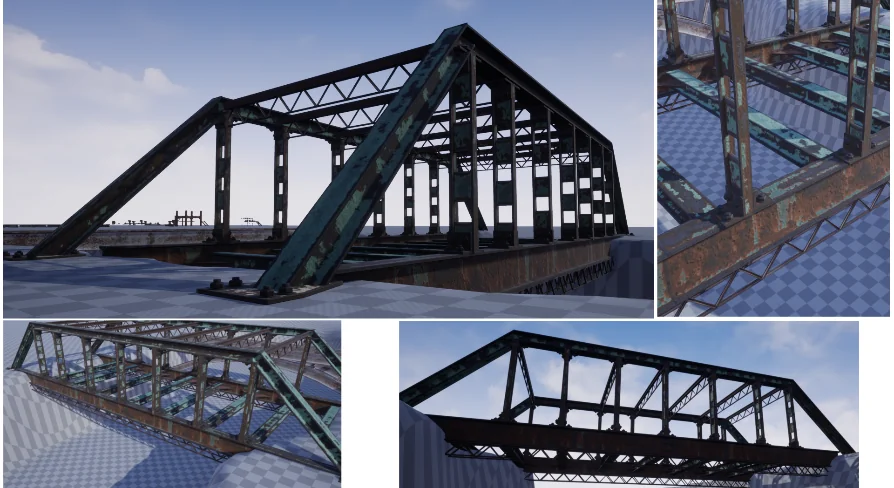
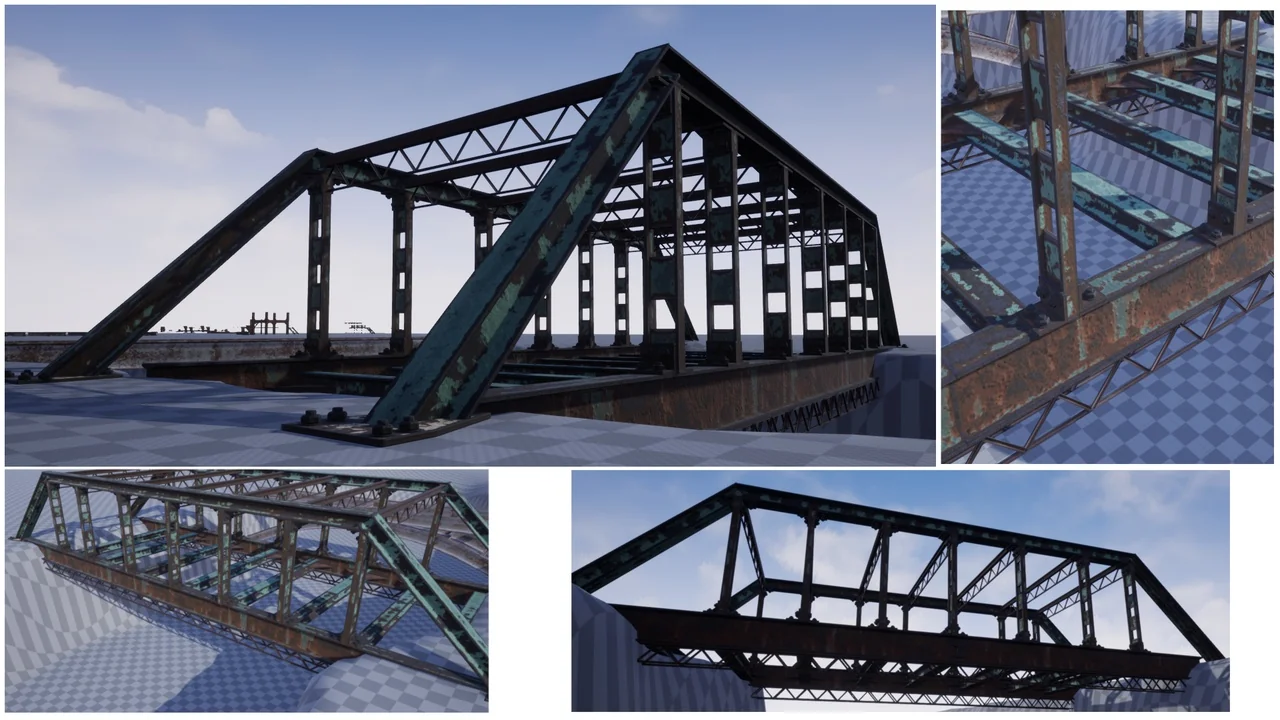
A bridge span or an abandoned factory interior needs structural pieces that look aged but still assemble into something plausible. Rusty Beams addresses that gap with a set of old rusty beams, brackets, and floor pieces that can be combined into bridge work, factory frames, construction-site clutter, or background structure. The visual target is not clean steel. It is the kind of rusted, old-paint surface that reads as years of exposure.
Assembling Bridge Spans and Factory Frames from I-Beams and C-Beams
The beam selection starts with three beam types and a roof beam. The named list includes i-beam wide, i-beam, c-beam, and roof beams, which gives a scene builder more than one silhouette for vertical supports, horizontal runs, and overhead structure. A wide I-beam can carry the visual weight of a bridge or a factory bay. A C-beam can act as a narrower edge, a rail, or a secondary support. Roof beams sit above the main frame and help close the top of an interior.
Because the pieces are separate, they can be mixed rather than used as a single fixed structure. That flexibility suits old bridges, abandoned factories, and construction sites, where beams rarely appear in a tidy grid. The same beam shapes can be repeated to build a long span, broken into shorter runs, or left as partial frames that suggest a structure in progress or one that has partly come down. The result can blend into a background or take a more central role in a scene that depends on industrial structure.
Brackets in Low and High Poly for Joints That Read
Connections are where a beam kit either holds together or looks like loose parts. Rusty Beams includes two brackets in its core set, with a right-angle bracket and a flat T-bracket named among the pieces. An added group brings four types of joining brackets, each available in a low-poly and a high-poly version. That range lets a builder choose simpler geometry for background work and denser geometry for joints that sit closer to the camera.
The bracket count also supports different assembly habits. A right-angle bracket can mark a corner where a vertical support meets a horizontal beam. A flat T-bracket can sit at a junction where one run meets another. With four joining bracket types in low and high poly, the set can be used to build frames that look connected rather than merely placed next to each other. For construction-site scenes, exposed brackets can become part of the detail. In a factory interior, they can reinforce the sense that the structure was assembled from standard parts.
Material Instances for Old Paint or Straight Rust
Each beam has a material instance. That is the main control point for the look of the set. A beam can be pushed toward an old paint finish with a color selection, or left as a rusty beam without the paint treatment. The same geometry can therefore serve a bridge with faded industrial paint, a factory frame with rust only, or a construction site where different beams have aged in different ways.
Color selection matters when the beams need to sit inside an existing palette. Old paint does not have to mean a single default color. The material instance allows a chosen color to be applied to the old paint look, so a scene can carry a consistent accent across several beams or separate one structure from another. Rust-only beams provide the opposite option: a more direct aged surface without the painted layer. Used together, the two approaches can break up repetition across a long bridge or a large factory wall.
Floor Panels, Stairs, and Scaffolding in Abandoned Interiors
Structural beams are only part of the set. Rusty Beams also includes a floor beam, a flat floor panel, stairs, and two flooring and wall types. Those pieces turn the kit from a frame-only collection into something that can shape a walkable or visually layered interior. A flat floor panel can close a gap between beams. A floor beam can sit under that panel as visible support. Stairs add a change in level, which is useful in factory interiors, construction sites, and any scene that needs vertical movement.
Scaffolding assets extend the same industrial vocabulary. They can be used around a construction site, placed against a factory wall, or grouped with beams to suggest temporary work. The two flooring and wall types give another surface option, so the set can move from open structural frames to enclosed or semi-enclosed spaces. In an abandoned factory, those surfaces can separate work areas or create platforms. On a bridge, they can support the deck or form part of the surrounding structure. The named pieces work as a kit: beams provide the frame, brackets provide the joints, and floor, stair, and scaffolding elements fill in the parts that make the structure feel usable.
Where Rusty Beams Fits in a Scene Build
Rusty Beams is suited to old bridges, abandoned factories, construction sites, and backgrounds that need structural detail without becoming the focus. The set reads as realistic and old, with rust as the common surface and scaffolding as part of the industrial vocabulary. It can also serve apocalyptic scenes where structures are aged and partly stripped back. A background bridge can use a few wide I-beams and a roof beam. A factory interior can use C-beams, brackets, floor panels, and stairs to build a more involved space. A construction site can lean on scaffolding and joining brackets to suggest assembly.
For a production, Rusty Beams works as a structural kit that can be brought in early to establish scale and then refined through material instances and bracket choices. The low-poly and high-poly bracket versions allow the same joint language to appear at different levels of detail. The old-paint or rust-only material instances make it possible to carry one set across multiple scenes without every beam looking identical. Use it when the set dressing needs to carry structural logic, not just surface rust.
 Bridges
 Apocalyptic
 Bridges
 Building