"031373f479d9561a"{"id":"1000250","slug":"polygon-prototype-pack","title":"POLYGON - Prototype Pack","category":"Tools, Objects \u0026 Decor","engine":"5.3+","assetVersion":"","engineVersion":"Engine Version: 5.3+","tag":"Tools","accent":"blue","visual":"mech","summary":"A comprehensive lowpoly asset toolkit by Synty Studios featuring 444 modular building pieces, props, stylized nature, and characters for rapid game development.","platform":"Unreal Engine","publishedAt":"2026-06-30T21:05:29.647Z","updatedAt":"2026-06-30T21:05:29.647Z","sourceNotes":[],"fileContents":[],"compatibility":["Unreal Engine","Engine Version: 5.3+"],"featuredImage":{"alt":"POLYGON - Prototype Pack","src":"/wp-content/uploads/published/2026/06/242c4ec774c3-433f81f9-e50c-438a-ac44-7fb4ceef52e9-d9443a89a4.webp"},"hasDownloadLink":true,"downloads":3,"terms":[{"taxonomy":"category","slug":"tools-objects-and-decor","name":"Tools, Objects \u0026 Decor"}],"galleryImages":[{"src":"/wp-content/uploads/published/2026/06/ce75284a69bb-5a90b0a7-0849-4dad-9fa2-fd138016751f-e2290206ca.webp","alt":"POLYGON - Prototype Pack"},{"src":"/wp-content/uploads/published/2026/06/c05855739781-789568a9-55e0-4d5f-be93-d372969ded6a-90c45197ab.webp","alt":"POLYGON - Prototype Pack"},{"src":"/wp-content/uploads/published/2026/06/76bd27475dd0-67ddd678-86c0-4406-b19d-ea12d41a6ae5-4227b4837f.webp","alt":"POLYGON - Prototype Pack"},{"src":"/wp-content/uploads/published/2026/06/e16560e6af62-a2b948c8-09a0-41f2-9f00-fa9e955fcc6a-c9e6e7869b.webp","alt":"POLYGON - Prototype Pack"},{"src":"/wp-content/uploads/published/2026/06/791c327648ca-af509833-49e1-4ed9-8f58-9c72b7ebba83-5df9b48e4c.webp","alt":"POLYGON - Prototype Pack"},{"src":"/wp-content/uploads/published/2026/06/4b17ebfbb8b0-f2dda2ac-6409-4787-81db-20c3b46c9310-84fd448c53.webp","alt":"POLYGON - Prototype Pack"},{"src":"/wp-content/uploads/published/2026/06/d09990623369-1d432301-9317-4940-be07-3e58500dd57a-d042998fb3.webp","alt":"POLYGON - Prototype Pack"},{"src":"/wp-content/uploads/published/2026/06/86bf9885533b-51b53694-f395-4b06-b31d-2a82c002ab75-f0408f17a7.webp","alt":"POLYGON - Prototype Pack"},{"src":"/wp-content/uploads/published/2026/06/e30ae9c55f25-a7e636f9-8375-4a0e-919a-2f20024051d9-40e3c8181b.webp","alt":"POLYGON - Prototype Pack"},{"src":"/wp-content/uploads/published/2026/06/398838a7c849-138a0e90-75dd-4239-bc11-51c00aa8e5f2-28dcb6b4e6.webp","alt":"POLYGON - Prototype Pack"}],"accessPanel":{"kind":"resource","title":"Download this resource","eyebrow":"Free Download","message":"Log in or create a free account to start your download.","fileName":"Content.7z","safetyNote":"Resources are manually reviewed before listing to improve quality and reduce obvious risks.","actionLabel":"Download Free","resourceType":"Resource archive"},"contentHtml":"\u003ch2\u003eConstructing Modular Environments for Rapid Iteration\u003c/h2\u003e\n\u003cp\u003eWhen standing up the initial geometry for a platformer, an RPG, or a shooter, the earliest stages of level design require structural pieces that prioritize scale and spatial flow over intricate detail. The POLYGON - Prototype Pack by Synty Studios delivers a robust framework for this exact phase of rapid game development. By relying on a modular architecture system, level designers can snap together complex, navigable spaces that form the foundational layout of a project.\u003c/p\u003e\n\u003cp\u003eThe structural core of the toolkit includes a comprehensive suite of building assets. Developers can map out interior rooms and exterior facades using standard walls, curved walls, doors, and windows. Structural support and verticality are handled through an array of floors, roofs, columns, and rails. To ensure players can traverse multi-level environments, the package supplies ramps, stairs, and ladders, allowing for immediate testing of jump heights, line-of-sight, and traversal mechanics.\u003c/p\u003e\n\u003cp\u003eTo accommodate different visual preferences during the blockout phase, the building assets are provided in both POLYGON and SIMPLE versions. This distinction allows teams to choose between a slightly more defined lowpoly aesthetic or a strictly minimalist geometric shell while mapping out their game worlds.\u003c/p\u003e\n\u003ch2\u003ePopulating the Diagnostic Play Space\u003c/h2\u003e\n\u003cp\u003eA playable mockup requires more than just empty hallways and flat arenas. To test interaction, cover systems, and item discovery, a level must be populated with physical obstacles and points of interest. Drawing from a pool of 444 unique assets, the toolkit supplies a wide variety of props that serve as immediate stand-ins for final game mechanics.\u003c/p\u003e\n\u003cp\u003eFor inventory and loot systems, the environment can be seeded with chests, standard crates, barrels, and vases or urns. The inclusion of a dedicated question mark crate provides an instantly recognizable interactable object for classic platforming mechanics. \u003c/p\u003e\n\u003cp\u003eWhen building out industrial or urban testing zones, developers can restrict player movement or provide tactical cover using road cones, road barriers, and pipe sets. Scattered debris and makeshift structures can be mocked up utilizing basic wood planks and metal plates with bolts, helping to define the visual language of a diagnostic level kit before any final art is commissioned.\u003c/p\u003e\n\u003ch2\u003eShaping the Stylized Lowpoly Landscape\u003c/h2\u003e\n\u003cp\u003eBeyond interior architecture, the toolkit provides the necessary elements to generate outdoor biomes and natural barriers. The stylized nature of the lowpoly assets ensures that even a rough prototype maintains a cohesive, readable visual identity.\u003c/p\u003e\n\u003cp\u003eGround layouts are established using dedicated terrains, which can then be detailed with scattered rocks and pebbles to test uneven surfaces or organic pathing. The vegetation is highly varied, offering distinctly shaped foliage to represent different potential environments. Developers can populate their exterior scenes with tropical trees, pine trees, basic bushes, and highly stylized variants like the cube tree and the polygon blob tree. Generic environmental assets, including grasses and clouds, round out the skybox and ground cover, giving a sense of scale and atmosphere to an otherwise bare prototype.\u003c/p\u003e\n\u003ch2\u003ePrototyping Characters, Weapons, and Vehicles\u003c/h2\u003e\n\u003cp\u003eTesting gameplay loops requires actors to inhabit the world and tools for those actors to wield. Rather than using static capsules or unrigged blocks, the toolkit provides specific character models to represent players, enemies, or NPCs. These lowpoly figures come in Male and Female configurations across three distinct styles: Dummy, Face, and No Face. This variety allows developers to visually separate different character classes or factions during early testing.\u003c/p\u003e\n\u003cp\u003eFor combat and interaction, the package includes a foundational armory. Melee systems can be prototyped using a bat, knife, sword, and shield, while ranged mechanics are covered by a rifle and a pistol. \u003c/p\u003e\n\u003cp\u003eTo measure performance and test specific game modes, developers can implement functional stand-ins like the boost pad, bomb, stopwatch, and shooting target. Furthermore, projects that require driving mechanics or larger-scale world traversal can utilize the included Sports car 1, providing an immediate physical vehicle for testing speed, physics, and road width.\u003c/p\u003e\n\u003ch2\u003eWorkflow Integration and Color Coding\u003c/h2\u003e\n\u003cp\u003eA successful blockout relies heavily on readability. To ensure that different elements of a level are instantly recognizable, the assets feature 10 alternative texture colors. This allows a level designer to establish a clear visual language—such as assigning red to hazardous areas, blue to interactive props, and grey to static geometry—without needing to create custom materials from scratch.\u003c/p\u003e\n\u003cp\u003eFor teams looking to understand how the 444 assets fit together, the included demo scene serves as a practical reference. It demonstrates how modular walls align with ramps, how props populate empty corners, and how the stylized lighting interacts with the lowpoly geometry. Ultimately, the POLYGON - Prototype Pack functions as an essential diagnostic tool, allowing developers to establish flow, pacing, and mechanics before committing to the expensive and time-consuming process of final asset production.\u003c/p\u003e\n\n\u003ch2\u003eContinue Browsing Similar Packs\u003c/h2\u003e\n\u003cul\u003e\n\u003cli\u003e\u003ca href=\"https://3dcghub.com/new-years-pack/\" title=\"New Year\u0026#039;s Pack\"\u003eNew Year\u0026#039;s Pack\u003c/a\u003e\u003c/li\u003e\n\u003cli\u003e\u003ca href=\"https://3dcghub.com/canine-playground-loot-place/\" title=\"Canine playground, Loot place\"\u003eCanine playground, Loot place\u003c/a\u003e\u003c/li\u003e\n\u003cli\u003e\u003ca href=\"https://3dcghub.com/garden-environment/\" title=\"Garden Environment\"\u003eGarden Environment\u003c/a\u003e\u003c/li\u003e\n\u003cli\u003e\u003ca href=\"https://3dcghub.com/vintage-scifi-pack-vol-3-egregores/\" title=\"Vintage SciFi pack VOL 3 Egregores\"\u003eVintage SciFi pack VOL 3 Egregores\u003c/a\u003e\u003c/li\u003e\n\u003cli\u003e\u003ca href=\"https://3dcghub.com/polygon-apocalypse-wasteland/\" title=\"POLYGON - Apocalypse Wasteland\"\u003ePOLYGON - Apocalypse Wasteland\u003c/a\u003e\u003c/li\u003e\n\u003c/ul\u003e","contentTextLength":5464,"navigation":{"current":1099,"total":3223,"previous":{"id":"1000251","slug":"unreal-engine-5-the-complete-automotive-cinematic-course","title":"Unreal Engine 5 - The Complete Automotive Cinematic Course","category":"Unreal Engine","platform":"Unreal Engine","updatedAt":"2026-06-30T21:27:39.957Z"},"next":{"id":"1000249","slug":"modern-rpg-bundle-v7-0-1","title":"Modern RPG BUNDLE v7.0.1","category":"RPG","platform":"Unreal Engine","updatedAt":"2026-06-30T20:57:03.116Z"}},"relatedResources":[{"id":"1000570","slug":"christmas-assets-volume-1","title":"Christmas Assets Volume 1","category":"Tools, Objects \u0026 Decor","engine":"5.1+","assetVersion":"","engineVersion":"Engine Version: 5.1+","tag":"Tools","accent":"blue","visual":"mech","summary":"A free Nanite-ready Christmas asset update tied to the Carnival Theme Park package, featuring a Christmas tree, gifts, toys, a Santa statue, wreaths, cookies, a","platform":"Unreal Engine","publishedAt":"2026-07-16T21:44:55.238Z","updatedAt":"2026-07-16T21:44:55.238Z","sourceNotes":[],"fileContents":[],"compatibility":["Unreal Engine","Engine Version: 5.1+"],"featuredImage":{"alt":"Christmas Assets Volume 1","src":"/wp-content/uploads/published/2026/07/727b3d7f52c5-f21fe630-a3e2-4b7c-8653-3abf61d9f346-58d5a2936a.webp"},"hasDownloadLink":true,"downloads":0},{"id":"4537","slug":"canine-playground-loot-place","title":"Canine playground, Loot place","category":"Tools, Objects \u0026 Decor","engine":"5.3+","assetVersion":"Engine version: 5.3+","engineVersion":"5.3","tag":"Tools","accent":"blue","visual":"character","summary":"Enhance your game with a realistic canine playground and loot area. This multipurpose asset pack features high-quality props for urban and nature scenes.","platform":"Unreal Engine","publishedAt":"2026-02-13T08:39:39.000Z","updatedAt":"2026-04-19T15:57:07.000Z","sourceNotes":[],"fileContents":[],"compatibility":["Unreal Engine","Engine version: 5.3+"],"featuredImage":{"alt":"Canine playground, Loot place","src":"https://3dcghub.com/wp-content/uploads/2026/02/ca803d9c-32b5-4c8d-abc3-032c4cfca636.webp"},"hasDownloadLink":true,"downloads":0},{"id":"4731","slug":"new-years-pack","title":"New Year's Pack","category":"Tools, Objects \u0026 Decor","engine":"5.4+","assetVersion":"Engine version: 5.4+","engineVersion":"5.4","tag":"Tools","accent":"blue","visual":"character","summary":"Create festive scenes with the Ultimate New Year's Pack. Features Santa characters, reindeers, modular rooms, and 130+ decor items for Unreal Engine 5.","platform":"Unreal Engine","publishedAt":"2026-02-13T09:31:05.000Z","updatedAt":"2026-04-19T15:57:05.000Z","sourceNotes":[],"fileContents":[],"compatibility":["Unreal Engine","Engine version: 5.4+"],"featuredImage":{"alt":"New Year's Pack","src":"https://3dcghub.com/wp-content/uploads/2026/02/733fd5a7-750a-4a1a-a573-ffa50e717ea7.webp"},"hasDownloadLink":true,"downloads":0}]}
Tools
POLYGON - Prototype Pack
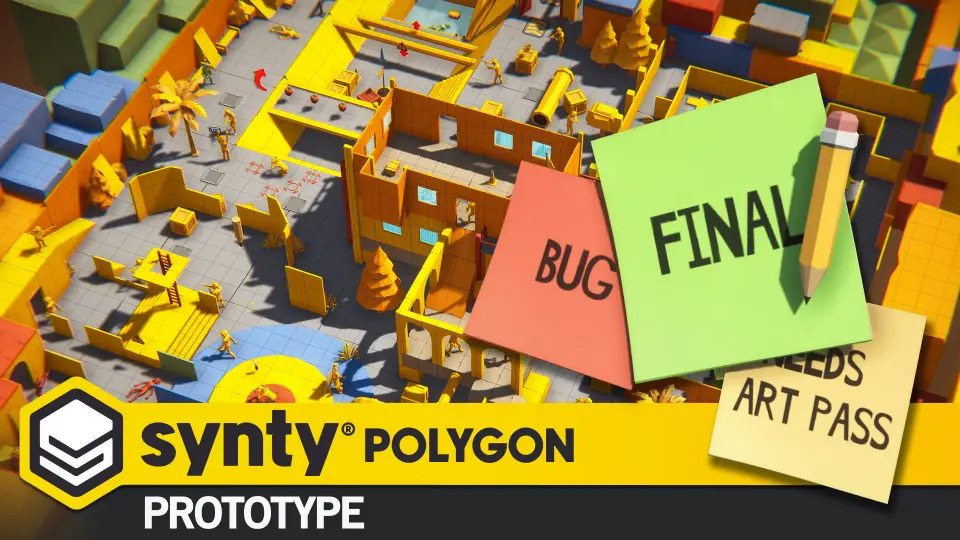
A comprehensive lowpoly asset toolkit by Synty Studios featuring 444 modular building pieces, props, stylized nature, and characters for rapid game development.
Constructing Modular Environments for Rapid Iteration
When standing up the initial geometry for a platformer, an RPG, or a shooter, the earliest stages of level design require structural pieces that prioritize scale and spatial flow over intricate detail. The POLYGON - Prototype Pack by Synty Studios delivers a robust framework for this exact phase of rapid game development. By relying on a modular architecture system, level designers can snap together complex, navigable spaces that form the foundational layout of a project.
The structural core of the toolkit includes a comprehensive suite of building assets. Developers can map out interior rooms and exterior facades using standard walls, curved walls, doors, and windows. Structural support and verticality are handled through an array of floors, roofs, columns, and rails. To ensure players can traverse multi-level environments, the package supplies ramps, stairs, and ladders, allowing for immediate testing of jump heights, line-of-sight, and traversal mechanics.
To accommodate different visual preferences during the blockout phase, the building assets are provided in both POLYGON and SIMPLE versions. This distinction allows teams to choose between a slightly more defined lowpoly aesthetic or a strictly minimalist geometric shell while mapping out their game worlds.
Populating the Diagnostic Play Space
A playable mockup requires more than just empty hallways and flat arenas. To test interaction, cover systems, and item discovery, a level must be populated with physical obstacles and points of interest. Drawing from a pool of 444 unique assets, the toolkit supplies a wide variety of props that serve as immediate stand-ins for final game mechanics.
For inventory and loot systems, the environment can be seeded with chests, standard crates, barrels, and vases or urns. The inclusion of a dedicated question mark crate provides an instantly recognizable interactable object for classic platforming mechanics.
When building out industrial or urban testing zones, developers can restrict player movement or provide tactical cover using road cones, road barriers, and pipe sets. Scattered debris and makeshift structures can be mocked up utilizing basic wood planks and metal plates with bolts, helping to define the visual language of a diagnostic level kit before any final art is commissioned.
Shaping the Stylized Lowpoly Landscape
Beyond interior architecture, the toolkit provides the necessary elements to generate outdoor biomes and natural barriers. The stylized nature of the lowpoly assets ensures that even a rough prototype maintains a cohesive, readable visual identity.
Ground layouts are established using dedicated terrains, which can then be detailed with scattered rocks and pebbles to test uneven surfaces or organic pathing. The vegetation is highly varied, offering distinctly shaped foliage to represent different potential environments. Developers can populate their exterior scenes with tropical trees, pine trees, basic bushes, and highly stylized variants like the cube tree and the polygon blob tree. Generic environmental assets, including grasses and clouds, round out the skybox and ground cover, giving a sense of scale and atmosphere to an otherwise bare prototype.
Prototyping Characters, Weapons, and Vehicles
Testing gameplay loops requires actors to inhabit the world and tools for those actors to wield. Rather than using static capsules or unrigged blocks, the toolkit provides specific character models to represent players, enemies, or NPCs. These lowpoly figures come in Male and Female configurations across three distinct styles: Dummy, Face, and No Face. This variety allows developers to visually separate different character classes or factions during early testing.
For combat and interaction, the package includes a foundational armory. Melee systems can be prototyped using a bat, knife, sword, and shield, while ranged mechanics are covered by a rifle and a pistol.
To measure performance and test specific game modes, developers can implement functional stand-ins like the boost pad, bomb, stopwatch, and shooting target. Furthermore, projects that require driving mechanics or larger-scale world traversal can utilize the included Sports car 1, providing an immediate physical vehicle for testing speed, physics, and road width.
Workflow Integration and Color Coding
A successful blockout relies heavily on readability. To ensure that different elements of a level are instantly recognizable, the assets feature 10 alternative texture colors. This allows a level designer to establish a clear visual language—such as assigning red to hazardous areas, blue to interactive props, and grey to static geometry—without needing to create custom materials from scratch.
For teams looking to understand how the 444 assets fit together, the included demo scene serves as a practical reference. It demonstrates how modular walls align with ramps, how props populate empty corners, and how the stylized lighting interacts with the lowpoly geometry. Ultimately, the POLYGON - Prototype Pack functions as an essential diagnostic tool, allowing developers to establish flow, pacing, and mechanics before committing to the expensive and time-consuming process of final asset production.
 Tools
Tools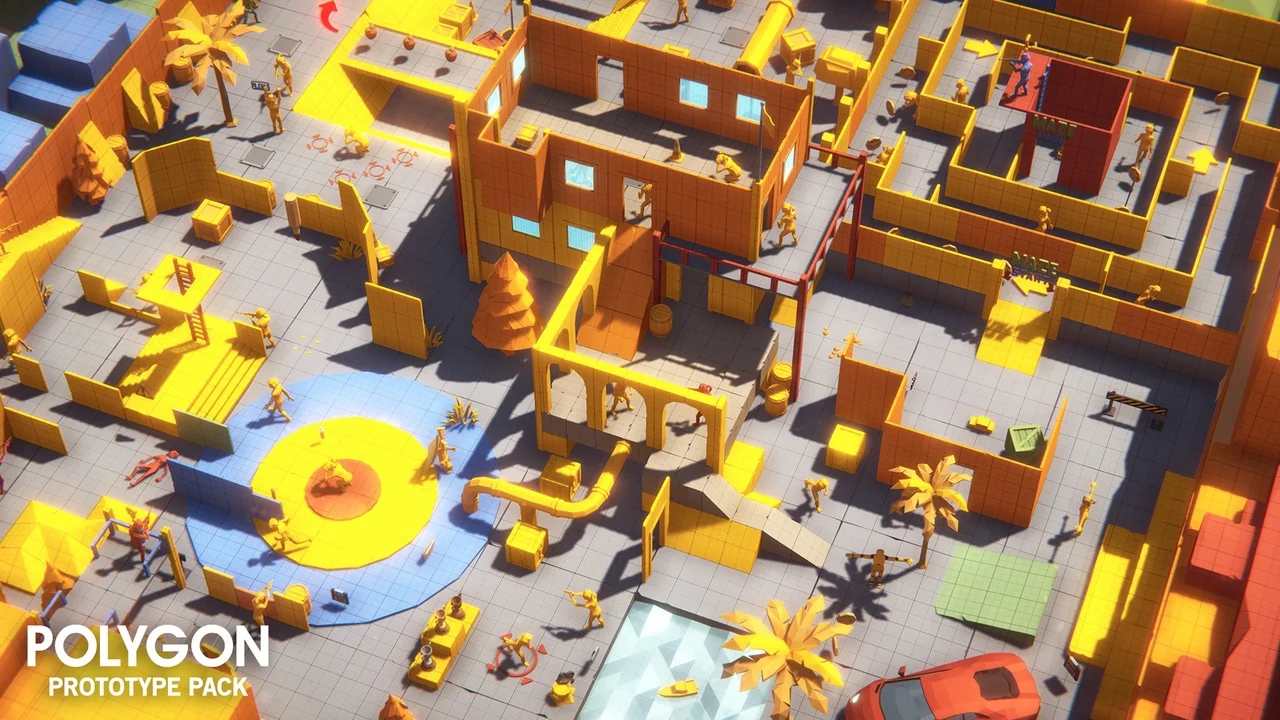
 Tools
Tools Tools
Tools Tools
Tools