"7b46a695175d8694"{"id":"1000321","slug":"plane","title":"Plane","category":"Vehicles \u0026 Transportation","engine":"5.2+","assetVersion":"","engineVersion":"Engine Version: 5.2+","tag":"Vehicles","accent":"blue","visual":"mech","summary":"A modular 3D model of the Soviet An-2 aircraft featuring interchangeable chassis configurations, customizable camouflage masks, and a fully separated cockpit.","platform":"Unreal Engine","publishedAt":"2026-07-04T17:37:41.032Z","updatedAt":"2026-07-04T17:37:41.032Z","sourceNotes":[],"fileContents":[],"compatibility":["Unreal Engine","Engine Version: 5.2+"],"featuredImage":{"alt":"Plane","src":"/wp-content/uploads/published/2026/07/5f2d78af7d60-b654c893-19e2-4331-bc31-3402fa34c7f2-b428ff30e5.webp"},"hasDownloadLink":true,"downloads":0,"terms":[{"taxonomy":"category","slug":"vehicles-and-transportation","name":"Vehicles \u0026 Transportation"}],"galleryImages":[{"src":"/wp-content/uploads/published/2026/07/5f8454bca3c3-23cd1574-e409-404b-bcc4-b9a225c0c31f-90b6afd641.webp","alt":"Plane"},{"src":"/wp-content/uploads/published/2026/07/671918ce1f7a-30d0dfed-354d-49a9-ac00-0886f4ec96b8-e9701dbd23.webp","alt":"Plane"},{"src":"/wp-content/uploads/published/2026/07/349ca4eaf25f-11bfa221-15dc-4909-b4d6-174c7a39f739-d62193a08f.webp","alt":"Plane"},{"src":"/wp-content/uploads/published/2026/07/88e3b82dff69-01c91577-a594-474b-b01b-6e16ec94c734-cacebdd1e8.webp","alt":"Plane"},{"src":"/wp-content/uploads/published/2026/07/f07bd1aa2493-1b89117e-10a8-4890-8f14-24f39528f298-2915b7aa7a.webp","alt":"Plane"},{"src":"/wp-content/uploads/published/2026/07/1f9d04f045fe-6d7dc507-fe12-48de-9b27-55d411e47c22-8499134ed1.webp","alt":"Plane"},{"src":"/wp-content/uploads/published/2026/07/38ae9418999a-b307ecd3-4928-4cdb-9c12-a6e0f83500b0-033963eb07.webp","alt":"Plane"},{"src":"/wp-content/uploads/published/2026/07/c00169de0c1e-4ac3e7fb-0d0c-43ba-8bfa-37b6302f9dc5-dfb1fd43ec.webp","alt":"Plane"},{"src":"/wp-content/uploads/published/2026/07/8ab76954255e-36643f7a-651d-4c44-9a98-3a4ddc524561-7867539759.webp","alt":"Plane"},{"src":"/wp-content/uploads/published/2026/07/a81bc3ad9182-e1e680f2-a382-42f2-9c90-ab8df7295e9c-4f61789541.webp","alt":"Plane"}],"accessPanel":{"kind":"resource","title":"Download this resource","eyebrow":"Free Download","message":"Log in or create a free account to start your download.","fileName":"Content.7z","safetyNote":"Resources are manually reviewed before listing to improve quality and reduce obvious risks.","actionLabel":"Download Free","resourceType":"Resource archive"},"contentHtml":"\u003ch2\u003eModular Configurations for the Soviet An-2\u003c/h2\u003e\n\u003cp\u003eThe core of this package centers on a modular recreation of the Soviet An-2 aircraft, structurally designed to accommodate varying environmental requirements. The inclusion of distinct chassis modifications allows the aircraft to be adapted for different landing surfaces and biome types within a project. The standard modification features a traditional wheeled chassis, situating the aircraft for standard runway takeoffs, dirt airstrips, or hangar environments. Beyond the standard configuration, the asset includes a water modification. This adapts the lower half of the aircraft for aquatic environments, enabling placement on lakes, rivers, or coastal docks. Additionally, a winter skiing modification replaces the standard undercarriage with skis, providing a structurally accurate setup for snowy terrain, frozen lakes, or arctic expeditions. Because these chassis modifications are modular, developers can deploy the same base aircraft across drastically different level designs without needing to source entirely separate vehicle models for each climate.\u003c/p\u003e\n\u003ch2\u003eDynamic Camouflage and Color Variation\u003c/h2\u003e\n\u003cp\u003eA significant focus of the aircraft's exterior design is its adaptable camouflage system. Rather than relying entirely on static textures that lock the model into a single visual identity, the material setup utilizes three distinct types of masks for spreading color. This masking approach facilitates a large variation in color schemes directly within the engine. By manipulating these three mask types, environment artists and vehicle designers can adjust the primary, secondary, and tertiary tones of the camouflage pattern. This is particularly useful in production scenarios that require multiple An-2 aircraft to appear on screen simultaneously, such as an active airfield or a multiplayer environment. The masks allow each plane to maintain a unique livery or blend into specific environmental palettes, ranging from lush forest greens to arid desert browns or winter whites, simply by pushing different color values through the provided masks.\u003c/p\u003e\n\u003ch2\u003eSeparated Components for Cockpit Control\u003c/h2\u003e\n\u003cp\u003eMoving to the interior, the cockpit is specifically constructed to be suitable for direct player control and complex mechanical animation. To support this level of interactivity, all the necessary control elements have been separated from the main static mesh. Inside the cabin, this includes individual meshes for the levers, the steering wheel, and the foot pedals. Because these parts are isolated, they can be individually rigged, rotated, and animated to match player inputs or automated flight sequences. This makes the cockpit highly applicable for flight simulation projects, first-person exploration games, or virtual reality experiences where the user's virtual hands need to interact directly with the aircraft's internal mechanisms. The separation of parts ensures that when a pilot pulls back on the steering wheel or adjusts a throttle lever, the geometry moves independently without distorting the surrounding dashboard.\u003c/p\u003e\n\u003ch3\u003eExterior Flight Surfaces and Animation\u003c/h3\u003e\n\u003cp\u003eBeyond the interior controls, key exterior and structural elements are also separated to facilitate full flight animation and scene transitions. The asset includes separated doors, flaps, and the front propeller. Separated doors allow for boarding and disembarking animations, bridging the gap between on-foot gameplay and vehicle operation. The independent flaps provide the necessary articulation for taxiing, takeoff, banking, and landing sequences, ensuring the aircraft's aerodynamic surfaces react realistically to flight mechanics. Meanwhile, the separated propeller mesh allows for high-speed rotational animation independent of the engine housing, which is critical for bringing the aircraft to life during active engine states.\u003c/p\u003e\n\u003ch2\u003eUnreal Engine 5 Lighting and Geometry Rendering\u003c/h2\u003e\n\u003cp\u003eOn a technical level, the aircraft is highly optimized for modern real-time rendering pipelines, specifically targeting Unreal Engine 5.0 and above. The product fully supports Nanite, Unreal Engine’s virtualized geometry system. Nanite support means that the dense structural details of the An-2, such as the intricate mechanical components of the separated cockpit dashboard, the curvature of the fuselage, and the precise edges of the flaps and propeller, can be rendered at maximum fidelity without the need for traditional Level of Detail (LOD) popping. This is highly advantageous for a vehicle model, as it ensures the silhouette and mechanical details remain crisp whether the camera is positioned miles away in the sky or inches from the exterior hull.\u003c/p\u003e\n\u003cp\u003eIn tandem with virtualized geometry, the asset supports Lumen for Unreal Engine 5.0+. Lumen provides fully dynamic global illumination and reflections, which is crucial for a moving vehicle. As the aircraft banks and changes direction in the sky, Lumen ensures that the exterior camouflage reacts accurately to shifting sunlight and atmospheric scattering. More importantly, Lumen’s real-time light bounces dramatically enhance the separated cockpit interior. Sunlight passing through the cockpit glass will dynamically illuminate the separated levers, steering wheel, and pedals, casting accurate real-time shadows across the cabin that shift as the plane maneuvers through the environment. If any rendering issues arise with the dynamic lighting, the developer advises consulting official Unreal Engine documentation regarding Lumen setup.\u003c/p\u003e\n\u003cp\u003eBy combining a modular undercarriage system with a highly interactive, fully separated cockpit and customizable camouflage masks, this Soviet An-2 package is set up to handle complex flight simulations, diverse environmental deployments, and dynamic Unreal Engine 5 lighting scenarios.\u003c/p\u003e\n\n\u003ch2\u003eExplore Similar Assets\u003c/h2\u003e\n\u003cul\u003e\n\u003cli\u003e\u003ca href=\"https://3dcghub.com/driveable-vehicle-ah-raider/\" title=\"Driveable Vehicle : AH-Raider\"\u003eDriveable Vehicle : AH-Raider\u003c/a\u003e\u003c/li\u003e\n\u003cli\u003e\u003ca href=\"https://3dcghub.com/stellar-phoenix-shuttle-spaceship-with-controller/\" title=\"Stellar Phoenix Shuttle - Spaceship With Controller\"\u003eStellar Phoenix Shuttle - Spaceship With Controller\u003c/a\u003e\u003c/li\u003e\n\u003cli\u003e\u003ca href=\"https://3dcghub.com/dystopia-airship/\" title=\"Dystopia Airship\"\u003eDystopia Airship\u003c/a\u003e\u003c/li\u003e\n\u003cli\u003e\u003ca href=\"https://3dcghub.com/sci-fi-aircraft/\" title=\"Sci Fi Aircraft\"\u003eSci Fi Aircraft\u003c/a\u003e\u003c/li\u003e\n\u003cli\u003e\u003ca href=\"https://3dcghub.com/physics-based-helicopter/\" title=\"Physics Based Helicopter\"\u003ePhysics Based Helicopter\u003c/a\u003e\u003c/li\u003e\n\u003c/ul\u003e","contentTextLength":5952,"navigation":{"current":1303,"total":3481,"previous":{"id":"14270","slug":"narrative-pro-2-complete-game-framework","title":"Narrative Pro 2 - Complete Game Framework","category":"Engine Tools","platform":"Unreal Engine","updatedAt":"2026-07-05T05:43:30.401Z"},"next":{"id":"1000320","slug":"parkway-home-modern-family-house-with-stylish-interior-environment","title":"Parkway Home – Modern Family House with Stylish Interior Environment","category":"Interior","platform":"Unreal Engine","updatedAt":"2026-07-04T17:34:15.892Z"}},"relatedResources":[{"id":"1001014","slug":"scifi-playable-flying-drones","title":"SciFi Playable Flying Drones","category":"Vehicles \u0026 Transportation","engine":"5.3+","assetVersion":"","engineVersion":"Engine Version: 5.3+","tag":"Vehicles","accent":"blue","visual":"mech","summary":"A playable sci-fi drone set with three pawns, five skins, 4K PBR textures, acceleration sound, and controls configured for immediate flight.","platform":"Unreal Engine","publishedAt":"2026-08-22T13:29:03.565Z","updatedAt":"2026-08-22T13:29:03.565Z","sourceNotes":[],"fileContents":[],"compatibility":["Unreal Engine","Engine Version: 5.3+"],"featuredImage":{"alt":"SciFi Playable Flying Drones","src":"/wp-content/uploads/published/2026/08/77b4dcd43224-75c0061e-e73b-4577-8f9f-fda418fe1f68-c298071771.webp"},"hasDownloadLink":true,"downloads":0},{"id":"5107","slug":"driveable-vehicle-ah-raider","title":"Driveable Vehicle : AH-Raider","category":"Vehicles \u0026 Transportation","engine":"5.0+","assetVersion":"Engine version: 5.0+","engineVersion":"4.16","tag":"Vehicles","accent":"blue","visual":"animation","summary":"Boost your Unreal Engine project with the AH-Raider. This drivable stealth helicopter features optimized blueprints, seven skins, and advanced weapon systems.","platform":"Unreal Engine","publishedAt":"2026-02-14T17:43:29.000Z","updatedAt":"2026-04-19T15:57:01.000Z","sourceNotes":[],"fileContents":[],"compatibility":["Unreal Engine","Engine version: 5.0+"],"featuredImage":{"alt":"Driveable Vehicle : AH-Raider","src":"https://3dcghub.com/wp-content/uploads/2026/02/99e4b997-773c-4bcc-b1c0-ddff44a70701.webp"},"hasDownloadLink":true,"downloads":0},{"id":"5282","slug":"stellar-phoenix-shuttle-spaceship-with-controller","title":"Stellar Phoenix Shuttle - Spaceship With Controller","category":"Vehicles \u0026 Transportation","engine":"5.1+","assetVersion":"Engine version: 5.1+","engineVersion":"5.1","tag":"Vehicles","accent":"blue","visual":"animation","summary":"Discover the Stellar Phoenix Shuttle for Unreal Engine. A complete spaceship asset with a flight controller, PBR textures, and animated parts for game developer","platform":"Unreal Engine","publishedAt":"2026-02-15T14:03:31.000Z","updatedAt":"2026-04-19T15:56:59.000Z","sourceNotes":[],"fileContents":[],"compatibility":["Unreal Engine","Engine version: 5.1+"],"featuredImage":{"alt":"Stellar Phoenix Shuttle - Spaceship With Controller","src":"https://3dcghub.com/wp-content/uploads/2026/02/03140a6b-8a6a-472f-a68f-9db9fd7b3131.webp"},"hasDownloadLink":true,"downloads":0}]}
Vehicles
Plane
A modular 3D model of the Soviet An-2 aircraft featuring interchangeable chassis configurations, customizable camouflage masks, and a fully separated cockpit.
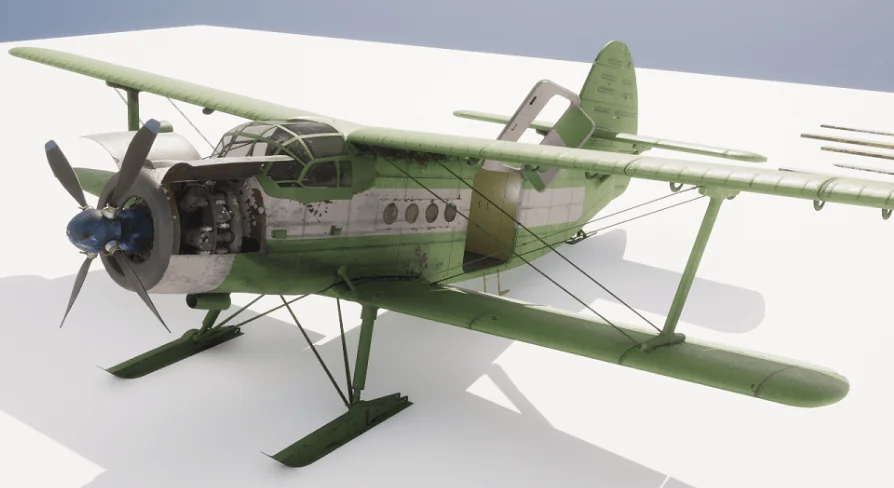
The core of this package centers on a modular recreation of the Soviet An-2 aircraft, structurally designed to accommodate varying environmental requirements. The inclusion of distinct chassis modifications allows the aircraft to be adapted for different landing surfaces and biome types within a project. The standard modification features a traditional wheeled chassis, situating the aircraft for standard runway takeoffs, dirt airstrips, or hangar environments. Beyond the standard configuration, the asset includes a water modification. This adapts the lower half of the aircraft for aquatic environments, enabling placement on lakes, rivers, or coastal docks. Additionally, a winter skiing modification replaces the standard undercarriage with skis, providing a structurally accurate setup for snowy terrain, frozen lakes, or arctic expeditions. Because these chassis modifications are modular, developers can deploy the same base aircraft across drastically different level designs without needing to source entirely separate vehicle models for each climate.
Dynamic Camouflage and Color Variation
A significant focus of the aircraft's exterior design is its adaptable camouflage system. Rather than relying entirely on static textures that lock the model into a single visual identity, the material setup utilizes three distinct types of masks for spreading color. This masking approach facilitates a large variation in color schemes directly within the engine. By manipulating these three mask types, environment artists and vehicle designers can adjust the primary, secondary, and tertiary tones of the camouflage pattern. This is particularly useful in production scenarios that require multiple An-2 aircraft to appear on screen simultaneously, such as an active airfield or a multiplayer environment. The masks allow each plane to maintain a unique livery or blend into specific environmental palettes, ranging from lush forest greens to arid desert browns or winter whites, simply by pushing different color values through the provided masks.
Separated Components for Cockpit Control
Moving to the interior, the cockpit is specifically constructed to be suitable for direct player control and complex mechanical animation. To support this level of interactivity, all the necessary control elements have been separated from the main static mesh. Inside the cabin, this includes individual meshes for the levers, the steering wheel, and the foot pedals. Because these parts are isolated, they can be individually rigged, rotated, and animated to match player inputs or automated flight sequences. This makes the cockpit highly applicable for flight simulation projects, first-person exploration games, or virtual reality experiences where the user's virtual hands need to interact directly with the aircraft's internal mechanisms. The separation of parts ensures that when a pilot pulls back on the steering wheel or adjusts a throttle lever, the geometry moves independently without distorting the surrounding dashboard.
Exterior Flight Surfaces and Animation
Beyond the interior controls, key exterior and structural elements are also separated to facilitate full flight animation and scene transitions. The asset includes separated doors, flaps, and the front propeller. Separated doors allow for boarding and disembarking animations, bridging the gap between on-foot gameplay and vehicle operation. The independent flaps provide the necessary articulation for taxiing, takeoff, banking, and landing sequences, ensuring the aircraft's aerodynamic surfaces react realistically to flight mechanics. Meanwhile, the separated propeller mesh allows for high-speed rotational animation independent of the engine housing, which is critical for bringing the aircraft to life during active engine states.
Unreal Engine 5 Lighting and Geometry Rendering
On a technical level, the aircraft is highly optimized for modern real-time rendering pipelines, specifically targeting Unreal Engine 5.0 and above. The product fully supports Nanite, Unreal Engine’s virtualized geometry system. Nanite support means that the dense structural details of the An-2, such as the intricate mechanical components of the separated cockpit dashboard, the curvature of the fuselage, and the precise edges of the flaps and propeller, can be rendered at maximum fidelity without the need for traditional Level of Detail (LOD) popping. This is highly advantageous for a vehicle model, as it ensures the silhouette and mechanical details remain crisp whether the camera is positioned miles away in the sky or inches from the exterior hull.
In tandem with virtualized geometry, the asset supports Lumen for Unreal Engine 5.0+. Lumen provides fully dynamic global illumination and reflections, which is crucial for a moving vehicle. As the aircraft banks and changes direction in the sky, Lumen ensures that the exterior camouflage reacts accurately to shifting sunlight and atmospheric scattering. More importantly, Lumen’s real-time light bounces dramatically enhance the separated cockpit interior. Sunlight passing through the cockpit glass will dynamically illuminate the separated levers, steering wheel, and pedals, casting accurate real-time shadows across the cabin that shift as the plane maneuvers through the environment. If any rendering issues arise with the dynamic lighting, the developer advises consulting official Unreal Engine documentation regarding Lumen setup.
By combining a modular undercarriage system with a highly interactive, fully separated cockpit and customizable camouflage masks, this Soviet An-2 package is set up to handle complex flight simulations, diverse environmental deployments, and dynamic Unreal Engine 5 lighting scenarios.
 Vehicles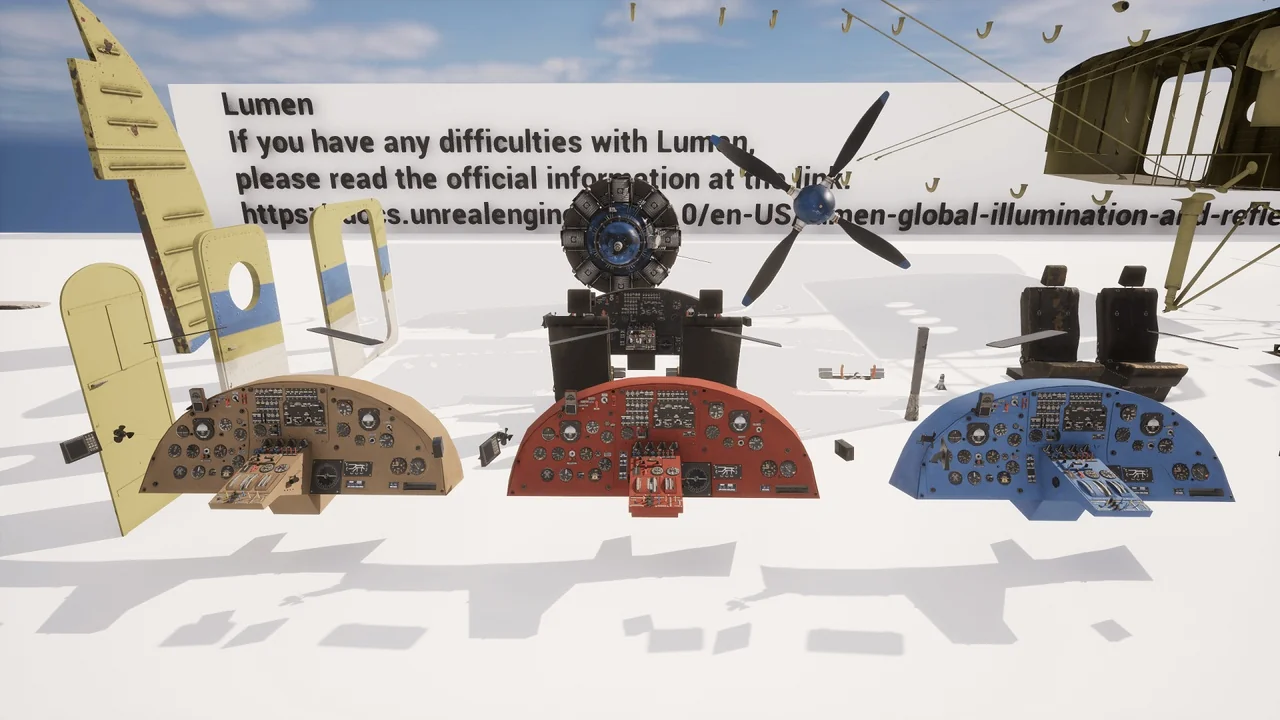
 Vehicles
 Vehicles
 Vehicles