"fa182e0cd0a6ea73"{"id":"1001849","slug":"nanite-foliage-vol1","title":"Nanite Foliage Vol1","category":"Trees","engine":"5.1+","assetVersion":"","engineVersion":"Engine Version: 5.1+","tag":"Trees","accent":"blue","visual":"mech","summary":"Nanite Foliage Vol1 delivers pure mesh, alpha-free TrueNanite vegetation alongside alpha variations for Unreal Engine games and cinematic environments.","platform":"Unreal Engine","publishedAt":"2026-10-21T08:42:48.422Z","updatedAt":"2026-10-21T08:42:48.422Z","sourceNotes":[],"fileContents":[],"compatibility":["Unreal Engine","Engine Version: 5.1+"],"featuredImage":{"alt":"Nanite Foliage Vol1","src":"/wp-content/uploads/published/2026/10/459cc03b861a-96f7beb5-da8b-4854-b903-80016cd1b75f-c8b6000f5c.webp"},"hasDownloadLink":true,"downloads":0,"terms":[{"taxonomy":"category","slug":"trees","name":"Trees"}],"galleryImages":[{"src":"/wp-content/uploads/published/2026/10/98cdf359b144-a3a1d12a-e95d-4e74-8037-ae88d79b923b-cfea06322c.webp","alt":"Nanite Foliage Vol1"},{"src":"/wp-content/uploads/published/2026/10/485e583a76eb-e93e442b-844a-443c-8c59-9e31e6c3118e-4e81bd59c6.webp","alt":"Nanite Foliage Vol1"},{"src":"/wp-content/uploads/published/2026/10/267578b84905-9d606764-9ea3-46c3-a1fb-32ac47041814-f82ba65b13.webp","alt":"Nanite Foliage Vol1"},{"src":"/wp-content/uploads/published/2026/10/54cadc578dcb-ef83d87d-2b0c-48c0-b35f-1c6833e1f012-281c95f702.webp","alt":"Nanite Foliage Vol1"},{"src":"/wp-content/uploads/published/2026/10/f507aedd6506-5f9269fc-5933-4bd4-bd72-fb40ea6eb75a-b71c1a1a32.webp","alt":"Nanite Foliage Vol1"},{"src":"/wp-content/uploads/published/2026/10/1ebf1c73874e-167fd98a-e689-4137-ba25-b349f65d1024-0d31df1925.webp","alt":"Nanite Foliage Vol1"},{"src":"/wp-content/uploads/published/2026/10/d63d67154dae-4908e601-0ad3-4646-8408-c6b9b35b9915-654cc700e3.webp","alt":"Nanite Foliage Vol1"},{"src":"/wp-content/uploads/published/2026/10/5e8300776427-b5d099c8-6609-4850-9cb7-48af96833728-36f0ace6a0.webp","alt":"Nanite Foliage Vol1"},{"src":"/wp-content/uploads/published/2026/10/94a1c53f2db4-b1d2eef0-4da1-495e-823a-0d7b0f8db947-a09e797b1d.webp","alt":"Nanite Foliage Vol1"}],"accessPanel":{"kind":"resource","title":"Download this resource","eyebrow":"Free Download","message":"Log in or create a free account to start your download.","fileName":"Content.7z","safetyNote":"Resources are manually reviewed before listing to improve quality and reduce obvious risks.","actionLabel":"Download Free","resourceType":"Resource archive"},"contentHtml":"\u003ch2\u003ePure Mesh Geometry and the TrueNanite Workflow\u003c/h2\u003e\n\u003cp\u003eTraditional real-time vegetation has long relied on alpha-tested cards to simulate leaves, twigs, and fine plant silhouettes. While this technique limits geometric density, it introduces heavy shader overdraw, complex opacity mask evaluations, and jagged edges at distance. Nanite Foliage Vol1 circumvents these compromises by applying the TrueNanite methodology, presenting foliage constructed entirely from pure mesh geometry without alpha channels. Every leaf contour, stem silhouette, and branch structure exists as actual polygonal surface area, letting virtualized micro-polygon geometry handle the visual definition directly in the viewport.\u003c/p\u003e\n\u003cp\u003eEliminating transparency maps changes how rendering passes evaluate landscape foliage. Geometry without alpha testing executes through standard opaque material passes, reducing the computational strain created by dense layers of overlapping transparency. Nanite processes these solid surfaces through its internal cluster-culling and streaming pipelines, drawing fine vegetative features cleanly without masked edge artifacts. For workflows that still mandate classic setup options or hybrid production tests, the package also includes matching alpha-mapped variations for the same foliage assets. Providing both approaches ensures that environment artists can toggle between fully geometric pure mesh rendering and traditional alpha cards depending on specific pipeline benchmarks.\u003c/p\u003e \u003ch2\u003eAsset Diversity: Trees, Bushes, Vines, and Ground Cover\u003c/h2\u003e\n\u003cp\u003eNatural landscapes require distinct botanical strata to feel visually grounded, ranging from high canopy trees down to low-lying forest floor scatter. Nanite Foliage Vol1 addresses this layered distribution across diverse biomes, supplying organic assets structured for temperate forests, woodlands, open meadows, and dense tropical jungles. The collection incorporates tall forest trees, mid-sized understory bushes, individual plants, creeping vines, and dense turf elements.\u003c/p\u003e\n\u003cp\u003eThe ground-level layer features modular grass groupings, flowers, and scattered leaves that establish micro-detail across landscape terrain. These smaller organic components populate the immediate foreground, providing fine physical density without relying on planar visual illusions. Taller elements, including shrubs, bushes, and freestanding trees, carry the same topological treatment into the middle distance and upper canopy. Creeping vines provide vertical connectivity, allowing artists to blend rocks, architectural ruins, or tree trunks with clinging foliage. Whether staging a lush tropical canopy or a sparse seasonal woodland, the variety of vegetative forms supports believable ecological gradation.\u003c/p\u003e \u003ch2\u003eNanite Foliage Optimization, LODs, and Wind Integration\u003c/h2\u003e\n\u003cp\u003eIntegrating dense natural vegetation into interactive worlds requires aggressive scalability. Because the primary assets in Nanite Foliage Vol1 are optimized explicitly for the Nanite foliage workflow, level of detail (LOD) handling occurs seamlessly through continuous cluster streaming. Instead of relying on jarring, discrete LOD switches that pop across camera transitions, the geometry scales its polygon density dynamically based on on-screen pixel footprint. Extreme detail remains present up close, while distant trees and hillsides shed polygonal mass without disrupting visual continuity.\u003c/p\u003e\n\u003cp\u003ePerformance remains linked to physical material response, and the assets feature physically based rendering (PBR) surfaces configured for realistic light interaction. Light scatters naturally across the solid geometric surfaces, avoiding the flat shading or harsh specular clipping common in masked leaves. Beyond static lighting behavior, the assets are wind ready, designed to integrate with dynamic ambient wind animation within Unreal Engine. This ensures that massive forests, jungle canopies, and meadow grasses react convincingly to environmental wind forces without breaking mesh cohesion or stretching underlying polygon clusters.\u003c/p\u003e \u003ch2\u003eReal-Time Game Landscapes and Cinematic Environments\u003c/h2\u003e\n\u003cp\u003eBalancing high visual fidelity against framerate demands often forces environment artists to maintain separate asset libraries for real-time gameplay and pre-rendered cinematics. Nanite Foliage Vol1 functions across both spaces by pairing extreme geometric fidelity with game-ready structure. In cinematic productions and virtual cinematography, the pure mesh TrueNanite models offer close-up detail capable of holding up directly against high-resolution camera passes, eliminating thin, pixelated leaf edges in tight focal planes.\u003c/p\u003e\n\u003cp\u003eIn game development pipelines, particularly open-world landscape design, the modular assembly of these plants supports rapid biome construction. Level designers can scatter heavy underbrush, forest floors, and dense woodland groves across sprawling terrains using native foliage painting and procedural generation systems. The dual inclusion of pure mesh and alpha-based variants permits broad platform adaptation, allowing technical directors to tailor rendering loads to their specific hardware targets. The library is built to handle next-gen natural world generation, bridging the gap between photorealistic fidelity and practical real-time performance.\u003c/p\u003e\n\n\u003ch2\u003eRelated Resources Worth Checking\u003c/h2\u003e\n\u003cul\u003e\n\u003cli\u003e\u003ca href=\"https://3dcghub.com/foliage-vol-3-oak-trees-nanite-and-low-poly/\" title=\"Foliage VOL.3 - Oak Trees (Nanite and Low Poly)\"\u003eFoliage VOL.3 - Oak Trees (Nanite and Low Poly)\u003c/a\u003e\u003c/li\u003e\n\u003cli\u003e\u003ca href=\"https://3dcghub.com/foliage-vol-19-scraggly-bushes-nanite-and-low-poly/\" title=\"Foliage VOL.19 - Scraggly Bushes (Nanite and Low Poly)\"\u003eFoliage VOL.19 - Scraggly Bushes (Nanite and Low Poly)\u003c/a\u003e\u003c/li\u003e\n\u003cli\u003e\u003ca href=\"https://3dcghub.com/foliage-vol-7-ash-trees-nanite-and-low-poly/\" title=\"Foliage VOL.7 - Ash Trees (Nanite and Low Poly)\"\u003eFoliage VOL.7 - Ash Trees (Nanite and Low Poly)\u003c/a\u003e\u003c/li\u003e\n\u003cli\u003e\u003ca href=\"https://3dcghub.com/foliage-vol-17-ground-plants-low-poly/\" title=\"Foliage VOL.17 - Ground Plants (Low Poly)\"\u003eFoliage VOL.17 - Ground Plants (Low Poly)\u003c/a\u003e\u003c/li\u003e\n\u003cli\u003e\u003ca href=\"https://3dcghub.com/foliage-vol-37-tree-stumps-nanite-low-poly/\" title=\"Foliage VOL.37- Tree Stumps (NANITE + LOW POLY)\"\u003eFoliage VOL.37- Tree Stumps (NANITE + LOW POLY)\u003c/a\u003e\u003c/li\u003e\n\u003c/ul\u003e","contentTextLength":5538,"navigation":{"current":7,"total":3789,"previous":{"id":"1001850","slug":"scifi-kitbash-level-builder-vol-2","title":"SciFi Kitbash Level Builder Vol.2","category":"Industrial","platform":"Unreal Engine","updatedAt":"2026-10-21T08:43:34.987Z"},"next":{"id":"1001848","slug":"forest-environment-riverside-forest-with-pine-and-tropical-trees","title":"Forest Environment ( Riverside Forest with Pine and Tropical Trees )","category":"Forest \u0026 Jungle","platform":"Unreal Engine","updatedAt":"2026-10-21T08:39:46.495Z"}},"relatedResources":[{"id":"1001778","slug":"foliage-vol-3-oak-trees-nanite-and-low-poly","title":"Foliage VOL.3 - Oak Trees (Nanite and Low Poly)","category":"Trees","engine":"5.1+","assetVersion":"","engineVersion":"Engine Version: 5.1+","tag":"Trees","accent":"blue","visual":"mech","summary":"Explore Foliage VOL.3 - Oak Trees (Nanite and Low Poly) featuring 22 meshes, 4K channel-packed textures, master materials, and Unreal Engine 5 Lumen support.","platform":"Unreal Engine","publishedAt":"2026-10-20T03:26:11.644Z","updatedAt":"2026-10-20T03:26:11.644Z","sourceNotes":[],"fileContents":[],"compatibility":["Unreal Engine","Engine Version: 5.1+"],"featuredImage":{"alt":"Foliage VOL.3 - Oak Trees (Nanite and Low Poly)","src":"/wp-content/uploads/published/2026/10/76cc3069015a-cf088094-d3eb-4e1d-9e68-3e23a2161532-65dcdb07a2.webp"},"hasDownloadLink":true,"downloads":0},{"id":"1000829","slug":"foliage-vol-19-scraggly-bushes-nanite-and-low-poly","title":"Foliage VOL.19 - Scraggly Bushes (Nanite and Low Poly)","category":"Trees","engine":"5.1+","assetVersion":"","engineVersion":"Engine Version: 5.1+","tag":"Trees","accent":"blue","visual":"mech","summary":"A foliage pack of 20 scraggly bush meshes built for Unreal Engine 5.0+, featuring Nanite and low poly variants, 4k textures, Lumen support, and master material","platform":"Unreal Engine","publishedAt":"2026-08-03T12:04:08.713Z","updatedAt":"2026-08-03T12:04:08.713Z","sourceNotes":[],"fileContents":[],"compatibility":["Unreal Engine","Engine Version: 5.1+"],"featuredImage":{"alt":"Foliage VOL.19 - Scraggly Bushes (Nanite and Low Poly)","src":"/wp-content/uploads/published/2026/08/4b3cc7f7b16f-c9417b0e-a1e6-4c4c-b734-092e1fe4283a-e6bdcf0441.webp"},"hasDownloadLink":true,"downloads":1},{"id":"1000507","slug":"foliage-vol-7-ash-trees-nanite-and-low-poly","title":"Foliage VOL.7 - Ash Trees (Nanite and Low Poly)","category":"Trees","engine":"5.1+","assetVersion":"","engineVersion":"Engine Version: 5.1+","tag":"Trees","accent":"blue","visual":"mech","summary":"Unreal Engine ash tree foliage pack with 20 Nanite and low-poly meshes, 4K textures, master materials, PBR channel packing, Lumen support, and game optimization","platform":"Unreal Engine","publishedAt":"2026-07-13T13:02:08.511Z","updatedAt":"2026-07-13T13:02:08.511Z","sourceNotes":[],"fileContents":[],"compatibility":["Unreal Engine","Engine Version: 5.1+"],"featuredImage":{"alt":"Foliage VOL.7 - Ash Trees (Nanite and Low Poly)","src":"/wp-content/uploads/published/2026/07/e457087b5357-ac8d5fe5-3566-42b7-8dc6-75785f02c340-3151dd9f35.webp"},"hasDownloadLink":true,"downloads":1}]}
Trees
Nanite Foliage Vol1
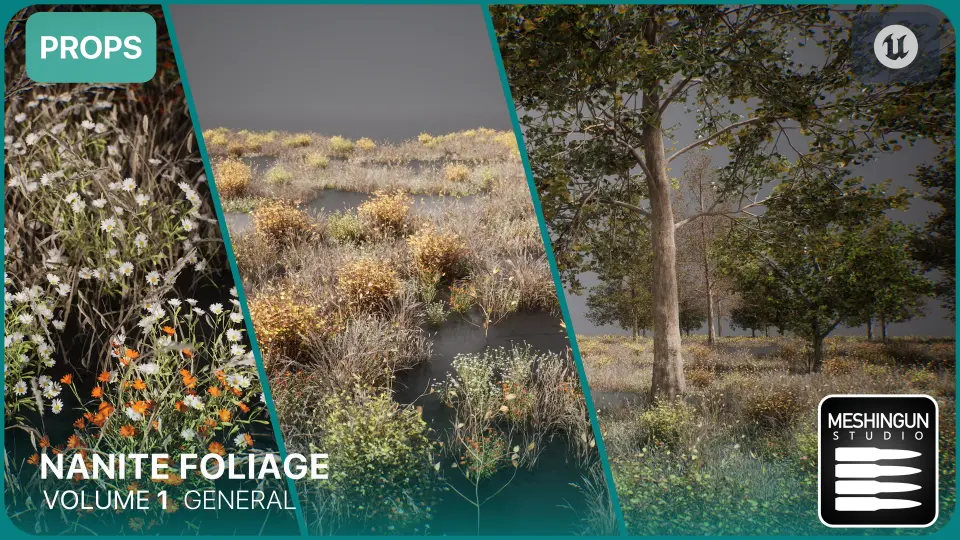
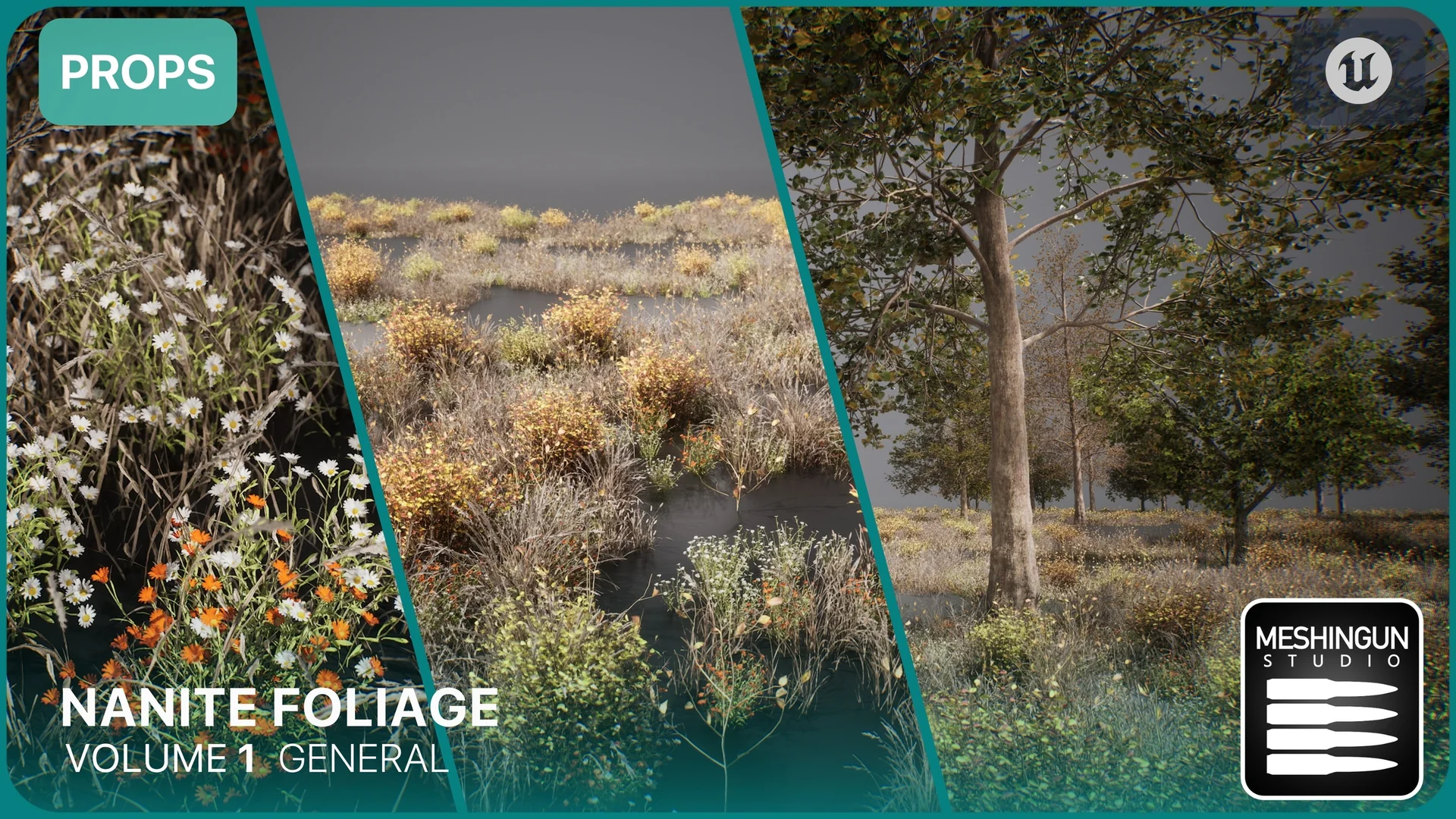
Nanite Foliage Vol1 delivers pure mesh, alpha-free TrueNanite vegetation alongside alpha variations for Unreal Engine games and cinematic environments.
Category:Unreal Engine,TreesPlatform: Unreal EngineEngine Version: 5.1+Published: Oct 21, 2026
Trees
Resource overview
Pure Mesh Geometry and the TrueNanite Workflow
Traditional real-time vegetation has long relied on alpha-tested cards to simulate leaves, twigs, and fine plant silhouettes. While this technique limits geometric density, it introduces heavy shader overdraw, complex opacity mask evaluations, and jagged edges at distance. Nanite Foliage Vol1 circumvents these compromises by applying the TrueNanite methodology, presenting foliage constructed entirely from pure mesh geometry without alpha channels. Every leaf contour, stem silhouette, and branch structure exists as actual polygonal surface area, letting virtualized micro-polygon geometry handle the visual definition directly in the viewport.
Eliminating transparency maps changes how rendering passes evaluate landscape foliage. Geometry without alpha testing executes through standard opaque material passes, reducing the computational strain created by dense layers of overlapping transparency. Nanite processes these solid surfaces through its internal cluster-culling and streaming pipelines, drawing fine vegetative features cleanly without masked edge artifacts. For workflows that still mandate classic setup options or hybrid production tests, the package also includes matching alpha-mapped variations for the same foliage assets. Providing both approaches ensures that environment artists can toggle between fully geometric pure mesh rendering and traditional alpha cards depending on specific pipeline benchmarks.
Asset Diversity: Trees, Bushes, Vines, and Ground Cover
Natural landscapes require distinct botanical strata to feel visually grounded, ranging from high canopy trees down to low-lying forest floor scatter. Nanite Foliage Vol1 addresses this layered distribution across diverse biomes, supplying organic assets structured for temperate forests, woodlands, open meadows, and dense tropical jungles. The collection incorporates tall forest trees, mid-sized understory bushes, individual plants, creeping vines, and dense turf elements.
The ground-level layer features modular grass groupings, flowers, and scattered leaves that establish micro-detail across landscape terrain. These smaller organic components populate the immediate foreground, providing fine physical density without relying on planar visual illusions. Taller elements, including shrubs, bushes, and freestanding trees, carry the same topological treatment into the middle distance and upper canopy. Creeping vines provide vertical connectivity, allowing artists to blend rocks, architectural ruins, or tree trunks with clinging foliage. Whether staging a lush tropical canopy or a sparse seasonal woodland, the variety of vegetative forms supports believable ecological gradation.
Nanite Foliage Optimization, LODs, and Wind Integration
Integrating dense natural vegetation into interactive worlds requires aggressive scalability. Because the primary assets in Nanite Foliage Vol1 are optimized explicitly for the Nanite foliage workflow, level of detail (LOD) handling occurs seamlessly through continuous cluster streaming. Instead of relying on jarring, discrete LOD switches that pop across camera transitions, the geometry scales its polygon density dynamically based on on-screen pixel footprint. Extreme detail remains present up close, while distant trees and hillsides shed polygonal mass without disrupting visual continuity.
Performance remains linked to physical material response, and the assets feature physically based rendering (PBR) surfaces configured for realistic light interaction. Light scatters naturally across the solid geometric surfaces, avoiding the flat shading or harsh specular clipping common in masked leaves. Beyond static lighting behavior, the assets are wind ready, designed to integrate with dynamic ambient wind animation within Unreal Engine. This ensures that massive forests, jungle canopies, and meadow grasses react convincingly to environmental wind forces without breaking mesh cohesion or stretching underlying polygon clusters.
Real-Time Game Landscapes and Cinematic Environments
Balancing high visual fidelity against framerate demands often forces environment artists to maintain separate asset libraries for real-time gameplay and pre-rendered cinematics. Nanite Foliage Vol1 functions across both spaces by pairing extreme geometric fidelity with game-ready structure. In cinematic productions and virtual cinematography, the pure mesh TrueNanite models offer close-up detail capable of holding up directly against high-resolution camera passes, eliminating thin, pixelated leaf edges in tight focal planes.
In game development pipelines, particularly open-world landscape design, the modular assembly of these plants supports rapid biome construction. Level designers can scatter heavy underbrush, forest floors, and dense woodland groves across sprawling terrains using native foliage painting and procedural generation systems. The dual inclusion of pure mesh and alpha-based variants permits broad platform adaptation, allowing technical directors to tailor rendering loads to their specific hardware targets. The library is built to handle next-gen natural world generation, bridging the gap between photorealistic fidelity and practical real-time performance.
 Trees
 Trees
 Trees
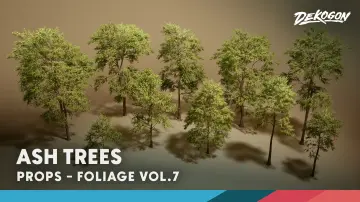 Trees