"20dc10f270470815"{"id":"1002500","slug":"modular-medieval-warrior-01","title":"Modular Medieval Warrior 01","category":"Characters \u0026 Creatures","engine":"4.16+,5.0+","assetVersion":"","engineVersion":"Engine Version: 4.16+,5.0+","tag":"Characters","accent":"blue","visual":"character","summary":"Modular Medieval Warrior 01 provides 54 models, 12 modular parts, cloth simulation, and custom face generation for Unreal Engine fantasy and historical projects","platform":"Unreal Engine","indexPolicy":"index","publishedAt":"2026-11-12T18:24:38.986Z","updatedAt":"2026-11-12T18:24:38.986Z","sourceNotes":[],"fileContents":[],"compatibility":["Unreal Engine","Engine Version: 4.16+,5.0+"],"featuredImage":{"alt":"Modular Medieval Warrior 01","src":"/wp-content/uploads/published/2026/11/6e935b874d5a-8ddbe787-a057-47e1-8bbe-1a76ff5361a1-2b920c6e63.webp"},"hasDownloadLink":true,"downloads":0,"terms":[{"taxonomy":"category","slug":"characters-and-creatures","name":"Characters \u0026 Creatures"}],"galleryImages":[{"src":"/wp-content/uploads/published/2026/11/2c0b63ad50af-e9c10475-acbc-466a-be49-87420d28c0ea-68e63b8f21.webp","alt":"Modular Medieval Warrior 01"},{"src":"/wp-content/uploads/published/2026/11/44af8e85b102-33bfa494-6a17-4b3d-a6d8-3a08627fcd9b-9b1365d941.webp","alt":"Modular Medieval Warrior 01"},{"src":"/wp-content/uploads/published/2026/11/82c63aeb5b2b-fb53a329-f4e0-4d7f-a684-8da1cd983fa2-b541a423b9.webp","alt":"Modular Medieval Warrior 01"},{"src":"/wp-content/uploads/published/2026/11/c5a46e339ba3-b5740779-9fbb-45cd-9d07-b533b08f703a-55a936ac82.webp","alt":"Modular Medieval Warrior 01"},{"src":"/wp-content/uploads/published/2026/11/aa5bbada79ce-2577c5dd-b076-431e-80b7-110e781e44bc-a5c132b3ba.webp","alt":"Modular Medieval Warrior 01"},{"src":"/wp-content/uploads/published/2026/11/31eba208d403-36aa6415-e1b2-4dbe-a5f1-3e259a5e6454-a8b9c020de.webp","alt":"Modular Medieval Warrior 01"},{"src":"/wp-content/uploads/published/2026/11/0d773caf12eb-b3476adc-e626-4bdb-b155-282b9b74bd75-88e96bee02.webp","alt":"Modular Medieval Warrior 01"}],"accessPanel":{"kind":"resource","title":"Get this resource","eyebrow":"Free resource","message":"Download this resource in your browser.","fileName":"Content.7z","safetyNote":"Resources are manually reviewed before listing to improve quality and reduce obvious risks.","actionLabel":"Get this resource","resourceType":"Resource archive","versions":[]},"contentHtml":"\u003ch2\u003eStaging Medieval Battles and Fantasy Encounters\u003c/h2\u003e\n\u003cp\u003eHistorical battlefields, frontier garrisons, and low-fantasy dungeon skirmishes frequently demand combatants who share a coherent visual theme without appearing identical. Modular Medieval Warrior 01 addresses this specific production requirement by delivering a framework for medium-armored fighters suited for medieval eras and fantasy game settings. Instead of populating an encampment or an opposing battleline with cloned soldiers, the system supplies the technical and aesthetic foundation to field distinct infantry units, patrol guards, or mercenary squads.\u003c/p\u003e\n\u003cp\u003eBecause the asset maintains direct compatibility with Modular Medieval Citizens, projects that already incorporate civilian crowds can seamlessly transition between non-combat and military personnel. A settlement defense scenario, for instance, can introduce armed retainers whose visual language bridges the gap between basic working attire and specialized military gear. The flexibility extends to playable roles as well. The setup accommodates both third-person (TPP) and first-person (FPP) camera perspectives directly inside the engine, making it just as capable of driving an up-close first-person melee title as it is an over-the-shoulder historical adventure.\u003c/p\u003e \u003ch2\u003eModular Assembly Across Fifty-Four Mesh Variants\u003c/h2\u003e\n\u003cp\u003eThe core structure of the character package relies on twelve distinct modular body parts. Creators can independently swap helmets, hoods, hair, beards, chests, shoulders, gloves, skirts, pants, boots, shields, and weapons. Across these equipment slots, the package delivers 54 individual models, each provided with two levels of detail (LODs) to help balance visual fidelity against rendering overhead when fielding groups of soldiers.\u003c/p\u003e\n\u003cp\u003eNaked base models are also included, which ensures that underlying anatomical layers do not conflict when clipping beneath different layers of clothing or light plate. With separate models and materials allocated across the modular slots, assembling specialized kits becomes straightforward. A heavy sentry can be equipped with a closed helmet, armored pauldrons, heavy boots, and a broad shield, while a light scout can strip down to a fabric hood, bare hands, trousers, and a sidearm. Four designated sockets provide dedicated connection points for holding and stowing shields and weapons, keeping props locked correctly to the hands or back.\u003c/p\u003e \u003ch2\u003eWarrior Blueprint Controls and Visual Customization\u003c/h2\u003e\n\u003cp\u003eCentral to assembling and tuning characters is the Character Creator Blueprint, which exposes an extensive set of engine variables to configure equipment, physical appearance, and palette choices. Built-in blendshapes and material instances allow developers to manipulate facial structures dynamically, incorporating distinct racial profiles and age control sliders to morph younger fighters into weathered veterans. For projects requiring rapid population of non-player characters, a randomized face generation feature creates varied facial contours automatically without manual adjustment.\u003c/p\u003e\n\u003cp\u003eCustomization extends beyond facial features and mesh choices. The package incorporates body proportion control, granting the ability to alter silhouettes so that two fighters wearing the same chest piece can possess noticeably different frames. To manage coloration across large contingents of troops, 21 separate body areas feature changeable Hue, Saturation, and Lightness (HSL) color masks. By adjusting these masks through the blueprint or material instances, developers can establish distinct heraldic schemes, faction colors, or localized unit markings across identical equipment sets without duplicating textures.\u003c/p\u003e \u003ch2\u003eSkeletal Rigging, Dynamic Simulation, and Physics\u003c/h2\u003e\n\u003cp\u003eEvery model is rigged and scaled directly to the standard Epic skeleton, ensuring compatibility with standard character animation pipelines. To eliminate joint distortion around high-stress bending regions, the skeleton includes dedicated twist bones. These twist bones yield substantially cleaner deformations along the forearms and thighs during extreme animation poses, such as swinging heavy weapons or drawing back a shield arm.\u003c/p\u003e\n\u003cp\u003eThe package includes modified Epic animations that have been adjusted inside Persona to match the stance and weight of an armored fighter. Physics assets are fully configured out of the box, allowing models to transition smoothly into realistic ragdoll states upon defeat. Secondary motion is handled through real-time cloth and hair simulation, adding natural sway to hoods, hair strands, beards, and skirts as combatants sprint, dodge, or turn.\u003c/p\u003e \u003ch2\u003ePBR Texture Packing and Memory Optimization\u003c/h2\u003e\n\u003cp\u003eDeploying multiple detailed characters concurrently requires careful texture budgeting. The package features 176 physically based rendering (PBR) textures comprising albedo, normal, and packed channel maps. Rather than dedicating separate texture files to individual material parameters, roughness, ambient occlusion (AO), and metallic values are packed together into the individual channels of a single RGB texture.\u003c/p\u003e\n\u003cp\u003eTo keep video memory requirements low, textures are authored in DXT1 format, cutting VRAM consumption by half relative to uncompressed or less efficient formats, while normal maps use the BC5 compression format to preserve surface fidelity on armor, fabric, and skin. This optimization strategy ensures that high-resolution visual details remain intact even when multiple armored fighters occupy the same frame.\u003c/p\u003e \u003ch2\u003eTechnical Deployment and Practical Applications\u003c/h2\u003e\n\u003cp\u003eImplementation is streamlined through the ready-to-play Character Blueprint, which comes fully wired with camera configurations, animation logic, and equipment switching functionality. A dedicated documentation file containing a tutorial is included to guide setup, variable tuning, and blueprint adjustments.\u003c/p\u003e\n\u003cp\u003eThis package is best suited for developers building medieval or fantasy action titles, role-playing games, or tactical combat systems that require high visual variation without building individual combatant assets from scratch. Teams seeking robust squad variety, optimized memory footprints, and ready-to-run first-person or third-person functionality will find the modular setup immediately usable in active production.\u003c/p\u003e\n\n\u003ch2\u003eContinue Browsing Similar Packs\u003c/h2\u003e\n\u003cul\u003e\n\u003cli\u003e\u003ca href=\"https://3dcghub.com/medieval-infantry/\" rel=\"noopener noreferrer\"\u003eMedieval Infantry\u003c/a\u003e\u003c/li\u003e\n\u003cli\u003e\u003ca href=\"https://3dcghub.com/samurai-warriors/\" rel=\"noopener noreferrer\"\u003eSamurai Warriors\u003c/a\u003e\u003c/li\u003e\n\u003cli\u003e\u003ca href=\"https://3dcghub.com/hero-mercenary-warrior/\" rel=\"noopener noreferrer\"\u003eHero Mercenary Warrior\u003c/a\u003e\u003c/li\u003e\n\u003cli\u003e\u003ca href=\"https://3dcghub.com/gothic-knight/\" rel=\"noopener noreferrer\"\u003eGothic Knight\u003c/a\u003e\u003c/li\u003e\n\u003cli\u003e\u003ca href=\"https://3dcghub.com/warrior-hero/\" rel=\"noopener noreferrer\"\u003eWarrior Hero\u003c/a\u003e\u003c/li\u003e\n\u003c/ul\u003e","contentTextLength":6378,"navigation":{"current":2,"total":4424,"previous":{"id":"1002501","slug":"shieldmaiden","title":"Shieldmaiden","category":"Characters \u0026 Creatures","platform":"Unreal Engine","updatedAt":"2026-11-12T18:26:55.975Z"},"next":{"id":"1002499","slug":"modular-fantasy-knights","title":"Modular Fantasy Knights","category":"Characters \u0026 Creatures","platform":"Unreal Engine","updatedAt":"2026-11-12T18:23:45.507Z"}},"relatedResources":[{"id":"1002485","slug":"medieval-infantry","title":"Medieval Infantry","category":"Characters \u0026 Creatures","engine":"4.19+,5.0+","assetVersion":"","engineVersion":"Engine Version: 4.19+,5.0+","tag":"Characters","accent":"blue","visual":"character","summary":"Customizable realistic medieval warriors with advanced material controls, UE mannequin compatibility, a dedicated weapon asset, and a deployable ballista.","platform":"Unreal Engine","indexPolicy":"index","publishedAt":"2026-11-12T03:49:48.304Z","updatedAt":"2026-11-12T03:49:48.304Z","sourceNotes":[],"fileContents":[],"compatibility":["Unreal Engine","Engine Version: 4.19+,5.0+"],"featuredImage":{"alt":"Medieval Infantry","src":"/wp-content/uploads/published/2026/11/b6de45965936-86df4195-fcaf-4770-a2e1-5228fc98f0d5-86b001c8c2.webp"},"hasDownloadLink":true,"downloads":0},{"id":"1001658","slug":"samurai-warriors","title":"Samurai Warriors","category":"Characters \u0026 Creatures","engine":"4.19+,5.0+","assetVersion":"","engineVersion":"Engine Version: 4.19+,5.0+","tag":"Characters","accent":"blue","visual":"character","summary":"Integrate Samurai Warriors with UE mannequin compatibility, NvCloth solver cloth dynamics, and modular material controls for medieval combat projects.","platform":"Unreal Engine","indexPolicy":"index","publishedAt":"2026-10-13T08:34:57.969Z","updatedAt":"2026-10-13T08:34:57.969Z","sourceNotes":[],"fileContents":[],"compatibility":["Unreal Engine","Engine Version: 4.19+,5.0+"],"featuredImage":{"alt":"Samurai Warriors","src":"/wp-content/uploads/published/2026/10/86ea906ffa4f-d5fb222a-187f-4a65-9e5f-6bf524e306b5-605f393566.webp"},"hasDownloadLink":true,"downloads":0},{"id":"2553","slug":"hero-mercenary-warrior","title":"Hero Mercenary Warrior","category":"Characters \u0026 Creatures","engine":"4.26+,5.0+","assetVersion":"Engine version: 4.26+,5.0+","engineVersion":"4.25","tag":"Characters","accent":"blue","visual":"character","summary":"Elevate your game with this realistic Hero Mercenary Warrior. It features modular armor, PBR textures, and facial morphs for professional fantasy projects.","platform":"Unreal Engine","indexPolicy":"noindex","publishedAt":"2026-02-07T10:20:54.000Z","updatedAt":"2026-04-19T15:58:00.000Z","sourceNotes":[],"fileContents":[],"compatibility":["Unreal Engine","Engine version: 4.26+,5.0+"],"featuredImage":{"alt":"Hero Mercenary Warrior","src":"https://3dcghub.com/wp-content/uploads/2026/02/dfd5e624-63d6-49e9-9b88-37f076de8a6b.webp"},"hasDownloadLink":true,"downloads":2}]}
Characters
Modular Medieval Warrior 01
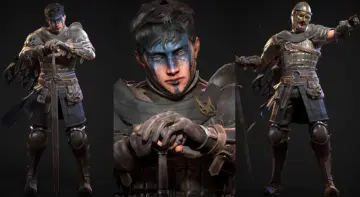
Modular Medieval Warrior 01 provides 54 models, 12 modular parts, cloth simulation, and custom face generation for Unreal Engine fantasy and historical projects
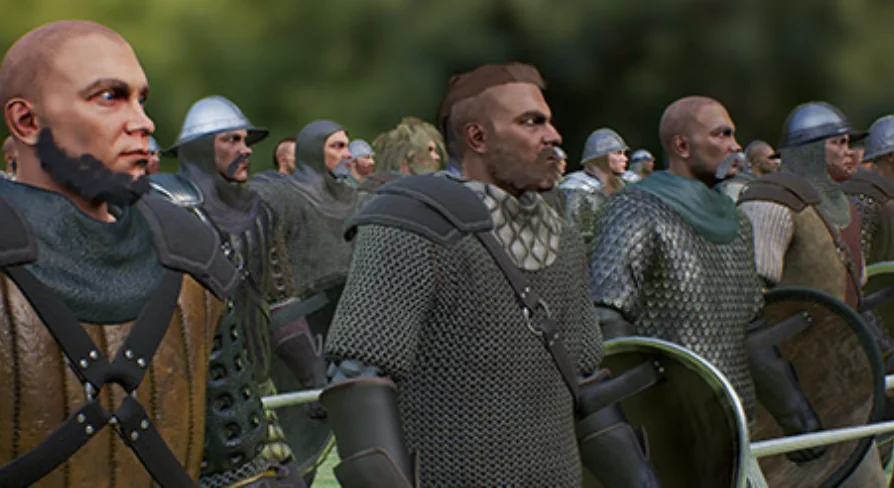
Historical battlefields, frontier garrisons, and low-fantasy dungeon skirmishes frequently demand combatants who share a coherent visual theme without appearing identical. Modular Medieval Warrior 01 addresses this specific production requirement by delivering a framework for medium-armored fighters suited for medieval eras and fantasy game settings. Instead of populating an encampment or an opposing battleline with cloned soldiers, the system supplies the technical and aesthetic foundation to field distinct infantry units, patrol guards, or mercenary squads.
Because the asset maintains direct compatibility with Modular Medieval Citizens, projects that already incorporate civilian crowds can seamlessly transition between non-combat and military personnel. A settlement defense scenario, for instance, can introduce armed retainers whose visual language bridges the gap between basic working attire and specialized military gear. The flexibility extends to playable roles as well. The setup accommodates both third-person (TPP) and first-person (FPP) camera perspectives directly inside the engine, making it just as capable of driving an up-close first-person melee title as it is an over-the-shoulder historical adventure.
Modular Assembly Across Fifty-Four Mesh Variants
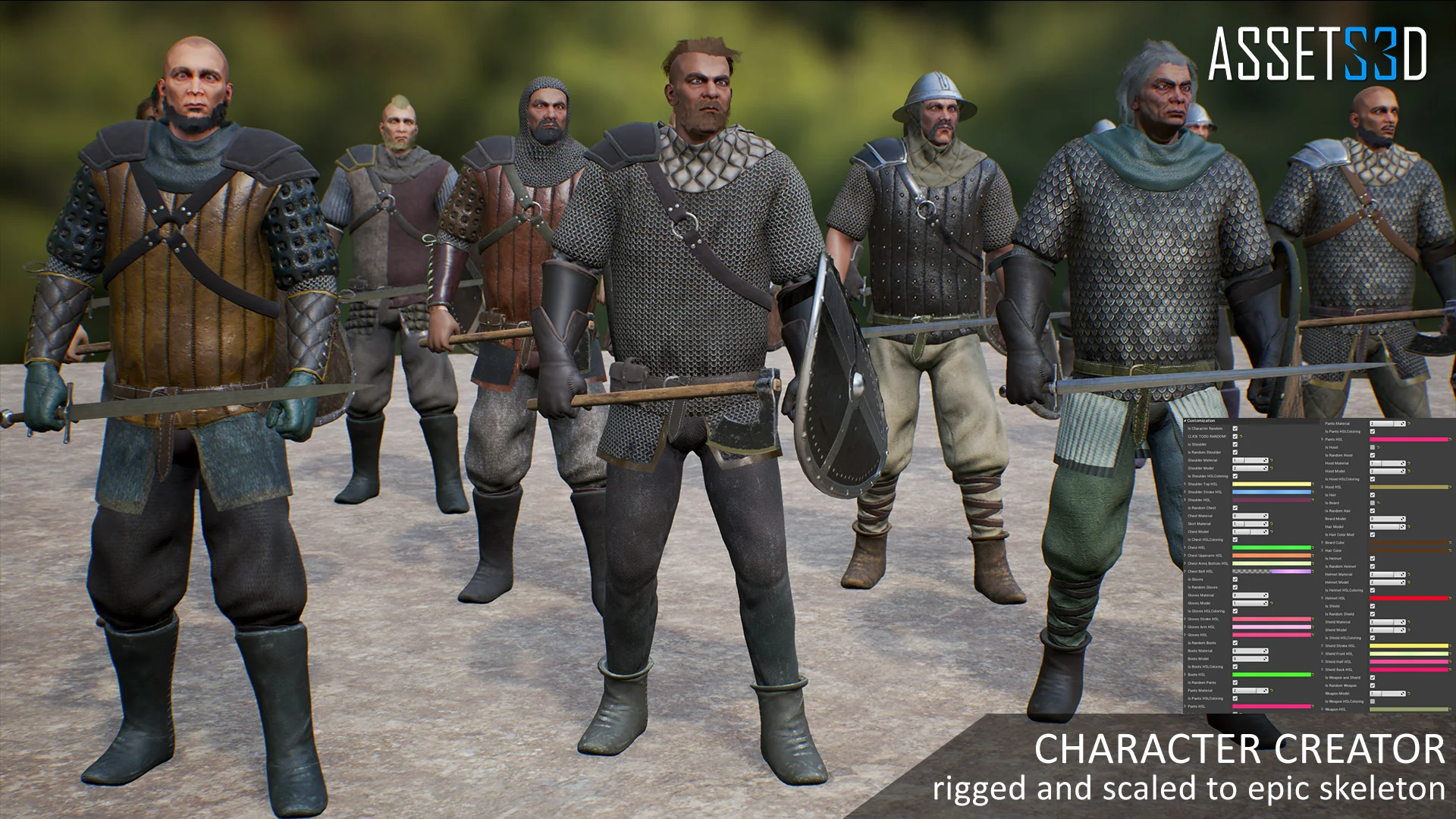
The core structure of the character package relies on twelve distinct modular body parts. Creators can independently swap helmets, hoods, hair, beards, chests, shoulders, gloves, skirts, pants, boots, shields, and weapons. Across these equipment slots, the package delivers 54 individual models, each provided with two levels of detail (LODs) to help balance visual fidelity against rendering overhead when fielding groups of soldiers.
Naked base models are also included, which ensures that underlying anatomical layers do not conflict when clipping beneath different layers of clothing or light plate. With separate models and materials allocated across the modular slots, assembling specialized kits becomes straightforward. A heavy sentry can be equipped with a closed helmet, armored pauldrons, heavy boots, and a broad shield, while a light scout can strip down to a fabric hood, bare hands, trousers, and a sidearm. Four designated sockets provide dedicated connection points for holding and stowing shields and weapons, keeping props locked correctly to the hands or back.
Warrior Blueprint Controls and Visual Customization
Central to assembling and tuning characters is the Character Creator Blueprint, which exposes an extensive set of engine variables to configure equipment, physical appearance, and palette choices. Built-in blendshapes and material instances allow developers to manipulate facial structures dynamically, incorporating distinct racial profiles and age control sliders to morph younger fighters into weathered veterans. For projects requiring rapid population of non-player characters, a randomized face generation feature creates varied facial contours automatically without manual adjustment.
Customization extends beyond facial features and mesh choices. The package incorporates body proportion control, granting the ability to alter silhouettes so that two fighters wearing the same chest piece can possess noticeably different frames. To manage coloration across large contingents of troops, 21 separate body areas feature changeable Hue, Saturation, and Lightness (HSL) color masks. By adjusting these masks through the blueprint or material instances, developers can establish distinct heraldic schemes, faction colors, or localized unit markings across identical equipment sets without duplicating textures.
Skeletal Rigging, Dynamic Simulation, and Physics
Every model is rigged and scaled directly to the standard Epic skeleton, ensuring compatibility with standard character animation pipelines. To eliminate joint distortion around high-stress bending regions, the skeleton includes dedicated twist bones. These twist bones yield substantially cleaner deformations along the forearms and thighs during extreme animation poses, such as swinging heavy weapons or drawing back a shield arm.
The package includes modified Epic animations that have been adjusted inside Persona to match the stance and weight of an armored fighter. Physics assets are fully configured out of the box, allowing models to transition smoothly into realistic ragdoll states upon defeat. Secondary motion is handled through real-time cloth and hair simulation, adding natural sway to hoods, hair strands, beards, and skirts as combatants sprint, dodge, or turn.
PBR Texture Packing and Memory Optimization
Deploying multiple detailed characters concurrently requires careful texture budgeting. The package features 176 physically based rendering (PBR) textures comprising albedo, normal, and packed channel maps. Rather than dedicating separate texture files to individual material parameters, roughness, ambient occlusion (AO), and metallic values are packed together into the individual channels of a single RGB texture.
To keep video memory requirements low, textures are authored in DXT1 format, cutting VRAM consumption by half relative to uncompressed or less efficient formats, while normal maps use the BC5 compression format to preserve surface fidelity on armor, fabric, and skin. This optimization strategy ensures that high-resolution visual details remain intact even when multiple armored fighters occupy the same frame.
Technical Deployment and Practical Applications
Implementation is streamlined through the ready-to-play Character Blueprint, which comes fully wired with camera configurations, animation logic, and equipment switching functionality. A dedicated documentation file containing a tutorial is included to guide setup, variable tuning, and blueprint adjustments.
This package is best suited for developers building medieval or fantasy action titles, role-playing games, or tactical combat systems that require high visual variation without building individual combatant assets from scratch. Teams seeking robust squad variety, optimized memory footprints, and ready-to-run first-person or third-person functionality will find the modular setup immediately usable in active production.
 Characters
 Characters
 Characters
 Characters