"c14ff6bd758dadb1"{"id":"1000525","slug":"military-supplies-vol-1-tents","title":"Military Supplies - VOL.1 - Tents","category":"Residential Buildings","engine":"4.26+,5.0+","assetVersion":"","engineVersion":"Engine Version: 4.26+,5.0+","tag":"Residential Buildi","accent":"blue","visual":"mech","summary":"Unreal Engine military tent pack with AAA-quality props, channel-packed textures, master materials, and a dynamic lighting scene for realistic base-building.","platform":"Unreal Engine","publishedAt":"2026-07-14T16:04:22.809Z","updatedAt":"2026-07-14T16:04:22.809Z","sourceNotes":[],"fileContents":[],"compatibility":["Unreal Engine","Engine Version: 4.26+,5.0+"],"featuredImage":{"alt":"Military Supplies - VOL.1 - Tents","src":"/wp-content/uploads/published/2026/07/26c877ef562a-272737bf-5b9e-4ee9-9e5b-74ba8e13cba6-3dd03e7377.webp"},"hasDownloadLink":true,"downloads":0,"terms":[{"taxonomy":"category","slug":"residential-buildings","name":"Residential Buildings"}],"galleryImages":[{"src":"/wp-content/uploads/published/2026/07/89a430281b4f-f284bd0b-e24c-455b-82ef-1ab5265d02d0-2a9e23e538.webp","alt":"Military Supplies - VOL.1 - Tents"},{"src":"/wp-content/uploads/published/2026/07/1c223537e505-91164176-d966-4eb5-8e42-866eb08d040b-d75d6a836f.webp","alt":"Military Supplies - VOL.1 - Tents"},{"src":"/wp-content/uploads/published/2026/07/a9ebba67ca2c-2dda8ef5-f135-450f-ba6d-74e98927a631-3e80f8d26d.webp","alt":"Military Supplies - VOL.1 - Tents"},{"src":"/wp-content/uploads/published/2026/07/95e79dafa634-dc2bfff3-5e88-4941-887a-e6abb65be96c-fdd3a3c0ad.webp","alt":"Military Supplies - VOL.1 - Tents"},{"src":"/wp-content/uploads/published/2026/07/26930772a7f6-509494da-97ba-4213-b9a9-c4d4d4d61170-7f1920feae.webp","alt":"Military Supplies - VOL.1 - Tents"},{"src":"/wp-content/uploads/published/2026/07/42ce63a0c7ba-41adf37a-b569-47f7-a3b4-8155007aede1-1cec114e48.webp","alt":"Military Supplies - VOL.1 - Tents"},{"src":"/wp-content/uploads/published/2026/07/7d7b8ba340e2-eb9363c1-b363-4781-8123-0ddff82c4427-f8a5bff06c.webp","alt":"Military Supplies - VOL.1 - Tents"},{"src":"/wp-content/uploads/published/2026/07/987483763aa5-382542e3-0ad5-4861-a46e-82b7900c9fc1-51afe40b3b.webp","alt":"Military Supplies - VOL.1 - Tents"},{"src":"/wp-content/uploads/published/2026/07/0fa6af630ab2-dad8cc67-0a69-4198-b998-4ee0f9d0115b-9c5205277e.webp","alt":"Military Supplies - VOL.1 - Tents"},{"src":"/wp-content/uploads/published/2026/07/9f0a8b755bb8-5320af19-34bc-46bf-8c67-c746bfe68df3-a337e6b4b3.webp","alt":"Military Supplies - VOL.1 - Tents"}],"accessPanel":{"kind":"resource","title":"Download this resource","eyebrow":"Free Download","message":"Log in or create a free account to start your download.","fileName":"Content.7z","safetyNote":"Resources are manually reviewed before listing to improve quality and reduce obvious risks.","actionLabel":"Download Free","resourceType":"Resource archive"},"contentHtml":"\u003cp\u003eBuilding a credible military encampment inside a game engine demands props that read clearly from multiple distances and angles. \u003cstrong\u003eMilitary Supplies - VOL.1 - Tents\u003c/strong\u003e Addresses that need by providing a full set of tent structures, props, maps, and materials built entirely within Unreal Engine. The pack targets realistic AAA visual quality while keeping performance budgets in mind, which makes it serviceable for combat scenes, quarantine zones, industrial camps, or horror-adjacent narratives that require believable field infrastructure.\u003c/p\u003e\u003ch2\u003eStructuring a Military Camp with Realistic Tents and Props\u003c/h2\u003e\u003cp\u003eEvery asset included in the project is delivered with all maps and materials already configured for Unreal Engine, removing the need to rebuild shading networks from scratch. The models are fully detailed from all sides, meaning tents and props can be placed in open terrain or clustered into compounds without broken geometry appearing on unseen faces. Designers can construct forward operating bases, training camps, or quarantined shelters using props that maintain visual fidelity at close range while supporting broader environment composition.\u003c/p\u003e\u003cp\u003eThe set comes with a test dynamic lighting scene, offering a ready-made framework for evaluating how the assets respond to real-time lighting. Level designers can drop into this preview environment, swap tents in and out, and measure how the props hold up under dynamic shadow behaviour before committing to a full layout. This workflow shortcut helps artists identify how surface treatment interacts with light across different times of day or atmospheric conditions.\u003c/p\u003e\u003ch2\u003eMaterial Controls and Channel-Packed Texture Workflows\u003c/h2\u003e\u003cp\u003eAt the core of the pack sits a master material setup that governs the majority of props and models included in the project. Rather than relying on isolated material instances for every object, the master setup exposes controls for roughness, albedo, normals, and additional parameters, giving artists the ability to tweak surface response without reimporting textures or generating new maps. This becomes useful when trying to match a tent canvas material to a specific weather condition or when dirtying up a prop to sit naturally inside a war-torn environment.\u003c/p\u003e\u003cp\u003eTexture efficiency is handled through channel-packed maps combining Roughness, Metalness, and Ambient Occlusion into a single image. This packing method reduces the number of individual texture lookups required by the renderer, keeping the material pipeline lean and directly aligned with modern game engine standards. For larger tents, the project provides multiple texture skins, letting the same mesh support visual variation across a camp without obvious repetition. An encampment can therefore be populated with identical tent models while still displaying differentiated surface treatments.\u003c/p\u003e\u003ch2\u003eTexture Resolution Allocation\u003c/h2\u003e\u003cp\u003eThe texture distribution across the asset pack is as follows:\u003c/p\u003e\u003cul\u003e\u003cli\u003e\u003cstrong\u003e4096\u003c/strong\u003e Resolution: 3 textures\u003c/li\u003e\u003cli\u003e\u003cstrong\u003e2048\u003c/strong\u003e Resolution: 26 textures\u003c/li\u003e\u003cli\u003e\u003cstrong\u003e1024\u003c/strong\u003e Resolution: 2 textures\u003c/li\u003e\u003cli\u003e\u003cstrong\u003e512\u003c/strong\u003e Resolution: 1 texture\u003c/li\u003e\u003cli\u003e\u003cstrong\u003e256\u003c/strong\u003e Resolution: 2 textures\u003c/li\u003e\u003cli\u003e\u003cstrong\u003e128\u003c/strong\u003e Resolution: 3 textures\u003c/li\u003e\u003c/ul\u003e\u003ch2\u003ePerformance Budget and Game-Ready Optimization\u003c/h2\u003e\u003cp\u003eEach asset was created with both visual fidelity and performance in mind, and the project is explicitly optimized for games. Texture resolution is prioritized according to likely visibility, with most maps sitting at 2048 pixels or higher to preserve surface detail on hero props, while smaller resolutions handle secondary objects or elements that do not require close inspection.\u003c/p\u003e\u003cp\u003eBy concentrating the highest resolutions on a small number of key textures and balancing the remainder across mid-range sizes, the pack keeps memory usage measured. Artists building large exterior scenes can populate wide areas without overloading video memory through excessive 4096 maps. The inclusion of the master material setup further reinforces this optimization approach, as controlling parameters at the material level reduces the need to bake variations into unique texture files for every prop iteration.\u003c/p\u003e\u003ch2\u003eBranding, Legal Safety, and Fully Detailed Models\u003c/h2\u003e\u003cp\u003eAll branding and labels used across the assets are custom-made by the studio, ensuring the pack is free of legal issues related to real-world trademark usage. Creators working on commercial projects can place these tents and props in their environments without needing to verify whether a logo or insignia is protected. This is a natural fit for game developers building military or simulation-themed titles where branding authenticity often conflicts with intellectual property restrictions.\u003c/p\u003e\u003ch2\u003eDetermining Scene Suitability for Military Supplies - VOL.1 - Tents\u003c/h2\u003e\u003cp\u003eThis multi-genre utility is reflected in how the assets can be applied across different creative directions. For simulation titles, the tent structures provide the architectural vocabulary of temporary field deployment, complete with detailed geometry suitable for player interaction or proximity examination. For horror or quarantine scenarios, the same tents can be staged as abandoned shelters within a restricted zone, with the dynamic lighting test scene serving as a starting point for isolating mood and atmosphere. Industrial military sites can combine the larger tents with supporting props to create worker housing or equipment storage areas within a broader facility.\u003c/p\u003e\u003cp\u003eDevelopers working with Unreal Engine environments will find the master material approach particularly suited to iterative level design. When a scene calls for a dry, sun-bleached camp, roughness and albedo controls can be pushed accordingly. If the narrative shifts to a rain-sooked or mud-bogged forward position, the same props adjust through material parameters without requiring a separate asset re-import. This flexibility gives environment artists and art directors a contained set of tools for modulating the visual tone of an encampment across different missions or story beats.\u003c/p\u003e\u003cp\u003eThe models maintain full detail from all sides, enabling open placements in gameplay spaces where players can walk around, through, or past structures. Tents positioned along the edge of a combat zone or placed as cover elements can be photographed from multiple angles without revealing hollow or untextured backsides. This all-angle modelling approach supports gameplay scenarios where environmental traversal is not strictly linear and props need to hold up from both interior and exterior viewpoints.\u003c/p\u003e\u003cp\u003eBecause everything pictured in the project is included, level designers can plan scene composition around the exact prop count and tent configurations shown. The absence of placeholder items or separately gated content means what is visible represents what can be placed in a scene, simplifying the pre-production planning phase for art directors who need to budget environment density before committing to a full build.\u003c/p\u003e\u003cp\u003eFor teams prioritising realistic military aesthetics alongside performance-conscious material setups, this volume provides a consistent package of props, textures, and lighting test environments built specifically for Unreal Engine. The combination of custom branding safety, fully detailed geometry, multiple texture skins, and integrated master material controls makes it a practical resource for constructing believable field infrastructure across a range of game genres.\u003c/p\u003e\n\n\u003ch2\u003eRelated Resources Worth Checking\u003c/h2\u003e\n\u003cul\u003e\n\u003cli\u003e\u003ca href=\"https://3dcghub.com/military-supplies-vol-5-war-machines/\" title=\"Military Supplies - VOL.5 - War Machines\"\u003eMilitary Supplies - VOL.5 - War Machines\u003c/a\u003e\u003c/li\u003e\n\u003cli\u003e\u003ca href=\"https://3dcghub.com/military-supplies-vol-2-clothing-and-bags/\" title=\"Military Supplies - VOL.2 - Clothing and Bags\"\u003eMilitary Supplies - VOL.2 - Clothing and Bags\u003c/a\u003e\u003c/li\u003e\n\u003cli\u003e\u003ca href=\"https://3dcghub.com/military-supplies-vol-4-furniture/\" title=\"Military Supplies - VOL.4 - Furniture\"\u003eMilitary Supplies - VOL.4 - Furniture\u003c/a\u003e\u003c/li\u003e\n\u003cli\u003e\u003ca href=\"https://3dcghub.com/quarantine-medical-tent/\" title=\"Quarantine Medical Tent\"\u003eQuarantine Medical Tent\u003c/a\u003e\u003c/li\u003e\n\u003cli\u003e\u003ca href=\"https://3dcghub.com/buildings-vol-9-modular-pipes-and-gutters-nanite-and-low-poly/\" title=\"Buildings VOL.9 - Modular Pipes \u0026amp; Gutters (Nanite \u0026amp; Low Poly)\"\u003eBuildings VOL.9 - Modular Pipes \u0026amp; Gutters (Nanite \u0026amp; Low Poly)\u003c/a\u003e\u003c/li\u003e\n\u003c/ul\u003e","contentTextLength":7563,"navigation":{"current":1337,"total":3719,"previous":{"id":"1000526","slug":"military-supplies-vol-8-field-supplies","title":"Military Supplies - VOL.8 - Field Supplies","category":"Residential Buildings","platform":"Unreal Engine","updatedAt":"2026-07-14T16:10:12.344Z"},"next":{"id":"1000524","slug":"military-soldier-mega-bundle","title":"Military Soldier Mega Bundle","category":"Humans","platform":"Unreal Engine","updatedAt":"2026-07-14T15:55:11.145Z"}},"relatedResources":[{"id":"1000526","slug":"military-supplies-vol-8-field-supplies","title":"Military Supplies - VOL.8 - Field Supplies","category":"Residential Buildings","engine":"4.26+,5.0+","assetVersion":"","engineVersion":"Engine Version: 4.26+,5.0+","tag":"Residential Buildi","accent":"blue","visual":"mech","summary":"Unreal Engine military field supplies pack with master material setup, channel-packed textures, camo skins, dynamic lighting scene, and AAA-quality props.","platform":"Unreal Engine","publishedAt":"2026-07-14T16:10:12.344Z","updatedAt":"2026-07-14T16:10:12.344Z","sourceNotes":[],"fileContents":[],"compatibility":["Unreal Engine","Engine Version: 4.26+,5.0+"],"featuredImage":{"alt":"Military Supplies - VOL.8 - Field Supplies","src":"/wp-content/uploads/published/2026/07/1cc1ce1919ea-de2cdda3-6def-439d-a1c3-cc4235fe14b8-a5d9c20c8d.webp"},"hasDownloadLink":true,"downloads":1},{"id":"1001743","slug":"military-supplies-vol-7-containers","title":"Military Supplies - VOL.7 - Containers","category":"Military","engine":"4.26+,5.0+","assetVersion":"","engineVersion":"Engine Version: 4.26+,5.0+","tag":"Military","accent":"blue","visual":"mech","summary":"Examine Military Supplies - VOL.7 - Containers for Unreal Engine, featuring AAA prop models, master material controls, channel packing, and custom branding.","platform":"Unreal Engine","publishedAt":"2026-10-20T02:48:28.328Z","updatedAt":"2026-10-20T02:48:28.328Z","sourceNotes":[],"fileContents":[],"compatibility":["Unreal Engine","Engine Version: 4.26+,5.0+"],"featuredImage":{"alt":"Military Supplies - VOL.7 - Containers","src":"/wp-content/uploads/published/2026/10/e157e2b0bec6-58586e0a-4e5f-4003-99ac-30986af9be64-35e5a8c6fe.webp"},"hasDownloadLink":true,"downloads":0},{"id":"1001742","slug":"military-supplies-vol-6-crates","title":"Military Supplies - VOL.6 - Crates","category":"Military","engine":"4.26+,5.0+","assetVersion":"","engineVersion":"Engine Version: 4.26+,5.0+","tag":"Military","accent":"blue","visual":"mech","summary":"Explore the game-ready Military Supplies - VOL.6 - Crates asset pack for Unreal Engine, featuring AAA textures, master materials, and dynamic lighting setups.","platform":"Unreal Engine","publishedAt":"2026-10-20T02:47:34.655Z","updatedAt":"2026-10-20T02:47:34.655Z","sourceNotes":[],"fileContents":[],"compatibility":["Unreal Engine","Engine Version: 4.26+,5.0+"],"featuredImage":{"alt":"Military Supplies - VOL.6 - Crates","src":"/wp-content/uploads/published/2026/10/ac663f84ef41-b4bc712c-aac5-43e3-bb82-ffd02940891a-2b1613adb1.webp"},"hasDownloadLink":true,"downloads":0}]}
Residential Buildi
Military Supplies - VOL.1 - Tents
Unreal Engine military tent pack with AAA-quality props, channel-packed textures, master materials, and a dynamic lighting scene for realistic base-building.
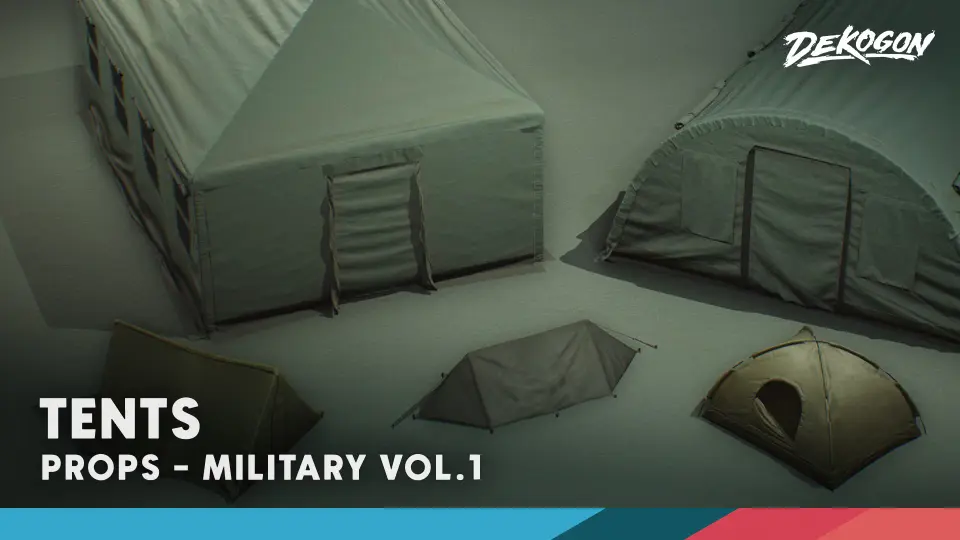
Building a credible military encampment inside a game engine demands props that read clearly from multiple distances and angles. Military Supplies - VOL.1 - Tents Addresses that need by providing a full set of tent structures, props, maps, and materials built entirely within Unreal Engine. The pack targets realistic AAA visual quality while keeping performance budgets in mind, which makes it serviceable for combat scenes, quarantine zones, industrial camps, or horror-adjacent narratives that require believable field infrastructure.
Structuring a Military Camp with Realistic Tents and Props
Every asset included in the project is delivered with all maps and materials already configured for Unreal Engine, removing the need to rebuild shading networks from scratch. The models are fully detailed from all sides, meaning tents and props can be placed in open terrain or clustered into compounds without broken geometry appearing on unseen faces. Designers can construct forward operating bases, training camps, or quarantined shelters using props that maintain visual fidelity at close range while supporting broader environment composition.
The set comes with a test dynamic lighting scene, offering a ready-made framework for evaluating how the assets respond to real-time lighting. Level designers can drop into this preview environment, swap tents in and out, and measure how the props hold up under dynamic shadow behaviour before committing to a full layout. This workflow shortcut helps artists identify how surface treatment interacts with light across different times of day or atmospheric conditions.
Material Controls and Channel-Packed Texture Workflows
At the core of the pack sits a master material setup that governs the majority of props and models included in the project. Rather than relying on isolated material instances for every object, the master setup exposes controls for roughness, albedo, normals, and additional parameters, giving artists the ability to tweak surface response without reimporting textures or generating new maps. This becomes useful when trying to match a tent canvas material to a specific weather condition or when dirtying up a prop to sit naturally inside a war-torn environment.
Texture efficiency is handled through channel-packed maps combining Roughness, Metalness, and Ambient Occlusion into a single image. This packing method reduces the number of individual texture lookups required by the renderer, keeping the material pipeline lean and directly aligned with modern game engine standards. For larger tents, the project provides multiple texture skins, letting the same mesh support visual variation across a camp without obvious repetition. An encampment can therefore be populated with identical tent models while still displaying differentiated surface treatments.
Texture Resolution Allocation
The texture distribution across the asset pack is as follows:
4096 Resolution: 3 textures
2048 Resolution: 26 textures
1024 Resolution: 2 textures
512 Resolution: 1 texture
256 Resolution: 2 textures
128 Resolution: 3 textures
Performance Budget and Game-Ready Optimization
Each asset was created with both visual fidelity and performance in mind, and the project is explicitly optimized for games. Texture resolution is prioritized according to likely visibility, with most maps sitting at 2048 pixels or higher to preserve surface detail on hero props, while smaller resolutions handle secondary objects or elements that do not require close inspection.
By concentrating the highest resolutions on a small number of key textures and balancing the remainder across mid-range sizes, the pack keeps memory usage measured. Artists building large exterior scenes can populate wide areas without overloading video memory through excessive 4096 maps. The inclusion of the master material setup further reinforces this optimization approach, as controlling parameters at the material level reduces the need to bake variations into unique texture files for every prop iteration.
Branding, Legal Safety, and Fully Detailed Models
All branding and labels used across the assets are custom-made by the studio, ensuring the pack is free of legal issues related to real-world trademark usage. Creators working on commercial projects can place these tents and props in their environments without needing to verify whether a logo or insignia is protected. This is a natural fit for game developers building military or simulation-themed titles where branding authenticity often conflicts with intellectual property restrictions.
Determining Scene Suitability for Military Supplies - VOL.1 - Tents
This multi-genre utility is reflected in how the assets can be applied across different creative directions. For simulation titles, the tent structures provide the architectural vocabulary of temporary field deployment, complete with detailed geometry suitable for player interaction or proximity examination. For horror or quarantine scenarios, the same tents can be staged as abandoned shelters within a restricted zone, with the dynamic lighting test scene serving as a starting point for isolating mood and atmosphere. Industrial military sites can combine the larger tents with supporting props to create worker housing or equipment storage areas within a broader facility.
Developers working with Unreal Engine environments will find the master material approach particularly suited to iterative level design. When a scene calls for a dry, sun-bleached camp, roughness and albedo controls can be pushed accordingly. If the narrative shifts to a rain-sooked or mud-bogged forward position, the same props adjust through material parameters without requiring a separate asset re-import. This flexibility gives environment artists and art directors a contained set of tools for modulating the visual tone of an encampment across different missions or story beats.
The models maintain full detail from all sides, enabling open placements in gameplay spaces where players can walk around, through, or past structures. Tents positioned along the edge of a combat zone or placed as cover elements can be photographed from multiple angles without revealing hollow or untextured backsides. This all-angle modelling approach supports gameplay scenarios where environmental traversal is not strictly linear and props need to hold up from both interior and exterior viewpoints.
Because everything pictured in the project is included, level designers can plan scene composition around the exact prop count and tent configurations shown. The absence of placeholder items or separately gated content means what is visible represents what can be placed in a scene, simplifying the pre-production planning phase for art directors who need to budget environment density before committing to a full build.
For teams prioritising realistic military aesthetics alongside performance-conscious material setups, this volume provides a consistent package of props, textures, and lighting test environments built specifically for Unreal Engine. The combination of custom branding safety, fully detailed geometry, multiple texture skins, and integrated master material controls makes it a practical resource for constructing believable field infrastructure across a range of game genres.
 Residential Buildi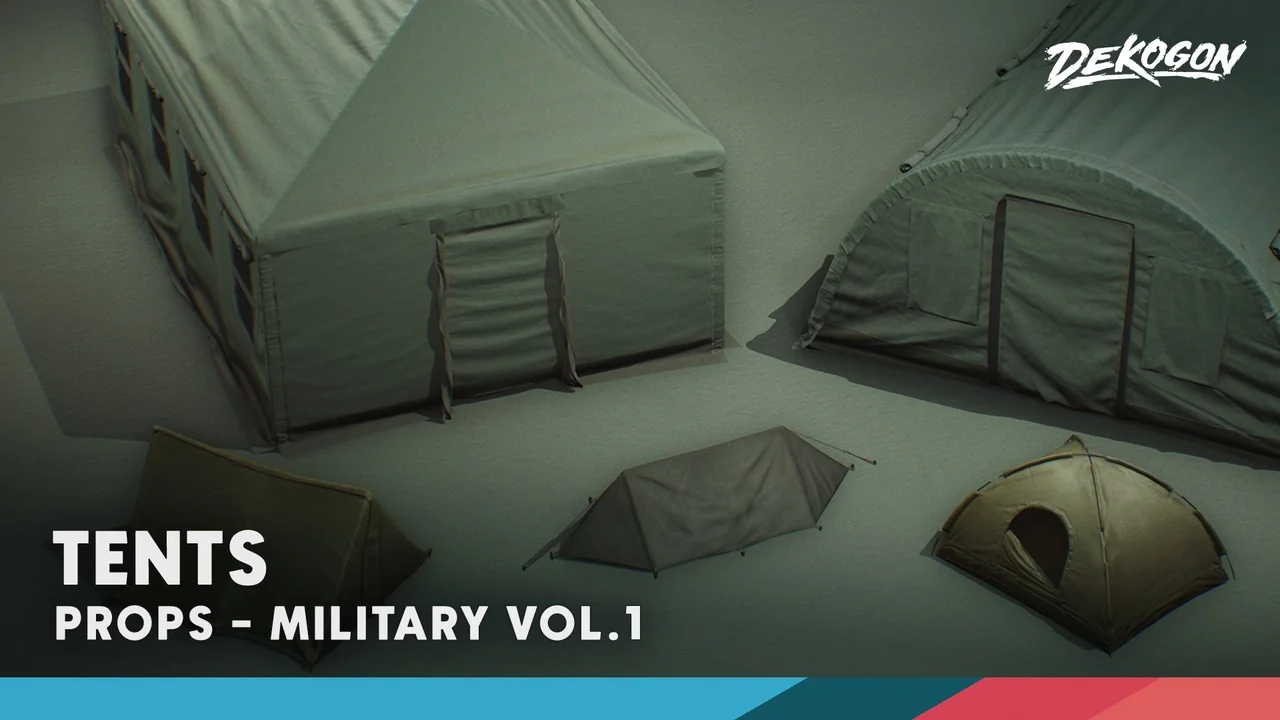
 Residential Buildi
 Military
 Military