"0341a2901a4ae9aa"{"id":"1000736","slug":"medieval-props-cellar","title":"Medieval Props: Cellar","category":"Towns \u0026 Villages","engine":"4.26+,5.0+","assetVersion":"","engineVersion":"Engine Version: 4.26+,5.0+","tag":"Towns \u0026 Villages","accent":"blue","visual":"mech","summary":"A kit of 39 ready-to-use medieval cellar props with optimized collisions, light maps, LODs, and static lighting support for production-ready game scenes.","platform":"Unreal Engine","publishedAt":"2026-07-26T16:37:21.995Z","updatedAt":"2026-07-26T16:37:21.995Z","sourceNotes":[],"fileContents":[],"compatibility":["Unreal Engine","Engine Version: 4.26+,5.0+"],"featuredImage":{"alt":"Medieval Props: Cellar","src":"/wp-content/uploads/published/2026/07/b2819a9fb30b-a315f1b8-c8bf-4eaa-a57a-c8eaaf6643ea-d7668fc742.webp"},"hasDownloadLink":true,"downloads":0,"terms":[{"taxonomy":"category","slug":"towns-and-villages","name":"Towns \u0026 Villages"}],"galleryImages":[{"src":"/wp-content/uploads/published/2026/07/0bbdaaccd3f1-6265cbf2-0661-474d-b868-9d755d40ef02-24a4f0016a.webp","alt":"Medieval Props: Cellar"},{"src":"/wp-content/uploads/published/2026/07/1f65f0fb2c09-262c1ea7-4e3a-4f47-ac9f-0c3023c9364c-ebf65e8691.webp","alt":"Medieval Props: Cellar"},{"src":"/wp-content/uploads/published/2026/07/205293db5f70-45b4dc90-4c8c-48d8-ac28-c49d9e3f0713-fb81ff3177.webp","alt":"Medieval Props: Cellar"},{"src":"/wp-content/uploads/published/2026/07/e1701b47c2a8-1a2e57cd-5142-43f0-912f-898b64e9938c-bef47872ac.webp","alt":"Medieval Props: Cellar"},{"src":"/wp-content/uploads/published/2026/07/b999ed5c1193-6b7716a9-3bda-40aa-807e-95315e45a207-e9969f6e2a.webp","alt":"Medieval Props: Cellar"},{"src":"/wp-content/uploads/published/2026/07/ab5ecfa6ba57-7559156e-e323-4b61-89cb-ee2ed79ebebb-57c86e3661.webp","alt":"Medieval Props: Cellar"},{"src":"/wp-content/uploads/published/2026/07/4f9d1aa4c3eb-e780dbe7-3a64-411c-ad1d-29198333f5c7-cf9837bac2.webp","alt":"Medieval Props: Cellar"},{"src":"/wp-content/uploads/published/2026/07/df89ce1856c8-65d568a6-595c-439e-911b-4e5b8225e390-0628df7bf0.webp","alt":"Medieval Props: Cellar"},{"src":"/wp-content/uploads/published/2026/07/e1a888300ab9-fa7db8e5-db3d-4f05-a04d-fd434303372f-7cde5a9771.webp","alt":"Medieval Props: Cellar"},{"src":"/wp-content/uploads/published/2026/07/8f825e39905c-39026803-9d4e-438d-a9c6-39c105308f57-76438d32e1.webp","alt":"Medieval Props: Cellar"}],"accessPanel":{"kind":"resource","title":"Download this resource","eyebrow":"Free Download","message":"Log in or create a free account to start your download.","fileName":"Content.7z","safetyNote":"Resources are manually reviewed before listing to improve quality and reduce obvious risks.","actionLabel":"Download Free","resourceType":"Resource archive"},"contentHtml":"\u003ch2\u003eDropping the Medieval Cellar Kit into a Scene\u003c/h2\u003e\n\u003cp\u003eSetup for this package begins with drag-and-drop placement rather than manual collision generation. Each asset ships with accurate, high-quality collisions already built, so props sit correctly on surfaces and interact with physics without requiring further tuning. Models come fully game-ready, meaning the typical pre-pass of generating collision hulls, adjusting texture compression, and setting lightmap resolutions has already been handled by the developer. Named entries follow an organized naming convention for quick and easy search, so locating a specific cellar element inside a large project folder remains straightforward even as the collection grows.\u003c/p\u003e\n\n\u003ch2\u003eCollection Scope: 39 Models with Texture Variants\u003c/h2\u003e\n\u003cp\u003eThe kit comprises a set of medieval cellar assets totaling 39 models when counting every variant. Texture variants are included as additional content, meaning individual pieces can swap surface appearance without doubling the mesh count or requiring separate imports. A cellar scene typically calls for repeated staples like barrels, bottles, and carts, so variant swapping becomes a practical way to avoid visual monotony across shelving units or stacked storage. Tags accompanying the package—\u003cem\u003eVillage\u003c/em\u003e, \u003cem\u003eBarn\u003c/em\u003e, \u003cem\u003eCellar\u003c/em\u003e, \u003cem\u003eBarrel\u003c/em\u003e, \u003cem\u003eBottle\u003c/em\u003e, \u003cem\u003eCart\u003c/em\u003e, and \u003cem\u003eHigh\u003c/em\u003e—signal the dominant object types and the general rural storage aesthetic the collection targets.\u003c/p\u003e\n\n\u003ch3\u003eNaming Conventions and Search Workflow\u003c/h3\u003e\n\u003cp\u003eFinding a specific asset inside a populated scene relies on naming clarity. Each mesh uses organized names intended for quick and easy search, which matters when a level designer needs to isolate every bottle instance or filter for cart-related props. Predictable prefixes and consistent descriptors cut down on manual filtering, especially when working across multiple rooms or duplicating a cellar layout for different buildings.\u003c/p\u003e\n\n\u003ch2\u003eLighting Behavior and Static-Light Compatibility\u003c/h2\u003e\n\u003cp\u003eThe props are compatible with static lighting, opening the collection to baked workflows common in medieval interiors where dynamic lighting may be unnecessary. Good lightmaps on every model help control baked shadow quality and reduce light bleed in tight cellar spaces. With baked lighting, the resolution and compression settings chosen for each model play a direct role in how textures hold up under close inspection, and the developer has already tuned the optimized resolution and texture compression settings for each mesh rather than applying a single blanket profile.\u003c/p\u003e\n\n\u003ch3\u003eHandling Auto-Exposure Shifts\u003c/h3\u003e\n\u003cp\u003eOne practical consideration: if the scene appears lighter or darker than expected, adjusting the Auto-Exposure parameters in Post-Processing becomes the recommended approach. Because cellar environments often sit at the contrast-heavy end of indoor lighting, exposure tuning in post remains a routine step rather than a defect of the assets themselves.\u003c/p\u003e\n\n\u003ch2\u003eLODs and Rendering Performance\u003c/h2\u003e\n\u003cp\u003eThe package provides clean Level of Detail (LOD) chains without artifacts, which is relevant for densely furnished cellar scenes where many nearby objects demand triangle reduction at distance. Clean LOD transitions prevent noticeable popping when the camera moves through a storage room or past stacked barrels. This matters most in rural village interiors or connected barn-cellar layouts where performance budgets tighten as prop counts increase. The combination of per-model texture optimization and artifact-free LOD chains keeps the collection suitable for scenes that rely on many small objects sharing limited screen space.\u003c/p\u003e\n\n\u003ch2\u003eWhere a Medieval Cellar Kit Fits\u003c/h2\u003e\n\u003cp\u003eTags such as \u003cem\u003eVillage\u003c/em\u003e, \u003cem\u003eBarn\u003c/em\u003e, \u003cem\u003eCellar\u003c/em\u003e, \u003cem\u003eBarrel\u003c/em\u003e, \u003cem\u003eBottle\u003c/em\u003e, and \u003cem\u003eCart\u003c/em\u003e point to the primary production contexts. The kit serves village interior dressing, barn storage layouts, and dedicated cellar rooms beneath medieval structures. Bottles align with pantry or alchemy-style storage, barrels with bulk goods, and carts with transport or trade staging inside a rural settlement. Texture variants extend reuse across multiple buildings—same mesh, different surface—reducing the need for bespoke assets when populating several houses within a single village.\u003c/p\u003e\n\n\u003ch2\u003eProduction-Ready Considerations for Level Teams\u003c/h2\u003e\n\u003cp\u003eFor teams focused on production readiness, the package sidesteps several common prep tasks. Collisions are already accurate and high-quality, removing the need to rebuild collision hulls after import. Lightmaps are tuned for static lighting workflows, and exposure correction resides in Post-Processing rather than per-material tweaks. The organized naming convention supports scalable scene assembly, while clean LODs hold up under varying camera distances. These factors make the kit appropriate for level designers populating medieval interiors who need stable, drop-in props without a lengthy technical configuration phase.\u003c/p\u003e\n\n\u003ch2\u003eRelated Resources Worth Checking\u003c/h2\u003e\n\u003cul\u003e\n\u003cli\u003e\u003ca href=\"https://3dcghub.com/palisade-walls-and-barriers-v1/\" title=\"Palisade Walls and Barriers - v1\"\u003ePalisade Walls and Barriers - v1\u003c/a\u003e\u003c/li\u003e\n\u003cli\u003e\u003ca href=\"https://3dcghub.com/modular-stylized-medieval-town-medieval-town-medieval-medieval-stylised-town/\" title=\"Modular Stylized Medieval Town ( Medieval Town Medieval Medieval Stylised Town )\"\u003eModular Stylized Medieval Town ( Medieval Town Medieval Medieval Stylised Town )\u003c/a\u003e\u003c/li\u003e\n\u003cli\u003e\u003ca href=\"https://3dcghub.com/battle-royale-island-pack-battle-royale-battle-royale-buildings-island/\" title=\"Battle Royale Island Pack (Battle Royale, Battle Royale Buildings, Island )\"\u003eBattle Royale Island Pack (Battle Royale, Battle Royale Buildings, Island )\u003c/a\u003e\u003c/li\u003e\n\u003cli\u003e\u003ca href=\"https://3dcghub.com/haunted-village-environment-horror-abandoned-postapo-medieval-russian-house/\" title=\"Haunted Village Environment ( Horror Abandoned Postapo Medieval Russian House )\"\u003eHaunted Village Environment ( Horror Abandoned Postapo Medieval Russian House )\u003c/a\u003e\u003c/li\u003e\n\u003cli\u003e\u003ca href=\"https://3dcghub.com/barnyard-megapack-barn-barn-props-farm-environment/\" title=\"Barnyard Megapack (Barn, Barn Props, Farm Environment)\"\u003eBarnyard Megapack (Barn, Barn Props, Farm Environment)\u003c/a\u003e\u003c/li\u003e\n\u003c/ul\u003e","contentTextLength":5175,"navigation":{"current":1430,"total":4017,"previous":{"id":"6575","slug":"medieval-rpg-toolkit-foley-fx","title":"Medieval RPG Toolkit - Foley FX","category":"Sound Effects","platform":"Unreal Engine","updatedAt":"2026-07-26T16:40:25.313Z"},"next":{"id":"1000735","slug":"mc-play-lute-animation-pack","title":"MC Play Lute Animation Pack","category":"Variety","platform":"Unreal Engine","updatedAt":"2026-07-26T16:32:11.962Z"}},"relatedResources":[{"id":"1001819","slug":"modular-lakeside-village-house","title":"Modular Lakeside Village House","category":"Towns \u0026 Villages","engine":"5.4+","assetVersion":"","engineVersion":"Engine Version: 5.4+","tag":"Towns \u0026 Villages","accent":"blue","visual":"mech","summary":"Build flexible medieval settlements with the Modular Lakeside Village House, featuring timber-frame meshes, Nanite and Lumen readiness, and prop dressings.","platform":"Unreal Engine","publishedAt":"2026-10-21T08:12:37.263Z","updatedAt":"2026-10-21T08:12:37.263Z","sourceNotes":[],"fileContents":[],"compatibility":["Unreal Engine","Engine Version: 5.4+"],"featuredImage":{"alt":"Modular Lakeside Village House","src":"/wp-content/uploads/published/2026/10/6efde37ccace-0f8066a2-a800-4991-80c1-284f46a493ec-fe5c450ef2.webp"},"hasDownloadLink":true,"downloads":0},{"id":"4463","slug":"palisade-walls-and-barriers-v1","title":"Palisade Walls and Barriers - v1","category":"Towns \u0026 Villages","engine":"5.0+","assetVersion":"Engine version: 5.0+","engineVersion":"4.22","tag":"Towns \u0026 Villages","accent":"blue","visual":"character","summary":"Enhance your fantasy RPG with 12 AAA-quality palisade walls and barriers. Fully optimized for Unreal Engine 5 with Nanite, Lumen, and tiled material support.","platform":"Unreal Engine","publishedAt":"2026-02-13T08:09:44.000Z","updatedAt":"2026-04-19T15:57:08.000Z","sourceNotes":[],"fileContents":[],"compatibility":["Unreal Engine","Engine version: 5.0+"],"featuredImage":{"alt":"Palisade Walls and Barriers - v1","src":"https://3dcghub.com/wp-content/uploads/2026/02/14a8c609-4a10-4984-993b-9c5d2b3fc6b1.webp"},"hasDownloadLink":true,"downloads":0},{"id":"1000199","slug":"polygon-goblin-war-camp","title":"POLYGON - Goblin War Camp","category":"Towns \u0026 Villages","engine":"4.26+,5.0+","assetVersion":"","engineVersion":"Engine Version: 4.26+,5.0+","tag":"Towns \u0026 Villages","accent":"blue","visual":"mech","summary":"A stylized swamp stronghold pack with 600+ blueprints, 15 rigged characters, war camp buildings, props, weapons, FX, and a demo scene.","platform":"Unreal Engine","publishedAt":"2026-06-23T11:24:33.942Z","updatedAt":"2026-06-23T11:24:33.942Z","sourceNotes":[],"fileContents":[],"compatibility":["Unreal Engine","Engine Version: 4.26+,5.0+"],"featuredImage":{"alt":"POLYGON - Goblin War Camp","src":"/wp-content/uploads/published/2026/06/ed918f3dbe1d-156e1b13-64f9-46db-a4f2-d9f67fae7972-c52baae97f.webp"},"hasDownloadLink":true,"downloads":5}]}
Towns & Villages
Medieval Props: Cellar
A kit of 39 ready-to-use medieval cellar props with optimized collisions, light maps, LODs, and static lighting support for production-ready game scenes.
Setup for this package begins with drag-and-drop placement rather than manual collision generation. Each asset ships with accurate, high-quality collisions already built, so props sit correctly on surfaces and interact with physics without requiring further tuning. Models come fully game-ready, meaning the typical pre-pass of generating collision hulls, adjusting texture compression, and setting lightmap resolutions has already been handled by the developer. Named entries follow an organized naming convention for quick and easy search, so locating a specific cellar element inside a large project folder remains straightforward even as the collection grows.
Collection Scope: 39 Models with Texture Variants
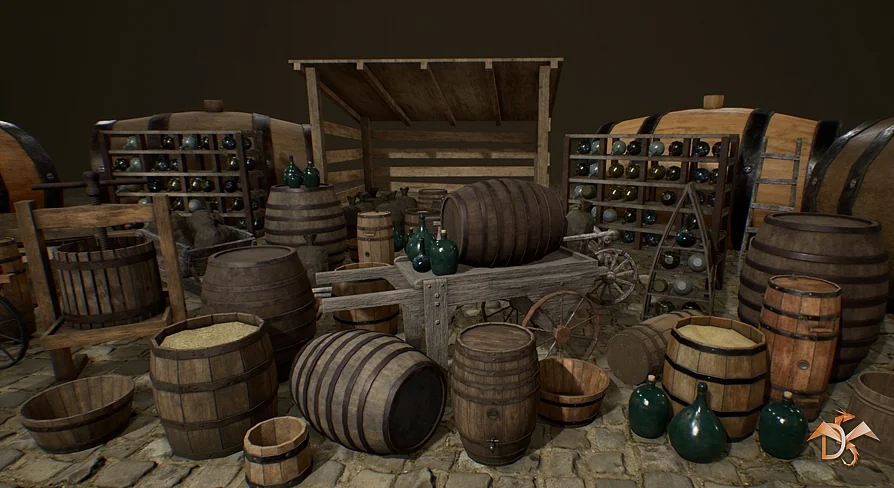
The kit comprises a set of medieval cellar assets totaling 39 models when counting every variant. Texture variants are included as additional content, meaning individual pieces can swap surface appearance without doubling the mesh count or requiring separate imports. A cellar scene typically calls for repeated staples like barrels, bottles, and carts, so variant swapping becomes a practical way to avoid visual monotony across shelving units or stacked storage. Tags accompanying the package—Village, Barn, Cellar, Barrel, Bottle, Cart, and High—signal the dominant object types and the general rural storage aesthetic the collection targets.
Naming Conventions and Search Workflow
Finding a specific asset inside a populated scene relies on naming clarity. Each mesh uses organized names intended for quick and easy search, which matters when a level designer needs to isolate every bottle instance or filter for cart-related props. Predictable prefixes and consistent descriptors cut down on manual filtering, especially when working across multiple rooms or duplicating a cellar layout for different buildings.
Lighting Behavior and Static-Light Compatibility
The props are compatible with static lighting, opening the collection to baked workflows common in medieval interiors where dynamic lighting may be unnecessary. Good lightmaps on every model help control baked shadow quality and reduce light bleed in tight cellar spaces. With baked lighting, the resolution and compression settings chosen for each model play a direct role in how textures hold up under close inspection, and the developer has already tuned the optimized resolution and texture compression settings for each mesh rather than applying a single blanket profile.
Handling Auto-Exposure Shifts
One practical consideration: if the scene appears lighter or darker than expected, adjusting the Auto-Exposure parameters in Post-Processing becomes the recommended approach. Because cellar environments often sit at the contrast-heavy end of indoor lighting, exposure tuning in post remains a routine step rather than a defect of the assets themselves.
LODs and Rendering Performance
The package provides clean Level of Detail (LOD) chains without artifacts, which is relevant for densely furnished cellar scenes where many nearby objects demand triangle reduction at distance. Clean LOD transitions prevent noticeable popping when the camera moves through a storage room or past stacked barrels. This matters most in rural village interiors or connected barn-cellar layouts where performance budgets tighten as prop counts increase. The combination of per-model texture optimization and artifact-free LOD chains keeps the collection suitable for scenes that rely on many small objects sharing limited screen space.
Where a Medieval Cellar Kit Fits
Tags such as Village, Barn, Cellar, Barrel, Bottle, and Cart point to the primary production contexts. The kit serves village interior dressing, barn storage layouts, and dedicated cellar rooms beneath medieval structures. Bottles align with pantry or alchemy-style storage, barrels with bulk goods, and carts with transport or trade staging inside a rural settlement. Texture variants extend reuse across multiple buildings—same mesh, different surface—reducing the need for bespoke assets when populating several houses within a single village.
Production-Ready Considerations for Level Teams
For teams focused on production readiness, the package sidesteps several common prep tasks. Collisions are already accurate and high-quality, removing the need to rebuild collision hulls after import. Lightmaps are tuned for static lighting workflows, and exposure correction resides in Post-Processing rather than per-material tweaks. The organized naming convention supports scalable scene assembly, while clean LODs hold up under varying camera distances. These factors make the kit appropriate for level designers populating medieval interiors who need stable, drop-in props without a lengthy technical configuration phase.
 Towns & Villages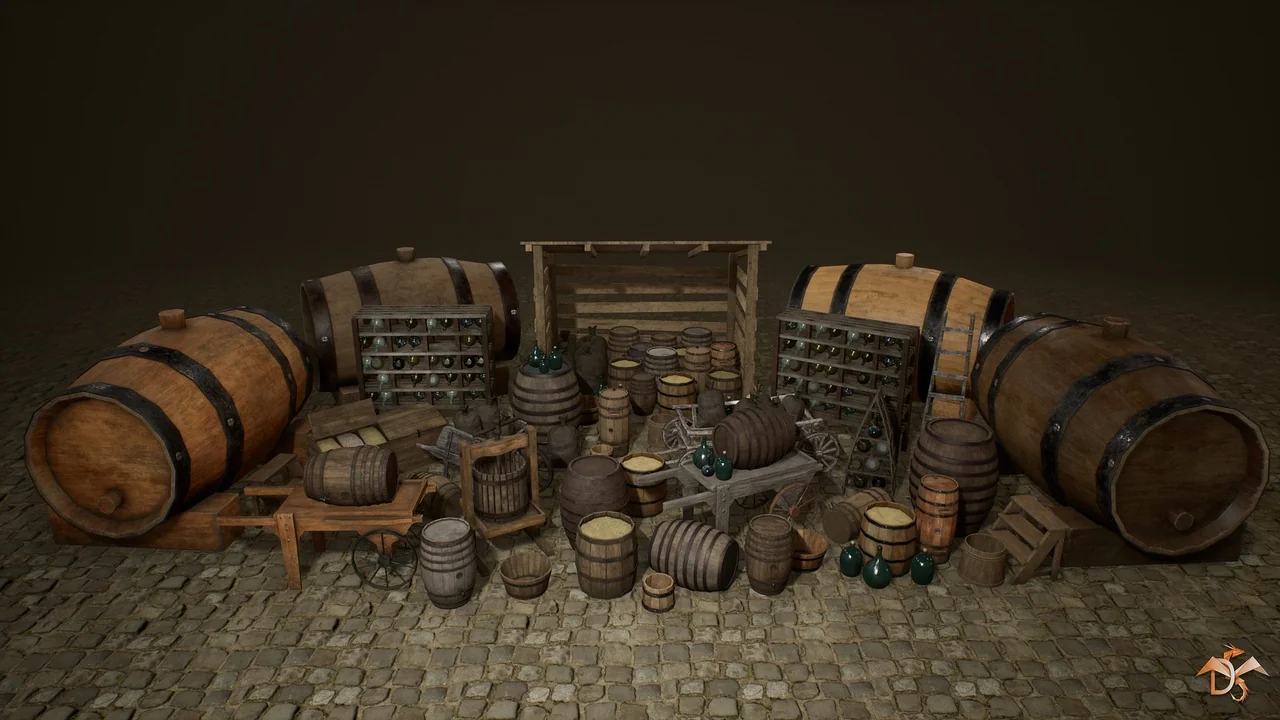
 Towns & Villages
 Towns & Villages
 Towns & Villages