"c14ff6bd758dadb1"{"id":"1001739","slug":"medieval-market-optimized","title":"Medieval Market Optimized","category":"Medieval","engine":"5.0+","assetVersion":"","engineVersion":"Engine Version: 5.0+","tag":"Medieval","accent":"blue","visual":"mech","summary":"Build responsive medieval trading districts with Medieval Market Optimized, featuring HISM produce setups, wind-driven canopies, and modular timber props.","platform":"Unreal Engine","publishedAt":"2026-10-20T02:44:48.458Z","updatedAt":"2026-10-20T02:44:48.458Z","sourceNotes":[],"fileContents":[],"compatibility":["Unreal Engine","Engine Version: 5.0+"],"featuredImage":{"alt":"Medieval Market Optimized","src":"/wp-content/uploads/published/2026/10/874de9c8435b-ab5bdf7c-ffa1-46ca-a661-f285b38c26cc-e69692ce7c.webp"},"hasDownloadLink":true,"downloads":0,"terms":[{"taxonomy":"category","slug":"medieval","name":"Medieval"}],"galleryImages":[{"src":"/wp-content/uploads/published/2026/10/b9fb38cc78cf-774aefa8-95c7-4096-a124-d4b6d25f0c1a-7b8d21cc10.webp","alt":"Medieval Market Optimized"},{"src":"/wp-content/uploads/published/2026/10/c244d5fdcfca-b3fd528e-5407-41e1-ab3b-9db82e5750da-0f1577d3c0.webp","alt":"Medieval Market Optimized"},{"src":"/wp-content/uploads/published/2026/10/3807febd2ceb-b0f890aa-e213-40fe-b7fd-5f0b420801dc-3eef9f3ab4.webp","alt":"Medieval Market Optimized"},{"src":"/wp-content/uploads/published/2026/10/f92fb30ea738-538bff99-8f2e-4336-befc-a3d0943a33ee-8f8dbf8e6d.webp","alt":"Medieval Market Optimized"},{"src":"/wp-content/uploads/published/2026/10/3b0079b3b533-f7e65b70-c4e6-4d80-892e-73fd66a1c7ac-bd13c750c1.webp","alt":"Medieval Market Optimized"},{"src":"/wp-content/uploads/published/2026/10/339efb434cb6-79111830-1ed0-47bb-9fb3-fca8696c3d7c-8f244ec3d5.webp","alt":"Medieval Market Optimized"},{"src":"/wp-content/uploads/published/2026/10/49fbf35c3c13-59066517-46b1-4820-9467-00dd5cc12d44-2a67f800be.webp","alt":"Medieval Market Optimized"},{"src":"/wp-content/uploads/published/2026/10/c7da7ec0a7ae-b4e81efe-0c84-4aaf-bdc9-7cb2f8542c23-8770d0c4e5.webp","alt":"Medieval Market Optimized"},{"src":"/wp-content/uploads/published/2026/10/b015b88cb60c-d788ffeb-8eec-413e-91f4-9abbe7411306-2d018533cc.webp","alt":"Medieval Market Optimized"}],"accessPanel":{"kind":"resource","title":"Download this resource","eyebrow":"Free Download","message":"Log in or create a free account to start your download.","fileName":"Content.7z","safetyNote":"Resources are manually reviewed before listing to improve quality and reduce obvious risks.","actionLabel":"Download Free","resourceType":"Resource archive"},"contentHtml":"\u003ch2\u003eConstructing Historical Trading Plazas with Medieval Market Props\u003c/h2\u003e\u003cp\u003ePopulating a believable medieval town square demands dense layers of everyday commerce: trade goods piled high, temporary timber architecture, and active merchant stalls overflowing with stock. Medieval Market Optimized addresses these environmental needs through an extensive assortment of trade stands, wooden platforms, wagons, and modular containers. At the heart of the collection is an immediate sense of daily rustic activity, anchored by recognizable elements such as a wooden wheelbarrow heaped high with fresh cabbages.\u003c/p\u003e\u003cp\u003eRather than confining level dressers to static, uniform stall configurations, the asset set offers versatile props that can be combined into bustling public avenues or sparse roadside trade stops. Wooden fences, heavy logs, barrels, barrel stands with matching barrel plugs, and platform pieces allow designers to delineate shop boundaries or shape uneven market alleyways. Stalls can be grouped together to simulate organized town guild halls or broken into scattered individual setups positioned across uneven terrain, supporting both realistic historical settings and stylized fantasy settlements.\u003c/p\u003e\u003ch2\u003eShader Layering, Generic Materials, and Vertex Color Workflows\u003c/h2\u003e\u003cp\u003eDense merchant scenes quickly become performance bottlenecks when relying on unique texture sets for every crate, beam, and produce bin. This collection utilizes an optimized material pipeline built on generic materials paired with baked normal maps and vertex color techniques. Surface details such as localized edge wear, accumulated dirt, and tonal variation are handled directly through shader parameters rather than large, memory-intensive bespoke texture bakes.\u003c/p\u003e\u003cp\u003eThrough this setup, artists can easily swap underlying textures or adjust core color swatches to align the market stalls with different architectural biomes or weathered states. The Primary material set incorporates hue control within \u003ccode\u003eMT_Generic\u003c/code\u003e, allowing developers to balance timber tints across distinct stalls. Dedicated dirt masks inject grime into recesses, while reworked shaders like \u003ccode\u003eMT_Floating_Geometry\u003c/code\u003e Refine surface transitions across layered woodwork. Additional geometric and texturing revisions, including irregular timber elements and modeled nails, prevent the repeating wooden structures from looking artificially uniform or planar under direct lighting.\u003c/p\u003e\u003ch2\u003eProduce Stacking and Draw-Call Reduction with HISM\u003c/h2\u003e\u003cp\u003eA thriving market requires bountiful displays of food, but placing hundreds of individual food meshes across multiple crates and baskets introduces significant render overhead. Medieval Market Optimized solves this by implementing Hierarchical Instanced Static Meshes (HISM) across its food displays, replacing loose, individually drawn produce meshes with instanced arrays designed specifically for crate and basket containers.\u003c/p\u003e\u003cp\u003eThe grocery inventory spans a wide selection of vegetables, fruits, and sundries. Produce varieties include:\u003c/p\u003e\u003cul\u003e\u003cli\u003eGreens and root vegetables such as cabbages, onions, carrots, beetroots, parsley, cucumbers, zucchini, and potatoes.\u003c/li\u003e\u003cli\u003eOrchard fruits including apples (assigned as \u003ccode\u003eApple_1\u003c/code\u003e), plums, lemons, oranges, peaches, and pears.\u003c/li\u003e\u003cli\u003eFresh produce and baked goods like ripe tomatoes and traditional kiflis.\u003c/li\u003e\u003cli\u003eRaw commodities such as coal, coal stacks, and loose fuel lumps.\u003c/li\u003e\u003c/ul\u003e\u003cp\u003eThese goods are fitted directly into specialized containers. Small baskets such as \u003ccode\u003eSM_Basket_2_small\u003c/code\u003e Accommodate items ranging from kiflis and plums to zucchini and tomatoes, while \u003ccode\u003eBasket_4\u003c/code\u003e And \u003ccode\u003eSM_Basket_4_small\u003c/code\u003e Hold apple arrangements. Rectangular units such as \u003ccode\u003eCrate_5_small\u003c/code\u003e House tailored layouts of plums, stone fruits, potatoes, and citrus. Produce rendered via HISM uses the dedicated material \u003ccode\u003eMT_D-N_HISM\u003c/code\u003e, which introduces randomized hue and contrast shifts across instances to break up visual repetition. Coupled with tuned LOD distance thresholds for HISM objects, these arrays preserve close-up visual variety while dropping complexity smoothly as the camera pulls back across a crowded square.\u003c/p\u003e\u003ch2\u003eCanopy Movement and Global Atmosphere via MPC_Wind\u003c/h2\u003e\u003cp\u003eStatic canvas canopies often break immersion in outdoor environments. To inject subtle motion into trading rows, the pack incorporates a simple canopy wind shader controlled globally through the \u003ccode\u003eMPC_Wind\u003c/code\u003e Material Parameter Collection. Adjusting wind parameters centrally propagates synchronized sway and flutter across stall canopies, unifying cloth response without requiring individual material tweaks on every tent.\u003c/p\u003e\u003cp\u003eLighting stability has also been refined for structural components. Key elements like stall roofs, including the adjusted profile of \u003ccode\u003eSM_Stall_4_roof\u003c/code\u003e, feature fine-tuned Distance Field Shadow Bias settings to eliminate harsh self-shadowing artifacts or detached shadows when placed under dynamic directional sunlight. Similar shadow bias tuning is applied to props like \u003ccode\u003eSM_Bag\u003c/code\u003e, ensuring that fabric sacks resting against stall poles or paving stones cast natural contact shadows into the scene.\u003c/p\u003e\u003ch2\u003eEnvironmental Storytelling Through Disarray and Functional Props\u003c/h2\u003e\u003cp\u003eLived-in spaces are defined as much by chaos and transition as they are by orderly merchandising displays. Alongside neatly organized vendor bins, the kit provides props that illustrate accidents, unpacking, and daily market labor. An open burlap sack reveals loose potatoes spilling from its brim, while a flipped wheelbarrow prop allows designers to dress disaster scenes, tavern back-alleys, or raided carts with strewn cabbages, onions, potatoes, apples, and chunks of coal across ground surfaces.\u003c/p\u003e\u003cp\u003eHeavy props such as the reworked \u003ccode\u003eSM_Anvil_stand\u003c/code\u003e Establish crafting corners, bridging the gap between food stalls and outdoor blacksmith workshops. Proper collision setups across all core assets—including stalls, crates, baskets, and wheeled transport wagons—ensure players and physics-enabled debris interact predictably with geometry during real-time gameplay. For projects building larger historical ecosystems, the pack shares visual and optimization conventions compatible with assets such as Medieval Ruins Optimized, providing a consistent aesthetic for games moving between thriving civilian centers and dilapidated frontier settlements.\u003c/p\u003e\n\n\u003ch2\u003eExplore Similar Assets\u003c/h2\u003e\n\u003cul\u003e\n\u003cli\u003e\u003ca href=\"https://3dcghub.com/medieval-seaside-village/\" title=\"Medieval Seaside Village\"\u003eMedieval Seaside Village\u003c/a\u003e\u003c/li\u003e\n\u003cli\u003e\u003ca href=\"https://3dcghub.com/medieval-village-pack-medieval-prop-medieval-market-medieval-house-medieval/\" title=\"Medieval Village Pack (Medieval Prop, Medieval Market, Medieval House, Medieval)\"\u003eMedieval Village Pack (Medieval Prop, Medieval Market, Medieval House, Medieval)\u003c/a\u003e\u003c/li\u003e\n\u003cli\u003e\u003ca href=\"https://3dcghub.com/laketown/\" title=\"Laketown\"\u003eLaketown\u003c/a\u003e\u003c/li\u003e\n\u003cli\u003e\u003ca href=\"https://3dcghub.com/medieval-italian-village-environment/\" title=\"Medieval Italian Village Environment\"\u003eMedieval Italian Village Environment\u003c/a\u003e\u003c/li\u003e\n\u003cli\u003e\u003ca href=\"https://3dcghub.com/medieval-village-megapack/\" title=\"Medieval Village Megapack\"\u003eMedieval Village Megapack\u003c/a\u003e\u003c/li\u003e\n\u003c/ul\u003e","contentTextLength":6430,"navigation":{"current":44,"total":3719,"previous":{"id":"1001740","slug":"mega-taunt-collection-2","title":"Mega Taunt Collection 2","category":"Gestures","platform":"Unreal Engine","updatedAt":"2026-10-20T02:45:29.940Z"},"next":{"id":"1001738","slug":"matte-painting-skybox-pack-sci-fi-skies","title":"Matte Painting Skybox Pack: Sci Fi Skies","category":"Sky \u0026 Space","platform":"Unreal Engine","updatedAt":"2026-10-20T02:44:03.470Z"}},"relatedResources":[{"id":"9207","slug":"medieval-seaside-village","title":"Medieval Seaside Village","category":"Medieval","engine":"5.5+","assetVersion":"Engine version: 5.5+","engineVersion":"5.3","tag":"Medieval","accent":"blue","visual":"city","summary":"Create stunning coastal landscapes with the Medieval Seaside Village environment pack. This modular kit includes 380 unique meshes optimized for next-generation lighting and geometry.","platform":"Unreal Engine","publishedAt":"2026-03-01T15:24:07.000Z","updatedAt":"2026-04-19T15:51:17.000Z","sourceNotes":[],"fileContents":[],"compatibility":["Unreal Engine","Engine version: 5.5+"],"featuredImage":{"alt":"Medieval Seaside Village","src":"https://3dcghub.com/wp-content/uploads/2026/03/e3e3d073-447b-4e0d-9423-f577f058d9dd.webp"},"hasDownloadLink":true,"downloads":1},{"id":"9225","slug":"medieval-village-pack-medieval-prop-medieval-market-medieval-house-medieval","title":"Medieval Village Pack (Medieval Prop, Medieval Market, Medieval House, Medieval)","category":"Medieval","engine":"4.26+,5.0+","assetVersion":"Engine version: 4.26+,5.0+","engineVersion":"","tag":"Medieval","accent":"blue","visual":"city","summary":"Medieval Village Pack brings together medieval buildings, indoor and outdoor props, foliage, tents, and market details for Unreal Engine village, fantasy, RPG, and historical environment scenes.","platform":"Unreal Engine","publishedAt":"2026-03-01T16:07:28.000Z","updatedAt":"2026-05-31T15:48:05.105Z","sourceNotes":[],"fileContents":[],"compatibility":["Unreal Engine","Engine version: 4.26+,5.0+"],"featuredImage":{"alt":"Medieval Village Pack (Medieval Prop, Medieval Market, Medieval House, Medieval)","src":"https://3dcghub.com/wp-content/uploads/2026/03/0deb269f-fd86-4df1-9d38-4fa288773733.webp"},"hasDownloadLink":true,"downloads":1},{"id":"9179","slug":"laketown","title":"Laketown","category":"Medieval","engine":"4.26+,5.0+","assetVersion":"Engine version: 4.26+,5.0+","engineVersion":"4.26","tag":"Medieval","accent":"blue","visual":"city","summary":"Transform your game world with Laketown, a collection of highly optimized medieval lake houses and docks. Featuring procedural snow effects and unique mesh variations, it is perfect for rapid level design.","platform":"Unreal Engine","publishedAt":"2026-02-27T14:14:03.000Z","updatedAt":"2026-04-19T15:51:18.000Z","sourceNotes":[],"fileContents":[],"compatibility":["Unreal Engine","Engine version: 4.26+,5.0+"],"featuredImage":{"alt":"Laketown","src":"https://3dcghub.com/wp-content/uploads/2026/02/6c9faaf2-fba7-495b-a77c-b3506cd7de16.webp"},"hasDownloadLink":true,"downloads":0}]}
Medieval
Medieval Market Optimized
Build responsive medieval trading districts with Medieval Market Optimized, featuring HISM produce setups, wind-driven canopies, and modular timber props.
Category:Unreal Engine,MedievalPlatform: Unreal EngineEngine Version: 5.0+Published: Oct 20, 2026
Medieval
Resource overview
Constructing Historical Trading Plazas with Medieval Market Props
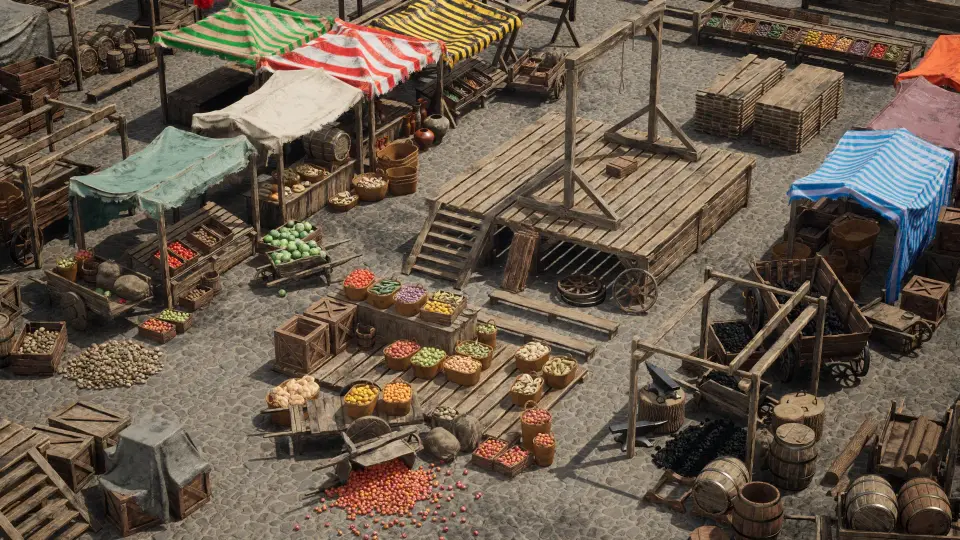
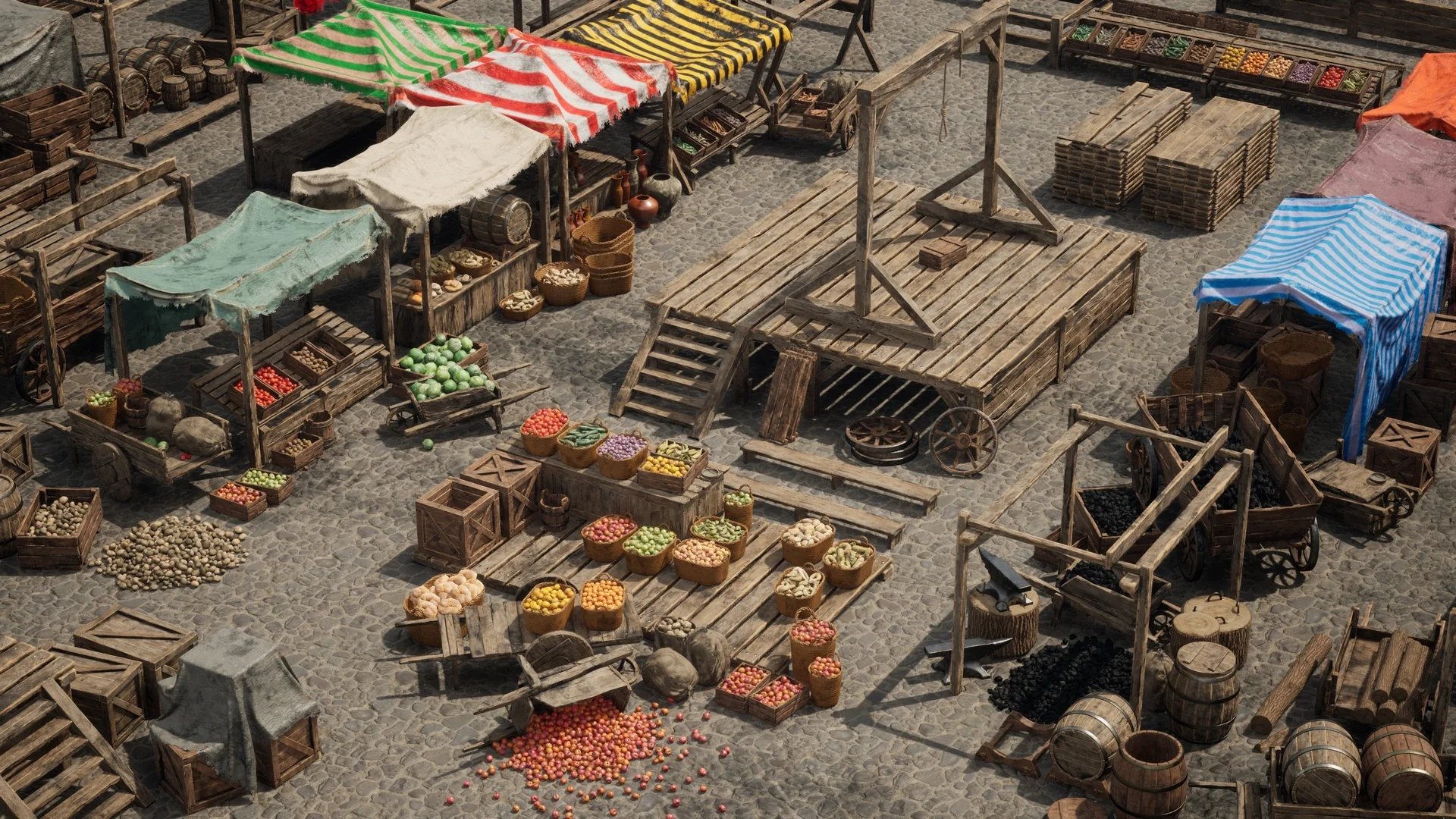
Populating a believable medieval town square demands dense layers of everyday commerce: trade goods piled high, temporary timber architecture, and active merchant stalls overflowing with stock. Medieval Market Optimized addresses these environmental needs through an extensive assortment of trade stands, wooden platforms, wagons, and modular containers. At the heart of the collection is an immediate sense of daily rustic activity, anchored by recognizable elements such as a wooden wheelbarrow heaped high with fresh cabbages.
Rather than confining level dressers to static, uniform stall configurations, the asset set offers versatile props that can be combined into bustling public avenues or sparse roadside trade stops. Wooden fences, heavy logs, barrels, barrel stands with matching barrel plugs, and platform pieces allow designers to delineate shop boundaries or shape uneven market alleyways. Stalls can be grouped together to simulate organized town guild halls or broken into scattered individual setups positioned across uneven terrain, supporting both realistic historical settings and stylized fantasy settlements.
Shader Layering, Generic Materials, and Vertex Color Workflows
Dense merchant scenes quickly become performance bottlenecks when relying on unique texture sets for every crate, beam, and produce bin. This collection utilizes an optimized material pipeline built on generic materials paired with baked normal maps and vertex color techniques. Surface details such as localized edge wear, accumulated dirt, and tonal variation are handled directly through shader parameters rather than large, memory-intensive bespoke texture bakes.
Through this setup, artists can easily swap underlying textures or adjust core color swatches to align the market stalls with different architectural biomes or weathered states. The Primary material set incorporates hue control within MT_Generic, allowing developers to balance timber tints across distinct stalls. Dedicated dirt masks inject grime into recesses, while reworked shaders like MT_Floating_Geometry Refine surface transitions across layered woodwork. Additional geometric and texturing revisions, including irregular timber elements and modeled nails, prevent the repeating wooden structures from looking artificially uniform or planar under direct lighting.
Produce Stacking and Draw-Call Reduction with HISM
A thriving market requires bountiful displays of food, but placing hundreds of individual food meshes across multiple crates and baskets introduces significant render overhead. Medieval Market Optimized solves this by implementing Hierarchical Instanced Static Meshes (HISM) across its food displays, replacing loose, individually drawn produce meshes with instanced arrays designed specifically for crate and basket containers.
The grocery inventory spans a wide selection of vegetables, fruits, and sundries. Produce varieties include:
Greens and root vegetables such as cabbages, onions, carrots, beetroots, parsley, cucumbers, zucchini, and potatoes.
Orchard fruits including apples (assigned as Apple_1), plums, lemons, oranges, peaches, and pears.
Fresh produce and baked goods like ripe tomatoes and traditional kiflis.
Raw commodities such as coal, coal stacks, and loose fuel lumps.
These goods are fitted directly into specialized containers. Small baskets such as SM_Basket_2_small Accommodate items ranging from kiflis and plums to zucchini and tomatoes, while Basket_4 And SM_Basket_4_small Hold apple arrangements. Rectangular units such as Crate_5_small House tailored layouts of plums, stone fruits, potatoes, and citrus. Produce rendered via HISM uses the dedicated material MT_D-N_HISM, which introduces randomized hue and contrast shifts across instances to break up visual repetition. Coupled with tuned LOD distance thresholds for HISM objects, these arrays preserve close-up visual variety while dropping complexity smoothly as the camera pulls back across a crowded square.
Canopy Movement and Global Atmosphere via MPC_Wind
Static canvas canopies often break immersion in outdoor environments. To inject subtle motion into trading rows, the pack incorporates a simple canopy wind shader controlled globally through the MPC_Wind Material Parameter Collection. Adjusting wind parameters centrally propagates synchronized sway and flutter across stall canopies, unifying cloth response without requiring individual material tweaks on every tent.
Lighting stability has also been refined for structural components. Key elements like stall roofs, including the adjusted profile of SM_Stall_4_roof, feature fine-tuned Distance Field Shadow Bias settings to eliminate harsh self-shadowing artifacts or detached shadows when placed under dynamic directional sunlight. Similar shadow bias tuning is applied to props like SM_Bag, ensuring that fabric sacks resting against stall poles or paving stones cast natural contact shadows into the scene.
Environmental Storytelling Through Disarray and Functional Props
Lived-in spaces are defined as much by chaos and transition as they are by orderly merchandising displays. Alongside neatly organized vendor bins, the kit provides props that illustrate accidents, unpacking, and daily market labor. An open burlap sack reveals loose potatoes spilling from its brim, while a flipped wheelbarrow prop allows designers to dress disaster scenes, tavern back-alleys, or raided carts with strewn cabbages, onions, potatoes, apples, and chunks of coal across ground surfaces.
Heavy props such as the reworked SM_Anvil_stand Establish crafting corners, bridging the gap between food stalls and outdoor blacksmith workshops. Proper collision setups across all core assets—including stalls, crates, baskets, and wheeled transport wagons—ensure players and physics-enabled debris interact predictably with geometry during real-time gameplay. For projects building larger historical ecosystems, the pack shares visual and optimization conventions compatible with assets such as Medieval Ruins Optimized, providing a consistent aesthetic for games moving between thriving civilian centers and dilapidated frontier settlements.
 Medieval
 Medieval
 Medieval
 Medieval