"a338a1d501976271"{"id":"1000015","slug":"medieval-fruits-and-vegetables","title":"Medieval Fruits And Vegetables","category":"Fruits \u0026 Vegetables","engine":"4.26+,5.0+","assetVersion":"","engineVersion":"4.26+,5.0+","tag":"Fruits","accent":"blue","visual":"mech","summary":"Medieval Fruits And Vegetables gathers low-poly food props, a table, brick wall materials, and 2048/1024 textures for market, kitchen, and tavern scenes.","platform":"Unreal Engine","publishedAt":"2026-05-20T04:45:34.585Z","updatedAt":"2026-05-20T04:45:34.585Z","sourceNotes":[],"fileContents":[],"compatibility":["Unreal Engine","Engine version: 4.26+,5.0+"],"featuredImage":{"alt":"Medieval Fruits And Vegetables","src":"/wp-content/uploads/published/2026/05/38fd23827831-d765a47d-4313-4b39-b86e-b29dbd5f5dd5-afcd852cc5.webp"},"hasDownloadLink":true,"downloads":0,"terms":[{"taxonomy":"category","slug":"fruits-and-vegetables","name":"Fruits \u0026 Vegetables"}],"galleryImages":[{"src":"/wp-content/uploads/published/2026/05/4ba13b32b886-c9502e12-a4ea-48bc-b709-24ec720bc921-a2fa98961e.webp","alt":"Medieval Fruits And Vegetables"},{"src":"/wp-content/uploads/published/2026/05/8d96e90f03eb-c56854ee-0dec-4e4c-889d-2f2d4b23e9d1-6d437c37e0.webp","alt":"Medieval Fruits And Vegetables"},{"src":"/wp-content/uploads/published/2026/05/85a27fd1231f-65a700f8-cd7b-4730-858a-11bf281ca219-b6c99e21b1.webp","alt":"Medieval Fruits And Vegetables"},{"src":"/wp-content/uploads/published/2026/05/e7083cc3e8ac-69c08110-3ddc-4726-a5d6-6eaf0cfae49b-4e8d9a156e.webp","alt":"Medieval Fruits And Vegetables"},{"src":"/wp-content/uploads/published/2026/05/8f8f10f41034-9ad1272b-eeb1-4791-84ab-03133d2e9512-1f54fe118c.webp","alt":"Medieval Fruits And Vegetables"}],"accessPanel":{"kind":"resource","title":"Access this resource","eyebrow":"Free Download","message":"Log in or create a free account to start your download.","fileName":"Content.7z","safetyNote":"Resources are manually reviewed before listing to improve quality and reduce obvious risks.","actionLabel":"Download Free","resourceType":"Resource archive"},"contentHtml":"\u003cp\u003eWhen a scene needs food props that can fill a market stall, kitchen corner, or tabletop without a lot of extra assembly, a compact produce set solves a very practical problem. \u003cstrong\u003eMedieval Fruits And Vegetables\u003c/strong\u003e Is exactly that kind of collection: a group of fruit and vegetable models paired with a table, supported by diffuse, normals, opacity, metallic, and specular textures in 2048x2048 and 1024x1024 sizes, with table and brick walls material included in the package.\u003c/p\u003e \u003cp\u003eThe collection totals 20,650 triangles and 10,930 vertexes across all props. That makes it easy to read as a complete set beyond one hero object. It is structured around common food items that can quickly populate medieval domestic spaces, storerooms, taverns, and trading areas with recognizable shapes instead of leaving surfaces empty or repeating one object too often.\u003c/p\u003e \u003ch2\u003eMedieval Fruits And Vegetables in a working scene\u003c/h2\u003e\n\u003cp\u003eThe pack covers a broad range of produce types, which is what gives it practical value during scene setup. Apples appear in green, red, and yellow variants, while pears are split between green and red. Several items also include cut versions, so the set is not limited to untouched whole produce.\u003c/p\u003e \u003cp\u003eThat mix matters when dressing a believable surface. Whole pieces help fill baskets, piles, and table spreads, while sliced pieces break repetition and suggest active use. The included items are Apple_Green, Apple_Green_Half, Apple_Red, Apple_Yellow, Beet, Beet_piece, Cabbage, Carrot, Carrot_piece, Garlic, Garlic_bunch, Grapes, Lemon, Lemon_Half, Lettuce, Onions, Onions_piece, Peach, Peach_Half, Pear_Green, Pear_Green_Half, Pear_Red, Pumpkin, and a Table. Instead of relying on one category of food, the set mixes fruit, root vegetables, leafy produce, bulbs, and a larger seasonal form in the pumpkin, which helps a scene read as stocked rather than selectively arranged.\u003c/p\u003e \u003ch2\u003eWhole produce and cut pieces for table dressing\u003c/h2\u003e\n\u003cp\u003eThe strongest production detail in this set is the presence of half and piece variants among the main props. Apple_Green_Half comes in at 128 triangles and 66 vertices, Lemon_Half at 128 triangles and 66 vertices, Peach_Half at 160 triangles and 83 vertices, Pear_Green_Half at 156 triangles and 75 vertices, Beet_piece at 64 triangles and 35 vertices, Carrot_piece at 52 triangles and 28 vertices, and Onions_piece at 66 triangles and 35 vertices.\u003c/p\u003e \u003cp\u003eThose smaller cuts give an environment artist or level artist a straightforward way to imply preparation, trade, or consumption. A full carrot at 232 triangles and 118 vertices can sit beside Carrot_piece for variation on a cutting surface. The same applies to whole beet and Beet_piece, or a complete green pear beside Pear_Green_Half. Even without adding any new prop types, these pairings make the collection more flexible. The food can look stored, displayed, or partially used depending on how the pieces are arranged around the included table or against brick wall materials.\u003c/p\u003e \u003ch2\u003eFrom Apple_Green to Pumpkin: the model range\u003c/h2\u003e\n\u003cp\u003eThe lighter props stay compact. Apple_Green uses 240 triangles and 124 vertices, Apple_Red 280 triangles and 151 vertices, Apple_Yellow 240 triangles and 124 vertices, Lemon 256 triangles and 130 vertices, Peach 224 triangles and 114 vertices, Onions 276 triangles and 140 vertices, Garlic 304 triangles and 154 vertices, and Pear_Red 304 triangles and 156 vertices. These numbers place many of the individual fruits and vegetables in a relatively modest range, suitable for repeated placement across a scene without one small item dominating the total budget.\u003c/p\u003e \u003cp\u003eSome meshes naturally scale up where the form is denser or more layered. Cabbage reaches 624 triangles and 375 vertices, Pumpkin 560 triangles and 282 vertices, and Pear_Green 512 triangles and 286 vertices. Garlic_bunch is a more complex grouped prop at 3,832 triangles and 1,964 vertices, giving the set at least one bundled item that can read well as a hanging or stacked cluster. The most demanding produce model is Grapes at 10,878 triangles and 5,625 vertices, and it also includes an LOD at 1,829 triangles and 1,098 vertices. That single detail stands out because it gives the grape cluster a defined lower-detail option inside the collection rather than treating every prop at one static density.\u003c/p\u003e \u003ch2\u003eGrapes, Garlic_bunch, and the props that break repetition\u003c/h2\u003e\n\u003cp\u003eNot every food scene works with isolated single items scattered on a flat surface. Dense clusters often do the work of filling visual space faster, and this set includes two props that serve that role especially well: Garlic_bunch and Grapes.\u003c/p\u003e \u003cp\u003eGarlic_bunch, at 3,832 triangles and 1,964 vertices, offers a grouped form that can anchor a section of table or a hanging storage area. Grapes push further, with 10,878 triangles and 5,625 vertices in the main mesh and a lower-detail LOD at 1,829 triangles and 1,098 vertices. In practical workflow terms, these are the props that can keep a food display from reading as a line of isolated duplicates. One cluster can hold attention while lower-count items like Lettuce at 64 triangles and 50 vertices or Carrot_piece at 52 triangles and 28 vertices support the arrangement around it. That leaves a clearer hierarchy inside the set itself: small fillers, mid-range staples, and a few denser forms for focal placement.\u003c/p\u003e \u003ch2\u003eTable, brick walls material, and how the package stages a scene\u003c/h2\u003e\n\u003cp\u003eThe collection does not stop at loose produce. It also includes a Table with 706 triangles and 582 vertices, plus table and brick walls material in the package. That changes the pack from a simple assortment of food meshes into something closer to a small scene-building kit.\u003c/p\u003e \u003cp\u003eIn workflow terms, the table gives the produce an immediate surface for presentation. The brick wall material adds a background treatment that fits naturally with interior or market-side staging. An artist blocking out a medieval kitchen, tavern storage room, or stall display does not need to start from bare props alone. A surface, wall treatment, and food set are already present, which helps move quickly from object import to actual composition. Even if the final environment uses different architecture, these included materials still function as a useful starting point for testing layout, prop density, and color distribution across the spread.\u003c/p\u003e \u003ch2\u003eTexture sizes and where the set fits in production\u003c/h2\u003e\n\u003cp\u003eThe texture support is clearly stated: diffuse, normals, opacity, metallic, and specular maps are included in 2048x2048 and 1024x1024 resolutions. That combination covers both surface color and material response, while the two listed texture sizes offer room for different scene demands without changing the identity of the set.\u003c/p\u003e \u003cp\u003eViewed as a complete package, Medieval Fruits And Vegetables fits best where environment work needs ready-made food dressing instead of custom modeling every edible object one by one. The total collection budget of 20,650 triangles and 10,930 vertexes, the presence of both whole and cut produce, the inclusion of a display table, and the added table and brick walls material make it suited to production tasks like populating counters, setting a market spread, or establishing a lived-in kitchen corner. It works less like a single showcase model and more like a practical stock of medieval food props that can move directly into scene assembly.\u003c/p\u003e\n\n\u003ch2\u003eMore From The Same Workflow\u003c/h2\u003e\n\u003cul\u003e\n\u003cli\u003e\u003ca href=\"https://3dcghub.com/farm-crops/\" title=\"Farm Crops\"\u003eFarm Crops\u003c/a\u003e\u003c/li\u003e\n\u003cli\u003e\u003ca href=\"https://3dcghub.com/medieval-props-vol-3-farm/\" title=\"Medieval Props Vol 3 Farm\"\u003eMedieval Props Vol 3 Farm\u003c/a\u003e\u003c/li\u003e\n\u003cli\u003e\u003ca href=\"https://3dcghub.com/knife-dagger/\" title=\"Knife Dagger\"\u003eKnife Dagger\u003c/a\u003e\u003c/li\u003e\n\u003cli\u003e\u003ca href=\"https://3dcghub.com/modular-medieval-docks-harbor-medieval-town-stylized-town-town-city/\" title=\"Modular Medieval Docks / Harbor (Medieval Town, Stylized Town, Town, City)\"\u003eModular Medieval Docks / Harbor (Medieval Town, Stylized Town, Town, City)\u003c/a\u003e\u003c/li\u003e\n\u003cli\u003e\u003ca href=\"https://3dcghub.com/modular-medieval-underground-prison-kit/\" title=\"Modular Medieval Underground Prison Kit\"\u003eModular Medieval Underground Prison Kit\u003c/a\u003e\u003c/li\u003e\n\u003c/ul\u003e","contentTextLength":7489,"navigation":{"current":1459,"total":3338,"previous":{"id":"1000016","slug":"modular-human-skeleton","title":"Modular Human Skeleton","category":"Characters \u0026 Creatures","platform":"Unreal Engine","updatedAt":"2026-05-20T05:09:24.230Z"},"next":{"id":"1000014","slug":"gun-weapon-grenade","title":"Gun Weapon Grenade","category":"Guns","platform":"Unreal Engine","updatedAt":"2026-05-19T18:17:17.267Z"}},"relatedResources":[{"id":"1001119","slug":"plant-fruits-and-vegetables","title":"plant Fruits and vegetables","category":"Nature \u0026 Plants","engine":"4.26+,5.0+","assetVersion":"","engineVersion":"Engine Version: 4.26+,5.0+","tag":"Nature \u0026 Plants","accent":"blue","visual":"mech","summary":"Nine high-precision plants with multiple models each, previewed in UE4, covering coffee, spinach, wheat, strawberry, raspberry, tomato, garlic, and more.","platform":"Unreal Engine","publishedAt":"2026-09-07T12:55:52.646Z","updatedAt":"2026-09-07T12:55:52.646Z","sourceNotes":[],"fileContents":[],"compatibility":["Unreal Engine","Engine Version: 4.26+,5.0+"],"featuredImage":{"alt":"plant Fruits and vegetables","src":"/wp-content/uploads/published/2026/09/43038826c872-8220691f-86a4-437c-a121-220d40179627-8de6da649a.webp"},"hasDownloadLink":true,"downloads":0},{"id":"1000611","slug":"full-interactive-physic-plants-with-fruits-and-veg-dynamic-system-r13","title":"Full Interactive Physic Plants with Fruits and Veg - Dynamic System R13","category":"Plants","engine":"4.26+,5.0+","assetVersion":"","engineVersion":"Engine Version: 4.26+,5.0+","tag":"Plants","accent":"blue","visual":"mech","summary":"Interactive foliage with fruits and vegetables built for farm environments. Includes dynamic physics behavior, proper texturing, demo level, and sound integrati","platform":"Unreal Engine","publishedAt":"2026-07-20T20:09:53.761Z","updatedAt":"2026-07-20T20:09:53.761Z","sourceNotes":[],"fileContents":[],"compatibility":["Unreal Engine","Engine Version: 4.26+,5.0+"],"featuredImage":{"alt":"Full Interactive Physic Plants with Fruits and Veg - Dynamic System R13","src":"/wp-content/uploads/published/2026/07/975a1ef48f2f-4be31ba8-cac5-4a78-8a5e-2ed9142b659f-3a2e333233.webp"},"hasDownloadLink":true,"downloads":0},{"id":"1000200","slug":"sci-fi-fruit-market-nanite","title":"Sci-Fi Fruit Market - Nanite","category":"Sci-Fi","engine":"5.0+","assetVersion":"","engineVersion":"Engine Version: 5.0+","tag":"Sci-Fi","accent":"blue","visual":"mech","summary":"A high-poly sci-fi fruit market kit bash for Unreal Engine 5 with Nanite and Lumen support, animated machines, smart materials, LUTs, and demo levels.","platform":"Unreal Engine","publishedAt":"2026-06-23T14:28:16.189Z","updatedAt":"2026-06-23T14:28:16.189Z","sourceNotes":[],"fileContents":[],"compatibility":["Unreal Engine","Engine Version: 5.0+"],"featuredImage":{"alt":"Sci-Fi Fruit Market - Nanite","src":"/wp-content/uploads/published/2026/06/74413fec2873-3a72388b-2226-4984-9107-23fc19af5d24-476369b57e.webp"},"hasDownloadLink":true,"downloads":0}]}
Fruits
Medieval Fruits And Vegetables
Medieval Fruits And Vegetables gathers low-poly food props, a table, brick wall materials, and 2048/1024 textures for market, kitchen, and tavern scenes.
When a scene needs food props that can fill a market stall, kitchen corner, or tabletop without a lot of extra assembly, a compact produce set solves a very practical problem. Medieval Fruits And Vegetables Is exactly that kind of collection: a group of fruit and vegetable models paired with a table, supported by diffuse, normals, opacity, metallic, and specular textures in 2048x2048 and 1024x1024 sizes, with table and brick walls material included in the package.
The collection totals 20,650 triangles and 10,930 vertexes across all props. That makes it easy to read as a complete set beyond one hero object. It is structured around common food items that can quickly populate medieval domestic spaces, storerooms, taverns, and trading areas with recognizable shapes instead of leaving surfaces empty or repeating one object too often.
Medieval Fruits And Vegetables in a working scene
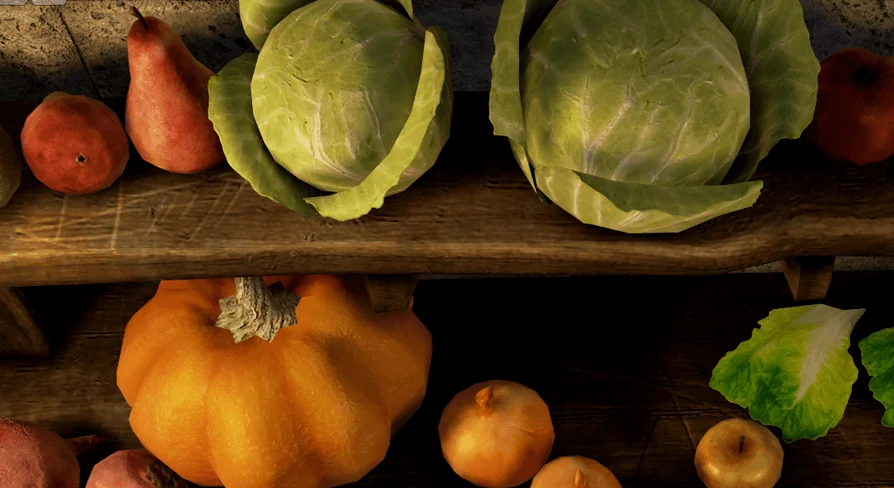
The pack covers a broad range of produce types, which is what gives it practical value during scene setup. Apples appear in green, red, and yellow variants, while pears are split between green and red. Several items also include cut versions, so the set is not limited to untouched whole produce.
That mix matters when dressing a believable surface. Whole pieces help fill baskets, piles, and table spreads, while sliced pieces break repetition and suggest active use. The included items are Apple_Green, Apple_Green_Half, Apple_Red, Apple_Yellow, Beet, Beet_piece, Cabbage, Carrot, Carrot_piece, Garlic, Garlic_bunch, Grapes, Lemon, Lemon_Half, Lettuce, Onions, Onions_piece, Peach, Peach_Half, Pear_Green, Pear_Green_Half, Pear_Red, Pumpkin, and a Table. Instead of relying on one category of food, the set mixes fruit, root vegetables, leafy produce, bulbs, and a larger seasonal form in the pumpkin, which helps a scene read as stocked rather than selectively arranged.
Whole produce and cut pieces for table dressing
The strongest production detail in this set is the presence of half and piece variants among the main props. Apple_Green_Half comes in at 128 triangles and 66 vertices, Lemon_Half at 128 triangles and 66 vertices, Peach_Half at 160 triangles and 83 vertices, Pear_Green_Half at 156 triangles and 75 vertices, Beet_piece at 64 triangles and 35 vertices, Carrot_piece at 52 triangles and 28 vertices, and Onions_piece at 66 triangles and 35 vertices.
Those smaller cuts give an environment artist or level artist a straightforward way to imply preparation, trade, or consumption. A full carrot at 232 triangles and 118 vertices can sit beside Carrot_piece for variation on a cutting surface. The same applies to whole beet and Beet_piece, or a complete green pear beside Pear_Green_Half. Even without adding any new prop types, these pairings make the collection more flexible. The food can look stored, displayed, or partially used depending on how the pieces are arranged around the included table or against brick wall materials.
From Apple_Green to Pumpkin: the model range
The lighter props stay compact. Apple_Green uses 240 triangles and 124 vertices, Apple_Red 280 triangles and 151 vertices, Apple_Yellow 240 triangles and 124 vertices, Lemon 256 triangles and 130 vertices, Peach 224 triangles and 114 vertices, Onions 276 triangles and 140 vertices, Garlic 304 triangles and 154 vertices, and Pear_Red 304 triangles and 156 vertices. These numbers place many of the individual fruits and vegetables in a relatively modest range, suitable for repeated placement across a scene without one small item dominating the total budget.
Some meshes naturally scale up where the form is denser or more layered. Cabbage reaches 624 triangles and 375 vertices, Pumpkin 560 triangles and 282 vertices, and Pear_Green 512 triangles and 286 vertices. Garlic_bunch is a more complex grouped prop at 3,832 triangles and 1,964 vertices, giving the set at least one bundled item that can read well as a hanging or stacked cluster. The most demanding produce model is Grapes at 10,878 triangles and 5,625 vertices, and it also includes an LOD at 1,829 triangles and 1,098 vertices. That single detail stands out because it gives the grape cluster a defined lower-detail option inside the collection rather than treating every prop at one static density.
Grapes, Garlic_bunch, and the props that break repetition
Not every food scene works with isolated single items scattered on a flat surface. Dense clusters often do the work of filling visual space faster, and this set includes two props that serve that role especially well: Garlic_bunch and Grapes.
Garlic_bunch, at 3,832 triangles and 1,964 vertices, offers a grouped form that can anchor a section of table or a hanging storage area. Grapes push further, with 10,878 triangles and 5,625 vertices in the main mesh and a lower-detail LOD at 1,829 triangles and 1,098 vertices. In practical workflow terms, these are the props that can keep a food display from reading as a line of isolated duplicates. One cluster can hold attention while lower-count items like Lettuce at 64 triangles and 50 vertices or Carrot_piece at 52 triangles and 28 vertices support the arrangement around it. That leaves a clearer hierarchy inside the set itself: small fillers, mid-range staples, and a few denser forms for focal placement.
Table, brick walls material, and how the package stages a scene
The collection does not stop at loose produce. It also includes a Table with 706 triangles and 582 vertices, plus table and brick walls material in the package. That changes the pack from a simple assortment of food meshes into something closer to a small scene-building kit.
In workflow terms, the table gives the produce an immediate surface for presentation. The brick wall material adds a background treatment that fits naturally with interior or market-side staging. An artist blocking out a medieval kitchen, tavern storage room, or stall display does not need to start from bare props alone. A surface, wall treatment, and food set are already present, which helps move quickly from object import to actual composition. Even if the final environment uses different architecture, these included materials still function as a useful starting point for testing layout, prop density, and color distribution across the spread.
Texture sizes and where the set fits in production
The texture support is clearly stated: diffuse, normals, opacity, metallic, and specular maps are included in 2048x2048 and 1024x1024 resolutions. That combination covers both surface color and material response, while the two listed texture sizes offer room for different scene demands without changing the identity of the set.
Viewed as a complete package, Medieval Fruits And Vegetables fits best where environment work needs ready-made food dressing instead of custom modeling every edible object one by one. The total collection budget of 20,650 triangles and 10,930 vertexes, the presence of both whole and cut produce, the inclusion of a display table, and the added table and brick walls material make it suited to production tasks like populating counters, setting a market spread, or establishing a lived-in kitchen corner. It works less like a single showcase model and more like a practical stock of medieval food props that can move directly into scene assembly.
 Fruits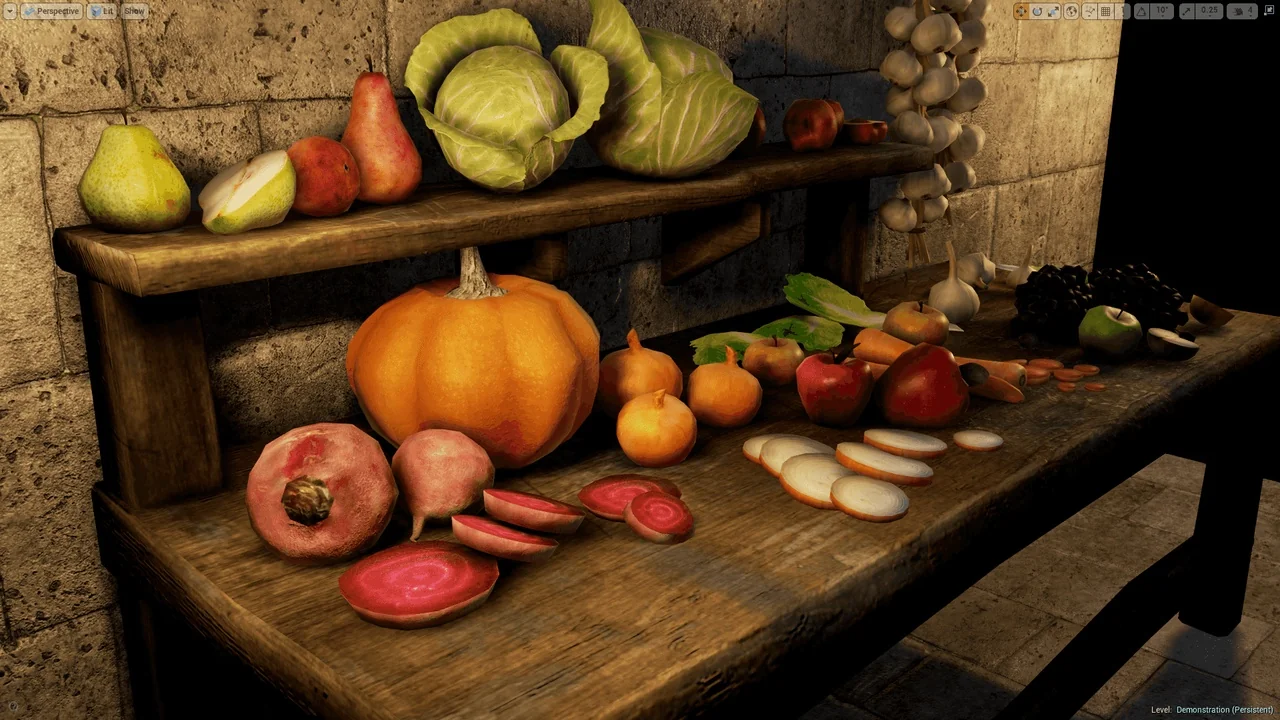
 Nature & Plants
 Plants
 Sci-Fi