Immediate Implementation and Scene Setup
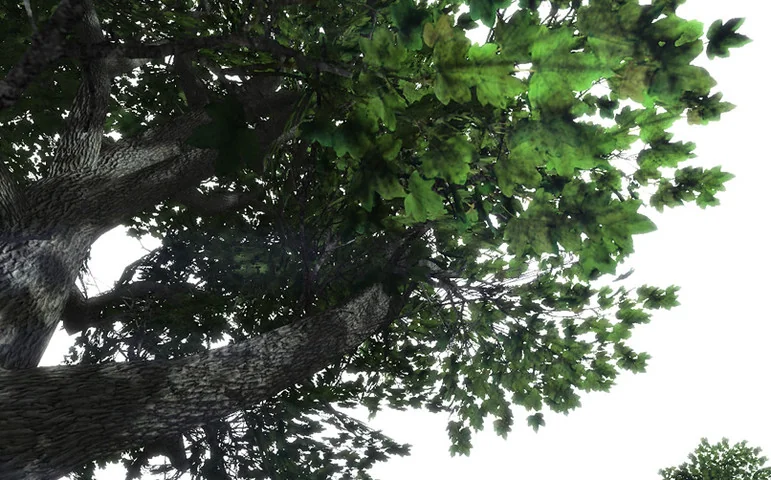
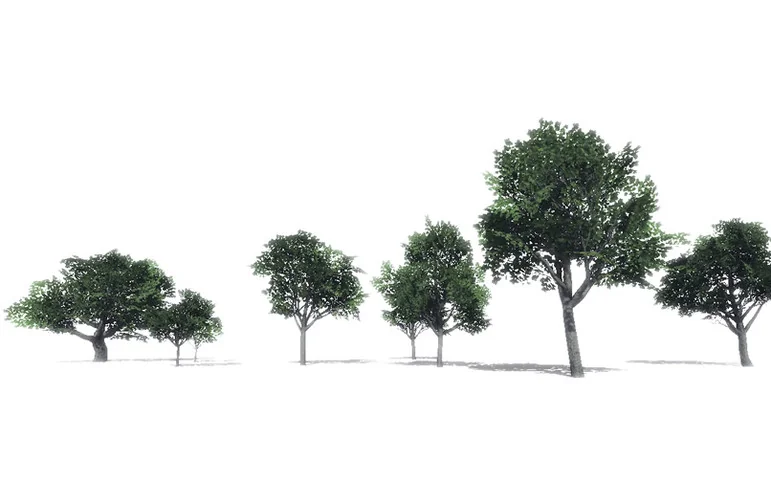
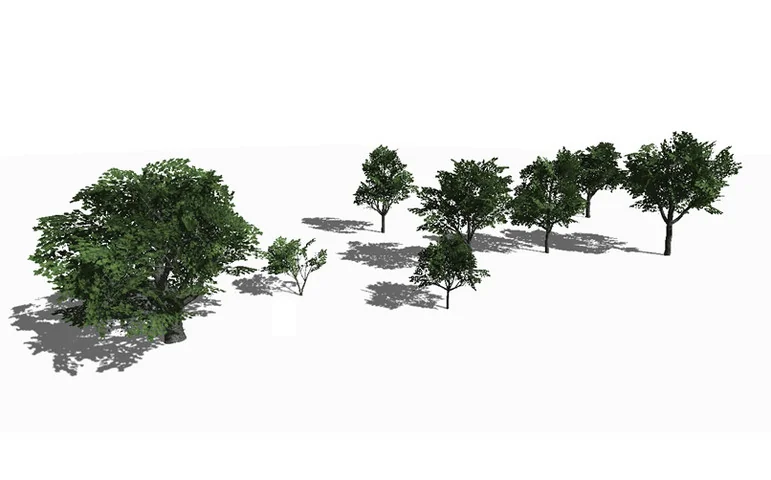
The Maple Trees Package is structured to facilitate a direct integration process into 3D environments, providing eight distinct maple tree variations. These assets arrive with several technical configurations pre-applied, which removes the need for manual setup of basic environmental physics. For instance, collision is already established for the models, ensuring that characters and objects interact with the trunks and branches correctly upon placement in a scene.
A significant portion of the implementation workflow involves the way these assets handle movement. The developer has configured the bending settings across every level of each tree. This suggests that the primary trunk, secondary branches, and tertiary limbs have individual settings to ensure natural motion within the engine. This level of detail in the bending hierarchy allows the trees to respond to environmental forces in a way that remains consistent across the different sizes and shapes available in the collection.
Technical Optimization and Resource Management
Efficiency in rendering is a core focus of the package’s design, particularly regarding how it handles textures and memory bandwidth. All eight trees utilize shared materials. By using a unified material set for the entire collection, the package reduces the overhead on the GPU, as the engine does not need to swap textures or materials as frequently when rendering multiple maple trees in a single frame. This approach is specifically designed to save on texture memory and bandwidth, which is critical for maintaining performance in scenes with dense vegetation.
The textures themselves are provided at a high resolution of 2048 x 1024px. The package utilizes specific map types to define the surface properties of the bark and foliage:
- Leaves: These use diffuse (d), normal (n), and translucency (t) maps. The inclusion of a translucency map allows for more realistic light transmission through the foliage, which is vital for achieving the look of a natural canopy.
- Bark: The bark surfaces are defined by diffuse (d), normal (n), and gloss (gl) maps, providing a distinct material response compared to the softer leaves.
To further enhance performance, the meshes for the leaves have been fillrate optimized. In real-time rendering, fillrate issues often occur when there is excessive transparent overdraw. By optimizing the mesh geometry to more closely follow the visible portions of the leaf textures, the package reduces the amount of empty transparent space being processed by the GPU.
Scaling and Mesh Complexity
The assets provide a range of heights and complexities to suit different environmental roles, from small undergrowth to large canopy trees. The height of the trees ranges from 6 meters to 20 meters. This variety allows for the creation of diverse forest profiles using the same asset base. The complexity of the geometry is managed through Level of Detail (LOD) settings. Depending on the current LOD being rendered, the triangle count for a tree can range from as low as 770 triangles to as high as 5300 triangles.
Because the trees are fully editable, creators have the flexibility to adjust these parameters to fit the specific needs of their project. This editability ensures that the 38 individual assets within the package can be tweaked beyond their out-of-the-box configurations while maintaining the core optimizations like the pre-set bending and material sharing.
Compatibility and Version History
The package has a long history of development, originally published for Unity version 3.4.2. Over time, it has been updated to maintain compatibility with more modern iterations of the engine. The current version, 1.1, was specifically updated to support Unity 2019.4.23. It is designed to work within the Built-in Render Pipeline, specifically version 2019.4.23f1. The entire package is contained within a 39.9 MB file, making it a relatively lightweight addition to a project’s asset library despite the high-resolution texture maps provided for the bark and foliage.
The workflow supported by this package is one of rapid deployment. By combining pre-configured collision, specific map types for translucency and gloss, and optimized leaf meshes, it addresses the common technical hurdles of vegetation rendering—namely performance overhead and realistic movement—while providing enough variety in height and mesh density to populate a range of outdoor environments.
Project Screenshots