"b00678cacce53329"{"id":"1002810","slug":"map-track-markers-vfx","title":"Map Track Markers VFX","category":"Spells \u0026 Combat","engine":"4.24+,5.0+","assetVersion":"","engineVersion":"Engine Version: 4.24+,5.0+","tag":"Spells \u0026 Combat","accent":"blue","visual":"mech","summary":"Explore Map Track Markers VFX, featuring 12 unique 3D Niagara effects, 2 meshes, 17 materials, 22 textures, and a dedicated demonstration map.","platform":"Unreal Engine","indexPolicy":"index","publishedAt":"2026-11-20T07:40:27.596Z","updatedAt":"2026-11-20T07:40:27.596Z","sourceNotes":[],"fileContents":[],"compatibility":["Unreal Engine","Engine Version: 4.24+,5.0+"],"featuredImage":{"alt":"Map Track Markers VFX","src":"/wp-content/uploads/published/2026/11/8d081c23ef13-69b8e3c8-3fe5-4c25-8ea7-83b0118f6b94-978e45af42.webp"},"fileSizeBytes":25296792,"hasDownloadLink":true,"downloads":0,"terms":[{"taxonomy":"category","slug":"spells-and-combat","name":"Spells \u0026 Combat"}],"galleryImages":[{"src":"/wp-content/uploads/published/2026/11/8b3c8a4cc6f8-b8c48cb8-e3c3-42d3-961b-dff623b771b0-346f8e5dd9.webp","alt":"Map Track Markers VFX"},{"src":"/wp-content/uploads/published/2026/11/143d532df971-756eb2df-943b-4b0f-b68c-f8473e3fc5fc-a428882219.webp","alt":"Map Track Markers VFX"},{"src":"/wp-content/uploads/published/2026/11/090f614b2927-e2aac20c-ab7c-4210-95e9-371ad0c135ff-8b6752b121.webp","alt":"Map Track Markers VFX"},{"src":"/wp-content/uploads/published/2026/11/d256b6c2f839-9f79efcc-20ba-423a-a0d4-b901470fd3ce-408865c4d3.webp","alt":"Map Track Markers VFX"},{"src":"/wp-content/uploads/published/2026/11/309f18f9f266-8720193a-5806-44a4-be5f-9fbc4d5b6d22-e499bdc7cb.webp","alt":"Map Track Markers VFX"},{"src":"/wp-content/uploads/published/2026/11/dc34b5c155cd-7349dbdf-1aad-4711-8ccc-e43c04a28ebc-777cf2bfbf.webp","alt":"Map Track Markers VFX"},{"src":"/wp-content/uploads/published/2026/11/0c5029218153-9a16c71f-efb1-4f3d-b6e4-bd24e6f439e7-0fa5ba1a34.webp","alt":"Map Track Markers VFX"},{"src":"/wp-content/uploads/published/2026/11/3fcae2d9424b-0e07aac3-025b-4434-871e-c140220f1e52-3e3468969e.webp","alt":"Map Track Markers VFX"},{"src":"/wp-content/uploads/published/2026/11/de17e7a512c6-e3e970c4-9834-40f7-a982-269680941c89-7f3317e7ed.webp","alt":"Map Track Markers VFX"},{"src":"/wp-content/uploads/published/2026/11/a099ea39f99c-7165b11d-45ad-47a3-953e-20ed16a98209-6dd5c49c45.webp","alt":"Map Track Markers VFX"}],"accessPanel":{"kind":"resource","title":"Get this resource","safetyNote":"Resources are manually reviewed before listing to improve quality and reduce obvious risks.","fileName":"Content.7z","resourceType":"Resource archive","versions":[]},"contentHtml":"\u003cp\u003eComplex three-dimensional environments frequently require direct, legible visual cues to orient players and delineate traversable routes. Whether navigating sprawling natural topography, subterranean dungeons, industrial corridors, or abstract game levels, clear spatial signposting prevents disorientation and reinforces level flow. In real-time development, steering movement through physical 3D space involves distinct challenges compared to basic two-dimensional screen overlays. Visual signifiers must integrate into the world volume, interacting naturally with local perspective, camera elevation, and geometric obstructions while remaining immediately legible from various approach angles.\u003c/p\u003e \u003ch2\u003eGuiding Spatial Flow with Map Track Markers\u003c/h2\u003e\n\u003cp\u003eWayfinding mechanics rely on specific visual primitives to relay intent. Moving along an intended trajectory requires continuous or semi-continuous cues, whereas pinpointing an objective demands an unambiguous focal point. Map Track Markers VFX delivers twelve distinct Niagara systems, with each effect built as an independent, unique visual solution rather than a simple color variation of a single emitter.\u003c/p\u003e \u003cp\u003eBecause all twelve effects are fully realized in 3D, they inhabit the spatial coordinates of the game world directly. In contrast to flat HUD reticles that cling to the viewport plane, these volumetric particle systems preserve depth, perspective scaling, and spatial anchoring. A marker placed at an intersection or along a winding track recedes into the distance naturally, giving the player immediate contextual awareness of scale and proximity.\u003c/p\u003e \u003cp\u003eThe collection spans several visual archetypes, encompassing directional arrows, upright pointers, route tracks, waypoint guides, target indicators, and localized path markers. Dynamic arrows communicate forward momentum or sharp directional pivots along a road, guiding characters through turns without interrupting movement. Upright pointers and localized target nodes act as definitive stop points, establishing clear visual anchors over objectives, resource nodes, or critical interaction triggers. By providing twelve completely unique Niagara systems, the pack accommodates varying degrees of visual prominence, allowing subtle pathway breadcrumbs to coexist with bold, high-priority destination beacons.\u003c/p\u003e \u003ch2\u003eDeconstructing the VFX System Architecture\u003c/h2\u003e\n\u003cp\u003eUnderpinning the visual diversity of the twelve Niagara systems is a tightly curated set of structural assets. The package relies on two dedicated static meshes alongside an interconnected shading setup of seventeen materials and material instances, backed by twenty-two textures. This architectural distribution highlights a deliberate balance between modular rendering assets and customized visual styling.\u003c/p\u003e \u003cp\u003eThe presence of two meshes indicates that certain markers utilize actual 3D geometry alongside or within their particle emitters. Mesh particles within Niagara grant precise structural control, ensuring that arrows or structural pointers retain clean edges, directional stability, and distinct volumetric silhouettes that simple camera-facing sprite planes cannot always achieve. When combined with dynamic particle ribbons, directional trails, or orbiting motes, these mesh components anchor the visual identity of each marker within the scene.\u003c/p\u003e \u003cp\u003eThe shading infrastructure makes extensive use of instancing, leveraging seventeen total materials and material instances. Material instances allow distinct visual properties—such as opacity masks, emissive intensities, panning speeds, and chromatic tones—to be configured rapidly without duplicating base shader code or inflating draw-call complexity. The twenty-two texture maps provide the foundational alpha channels, gradient masks, noise patterns, and motion drivers required to generate energetic motion across each marker. Flowing directional lines, soft luminous fades, and crisp graphic icons all draw from this unified texture bank, enabling each of the twelve effects to maintain a distinct visual signature while utilizing a cohesive set of shared materials.\u003c/p\u003e \u003ch2\u003eStaging and Verification in Demo_MapTrackMarkers\u003c/h2\u003e\n\u003cp\u003eEvaluating real-time particle behavior requires seeing emitters running in an active environment rather than viewing them in an isolated cascade viewport. The inclusion of the dedicated showcase level, named Demo_MapTrackMarkers, establishes a direct staging environment where each effect can be reviewed in real-time engine conditions.\u003c/p\u003e \u003cp\u003eInspecting visual markers within a dedicated level allows developers to evaluate critical perceptual qualities across different viewing scenarios. A pathway marker may appear suitably prominent in an emitter preview window, but observing it against varying floor surfaces and ambient light inside Demo_MapTrackMarkers clarifies how the materials read against complex backdrops. Camera perspective also fundamentally alters how 3D particles are perceived. By walking or flying a camera around the markers in the demo level, it becomes possible to inspect occlusion behavior, horizon falloff, and silhouette retention when viewing arrows from acute angles or inspecting tall pointers from steep top-down perspectives.\u003c/p\u003e \u003cp\u003eThe demo environment also provides an immediate reference for scale. Because these markers function as indicators of physical points and travel tracks, calibrating their physical dimensions relative to standard player perspectives is essential. Reviewing the complete collection inside Demo_MapTrackMarkers allows for swift comparison between the twelve distinct configurations, highlighting which effects serve best as continuous track markers and which ones carry the visual density needed for terminal map destinations.\u003c/p\u003e \u003ch2\u003eVisual Hierarchy Across Pathway and Target Markers\u003c/h2\u003e\n\u003cp\u003eEffective navigation systems rarely rely on a single visual language for all user feedback. Overloading an environment with identical, bright indicators can clutter the play space and induce navigational fatigue, diluting the importance of major milestones. A structured wayfinding hierarchy uses lower-intensity markers to trace pathways, reserving visually dense or animated markers for critical points of interest.\u003c/p\u003e \u003cp\u003eWithin this asset, the presence of distinct arrow, pointer, path, and target archetypes supports this visual stratification. Directional arrow effects and pathway runners can be arranged sequentially across a corridor or terrain spline, pointing the player toward an objective with minimal visual distraction. As the player reaches the terminus of the route, an upright pointer or focused target particle effect can mark the exact objective position, signaling completion or interaction readiness.\u003c/p\u003e \u003cp\u003eBecause the twelve Niagara effects provide distinct visual presentations, creators can assign unique marker types to different systemic functions. One effect might serve strictly for quest milestones, another for active breadcrumb navigation, and a third for tactical target designations or boundary points. Leveraging the modular material instances and diverse texture assignments ensures that these functional distinctions remain sharp, consistent, and readable across the entire game environment.\u003c/p\u003e\n\n\u003ch2\u003eContinue Browsing Similar Packs\u003c/h2\u003e\n\u003cul\u003e\n\u003cli\u003e\u003ca href=\"https://3dcghub.com/stylized-vfx-lightning/\" rel=\"noopener noreferrer\"\u003eStylized VFX - Lightning\u003c/a\u003e\u003c/li\u003e\n\u003cli\u003e\u003ca href=\"https://3dcghub.com/niagara-muzzle-flash-and-ejection-vfx-muzzle-flash-gun-vfx-bullet-vfx/\" rel=\"noopener noreferrer\"\u003eNiagara Muzzle Flash \u0026amp; Ejection VFX (Muzzle Flash, Gun VFX, Bullet VFX)\u003c/a\u003e\u003c/li\u003e\n\u003cli\u003e\u003ca href=\"https://3dcghub.com/m5-vfx-rpg1-sword-trails-niagara/\" rel=\"noopener noreferrer\"\u003eM5 VFX RPG1. Sword Trails(Niagara)\u003c/a\u003e\u003c/li\u003e\n\u003cli\u003e\u003ca href=\"https://3dcghub.com/fantasy-rpg-vfx-pack/\" rel=\"noopener noreferrer\"\u003eFantasy RPG VFX Pack\u003c/a\u003e\u003c/li\u003e\n\u003cli\u003e\u003ca href=\"https://3dcghub.com/dash-vfx/\" rel=\"noopener noreferrer\"\u003eDash VFX\u003c/a\u003e\u003c/li\u003e\n\u003c/ul\u003e","contentTextLength":7370,"navigation":{"current":70,"total":4797,"previous":{"id":"1002811","slug":"mega-sci-fi-particle-fx-bundle-3in1","title":"Mega Sci-Fi Particle FX Bundle 3in1","category":"Variety","platform":"Unreal Engine","updatedAt":"2026-11-20T07:41:29.840Z"},"next":{"id":"1002809","slug":"magic-spells-and-explosions","title":"Magic Spells and Explosions","category":"Spells \u0026 Combat","platform":"Unreal Engine","updatedAt":"2026-11-20T07:39:19.241Z"}},"relatedResources":[{"id":"1002282","slug":"stylized-vfx-lightning","title":"Stylized VFX - Lightning","category":"Spells \u0026 Combat","engine":"4.26+,5.0+","assetVersion":"","engineVersion":"Engine Version: 4.26+,5.0+","tag":"Spells \u0026 Combat","accent":"blue","visual":"mech","summary":"Explore 70 unique stylized lightning VFX built with optimized Sub UV materials for rapid drag-and-drop scene staging and electric combat gameplay.","platform":"Unreal Engine","indexPolicy":"index","publishedAt":"2026-10-29T16:58:48.449Z","updatedAt":"2026-10-29T16:58:48.449Z","sourceNotes":[],"fileContents":[],"compatibility":["Unreal Engine","Engine Version: 4.26+,5.0+"],"featuredImage":{"alt":"Stylized VFX - Lightning","src":"/wp-content/uploads/published/2026/10/619a1b1e94e4-6f0ab4a7-5e66-4219-a0bd-6f1369979f8d-60a39083c1.webp"},"fileSizeBytes":9856152,"hasDownloadLink":true,"downloads":3},{"id":"1002131","slug":"niagara-muzzle-flash-and-ejection-vfx-muzzle-flash-gun-vfx-bullet-vfx","title":"Niagara Muzzle Flash \u0026 Ejection VFX (Muzzle Flash, Gun VFX, Bullet VFX)","category":"Spells \u0026 Combat","engine":"4.25+,5.0+","assetVersion":"","engineVersion":"Engine Version: 4.25+,5.0+","tag":"Spells \u0026 Combat","accent":"blue","visual":"mech","summary":"Explore Niagara Muzzle Flash \u0026 Ejection VFX, featuring 17 particle systems across 5 weapon classes with realistic muzzle flashes and bullet shell ejections.","platform":"Unreal Engine","indexPolicy":"index","publishedAt":"2026-10-29T09:12:22.074Z","updatedAt":"2026-10-29T09:12:22.074Z","sourceNotes":[],"fileContents":[],"compatibility":["Unreal Engine","Engine Version: 4.25+,5.0+"],"featuredImage":{"alt":"Niagara Muzzle Flash \u0026 Ejection VFX (Muzzle Flash, Gun VFX, Bullet VFX)","src":"/wp-content/uploads/published/2026/10/31a727bcc5b7-e1a79014-146f-40db-a58b-c05ead407923-cec126815f.webp"},"fileSizeBytes":232616178,"hasDownloadLink":true,"downloads":3},{"id":"1002865","slug":"niagara-death-effects-vol-1","title":"Niagara Death Effects Vol.1","category":"Spells \u0026 Combat","engine":"4.25+,5.0+","assetVersion":"","engineVersion":"Engine Version: 4.25+,5.0+","tag":"Spells \u0026 Combat","accent":"blue","visual":"mech","summary":"Explore Niagara Death Effects Vol.1, covering character replacement workflows, realistic VFX design, and static mesh support in the Niagara system.","platform":"Unreal Engine","indexPolicy":"index","publishedAt":"2026-11-20T12:49:12.930Z","updatedAt":"2026-11-20T12:49:12.930Z","sourceNotes":[],"fileContents":[],"compatibility":["Unreal Engine","Engine Version: 4.25+,5.0+"],"featuredImage":{"alt":"Niagara Death Effects Vol.1","src":"/wp-content/uploads/published/2026/11/be51aa5a1c79-f9c58b4f-584f-4892-8dcb-79746dfe37af-aa345572ac.webp"},"fileSizeBytes":193356587,"hasDownloadLink":true,"downloads":0}]}
Resource screenshots
1 / 10
Join our channel
Follow 3DCGHUB on Telegram for new resource drops, migration updates, and community notices.
Complex three-dimensional environments frequently require direct, legible visual cues to orient players and delineate traversable routes. Whether navigating sprawling natural topography, subterranean dungeons, industrial corridors, or abstract game levels, clear spatial signposting prevents disorientation and reinforces level flow. In real-time development, steering movement through physical 3D space involves distinct challenges compared to basic two-dimensional screen overlays. Visual signifiers must integrate into the world volume, interacting naturally with local perspective, camera elevation, and geometric obstructions while remaining immediately legible from various approach angles.
Guiding Spatial Flow with Map Track Markers
Wayfinding mechanics rely on specific visual primitives to relay intent. Moving along an intended trajectory requires continuous or semi-continuous cues, whereas pinpointing an objective demands an unambiguous focal point. Map Track Markers VFX delivers twelve distinct Niagara systems, with each effect built as an independent, unique visual solution rather than a simple color variation of a single emitter.
Because all twelve effects are fully realized in 3D, they inhabit the spatial coordinates of the game world directly. In contrast to flat HUD reticles that cling to the viewport plane, these volumetric particle systems preserve depth, perspective scaling, and spatial anchoring. A marker placed at an intersection or along a winding track recedes into the distance naturally, giving the player immediate contextual awareness of scale and proximity.
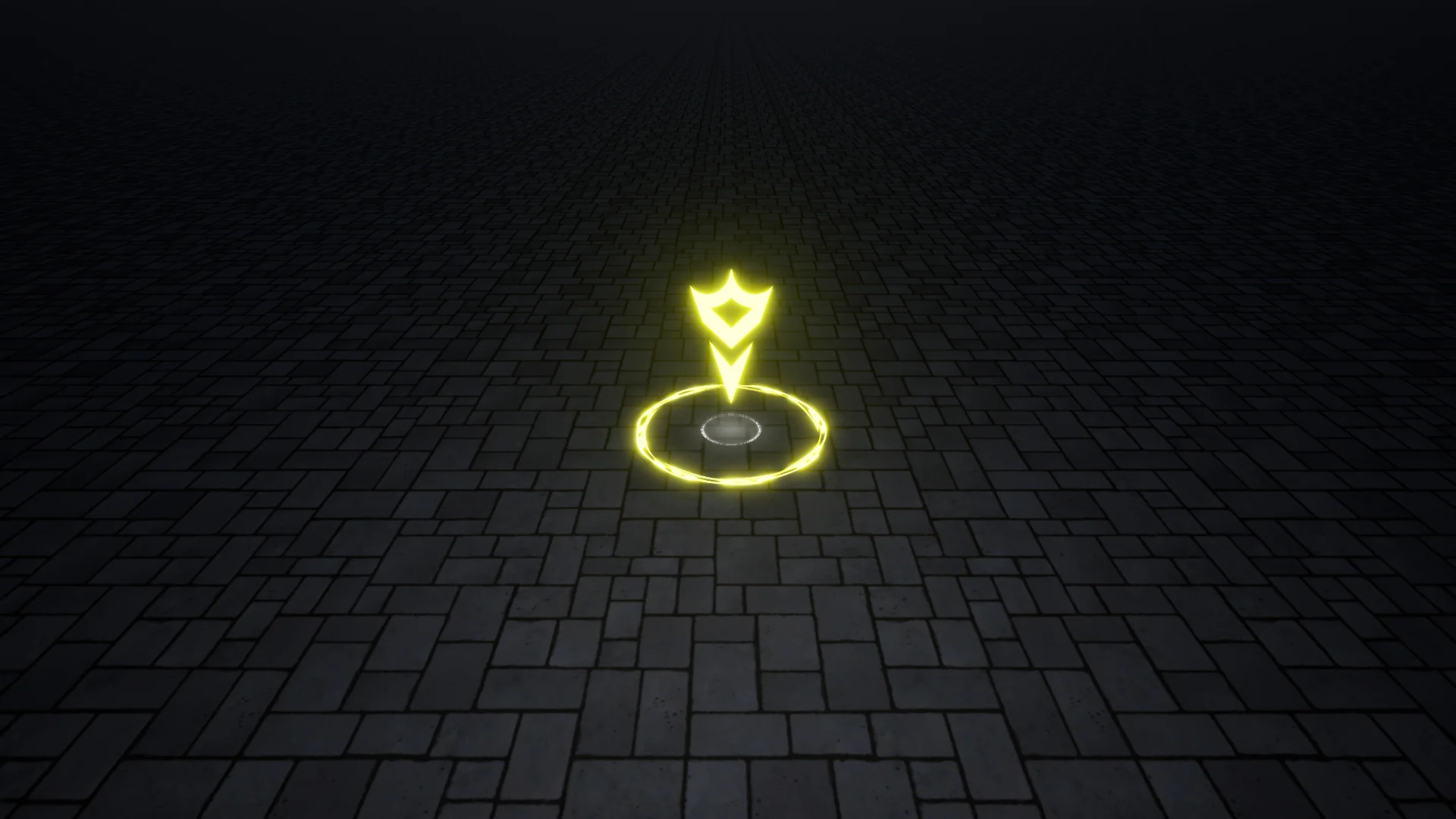
The collection spans several visual archetypes, encompassing directional arrows, upright pointers, route tracks, waypoint guides, target indicators, and localized path markers. Dynamic arrows communicate forward momentum or sharp directional pivots along a road, guiding characters through turns without interrupting movement. Upright pointers and localized target nodes act as definitive stop points, establishing clear visual anchors over objectives, resource nodes, or critical interaction triggers. By providing twelve completely unique Niagara systems, the pack accommodates varying degrees of visual prominence, allowing subtle pathway breadcrumbs to coexist with bold, high-priority destination beacons.
Deconstructing the VFX System Architecture
Underpinning the visual diversity of the twelve Niagara systems is a tightly curated set of structural assets. The package relies on two dedicated static meshes alongside an interconnected shading setup of seventeen materials and material instances, backed by twenty-two textures. This architectural distribution highlights a deliberate balance between modular rendering assets and customized visual styling.
The presence of two meshes indicates that certain markers utilize actual 3D geometry alongside or within their particle emitters. Mesh particles within Niagara grant precise structural control, ensuring that arrows or structural pointers retain clean edges, directional stability, and distinct volumetric silhouettes that simple camera-facing sprite planes cannot always achieve. When combined with dynamic particle ribbons, directional trails, or orbiting motes, these mesh components anchor the visual identity of each marker within the scene.
The shading infrastructure makes extensive use of instancing, leveraging seventeen total materials and material instances. Material instances allow distinct visual properties—such as opacity masks, emissive intensities, panning speeds, and chromatic tones—to be configured rapidly without duplicating base shader code or inflating draw-call complexity. The twenty-two texture maps provide the foundational alpha channels, gradient masks, noise patterns, and motion drivers required to generate energetic motion across each marker. Flowing directional lines, soft luminous fades, and crisp graphic icons all draw from this unified texture bank, enabling each of the twelve effects to maintain a distinct visual signature while utilizing a cohesive set of shared materials.
Staging and Verification in Demo_MapTrackMarkers
Evaluating real-time particle behavior requires seeing emitters running in an active environment rather than viewing them in an isolated cascade viewport. The inclusion of the dedicated showcase level, named Demo_MapTrackMarkers, establishes a direct staging environment where each effect can be reviewed in real-time engine conditions.
Inspecting visual markers within a dedicated level allows developers to evaluate critical perceptual qualities across different viewing scenarios. A pathway marker may appear suitably prominent in an emitter preview window, but observing it against varying floor surfaces and ambient light inside Demo_MapTrackMarkers clarifies how the materials read against complex backdrops. Camera perspective also fundamentally alters how 3D particles are perceived. By walking or flying a camera around the markers in the demo level, it becomes possible to inspect occlusion behavior, horizon falloff, and silhouette retention when viewing arrows from acute angles or inspecting tall pointers from steep top-down perspectives.
The demo environment also provides an immediate reference for scale. Because these markers function as indicators of physical points and travel tracks, calibrating their physical dimensions relative to standard player perspectives is essential. Reviewing the complete collection inside Demo_MapTrackMarkers allows for swift comparison between the twelve distinct configurations, highlighting which effects serve best as continuous track markers and which ones carry the visual density needed for terminal map destinations.
Visual Hierarchy Across Pathway and Target Markers
Effective navigation systems rarely rely on a single visual language for all user feedback. Overloading an environment with identical, bright indicators can clutter the play space and induce navigational fatigue, diluting the importance of major milestones. A structured wayfinding hierarchy uses lower-intensity markers to trace pathways, reserving visually dense or animated markers for critical points of interest.
Within this asset, the presence of distinct arrow, pointer, path, and target archetypes supports this visual stratification. Directional arrow effects and pathway runners can be arranged sequentially across a corridor or terrain spline, pointing the player toward an objective with minimal visual distraction. As the player reaches the terminus of the route, an upright pointer or focused target particle effect can mark the exact objective position, signaling completion or interaction readiness.
Because the twelve Niagara effects provide distinct visual presentations, creators can assign unique marker types to different systemic functions. One effect might serve strictly for quest milestones, another for active breadcrumb navigation, and a third for tactical target designations or boundary points. Leveraging the modular material instances and diverse texture assignments ensures that these functional distinctions remain sharp, consistent, and readable across the entire game environment.
 Spells & Combat
 Spells & Combat
 Spells & Combat