"6c6413bef81af556"{"id":"1001183","slug":"m5-vfx-vol2-fire-and-flames-niagara","title":"M5 VFX Vol2. Fire and Flames(Niagara)","category":"Fire \u0026 Explosions","engine":"5.0+","assetVersion":"","engineVersion":"Engine Version: 5.0+","tag":"Fire \u0026 Explosions","accent":"blue","visual":"mech","summary":"M5 VFX Vol2. Fire and Flames delivers scalable Niagara fire effects, preset flame Blueprint props, and image sequence textures for Unreal Engine 5 projects.","platform":"Unreal Engine","publishedAt":"2026-09-17T06:18:36.967Z","updatedAt":"2026-09-17T06:18:36.967Z","sourceNotes":[],"fileContents":[],"compatibility":["Unreal Engine","Engine Version: 5.0+"],"featuredImage":{"alt":"M5 VFX Vol2. Fire and Flames(Niagara)","src":"/wp-content/uploads/published/2026/09/5533604d9350-dfdcba29-c4ae-4d06-8579-6305ce4485bb-68b47cc48a.webp"},"hasDownloadLink":true,"downloads":0,"terms":[{"taxonomy":"category","slug":"fire-and-explosions","name":"Fire \u0026 Explosions"}],"galleryImages":[{"src":"/wp-content/uploads/published/2026/09/dddc1e721531-949b61fe-dc24-4e35-a6c8-81519539ccaa-a9efa17bc8.webp","alt":"M5 VFX Vol2. Fire and Flames(Niagara)"},{"src":"/wp-content/uploads/published/2026/09/d43620e3dd24-ef1759ad-8ba0-4561-bb37-ab5cc2ba8cd1-8b653e5c15.webp","alt":"M5 VFX Vol2. Fire and Flames(Niagara)"},{"src":"/wp-content/uploads/published/2026/09/d783ff33b773-b4252561-4072-49bc-aad6-7ed43ee40acd-905323d3ff.webp","alt":"M5 VFX Vol2. Fire and Flames(Niagara)"},{"src":"/wp-content/uploads/published/2026/09/acb1c21af6ea-0c2362ba-6247-43a1-beaa-ebbb6a5a4106-d0876267f7.webp","alt":"M5 VFX Vol2. Fire and Flames(Niagara)"},{"src":"/wp-content/uploads/published/2026/09/8aac56b0b5d2-a94b9f28-30d1-440f-8a22-f2881d3112e0-f3965d5ad0.webp","alt":"M5 VFX Vol2. Fire and Flames(Niagara)"},{"src":"/wp-content/uploads/published/2026/09/ab970e0df05d-c24c6358-6a4b-4f5c-88fe-101d274e8c56-547e4b0da9.webp","alt":"M5 VFX Vol2. Fire and Flames(Niagara)"},{"src":"/wp-content/uploads/published/2026/09/815d75069a15-14ab1900-3811-4624-a0ab-a2bf9c4746e8-bd189f91fc.webp","alt":"M5 VFX Vol2. Fire and Flames(Niagara)"},{"src":"/wp-content/uploads/published/2026/09/23fe4dd1db7f-5da55b44-7a04-45e8-820c-8e60165a693d-60c5047439.webp","alt":"M5 VFX Vol2. Fire and Flames(Niagara)"},{"src":"/wp-content/uploads/published/2026/09/304713c8240a-25c36ef6-186b-4d41-8d3a-78b192bd7b93-0d6a8e5379.webp","alt":"M5 VFX Vol2. Fire and Flames(Niagara)"},{"src":"/wp-content/uploads/published/2026/09/c205d2e50d76-0a3ab532-c3d6-4ed2-a42d-c4d329ca699b-aa780d74ff.webp","alt":"M5 VFX Vol2. Fire and Flames(Niagara)"}],"accessPanel":{"kind":"resource","title":"Download this resource","eyebrow":"Free Download","message":"Log in or create a free account to start your download.","fileName":"Content.7z","safetyNote":"Resources are manually reviewed before listing to improve quality and reduce obvious risks.","actionLabel":"Download Free","resourceType":"Resource archive"},"contentHtml":"\u003cp\u003eEnvironmental heat and combustion often define the mood of an interactive environment, whether lighting a dimly lit interior corridor or punctuating an action sequence across a ruined landscape. M5 VFX Vol2. Fire and Flames(Niagara) addresses these demands directly by supplying a flexible visual effects framework focused entirely on combustion phenomena. The collection encompasses an extensive range of practical thermal behaviors, allowing creators to implement everything from subtle ambient flame accents to high-energy concussive detonations.\u003c/p\u003e \u003ch2\u003eEnvironmental Combustion from Flickering Candles to Explosions\u003c/h2\u003e\n\u003cp\u003eReal-time level design requires distinct tiers of fire intensity depending on narrative staging and physical scale. In quiet interior sequences, tiny light-yielding elements dictate player focus. The package provides miniature flame dynamics tailored to shaking candles, where minute shifts in motion establish ambient tension without drawing excessive performance overhead. These subtle elements serve scenes that depend on quiet, intimate lighting where heavy, sprawling fire would look completely unnatural.\u003c/p\u003e \u003cp\u003eStepping upward into mid-scale environmental lighting, the asset provides dedicated systems for standard fire and campsite bonfires. Bonfires balance sustained fuel burning, irregular updrafts, and rising smoke profiles suitable for open-world waypoints, outdoor camps, and rustic village set pieces. The motion language captured in these systems accounts for standard burning rhythms, giving level designers reliable thermal sources to place around props, fire pits, and barricades.\u003c/p\u003e \u003cp\u003eAt the upper limits of visual impact, the collection delivers wide-area fire spreads, vigorous flames, and concussive explosions. These larger setups generate the necessary mass, turbulence, and displacement needed for structural collapses, defensive breaches, and active combat zones. Because the system can express small fire to large fire within a cohesive aesthetic envelope, artists avoid mismatched particle treatments when transitioning from micro-scale interior sources to catastrophic exterior blazes.\u003c/p\u003e \u003ch2\u003ePreset Flames and Prop Integration Across N_M5_Vol2 Maps\u003c/h2\u003e\n\u003cp\u003eFast implementation in production often hinges on how quickly visual effects can be placed, aligned, and tested alongside level architecture. M5 VFX Vol2. Fire and Flames incorporates Blueprint props that allow artists to assign and place preset flames directly within their levels. Instead of constructing actor assemblies manually or repositioning isolated components, these Blueprint actors let users drop ready-to-run light and fire combinations straight into target scenes.\u003c/p\u003e \u003cp\u003eTo assist with immediate inspection and testing, the collection includes dedicated reference levels: N_M5_Vol2_Ref_Map.umap and N_M5_Vol2_Blueprints_Map.umap. The reference map provides an environment to assess the raw Niagara emitter setups, evaluate particle behavior in neutral lighting, and inspect overall flame shapes side by side. Designers can study individual effect profiles to determine which visual archetype suits their current biome or lighting setup.\u003c/p\u003e \u003cp\u003eIn turn, N_M5_Vol2_Blueprints_Map.umap serves as an active proving ground for the pre-assembled Blueprint actors. In this environment, technical artists and level dressers can evaluate how the preset flames interact with physical props and inspect the default settings established in the Blueprint classes. Testing these actors inside the curated blueprint map makes it easy to observe how flame bases conform to geometry, how illumination aligns with the visual core, and how different preset arrangements look under runtime conditions.\u003c/p\u003e \u003ch2\u003eStreamlining Emitters with the Niagara Effect Scale Parameter\u003c/h2\u003e\n\u003cp\u003eTuning complex combustion systems often becomes tedious when individual sub-components must be tweaked one by one. Fire effects rarely rely on a single particle layer; they generally pair dense smoke plumes, base flame cores, surface licking licks, and flying embers. Adjusting the spatial footprint of such an asset normally demands recalculating initial sizes, velocities, and spawn footprints across several distinct emitters within a single system.\u003c/p\u003e \u003cp\u003eThe package simplifies this procedure through its Niagara effect scale property, introduced in the v1.5 update. This dedicated control parameter allows users to scale the overall size of Fire\u0026amp;Smoke simultaneously without having to change each emitter value by hand. If a bonfire needs to double in height for an outdoor beacon, or if a structural fire must be shrunk to fit an iron brazier, the developer can alter the master effect scale parameter directly. The underlying smoke plumes and flame bodies adjust proportionally, maintaining their balanced interaction without breaking the visual relationship between rising smoke volumes and burning flames.\u003c/p\u003e \u003cp\u003eUnderpinning this visual clarity is a library of high-quality image sequence textures. These sequence sheets supply fluid, frame-by-frame animation data that captures authentic fluid movements, flame turbulence, and dissipation curves. Rather than relying on simple static shapes warped by mathematical distortion, the image sequences retain crisp, naturalistic edge transitions that hold visual fidelity across realistic and stylized art directions.\u003c/p\u003e \u003ch2\u003eEngine Version Evolution: Chaos Destruction, Apex, and UE 5.5 Support\u003c/h2\u003e\n\u003cp\u003eThe technical architecture of the package reflects the broader evolution of real-time physics and particle runtimes across engine generations. The Niagara implementation of the collection strictly requires Unreal Engine 5 and above. Modern versions take full advantage of current particle paradigms, bypassing the constraints of older Cascade modules to deliver clean data-driven particle behaviors.\u003c/p\u003e \u003cp\u003eHistorical versions developed between 4.18 and 4.27 relied on Apex destruction workflows, requiring users to explicitly enable the Apex Destruction plugin within their projects. In that legacy architecture, the building_DM_Blueprint simple guide demonstrated how developers could attach targeted fire effects to a specific fracture chunk during structural damage events. When scenes fractured, fire could follow individual debris chunks to simulate progressive structural destruction.\u003c/p\u003e \u003cp\u003eAs the engine transitioned into Unreal Engine 5, Epic Games shifted structural simulation over to the Chaos Destruction system. Consequently, the legacy Fracture Mesh components and related Apex setup files were excluded from the UE5 release line, leaving the package to focus purely on modern Niagara execution. Maintenance has continued forward into the newest engine updates: version 1.55 directly addresses UE 5.5 by converting static meshes in the level to moveable, which completely removes level warning messages during project loads.\u003c/p\u003e \u003ch2\u003eProduction Alignment and Scene Deployment\u003c/h2\u003e\n\u003cp\u003eBecause the collection spans delicate shaking candles, standard campsite bonfires, large-scale structural infernos, and abrupt detonations, it eliminates the need to source disparate fire packs across a single project. The inclusion of high-quality image sequence textures and balanced smoke dynamics gives the visual elements enough weight to support cinematic sequences while remaining accessible for standard real-time background dressing.\u003c/p\u003e \u003cp\u003eTechnical artists, lighting artists, and environment dressers benefit most from this collection. Teams building interior exploration scenes can quickly populate candelabras and lanterns using the Blueprint presets, while open-world designers can deploy and rescale bonfires across sprawling territories using the unified Niagara effect scale control. By combining self-contained Blueprint props, ready-to-test reference maps, and direct master scaling, the package offers a coherent, dependable fire pipeline for active Unreal Engine 5 productions.\u003c/p\u003e\n\n\u003ch2\u003eMore From The Same Workflow\u003c/h2\u003e\n\u003cul\u003e\n\u003cli\u003e\u003ca href=\"https://3dcghub.com/explosions-niagara-explosions-fire-smoke-atom-explosions-explosions-bundle/\" title=\"EXPLOSIONS - Niagara Explosions, Fire, Smoke, Atom Explosions, Explosions Bundle\"\u003eEXPLOSIONS - Niagara Explosions, Fire, Smoke, Atom Explosions, Explosions Bundle\u003c/a\u003e\u003c/li\u003e\n\u003cli\u003e\u003ca href=\"https://3dcghub.com/explosion-fx-customizable/\" title=\"Explosion FX Customizable\"\u003eExplosion FX Customizable\u003c/a\u003e\u003c/li\u003e\n\u003cli\u003e\u003ca href=\"https://3dcghub.com/dragon-flame-fx/\" title=\"Dragon Flame FX\"\u003eDragon Flame FX\u003c/a\u003e\u003c/li\u003e\n\u003cli\u003e\u003ca href=\"https://3dcghub.com/fire-fx-vdb/\" title=\"Fire FX VDB\"\u003eFire FX VDB\u003c/a\u003e\u003c/li\u003e\n\u003cli\u003e\u003ca href=\"https://3dcghub.com/fire-bursts-vdb/\" title=\"Fire Bursts VDB\"\u003eFire Bursts VDB\u003c/a\u003e\u003c/li\u003e\n\u003c/ul\u003e","contentTextLength":7994,"navigation":{"current":15,"total":3140,"previous":{"id":"1001184","slug":"semi-permanent-blood-droplets","title":"Semi-Permanent Blood Droplets","category":"Liquid","platform":"Unreal Engine","updatedAt":"2026-09-17T06:32:56.595Z"},"next":{"id":"1001182","slug":"mocap-online-free-animation-pack-unreal-3d-character-animations-for-fab-market","title":"MoCap Online Free Animation Pack | UNREAL 3D Character Animations for FAB Market","category":"Locomotion / Gaits","platform":"Unreal Engine","updatedAt":"2026-09-17T05:23:01.662Z"}},"relatedResources":[{"id":"15588","slug":"explosions-niagara-explosions-fire-smoke-atom-explosions-explosions-bundle","title":"EXPLOSIONS - Niagara Explosions, Fire, Smoke, Atom Explosions, Explosions Bundle","category":"Fire \u0026 Explosions","engine":"5.0+","assetVersion":"Engine version: 5.0+","engineVersion":"4.27","tag":"Fire \u0026 Explosions","accent":"blue","visual":"audio","summary":"Upgrade your project's visual impact with 21 high-quality Niagara particle systems. This bundle includes everything from massive atomic blasts to realistic fire and debris effects.","platform":"Unreal Engine","publishedAt":"2026-03-12T12:10:38.000Z","updatedAt":"2026-04-19T15:44:44.000Z","sourceNotes":[],"fileContents":[],"compatibility":["Unreal Engine","Engine version: 5.0+"],"featuredImage":{"alt":"EXPLOSIONS - Niagara Explosions, Fire, Smoke, Atom Explosions, Explosions Bundle","src":"https://3dcghub.com/wp-content/uploads/2026/03/c7be6eaf-178c-45f8-97c0-05dcf1be23f5.webp"},"hasDownloadLink":true,"downloads":3},{"id":"15572","slug":"explosion-fx-customizable","title":"Explosion FX Customizable","category":"Fire \u0026 Explosions","engine":"5.2+","assetVersion":"Engine version: 5.2+","engineVersion":"5.2","tag":"Fire \u0026 Explosions","accent":"blue","visual":"city","summary":"Enhance your project with the Explosion FX Customizable pack, featuring eight unique explosion types and advanced motion vector technology. Adjust color, size, and velocity to fit your specific game environment.","platform":"Unreal Engine","publishedAt":"2026-03-12T12:08:07.000Z","updatedAt":"2026-04-19T15:44:44.000Z","sourceNotes":[],"fileContents":[],"compatibility":["Unreal Engine","Engine version: 5.2+"],"featuredImage":{"alt":"Explosion FX Customizable","src":"https://3dcghub.com/wp-content/uploads/2026/03/d6bee4e5-bf0f-4f6f-9b75-e040ff6125ad.webp"},"hasDownloadLink":true,"downloads":2},{"id":"15554","slug":"dragon-flame-fx","title":"Dragon Flame FX","category":"Fire \u0026 Explosions","engine":"5.0+","assetVersion":"Engine version: 5.0+","engineVersion":"4.27","tag":"Fire \u0026 Explosions","accent":"blue","visual":"city","summary":"Enhance your fantasy creatures with Dragon Flame FX, a collection of Niagara-based breath and flamethrower effects. This pack features fire, lightning, and electric variations with customizable parameters.","platform":"Unreal Engine","publishedAt":"2026-03-12T12:06:48.000Z","updatedAt":"2026-04-19T15:44:45.000Z","sourceNotes":[],"fileContents":[],"compatibility":["Unreal Engine","Engine version: 5.0+"],"featuredImage":{"alt":"Dragon Flame FX","src":"https://3dcghub.com/wp-content/uploads/2026/03/2710aa9f-b744-483b-a844-f29717ae5fa6.webp"},"hasDownloadLink":true,"downloads":1}]}
Fire & Explosions
M5 VFX Vol2. Fire and Flames(Niagara)
M5 VFX Vol2. Fire and Flames delivers scalable Niagara fire effects, preset flame Blueprint props, and image sequence textures for Unreal Engine 5 projects.
Environmental heat and combustion often define the mood of an interactive environment, whether lighting a dimly lit interior corridor or punctuating an action sequence across a ruined landscape. M5 VFX Vol2. Fire and Flames(Niagara) addresses these demands directly by supplying a flexible visual effects framework focused entirely on combustion phenomena. The collection encompasses an extensive range of practical thermal behaviors, allowing creators to implement everything from subtle ambient flame accents to high-energy concussive detonations.
Environmental Combustion from Flickering Candles to Explosions
Real-time level design requires distinct tiers of fire intensity depending on narrative staging and physical scale. In quiet interior sequences, tiny light-yielding elements dictate player focus. The package provides miniature flame dynamics tailored to shaking candles, where minute shifts in motion establish ambient tension without drawing excessive performance overhead. These subtle elements serve scenes that depend on quiet, intimate lighting where heavy, sprawling fire would look completely unnatural.
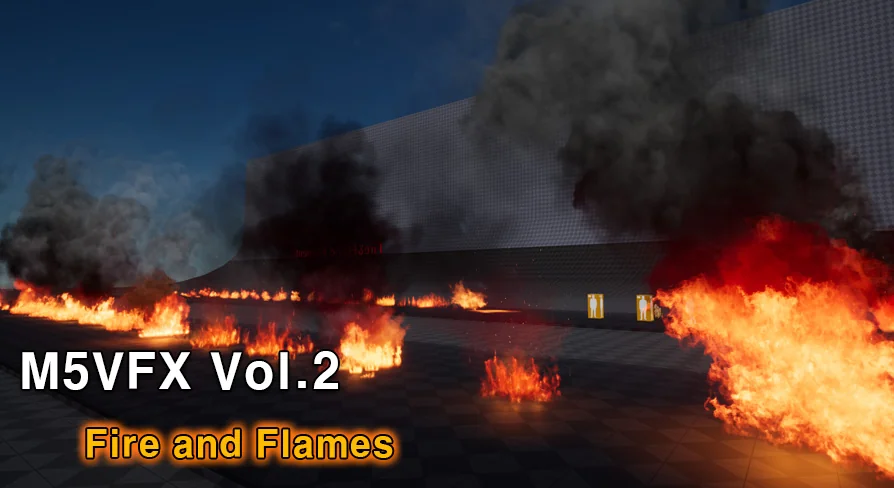
Stepping upward into mid-scale environmental lighting, the asset provides dedicated systems for standard fire and campsite bonfires. Bonfires balance sustained fuel burning, irregular updrafts, and rising smoke profiles suitable for open-world waypoints, outdoor camps, and rustic village set pieces. The motion language captured in these systems accounts for standard burning rhythms, giving level designers reliable thermal sources to place around props, fire pits, and barricades.
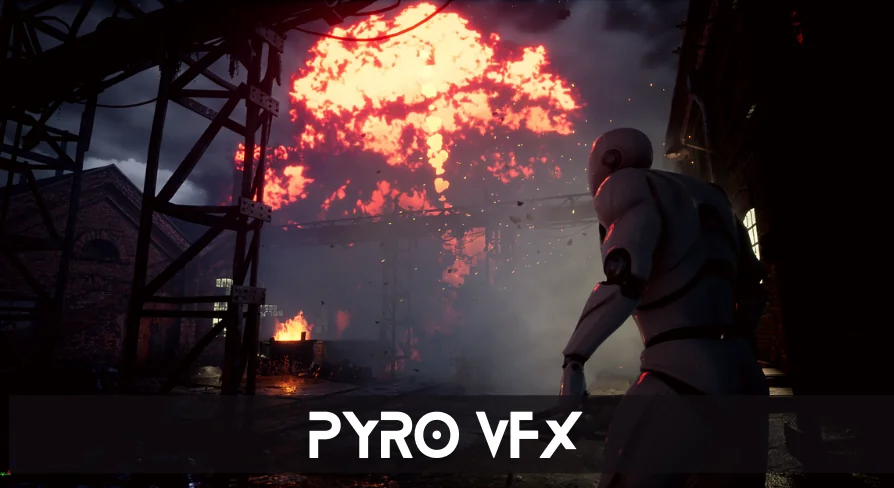
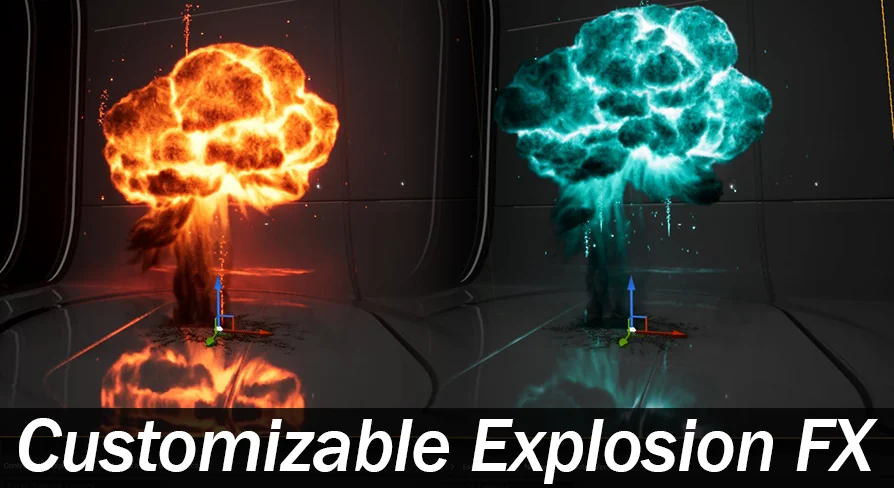
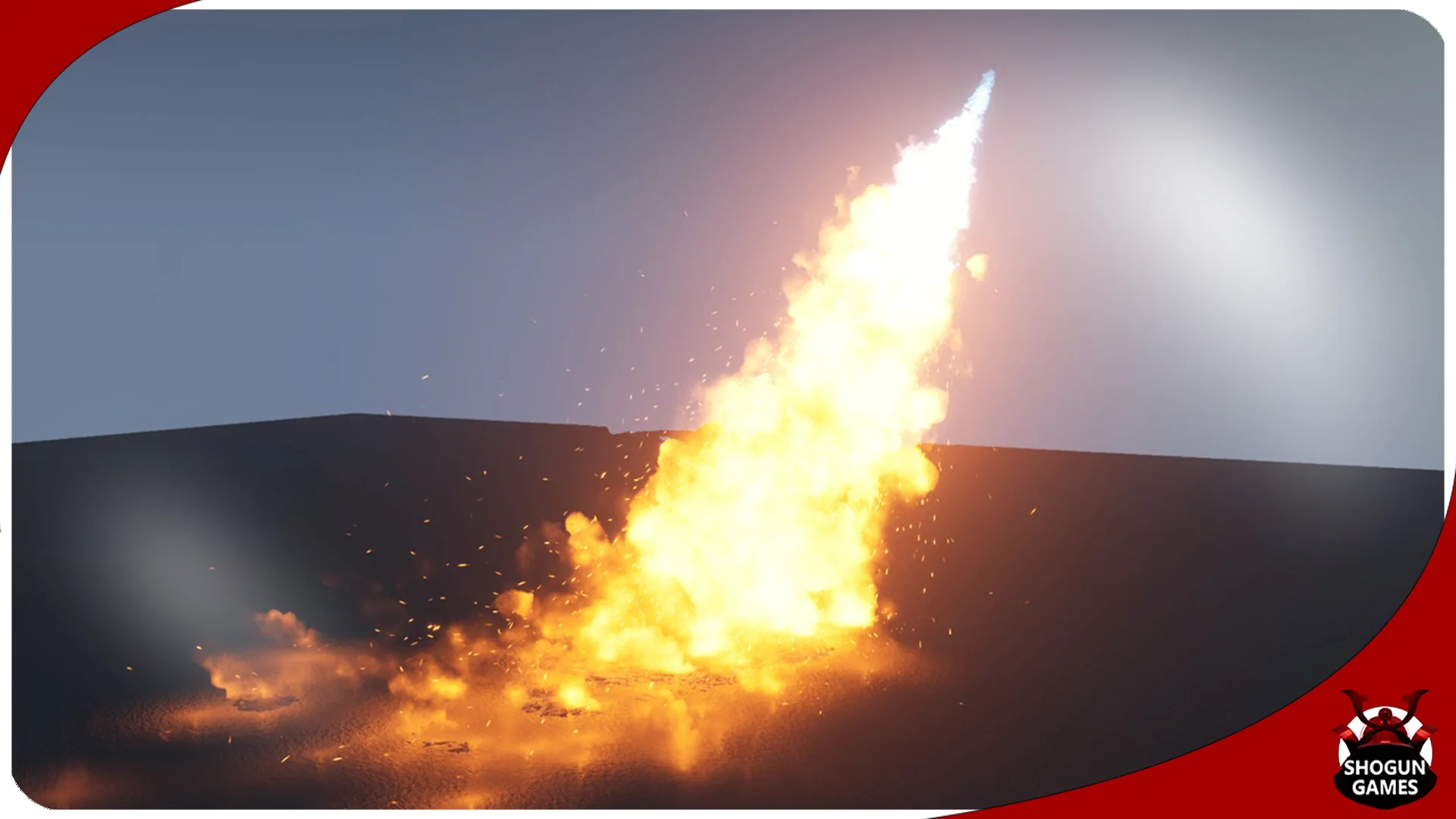
At the upper limits of visual impact, the collection delivers wide-area fire spreads, vigorous flames, and concussive explosions. These larger setups generate the necessary mass, turbulence, and displacement needed for structural collapses, defensive breaches, and active combat zones. Because the system can express small fire to large fire within a cohesive aesthetic envelope, artists avoid mismatched particle treatments when transitioning from micro-scale interior sources to catastrophic exterior blazes.
Preset Flames and Prop Integration Across N_M5_Vol2 Maps
Fast implementation in production often hinges on how quickly visual effects can be placed, aligned, and tested alongside level architecture. M5 VFX Vol2. Fire and Flames incorporates Blueprint props that allow artists to assign and place preset flames directly within their levels. Instead of constructing actor assemblies manually or repositioning isolated components, these Blueprint actors let users drop ready-to-run light and fire combinations straight into target scenes.
To assist with immediate inspection and testing, the collection includes dedicated reference levels: N_M5_Vol2_Ref_Map.umap and N_M5_Vol2_Blueprints_Map.umap. The reference map provides an environment to assess the raw Niagara emitter setups, evaluate particle behavior in neutral lighting, and inspect overall flame shapes side by side. Designers can study individual effect profiles to determine which visual archetype suits their current biome or lighting setup.
In turn, N_M5_Vol2_Blueprints_Map.umap serves as an active proving ground for the pre-assembled Blueprint actors. In this environment, technical artists and level dressers can evaluate how the preset flames interact with physical props and inspect the default settings established in the Blueprint classes. Testing these actors inside the curated blueprint map makes it easy to observe how flame bases conform to geometry, how illumination aligns with the visual core, and how different preset arrangements look under runtime conditions.
Streamlining Emitters with the Niagara Effect Scale Parameter
Tuning complex combustion systems often becomes tedious when individual sub-components must be tweaked one by one. Fire effects rarely rely on a single particle layer; they generally pair dense smoke plumes, base flame cores, surface licking licks, and flying embers. Adjusting the spatial footprint of such an asset normally demands recalculating initial sizes, velocities, and spawn footprints across several distinct emitters within a single system.
The package simplifies this procedure through its Niagara effect scale property, introduced in the v1.5 update. This dedicated control parameter allows users to scale the overall size of Fire&Smoke simultaneously without having to change each emitter value by hand. If a bonfire needs to double in height for an outdoor beacon, or if a structural fire must be shrunk to fit an iron brazier, the developer can alter the master effect scale parameter directly. The underlying smoke plumes and flame bodies adjust proportionally, maintaining their balanced interaction without breaking the visual relationship between rising smoke volumes and burning flames.
Underpinning this visual clarity is a library of high-quality image sequence textures. These sequence sheets supply fluid, frame-by-frame animation data that captures authentic fluid movements, flame turbulence, and dissipation curves. Rather than relying on simple static shapes warped by mathematical distortion, the image sequences retain crisp, naturalistic edge transitions that hold visual fidelity across realistic and stylized art directions.
Engine Version Evolution: Chaos Destruction, Apex, and UE 5.5 Support
The technical architecture of the package reflects the broader evolution of real-time physics and particle runtimes across engine generations. The Niagara implementation of the collection strictly requires Unreal Engine 5 and above. Modern versions take full advantage of current particle paradigms, bypassing the constraints of older Cascade modules to deliver clean data-driven particle behaviors.
Historical versions developed between 4.18 and 4.27 relied on Apex destruction workflows, requiring users to explicitly enable the Apex Destruction plugin within their projects. In that legacy architecture, the building_DM_Blueprint simple guide demonstrated how developers could attach targeted fire effects to a specific fracture chunk during structural damage events. When scenes fractured, fire could follow individual debris chunks to simulate progressive structural destruction.
As the engine transitioned into Unreal Engine 5, Epic Games shifted structural simulation over to the Chaos Destruction system. Consequently, the legacy Fracture Mesh components and related Apex setup files were excluded from the UE5 release line, leaving the package to focus purely on modern Niagara execution. Maintenance has continued forward into the newest engine updates: version 1.55 directly addresses UE 5.5 by converting static meshes in the level to moveable, which completely removes level warning messages during project loads.
Production Alignment and Scene Deployment
Because the collection spans delicate shaking candles, standard campsite bonfires, large-scale structural infernos, and abrupt detonations, it eliminates the need to source disparate fire packs across a single project. The inclusion of high-quality image sequence textures and balanced smoke dynamics gives the visual elements enough weight to support cinematic sequences while remaining accessible for standard real-time background dressing.
Technical artists, lighting artists, and environment dressers benefit most from this collection. Teams building interior exploration scenes can quickly populate candelabras and lanterns using the Blueprint presets, while open-world designers can deploy and rescale bonfires across sprawling territories using the unified Niagara effect scale control. By combining self-contained Blueprint props, ready-to-test reference maps, and direct master scaling, the package offers a coherent, dependable fire pipeline for active Unreal Engine 5 productions.
 Fire & Explosions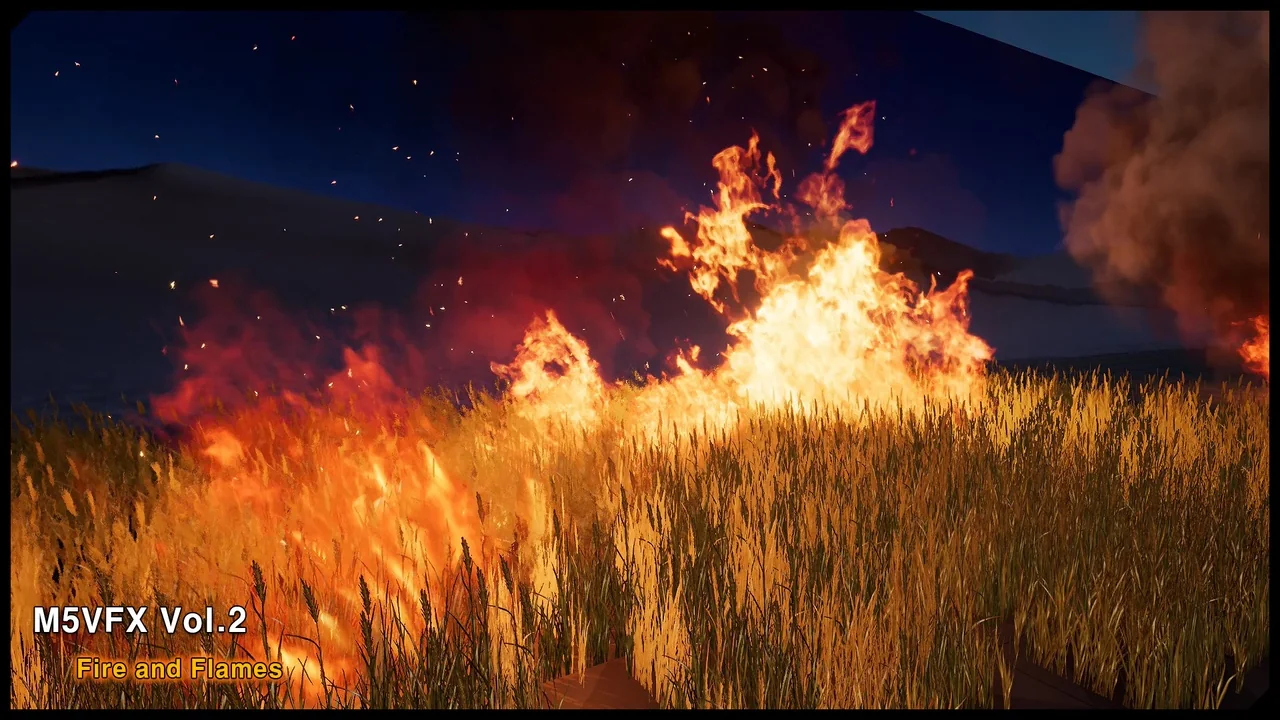
 Fire & Explosions
 Fire & Explosions
 Fire & Explosions