"4a94497540a6fc24"{"id":"1002708","slug":"lowpoly-style-asia-environment","title":"Lowpoly Style Asia Environment","category":"Towns \u0026 Villages","engine":"5.0+","assetVersion":"","engineVersion":"Engine Version: 5.0+","tag":"Towns \u0026 Villages","accent":"blue","visual":"city","summary":"Explore the Lowpoly Style Asia Environment, featuring 113 FBX meshes, faceted terrain blocks, enterable buildings, and unified batchable materials.","platform":"Unreal Engine","indexPolicy":"index","publishedAt":"2026-11-17T18:39:01.649Z","updatedAt":"2026-11-17T18:39:01.649Z","sourceNotes":[],"fileContents":[],"compatibility":["Unreal Engine","Engine Version: 5.0+"],"featuredImage":{"alt":"Lowpoly Style Asia Environment","src":"/wp-content/uploads/published/2026/11/9a2e4a72e957-ce7715ba-8e1e-4379-ad6e-7f6e1c1c5372-a0a35b8237.webp"},"hasDownloadLink":true,"downloads":0,"terms":[{"taxonomy":"category","slug":"towns-and-villages","name":"Towns \u0026 Villages"}],"galleryImages":[{"src":"/wp-content/uploads/published/2026/11/c23f513e8470-56dcf5b6-171a-48a6-b814-ed153c52a750-5ccd00eeed.webp","alt":"Lowpoly Style Asia Environment"},{"src":"/wp-content/uploads/published/2026/11/58c03c7abb73-d11a87db-7344-44c0-a0a5-51d6da8d2805-f6ec105776.webp","alt":"Lowpoly Style Asia Environment"},{"src":"/wp-content/uploads/published/2026/11/d52fa81bcccc-0c12f5bd-82b2-4f27-b750-cff90ffc3739-8bdeda6162.webp","alt":"Lowpoly Style Asia Environment"},{"src":"/wp-content/uploads/published/2026/11/f0e311a2dabe-952c3e42-6a3b-4fb7-aa27-65c004a0c2eb-65297d8735.webp","alt":"Lowpoly Style Asia Environment"},{"src":"/wp-content/uploads/published/2026/11/968ed85f43b7-f86288f6-27e0-4d90-b53e-398902444c22-e8a161f03e.webp","alt":"Lowpoly Style Asia Environment"},{"src":"/wp-content/uploads/published/2026/11/489f13800a69-9dd8754e-7a98-4262-ac11-3ec027bd68bd-95a45c0479.webp","alt":"Lowpoly Style Asia Environment"},{"src":"/wp-content/uploads/published/2026/11/51010dc1b555-b08c4d85-746e-4fec-b043-23fee6732ed7-380c7c55cd.webp","alt":"Lowpoly Style Asia Environment"},{"src":"/wp-content/uploads/published/2026/11/45fa86f07418-78e9d4ba-a55b-4334-8a79-cae1843e714b-959910008f.webp","alt":"Lowpoly Style Asia Environment"},{"src":"/wp-content/uploads/published/2026/11/5c51810403d1-c1d91fd0-128d-4c08-80f6-4a3951fbc4b8-7d95fab7a8.webp","alt":"Lowpoly Style Asia Environment"},{"src":"/wp-content/uploads/published/2026/11/f5439bc24ead-735269bd-f32b-45cd-96a6-40e27f19f92e-710c2fc78f.webp","alt":"Lowpoly Style Asia Environment"}],"accessPanel":{"kind":"resource","title":"Get this resource","safetyNote":"Resources are manually reviewed before listing to improve quality and reduce obvious risks.","fileName":"Content.7z","resourceType":"Resource archive","versions":[]},"contentHtml":"\u003cp\u003eMountain settings offer an evocative foundation for stylized level design, particularly when constructing remote sanctuaries, secluded monasteries, and ancient temple complexes. Achieving a cohesive cartoon aesthetic across rugged outdoor topography requires balancing structural silhouettes with deliberate natural contours. Whether a project calls for a Japanese shrine retreat, a Chinese medieval village, or a sweeping mountain ascent layered with terraced gardens, success relies on clean geometry, distinct shapes, and unified surface properties. When visual assets share an aligned structural language, expansive outdoor scenes remain readable and visually coherent from wide panoramic vantage points down to individual pathways.\u003c/p\u003e \u003ch2\u003eLowpoly Asia Architecture and Modular Meshes\u003c/h2\u003e\n\u003cp\u003eAt the center of this environment collection is a complete modular kit comprised of 113 FBX meshes made for swift placement and flexible arrangement. The architectural kit covers temples, standard village buildings, bridges, stone statues, and a wide array of perimeter decorations. These components are accompanied by blueprints and integrated particle systems, allowing level designers to populate environments through a simple drag-and-drop workflow. Rather than manually wiring static meshes with ambient atmospheric effects, designers can directly place functional blueprints that incorporate both the structural forms and the accompanying visual effects into the scene.\u003c/p\u003e\n\u003cp\u003eThe architectural assets are tailored to evoke traditional Asian architectural motifs, drawing from Japanese and Chinese construction elements. Tiered temple roofs, decorative eaves, connecting bridges, and ceremonial statues establish immediate cultural identity. Because the elements are broken down into discrete FBX meshes, creators are not restricted to rigid pre-assembled compounds. Bridges can span rocky chasms or tranquil garden waters, while statues and ornamental decorations frame exterior courtyards, stone stairwells, and winding mountain entrances. This level of modularity makes it possible to construct everything from an isolated hermitage guarding a temple to an extensive medieval village sprawling across multiple tiers of terrain.\u003c/p\u003e \u003ch2\u003eEnterable Buildings and Structural Layouts\u003c/h2\u003e\n\u003cp\u003eA notable functional characteristic of the structural assets is that all buildings can be entered. In many stylized environment kits, buildings are modeled purely as solid exterior shells, restricting gameplay strictly to streets, paths, and outdoor courtyards. In contrast, fully enterable structures remove the visual and systemic boundaries between outdoor navigation and indoor exploration. Level creators can guide players from rocky mountain paths directly through the doorways of ancient temples or village dwellings without relying on teleport triggers, loading screens, or artificial barricades.\u003c/p\u003e\n\u003cp\u003eThis design freedom broadens the types of gameplay scenarios that can take place within a single unified map. Interior rooms can host gameplay objectives, non-player character encounters, narrative focal points, or collectible item caches. Because the exterior and interior spaces exist within the same geometry, combat encounters, exploration loops, and camera transitions remain continuous. Designers can populate temple interiors with thematic decorations, use doorway framing to control player sightlines, and establish believable living quarters within a high mountain monastery.\u003c/p\u003e \u003ch2\u003eFaceted Terrain Meshes and Mountain Environment Geometry\u003c/h2\u003e\n\u003cp\u003eTo establish the rugged geography required for a secluded mountain redoubt, the collection includes 13 dedicated meshes designed specifically for faceted terrain creation. Stylized and cartoon visual targets frequently avoid smooth, heightmap-driven landscapes in favor of sharp, crystalline planes and hard-edged polygonal surfaces. These 13 terrain pieces allow level builders to block out dramatic topographical features, including sheer cliff faces, angular mountain ridges, terraced plateaus, and stepped rock formations.\u003c/p\u003e\n\u003cp\u003eSurrounding these faceted terrain blocks is an extensive selection of natural assets, including trees, plants, rocks, and dedicated garden props. By layering stylized vegetation across the stepped terrain geometry, designers can carve out lush gardens, overgrown temple borders, and wild forest borders that buffer the monastery from the world below. The sharp, low-poly nature of the plant and rock meshes matches the faceted terrain slabs, preventing any visual mismatch between the landscape foundation and the dressing placed on top of it. Winding stone bridges and stone statues integrate naturally into these garden environments, reinforcing the sense of an ancient, carefully tended mountain sanctuary.\u003c/p\u003e \u003ch2\u003eShared Material Workflows and Draw Call Optimization\u003c/h2\u003e\n\u003cp\u003eMaintaining high rendering performance in dense, stylized scenes depends heavily on draw call management. In large outdoor environments packed with dozens of modular buildings, scattered props, multi-piece bridges, and dense foliage clusters, unique materials and texture lookups can quickly exhaust performance budgets. To resolve this bottleneck, nearly all models in this collection share the exact same material and texture setup.\u003c/p\u003e\n\u003cp\u003eBecause the meshes draw from a single shared material, modern rendering engines can batch static meshes together with exceptional efficiency. Hundreds of individual props—ranging from building walls and temple roofs to trees, garden plants, and faceted rocks—can be processed in minimal draw calls. This unified material architecture provides reliable framerates even on hardware configurations with tight processing limits. Furthermore, this asset pipeline guarantees identical surface responses, lighting behavior, and color balance across all 113 FBX meshes and the 13 terrain pieces, eliminating the need to manually tweak individual shaders to achieve artistic uniformity.\u003c/p\u003e \u003ch2\u003eDemoscene Assembly and Multi-Pack Style Integration\u003c/h2\u003e\n\u003cp\u003eTo provide an immediate demonstration of spatial scale and asset composition, the collection includes a complete pre-assembled demoscene. The demoscene models the core conceptual narrative: a secluded monastery hidden high in the mountains, watching over ancient temples surrounded by gardens, bridges, and faceted cliff sides. Developers can inspect this scene directly to analyze structural assembly, foliage clustering, and lighting techniques, or use the pre-built layout as a working level for rapid prototyping and gameplay testing.\u003c/p\u003e\n\u003cp\u003eBeyond standalone use, the unified material architecture links directly into a broader ecosystem of stylized environments. The exact same material and texture configuration is utilized across several related biome releases, including the Lowpoly Style Woodlands Pack, Lowpoly Style Winter Pack, Lowpoly Style Desert Pack, Lowpoly Style Forest Pack, Lowpoly Style Tropical Pack, and the comprehensive Ultra Pack compilation. Because every asset in these respective libraries references the identical material foundation, developers can merge environments seamlessly. A snow-covered monastery transition, a dense woodland valley leading up to an Asian village, or a tropical coastal temple can all be constructed within a single project without introducing mismatched shaders, redundant draw calls, or conflicting artistic pipelines.\u003c/p\u003e\n\n\u003ch2\u003eMore From The Same Workflow\u003c/h2\u003e\n\u003cul\u003e\n\u003cli\u003e\u003ca href=\"https://3dcghub.com/lowpoly-style-ultra-pack/\" rel=\"noopener noreferrer\"\u003eLowpoly Style Ultra Pack\u003c/a\u003e\u003c/li\u003e\n\u003cli\u003e\u003ca href=\"https://3dcghub.com/lowpoly-style-woodlands-pack/\" rel=\"noopener noreferrer\"\u003eLowpoly Style Woodlands Pack\u003c/a\u003e\u003c/li\u003e\n\u003cli\u003e\u003ca href=\"https://3dcghub.com/stylized-countryside-stylized-stylised-country-country-side-road-lowpoly-3d/\" rel=\"noopener noreferrer\"\u003eStylized Countryside ( Stylized Stylised Country Country Side Road Lowpoly 3d )\u003c/a\u003e\u003c/li\u003e\n\u003cli\u003e\u003ca href=\"https://3dcghub.com/house-on-a-hill-house-houses-fantasy-house-stylized-house/\" rel=\"noopener noreferrer\"\u003eHouse On A Hill (House, Houses, Fantasy House, Stylized House)\u003c/a\u003e\u003c/li\u003e\n\u003cli\u003e\u003ca href=\"https://3dcghub.com/modular-medieval-town-medieval-town-medieval-village-fantasy-town/\" rel=\"noopener noreferrer\"\u003eModular Medieval Town (Medieval Town, Medieval Village, Fantasy Town)\u003c/a\u003e\u003c/li\u003e\n\u003c/ul\u003e","contentTextLength":7622,"navigation":{"current":12,"total":4642,"previous":{"id":"1002709","slug":"medieval-houses-modular-vol-2","title":"Medieval Houses Modular Vol 2","category":"Medieval","platform":"Unreal Engine","updatedAt":"2026-11-17T18:40:09.851Z"},"next":{"id":"1002707","slug":"low-poly-viking-world","title":"Low Poly Viking World","category":"Medieval","platform":"Unreal Engine","updatedAt":"2026-11-17T18:37:28.653Z"}},"relatedResources":[{"id":"1001891","slug":"lowpoly-style-ultra-pack","title":"Lowpoly Style Ultra Pack","category":"Fantasy","engine":"4.25+,5.0+","assetVersion":"","engineVersion":"Engine Version: 4.25+,5.0+","tag":"Fantasy","accent":"blue","visual":"mech","summary":"Deploy modular stylized levels with the Lowpoly Style Ultra Pack, featuring 250+ meshes, 6 vast environments, shared materials, colliders, and lightmap UVs.","platform":"Unreal Engine","indexPolicy":"index","publishedAt":"2026-10-22T11:31:27.501Z","updatedAt":"2026-10-22T11:31:27.501Z","sourceNotes":[],"fileContents":[],"compatibility":["Unreal Engine","Engine Version: 4.25+,5.0+"],"featuredImage":{"alt":"Lowpoly Style Ultra Pack","src":"/wp-content/uploads/published/2026/10/0f7034b41d07-a1040993-537e-47ed-bad5-9e9702bbc09b-9e49fc450a.webp"},"fileSizeBytes":1802335783,"hasDownloadLink":true,"downloads":1},{"id":"1001735","slug":"lowpoly-style-woodlands-pack","title":"Lowpoly Style Woodlands Pack","category":"Forest \u0026 Jungle","engine":"4.26+,5.0+","assetVersion":"","engineVersion":"Engine Version: 4.26+,5.0+","tag":"Forest \u0026 Jungle","accent":"blue","visual":"mech","summary":"Construct stylized alpine landscapes and woodland camps using the Lowpoly Style Woodlands Pack, featuring unified material batching and modular nature assets.","platform":"Unreal Engine","indexPolicy":"index","publishedAt":"2026-10-20T02:40:02.803Z","updatedAt":"2026-10-20T02:40:02.803Z","sourceNotes":[],"fileContents":[],"compatibility":["Unreal Engine","Engine Version: 4.26+,5.0+"],"featuredImage":{"alt":"Lowpoly Style Woodlands Pack","src":"/wp-content/uploads/published/2026/10/066b0cf4ab99-f8e12b2e-0c2b-4e5d-9ccd-60d3246ca57a-d7f06bb336.webp"},"fileSizeBytes":392192439,"hasDownloadLink":true,"downloads":0},{"id":"1000102","slug":"stylized-countryside-stylized-stylised-country-country-side-road-lowpoly-3d","title":"Stylized Countryside ( Stylized Stylised Country Country Side Road Lowpoly 3d )","category":"Towns \u0026 Villages","engine":"Engine Version: 5.3+","assetVersion":"Engine Version: 5.3+","engineVersion":"","tag":"Towns \u0026 Villages","accent":"blue","visual":"mech","summary":"A stylized countryside environment for Unreal Engine with 28 unique meshes, game-ready optimization, and Lumen-enabled support for levels.","platform":"Unreal Engine","indexPolicy":"index","publishedAt":"2026-06-07T15:53:08.005Z","updatedAt":"2026-06-07T15:53:08.005Z","sourceNotes":[],"fileContents":[],"compatibility":["Unreal Engine","Engine Version: 5.3+"],"featuredImage":{"alt":"Stylized Countryside ( Stylized Stylised Country Country Side Road Lowpoly 3d )","src":"/wp-content/uploads/published/2026/06/eaefb0a60143-ec69bcc2-bab3-41d8-a14c-37704d9393e8-115a395015.webp"},"fileSizeBytes":797128343,"hasDownloadLink":true,"downloads":0}]}
Resource screenshots
1 / 10
Join our channel
Follow 3DCGHUB on Telegram for new resource drops, migration updates, and community notices.
Mountain settings offer an evocative foundation for stylized level design, particularly when constructing remote sanctuaries, secluded monasteries, and ancient temple complexes. Achieving a cohesive cartoon aesthetic across rugged outdoor topography requires balancing structural silhouettes with deliberate natural contours. Whether a project calls for a Japanese shrine retreat, a Chinese medieval village, or a sweeping mountain ascent layered with terraced gardens, success relies on clean geometry, distinct shapes, and unified surface properties. When visual assets share an aligned structural language, expansive outdoor scenes remain readable and visually coherent from wide panoramic vantage points down to individual pathways.
Lowpoly Asia Architecture and Modular Meshes
At the center of this environment collection is a complete modular kit comprised of 113 FBX meshes made for swift placement and flexible arrangement. The architectural kit covers temples, standard village buildings, bridges, stone statues, and a wide array of perimeter decorations. These components are accompanied by blueprints and integrated particle systems, allowing level designers to populate environments through a simple drag-and-drop workflow. Rather than manually wiring static meshes with ambient atmospheric effects, designers can directly place functional blueprints that incorporate both the structural forms and the accompanying visual effects into the scene.
The architectural assets are tailored to evoke traditional Asian architectural motifs, drawing from Japanese and Chinese construction elements. Tiered temple roofs, decorative eaves, connecting bridges, and ceremonial statues establish immediate cultural identity. Because the elements are broken down into discrete FBX meshes, creators are not restricted to rigid pre-assembled compounds. Bridges can span rocky chasms or tranquil garden waters, while statues and ornamental decorations frame exterior courtyards, stone stairwells, and winding mountain entrances. This level of modularity makes it possible to construct everything from an isolated hermitage guarding a temple to an extensive medieval village sprawling across multiple tiers of terrain.
Enterable Buildings and Structural Layouts
A notable functional characteristic of the structural assets is that all buildings can be entered. In many stylized environment kits, buildings are modeled purely as solid exterior shells, restricting gameplay strictly to streets, paths, and outdoor courtyards. In contrast, fully enterable structures remove the visual and systemic boundaries between outdoor navigation and indoor exploration. Level creators can guide players from rocky mountain paths directly through the doorways of ancient temples or village dwellings without relying on teleport triggers, loading screens, or artificial barricades.
This design freedom broadens the types of gameplay scenarios that can take place within a single unified map. Interior rooms can host gameplay objectives, non-player character encounters, narrative focal points, or collectible item caches. Because the exterior and interior spaces exist within the same geometry, combat encounters, exploration loops, and camera transitions remain continuous. Designers can populate temple interiors with thematic decorations, use doorway framing to control player sightlines, and establish believable living quarters within a high mountain monastery.
Faceted Terrain Meshes and Mountain Environment Geometry
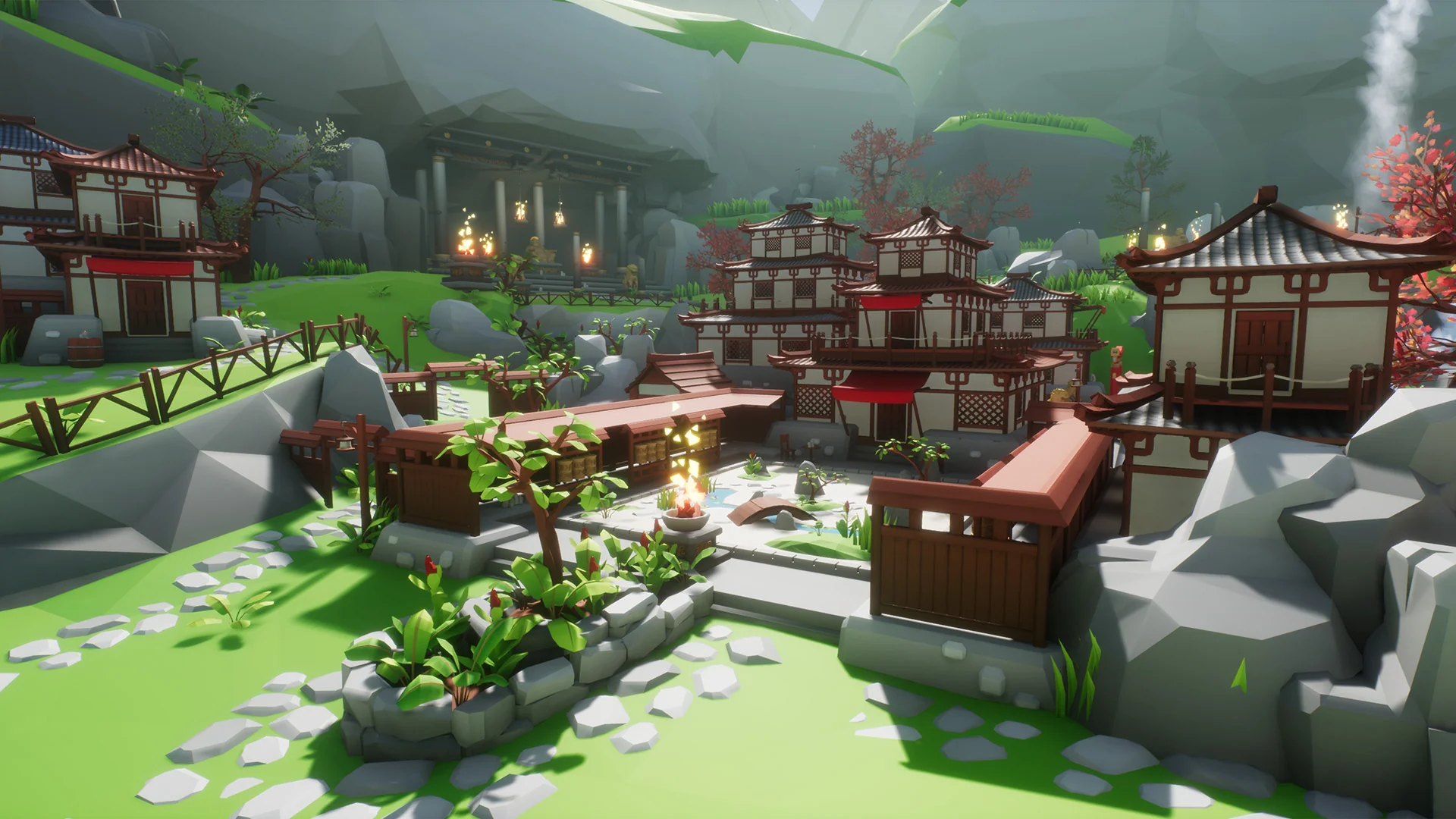
To establish the rugged geography required for a secluded mountain redoubt, the collection includes 13 dedicated meshes designed specifically for faceted terrain creation. Stylized and cartoon visual targets frequently avoid smooth, heightmap-driven landscapes in favor of sharp, crystalline planes and hard-edged polygonal surfaces. These 13 terrain pieces allow level builders to block out dramatic topographical features, including sheer cliff faces, angular mountain ridges, terraced plateaus, and stepped rock formations.
Surrounding these faceted terrain blocks is an extensive selection of natural assets, including trees, plants, rocks, and dedicated garden props. By layering stylized vegetation across the stepped terrain geometry, designers can carve out lush gardens, overgrown temple borders, and wild forest borders that buffer the monastery from the world below. The sharp, low-poly nature of the plant and rock meshes matches the faceted terrain slabs, preventing any visual mismatch between the landscape foundation and the dressing placed on top of it. Winding stone bridges and stone statues integrate naturally into these garden environments, reinforcing the sense of an ancient, carefully tended mountain sanctuary.
Shared Material Workflows and Draw Call Optimization
Maintaining high rendering performance in dense, stylized scenes depends heavily on draw call management. In large outdoor environments packed with dozens of modular buildings, scattered props, multi-piece bridges, and dense foliage clusters, unique materials and texture lookups can quickly exhaust performance budgets. To resolve this bottleneck, nearly all models in this collection share the exact same material and texture setup.
Because the meshes draw from a single shared material, modern rendering engines can batch static meshes together with exceptional efficiency. Hundreds of individual props—ranging from building walls and temple roofs to trees, garden plants, and faceted rocks—can be processed in minimal draw calls. This unified material architecture provides reliable framerates even on hardware configurations with tight processing limits. Furthermore, this asset pipeline guarantees identical surface responses, lighting behavior, and color balance across all 113 FBX meshes and the 13 terrain pieces, eliminating the need to manually tweak individual shaders to achieve artistic uniformity.
Demoscene Assembly and Multi-Pack Style Integration
To provide an immediate demonstration of spatial scale and asset composition, the collection includes a complete pre-assembled demoscene. The demoscene models the core conceptual narrative: a secluded monastery hidden high in the mountains, watching over ancient temples surrounded by gardens, bridges, and faceted cliff sides. Developers can inspect this scene directly to analyze structural assembly, foliage clustering, and lighting techniques, or use the pre-built layout as a working level for rapid prototyping and gameplay testing.
Beyond standalone use, the unified material architecture links directly into a broader ecosystem of stylized environments. The exact same material and texture configuration is utilized across several related biome releases, including the Lowpoly Style Woodlands Pack, Lowpoly Style Winter Pack, Lowpoly Style Desert Pack, Lowpoly Style Forest Pack, Lowpoly Style Tropical Pack, and the comprehensive Ultra Pack compilation. Because every asset in these respective libraries references the identical material foundation, developers can merge environments seamlessly. A snow-covered monastery transition, a dense woodland valley leading up to an Asian village, or a tropical coastal temple can all be constructed within a single project without introducing mismatched shaders, redundant draw calls, or conflicting artistic pipelines.
 Fantasy
 Forest & Jungle
 Towns & Villages