"9d95bb12aa6c551e"{"id":"1000071","slug":"laboratory-research-center-2","title":"Laboratory - Research Center","category":"Interior","engine":"Engine Version: 4.26+,5.0+","assetVersion":"Engine Version: 4.26+,5.0+","engineVersion":"","tag":"Interior","accent":"cyan","visual":"mech","summary":"A modular laboratory kit with interior, exterior, and research center props, including furniture, pipes, devices, and a demonstration map.","platform":"Unreal Engine","updatedAt":"2026-06-01T15:51:12.991Z","sourceNotes":[],"fileContents":[],"compatibility":["Unreal Engine","Engine Version: 4.26+,5.0+"],"featuredImage":{"alt":"Laboratory - Research Center","src":"/wp-content/uploads/published/2026/06/76d353287be0-23df10c7-7d9e-4ad0-9293-a0712e2bbbf4-d811b62c48.webp"},"hasDownloadLink":true,"pageviews":0,"galleryImages":[{"src":"/wp-content/uploads/published/2026/06/a2cdf04c3c90-d7f32305-6f96-44d3-841b-e6fa3ab3b4a0-5c7d15ad3e.webp","alt":"Laboratory - Research Center"},{"src":"/wp-content/uploads/published/2026/06/6835d47ee4c7-420cb745-68d4-4600-a33c-e799101adee9-bc2bf0a3c0.webp","alt":"Laboratory - Research Center"},{"src":"/wp-content/uploads/published/2026/06/72c36d98fe74-6812ef03-6b45-4052-937b-8fb8f2ffccc0-4fd38ba6d4.webp","alt":"Laboratory - Research Center"},{"src":"/wp-content/uploads/published/2026/06/d1e35f7fa791-6a15e031-5405-4c55-b2e3-fc3b498a8dbe-3e18c1921f.webp","alt":"Laboratory - Research Center"},{"src":"/wp-content/uploads/published/2026/06/c23e93ac6f3c-908aeb03-9d45-4e4b-b515-74421d3b8260-d772db03f3.webp","alt":"Laboratory - Research Center"},{"src":"/wp-content/uploads/published/2026/06/ec0e23f390af-7e285a10-7f05-4ae5-bd34-f7ae358c35c8-8ce1318804.webp","alt":"Laboratory - Research Center"},{"src":"/wp-content/uploads/published/2026/06/2dd5c44fdd59-f1f7f963-cb24-41c5-9410-1646a2e19e25-b2efa226f5.webp","alt":"Laboratory - Research Center"},{"src":"/wp-content/uploads/published/2026/06/c8eb7c4d999c-14d1a801-6cfc-495c-b694-fb9ab15d2b62-f6e6f93698.webp","alt":"Laboratory - Research Center"},{"src":"/wp-content/uploads/published/2026/06/40782c188722-71171344-cf21-4bf5-a59e-78e2cd572eae-7b05e7ee75.webp","alt":"Laboratory - Research Center"},{"src":"/wp-content/uploads/published/2026/06/0d1db9caaeed-5e1b7d99-1410-45bc-9ec9-364283067c23-919eb3ba4d.webp","alt":"Laboratory - Research Center"}],"accessPanel":{"kind":"resource","title":"Access this resource","eyebrow":"Free protected download","message":"Sign in or create an account to continue to the protected download through the managed storage service.","fileName":"Content.7z","safetyNote":"Resources are manually reviewed before listing to improve quality and reduce obvious risks.","actionLabel":"Download Free","resourceType":"Resource archive","sourceShortcode":"cryptomus_member"},"contentHtml":"\u003cp\u003eBuilding a believable research facility usually means solving several scene problems at once: the shell of the location, the rooms inside it, and the smaller props that make the space read as a functioning workplace. Laboratory - Research Center addresses that need as a laboratory kit that combines modular interior pieces, exterior parts, and supporting props for research center scenes.\u003c/p\u003e\u003cp\u003eRather than focusing on a single corner of the environment, the kit covers the larger structure and the practical items that fill it out. Furniture, chairs, pipes, and devices are all part of the package, giving it a clear place in environment production where a team needs to move from empty space to a recognizable laboratory setting without treating architecture and props as separate tasks.\u003c/p\u003e\u003ch2\u003eSetting up a research center with modular interior and exterior parts\u003c/h2\u003e\u003cp\u003eThe strongest production role of this kit is in scene assembly. Its modular approach to interior and exterior construction makes it suited to building a research center as a connected environment instead of a one-off room.\u003c/p\u003e\u003cp\u003eThat matters in day-to-day workflow because laboratory scenes often need more than a hero shot. A research center may include corridors, work rooms, support spaces, and outer structural elements that all need to feel related. With modular interior and exterior elements in the same package, the environment can be assembled as a consistent location. The resource name points directly to that goal: this is not just a collection of science props, but a kit for forming a laboratory setting that reads as a complete research center.\u003c/p\u003e\u003cp\u003eThe modular angle also places it naturally in level building. One of its tags is level, which aligns with the way this kind of content is typically used: not as a standalone object, but as a set of repeatable environment pieces that help establish a larger playable or explorable space. The inclusion of both interior and exterior content gives teams room to carry the same visual language from outside the building into the operational areas within it.\u003c/p\u003e\u003ch2\u003eFurniture, chairs, pipes, and devices that make the laboratory readable\u003c/h2\u003e\u003cp\u003eA laboratory environment depends on more than walls and floors. It needs the everyday objects and structural details that signal purpose, occupancy, and use. This kit includes props such as furniture, chairs, pipes, and devices for a research center, which makes it useful for turning a modular shell into a location with clear function.\u003c/p\u003e\u003cp\u003eFurniture and chairs help establish the office and workplace side of the setting. The tags include office and interior, which broadens the scene identity beyond sterile science imagery alone. A research center often has areas that feel administrative or operational as well as experimental, and the presence of furniture-based props supports that reading. Pipes and devices push the environment back toward technical and laboratory-specific visual language. Those elements are especially important in realistic scenes because they give surfaces and rooms a purpose. A bare modular room can look unfinished; a room populated with seating, furnishings, visible pipework, and research devices immediately starts to communicate workflow, occupation, and infrastructure.\u003c/p\u003e\u003cp\u003eThis balance of structural and smaller-scale pieces makes the kit practical for scene dressing. Instead of treating props as an afterthought, the package already includes the categories of objects most likely to shape the identity of a research facility. That helps when blocking out rooms, establishing routes through a level, and making spaces feel equipped rather than decorative.\u003c/p\u003e\u003ch2\u003eWhere Laboratory - Research Center fits in a production workflow\u003c/h2\u003e\u003cp\u003eThis resource fits best at the stage where a team needs to move from concept-level space planning into a playable or presentable environment. It offers enough range in its description to support layout, dressing, and presentation in one pass.\u003c/p\u003e\u003cp\u003eFor production work, that can begin with the modular interior and exterior pieces that define the footprint of the facility. Once the core spaces are in place, props such as furniture, chairs, pipes, and devices can be used to differentiate areas and give rooms a role. A space lined with pipes and technical devices will read differently from one arranged around furniture and chairs, even when both belong to the same research center. Because the kit spans these categories, it supports a workflow where broad layout and detailed dressing stay visually connected.\u003c/p\u003e\u003cp\u003eThe presence of a demonstration map also matters here. A demonstration map gives the package a built example of how its parts can come together in an actual environment. For teams evaluating how to stage the assets or how the pieces relate in context, that kind of included scene can shorten the gap between importing content and understanding how it behaves as a complete laboratory setup. It is not just a pile of separate components; there is already a demonstrated arrangement showing the intended environment type.\u003c/p\u003e\u003ch2\u003eRealistic PBR laboratory scenes and current gen games budgets\u003c/h2\u003e\u003cp\u003eThe tags identify the package as PBR and realistic, placing it in a visual style focused on believable material response and grounded environment work. For a laboratory setting, that style choice is especially relevant because these spaces rely on clean surfaces, functional furnishings, technical devices, and visible infrastructure to feel convincing.\u003c/p\u003e\u003cp\u003eThe package is also stated to have assets created to correspond to current gen games budgets. In production terms, that points to a balance between scene detail and game-ready resource planning. The wording does not frame the kit as an abstract visualization set or a purely cinematic collection. It is positioned around the needs of contemporary game environments, where a laboratory area has to look dense enough to feel authentic while still fitting the broader demands of a playable project. For environment artists and level builders, that makes the kit easier to place within a game pipeline focused on realistic spaces.\u003c/p\u003e\u003cp\u003eThe realistic and modular tags work well together. Realism in environment art often depends on repetition handled carefully: repeating wall systems, recurring furniture families, and infrastructure like pipes that unify multiple rooms. A modular kit supports that pattern naturally, while the realistic PBR direction helps the repeated elements still feel like parts of one believable facility rather than abstract building blocks.\u003c/p\u003e\u003ch2\u003eUsing the demonstration map as a starting point\u003c/h2\u003e\u003cp\u003eIncluded demonstration content can be more useful than it first appears, especially in environment production. The demonstration map here gives a ready example of the laboratory kit in context.\u003c/p\u003e\u003cp\u003eThat makes it a practical starting point for anyone trying to judge spacing, density, and scene composition in a research center setting. A map can show how modular sections, furniture, chairs, pipes, and devices relate to one another when assembled into a coherent environment. It also provides a direct way to read the intended balance between the interior, exterior, and prop sides of the package. For teams building realistic laboratory scenes, that kind of example helps place the kit quickly within a production: as a foundation for a research facility level, a base for an interior-heavy environment, or a reference scene for extending a larger technical complex.\u003c/p\u003e\u003cp\u003eThe package sits most naturally in projects that need a realistic laboratory or office-adjacent research space assembled from modular parts, then dressed with matching props. Its strength is not in a single hero object but in giving a production a connected environment vocabulary for research center scenes.\u003c/p\u003e\n\n\u003ch2\u003eExplore Similar Assets\u003c/h2\u003e\n\u003cul\u003e\n\u003cli\u003e\u003ca href=\"https://3dcghub.com/laboratory-research-center/\" title=\"Laboratory - Research Center\"\u003eLaboratory - Research Center\u003c/a\u003e\u003c/li\u003e\n\u003cli\u003e\u003ca href=\"https://3dcghub.com/science-laboratory/\" title=\"Science Laboratory\"\u003eScience Laboratory\u003c/a\u003e\u003c/li\u003e\n\u003cli\u003e\u003ca href=\"https://3dcghub.com/cyberpunk-laboratory-research-center-cyberpunk-cyberpunk-lab-laboratory-lab/\" title=\"CyberPunk Laboratory ( Research Center Cyberpunk Cyberpunk Lab Laboratory Lab )\"\u003eCyberPunk Laboratory ( Research Center Cyberpunk Cyberpunk Lab Laboratory Lab )\u003c/a\u003e\u003c/li\u003e\n\u003cli\u003e\u003ca href=\"https://3dcghub.com/generic-space-station/\" title=\"Generic Space Station\"\u003eGeneric Space Station\u003c/a\u003e\u003c/li\u003e\n\u003cli\u003e\u003ca href=\"https://3dcghub.com/high-school-science-lab-classroom-90s-themed-day-night-lighting/\" title=\"High school Science Lab Classroom - 90\u0026#039;s themed (Day/Night Lighting)\"\u003eHigh school Science Lab Classroom - 90\u0026#039;s themed (Day/Night Lighting)\u003c/a\u003e\u003c/li\u003e\n\u003c/ul\u003e","contentTextLength":7960,"navigation":{"current":609,"total":2610,"previous":{"id":"1000072","slug":"low-poly-industrial-area","title":"Low Poly: Industrial Area","category":"Interior","platform":"Unreal Engine","updatedAt":"2026-06-02T10:41:38.173Z"},"next":{"id":"1000070","slug":"infected-rage-unleashed","title":"INFECTED Rage Unleashed","category":"Characters \u0026 Creatures","platform":"Unreal Engine","updatedAt":"2026-06-01T15:49:49.372Z"}},"relatedResources":[{"id":"9001","slug":"science-laboratory","title":"Science Laboratory","category":"Interior","engine":"4.26+,5.0+","assetVersion":"Engine version: 4.26+,5.0+","engineVersion":"4.18","tag":"Interior","accent":"violet","visual":"city","summary":"Build a professional-grade research facility with the Science Laboratory asset pack. This comprehensive collection includes over 440 modular pieces, specialized props, and advanced material effects for game developers.","platform":"Unreal Engine","updatedAt":"2026-04-19T15:55:19.000Z","sourceNotes":[],"fileContents":[],"compatibility":["Unreal Engine","Engine version: 4.26+,5.0+"],"featuredImage":{"alt":"Science Laboratory","src":"https://3dcghub.com/wp-content/uploads/2026/02/fc1e7ba4-ae21-49bc-a96c-e1611d23b590.webp"},"hasDownloadLink":true,"pageviews":8},{"id":"8891","slug":"laboratory-research-center","title":"Laboratory - Research Center","category":"Interior","engine":"4.26+,5.0+","assetVersion":"Engine version: 4.26+,5.0+","engineVersion":"4.18","tag":"Interior","accent":"amber","visual":"city","summary":"Build high-fidelity scientific facilities with the Laboratory - Research Center kit. This modular set includes everything from structural pieces to detailed research equipment for modern game development.","platform":"Unreal Engine","updatedAt":"2026-04-19T15:51:20.000Z","sourceNotes":[],"fileContents":[],"compatibility":["Unreal Engine","Engine version: 4.26+,5.0+"],"featuredImage":{"alt":"Laboratory - Research Center","src":"https://3dcghub.com/wp-content/uploads/2026/02/23df10c7-7d9e-4ad0-9293-a0712e2bbbf4.webp"},"hasDownloadLink":true,"pageviews":6},{"id":"7600","slug":"cyberpunk-laboratory-research-center-cyberpunk-cyberpunk-lab-laboratory-lab","title":"CyberPunk Laboratory ( Research Center Cyberpunk Cyberpunk Lab Laboratory Lab )","category":"Cyberpunk","engine":"4.26+,5.0+","assetVersion":"Engine version: 4.26+,5.0+","engineVersion":"4.21","tag":"Cyberpunk","accent":"violet","visual":"city","summary":"Create stunning high-tech environments with this professional kitbash set. It includes over 100 unique meshes and a specialized level art tool for rapid scene building.","platform":"Unreal Engine","updatedAt":"2026-04-19T15:55:57.000Z","sourceNotes":[],"fileContents":[],"compatibility":["Unreal Engine","Engine version: 4.26+,5.0+"],"featuredImage":{"alt":"CyberPunk Laboratory ( Research Center Cyberpunk Cyberpunk Lab Laboratory Lab )","src":"https://3dcghub.com/wp-content/uploads/2026/02/1f34f752-1dbc-4e87-9025-19395d70c9bb.webp"},"hasDownloadLink":true,"pageviews":7}]}
Interior
Laboratory - Research Center
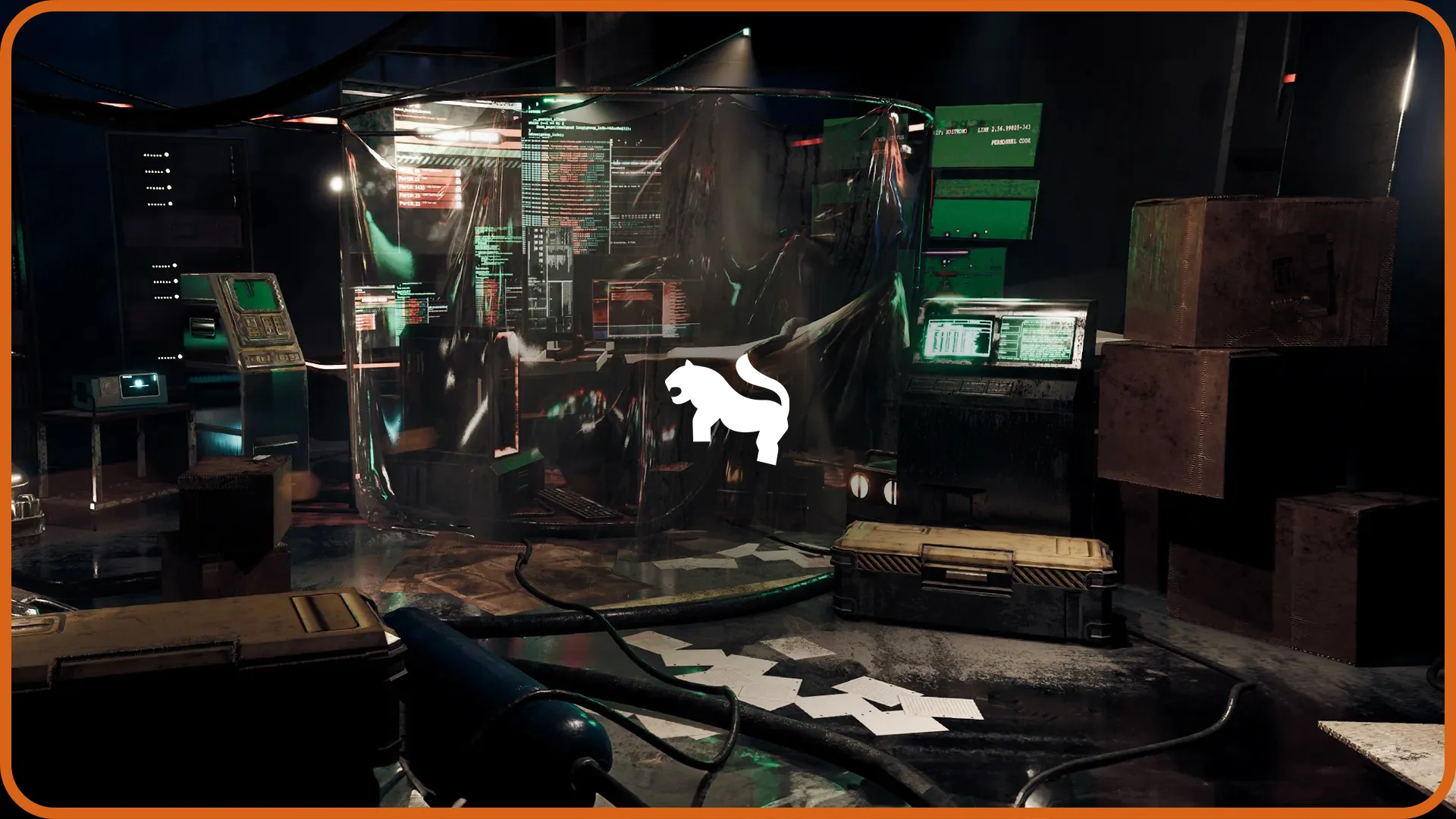
A modular laboratory kit with interior, exterior, and research center props, including furniture, pipes, devices, and a demonstration map.
Building a believable research facility usually means solving several scene problems at once: the shell of the location, the rooms inside it, and the smaller props that make the space read as a functioning workplace. Laboratory - Research Center addresses that need as a laboratory kit that combines modular interior pieces, exterior parts, and supporting props for research center scenes.
Rather than focusing on a single corner of the environment, the kit covers the larger structure and the practical items that fill it out. Furniture, chairs, pipes, and devices are all part of the package, giving it a clear place in environment production where a team needs to move from empty space to a recognizable laboratory setting without treating architecture and props as separate tasks.
Setting up a research center with modular interior and exterior parts
The strongest production role of this kit is in scene assembly. Its modular approach to interior and exterior construction makes it suited to building a research center as a connected environment instead of a one-off room.
That matters in day-to-day workflow because laboratory scenes often need more than a hero shot. A research center may include corridors, work rooms, support spaces, and outer structural elements that all need to feel related. With modular interior and exterior elements in the same package, the environment can be assembled as a consistent location. The resource name points directly to that goal: this is not just a collection of science props, but a kit for forming a laboratory setting that reads as a complete research center.
The modular angle also places it naturally in level building. One of its tags is level, which aligns with the way this kind of content is typically used: not as a standalone object, but as a set of repeatable environment pieces that help establish a larger playable or explorable space. The inclusion of both interior and exterior content gives teams room to carry the same visual language from outside the building into the operational areas within it.
Furniture, chairs, pipes, and devices that make the laboratory readable
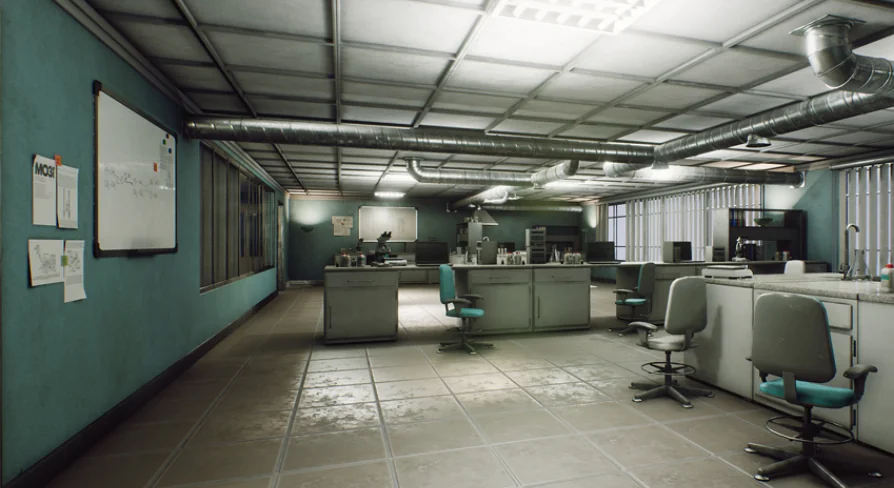
A laboratory environment depends on more than walls and floors. It needs the everyday objects and structural details that signal purpose, occupancy, and use. This kit includes props such as furniture, chairs, pipes, and devices for a research center, which makes it useful for turning a modular shell into a location with clear function.
Furniture and chairs help establish the office and workplace side of the setting. The tags include office and interior, which broadens the scene identity beyond sterile science imagery alone. A research center often has areas that feel administrative or operational as well as experimental, and the presence of furniture-based props supports that reading. Pipes and devices push the environment back toward technical and laboratory-specific visual language. Those elements are especially important in realistic scenes because they give surfaces and rooms a purpose. A bare modular room can look unfinished; a room populated with seating, furnishings, visible pipework, and research devices immediately starts to communicate workflow, occupation, and infrastructure.
This balance of structural and smaller-scale pieces makes the kit practical for scene dressing. Instead of treating props as an afterthought, the package already includes the categories of objects most likely to shape the identity of a research facility. That helps when blocking out rooms, establishing routes through a level, and making spaces feel equipped rather than decorative.
Where Laboratory - Research Center fits in a production workflow
This resource fits best at the stage where a team needs to move from concept-level space planning into a playable or presentable environment. It offers enough range in its description to support layout, dressing, and presentation in one pass.
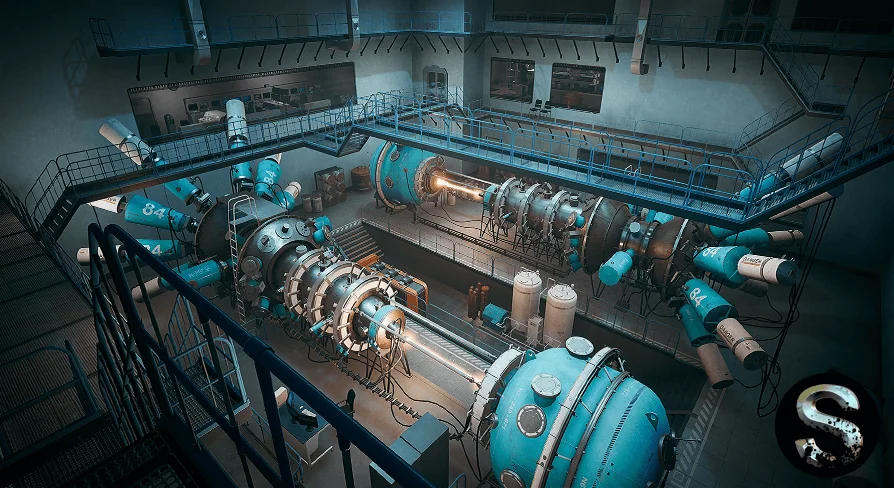
For production work, that can begin with the modular interior and exterior pieces that define the footprint of the facility. Once the core spaces are in place, props such as furniture, chairs, pipes, and devices can be used to differentiate areas and give rooms a role. A space lined with pipes and technical devices will read differently from one arranged around furniture and chairs, even when both belong to the same research center. Because the kit spans these categories, it supports a workflow where broad layout and detailed dressing stay visually connected.
The presence of a demonstration map also matters here. A demonstration map gives the package a built example of how its parts can come together in an actual environment. For teams evaluating how to stage the assets or how the pieces relate in context, that kind of included scene can shorten the gap between importing content and understanding how it behaves as a complete laboratory setup. It is not just a pile of separate components; there is already a demonstrated arrangement showing the intended environment type.
Realistic PBR laboratory scenes and current gen games budgets
The tags identify the package as PBR and realistic, placing it in a visual style focused on believable material response and grounded environment work. For a laboratory setting, that style choice is especially relevant because these spaces rely on clean surfaces, functional furnishings, technical devices, and visible infrastructure to feel convincing.
The package is also stated to have assets created to correspond to current gen games budgets. In production terms, that points to a balance between scene detail and game-ready resource planning. The wording does not frame the kit as an abstract visualization set or a purely cinematic collection. It is positioned around the needs of contemporary game environments, where a laboratory area has to look dense enough to feel authentic while still fitting the broader demands of a playable project. For environment artists and level builders, that makes the kit easier to place within a game pipeline focused on realistic spaces.
The realistic and modular tags work well together. Realism in environment art often depends on repetition handled carefully: repeating wall systems, recurring furniture families, and infrastructure like pipes that unify multiple rooms. A modular kit supports that pattern naturally, while the realistic PBR direction helps the repeated elements still feel like parts of one believable facility rather than abstract building blocks.
Using the demonstration map as a starting point
Included demonstration content can be more useful than it first appears, especially in environment production. The demonstration map here gives a ready example of the laboratory kit in context.
That makes it a practical starting point for anyone trying to judge spacing, density, and scene composition in a research center setting. A map can show how modular sections, furniture, chairs, pipes, and devices relate to one another when assembled into a coherent environment. It also provides a direct way to read the intended balance between the interior, exterior, and prop sides of the package. For teams building realistic laboratory scenes, that kind of example helps place the kit quickly within a production: as a foundation for a research facility level, a base for an interior-heavy environment, or a reference scene for extending a larger technical complex.
The package sits most naturally in projects that need a realistic laboratory or office-adjacent research space assembled from modular parts, then dressed with matching props. Its strength is not in a single hero object but in giving a production a connected environment vocabulary for research center scenes.
 Interior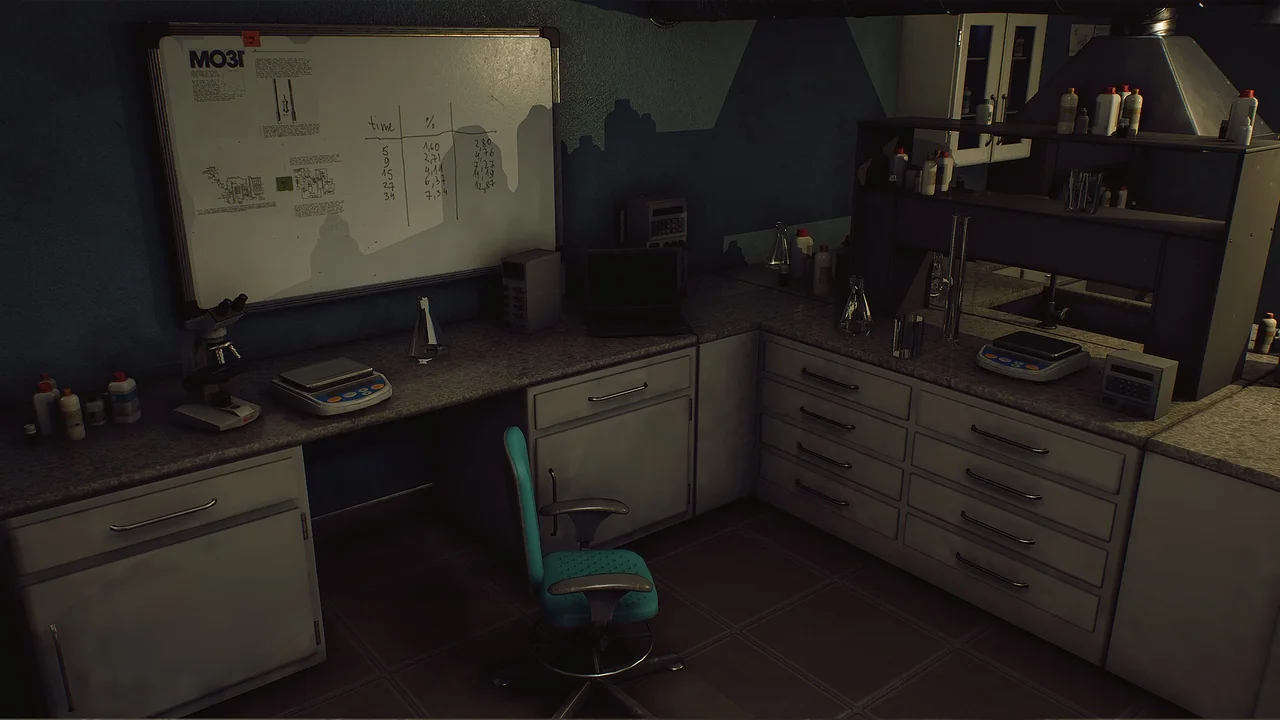
 Interior
 Interior
 Cyberpunk