"7ad89cffa44984cf"{"id":"1002520","slug":"demon-lord","title":"Demon Lord","category":"Characters \u0026 Creatures","engine":"4.26+,5.0+","assetVersion":"","engineVersion":"Engine Version: 4.26+,5.0+","tag":"Characters","accent":"blue","visual":"character","summary":"Explore the Demon Lord asset featuring 23.55K triangles, a 90-bone rig, 24 animations, PBR and legacy shaders, and 5 discrete material setups.","platform":"Unreal Engine","indexPolicy":"index","publishedAt":"2026-11-13T09:05:10.701Z","updatedAt":"2026-11-13T09:05:10.701Z","sourceNotes":[],"fileContents":[],"compatibility":["Unreal Engine","Engine Version: 4.26+,5.0+"],"featuredImage":{"alt":"Demon Lord","src":"/wp-content/uploads/published/2026/11/1b3213e9707b-f3b45aad-eca3-4252-835c-ba071100ca8e-70d5c66a37.webp"},"hasDownloadLink":true,"downloads":0,"terms":[{"taxonomy":"category","slug":"characters-and-creatures","name":"Characters \u0026 Creatures"}],"galleryImages":[{"src":"/wp-content/uploads/published/2026/11/355933c2d173-cd6e97e3-0cf6-46df-bec9-ffbe1f0d8770-299017b68d.webp","alt":"Demon Lord"},{"src":"/wp-content/uploads/published/2026/11/b4927fd29d26-5acb5a23-1bcf-4cc1-aac8-ff890fd08fcc-7409f56691.webp","alt":"Demon Lord"},{"src":"/wp-content/uploads/published/2026/11/4b4c19bc6213-2d70b15b-d10d-4354-bb5b-8d18f91e8970-794773dd3c.webp","alt":"Demon Lord"},{"src":"/wp-content/uploads/published/2026/11/c05130de258d-6a00819d-b3cc-4715-ad20-5aa7c5db4026-0e298f5322.webp","alt":"Demon Lord"},{"src":"/wp-content/uploads/published/2026/11/0c17a8dc0ce0-003d97e3-b76a-4c1c-95a7-418d8f122809-1e1d2b3e73.webp","alt":"Demon Lord"}],"accessPanel":{"kind":"resource","title":"Get this resource","eyebrow":"Free resource","message":"Download this resource in your browser.","fileName":"Content.7z","safetyNote":"Resources are manually reviewed before listing to improve quality and reduce obvious risks.","actionLabel":"Get this resource","resourceType":"Resource archive","versions":[]},"contentHtml":"\u003ch2\u003eRigging Structure and Skeletal Setup for the Demon Lord\u003c/h2\u003e\u003cp\u003eIntegrating a complex creature into an interactive pipeline begins with understanding its skeletal framework. The Demon Lord is constructed around a 90-bone hierarchy, providing the structural articulation required for an underworld fire demon. In real-time production, a 90-bone skeleton allows sufficient resolution for non-human anatomy, distributing control points across standard humanoid segments as well as auxiliary limbs, appendages, and articulated gear.\u003c/p\u003e\u003cp\u003eBecause the creature features distinct anatomical elements such as large wings, the extended bone count accommodates multi-joint wing spans without causing unnatural skin stretching. Independent joint chains allow wings to fold, flare, beat, and react to physical forces in world space. The 90-bone limit balances kinematic complexity against runtime CPU evaluation costs, remaining efficient for both character-driven mechanics and computational physics setups.\u003c/p\u003e\u003cp\u003eWeapons and dynamic attachments also tie directly into this bone framework. The presence of specialized equipment—namely a whip, a sword, and flame elements—relies on dedicated bone chains or socket attachments. A whip requires continuous articulation along its length to simulate fluid strikes and curling motions, which benefits from the allocated bone count. By managing these components inside a single 90-bone rig, secondary props deform cleanly alongside character locomotion without requiring disparate skeletal roots.\u003c/p\u003e\u003ch2\u003eImplementing the 24 Motion Sets and Animationblueprint\u003c/h2\u003e\u003cp\u003eDeploying the character into an engine environment takes advantage of its 24 included animations, working in tandem with the Animationblueprint and scripting tags. Having 24 discrete motion cycles allows developers to construct comprehensive state machines that address locomotion, idle variants, offensive actions, and combat transitions straight out of the box.\u003c/p\u003e\u003cp\u003eWith weapon assignments split between a sword and a whip, the animation roster supports diverse attack radii and dynamic combat styles. Blending between standard stance work and weapon swings is governed through the Animationblueprint, which handles logic for transitions, speed variables, directional movement, and hit reactions. The inclusion of scripting tags reflects ready integration into procedural behaviors, where code-driven directives trigger specific clips based on player proximity, combat encounters, or scripted cinematic sequences.\u003c/p\u003e\u003cp\u003eIn fantasy and horror genres, timing and weight define how imposing an underworld monster feels to the player. The motion data coordinates broad physical movement across the main torso while driving secondary motion in the wings and weapon sets. Organizing these 24 animations within an established animation graph ensures seamless blending between ground locomotion, mid-action swings, and idle posturing without jarring positional pops or misaligned root trajectories.\u003c/p\u003e\u003ch2\u003eMaterial Separation Across the Demon Lord Model\u003c/h2\u003e\u003cp\u003eSurface construction on the Demon Lord model is organized into five targeted materials: main body, wings, whip, sword, and flames. Isolating the character into five distinct material draws serves specific visual and technical functions in real-time engines, giving developers granular control over rendering parameters and surface response.\u003c/p\u003e\u003cp\u003eSplitting the main body from the wings allows the fleshy, muscular demon anatomy to be shaded independently from thin, membranous wing surfaces. Wings often require two-sided rendering or distinct transmission values to catch backlighting, which can be applied directly to the wing material without forcing unnecessary rendering overhead onto the main torso. Similarly, separating the whip and sword ensures that hard-surface weapons and flexible tools possess dedicated shader logic, isolating metallic surfaces, blood masks, or sharpness properties from organic flesh.\u003c/p\u003e\u003cp\u003eThe dedicated flames material provides an isolated pipeline for dynamic rendering. Fire elements generally require additive blending, scrolling UV coordinates, or emissive boosts to stand out against environmental lighting. By treating flames as their own material draw, artists can adjust glow intensity and translucency settings without modifying the baseline diffuse and roughness attributes of the demon's skin. The asset supports texture resolutions reaching up to 4096\u0026times;4096, providing dense texel detail across large monitor outputs or high-fidelity camera angles.\u003c/p\u003e\u003ch2\u003ePBR and Legacy Shader Pipeline Options\u003c/h2\u003e\u003cp\u003eRendering compatibility covers two distinct workflows: Physically Based Rendering (PBR) and legacy shader setups. This dual-pipeline support expands the technical envelope where the character can be deployed, accommodating both modern deferred rendering engines and legacy forward rendering pipelines.\u003c/p\u003e\u003cp\u003eWhen working within a PBR context, the 4096\u0026times;4096 textures handle light response using standardized mathematical approximations for roughness, metallicity, and surface albedo. This setup ensures that the horns, leathery skin, obsidian-like weaponry, and ember-infused surfaces react accurately to dynamic environmental point lights, directional daylight, and reflections. The high-resolution maps preserve organic micro-details, skin folds, and weapon wear even when the camera is positioned tightly against the mesh.\u003c/p\u003e\u003cp\u003eFor projects running on older engines, mobile architectures, or stylized forward passes, the legacy shader compatibility allows the model to function without requiring manual map conversion. Legacy shaders typically rely on direct specular-glossiness calculations and baked ambient parameters, allowing developers to maintain consistent visual readability across hardware configurations that do not support complex PBR illumination formulas. Having both approaches ready minimizes asset preparation time when porting between varying target platforms.\u003c/p\u003e\u003ch2\u003eLowpoly Geometry Budget and Scene Integration\u003c/h2\u003e\u003cp\u003eThe mesh geometry totals 23.55 K triangles (23,550 tris), categorizing the model within a lowpoly budget while retaining the volumetric mass of a realistic horror adversary. In modern production standards, roughly 24,000 triangles represent an optimized sweet spot for central enemy characters, mini-bosses, or summonable entities that demand high visual fidelity without overloading the geometric pipeline.\u003c/p\u003e\u003cp\u003eThis polygonal distribution is focused where silhouette definition matters most: the horn curves, facial contours, joint bends, and weapon edges. Efficient topology across these 23.55 K tris prevents mesh collapse during intense deformation, particularly along the 90-bone articulation points such as the shoulders, knees, and wing joints. Managing polygon flow around animated zones ensures smooth deformation without relying on extreme geometric density.\u003c/p\u003e\u003cp\u003eThe character is tagged under lowpoly, fantasy, realistic, and horror, reflecting its visual styling as an aggressive underworld creature. Additionally, notes link compatibility considerations to the Farm Animals Pack, ensuring clean operational coexistence within shared system setups. Whether deployed as a towering antagonist or a scripted dungeon encounter, the balanced 23.55 K triangle count, 5-material architecture, 90-bone skeletal rig, and 24-clip motion library provide a production-ready baseline for real-time fantasy projects.\u003c/p\u003e\n\n\u003ch2\u003eMore From The Same Workflow\u003c/h2\u003e\n\u003cul\u003e\n\u003cli\u003e\u003ca href=\"https://3dcghub.com/sci-fi-armor-7/\" rel=\"noopener noreferrer\"\u003eSci-Fi Armor 7\u003c/a\u003e\u003c/li\u003e\n\u003cli\u003e\u003ca href=\"https://3dcghub.com/demon-commander/\" rel=\"noopener noreferrer\"\u003eDemon Commander\u003c/a\u003e\u003c/li\u003e\n\u003cli\u003e\u003ca href=\"https://3dcghub.com/young-imp/\" rel=\"noopener noreferrer\"\u003eYoung Imp\u003c/a\u003e\u003c/li\u003e\n\u003cli\u003e\u003ca href=\"https://3dcghub.com/yokai/\" rel=\"noopener noreferrer\"\u003eYokai\u003c/a\u003e\u003c/li\u003e\n\u003cli\u003e\u003ca href=\"https://3dcghub.com/otherside-beast/\" rel=\"noopener noreferrer\"\u003eOtherside beast\u003c/a\u003e\u003c/li\u003e\n\u003c/ul\u003e","contentTextLength":7442,"navigation":{"current":57,"total":4499,"previous":{"id":"1002521","slug":"demonkiller","title":"DemonKiller","category":"Creatures \u0026 Monsters","platform":"Unreal Engine","updatedAt":"2026-11-13T09:06:10.171Z"},"next":{"id":"1002519","slug":"cyberpunk-character","title":"Cyberpunk Character","category":"Characters \u0026 Creatures","platform":"Unreal Engine","updatedAt":"2026-11-13T09:04:25.591Z"}},"relatedResources":[{"id":"1002535","slug":"high-demon","title":"High Demon","category":"Characters \u0026 Creatures","engine":"4.26+,5.0+","assetVersion":"","engineVersion":"Engine Version: 4.26+,5.0+","tag":"Characters","accent":"blue","visual":"character","summary":"Examine the High Demon asset featuring 32 animations, 5 4K texture sets, PBR materials, and an Epic Skeleton rig for fantasy and boss encounters.","platform":"Unreal Engine","indexPolicy":"index","publishedAt":"2026-11-13T09:38:20.796Z","updatedAt":"2026-11-13T09:38:20.796Z","sourceNotes":[],"fileContents":[],"compatibility":["Unreal Engine","Engine Version: 4.26+,5.0+"],"featuredImage":{"alt":"High Demon","src":"/wp-content/uploads/published/2026/11/755143acd082-002fa004-35f1-42de-8aac-41d73ed4f018-bce721a997.webp"},"hasDownloadLink":true,"downloads":0},{"id":"1002462","slug":"sci-fi-armor-7","title":"Sci-Fi Armor 7","category":"Characters \u0026 Creatures","engine":"4.23+,5.0+","assetVersion":"","engineVersion":"Engine Version: 4.23+,5.0+","tag":"Characters","accent":"blue","visual":"character","summary":"Explore Sci-Fi Armor 7 featuring an Epic Skeleton rig, 7 PBR texture sets, custom color materials, 23,748 triangles, and Demon 2 compatibility.","platform":"Unreal Engine","indexPolicy":"index","publishedAt":"2026-11-11T08:49:35.570Z","updatedAt":"2026-11-11T08:49:35.570Z","sourceNotes":[],"fileContents":[],"compatibility":["Unreal Engine","Engine Version: 4.23+,5.0+"],"featuredImage":{"alt":"Sci-Fi Armor 7","src":"/wp-content/uploads/published/2026/11/f884fd84f883-1691686d-8568-43a7-a8eb-a0e3d00ecbaa-9a3e3b2c04.webp"},"hasDownloadLink":true,"downloads":0},{"id":"1002297","slug":"demon-commander","title":"Demon Commander","category":"Characters \u0026 Creatures","engine":"4.18+,5.0+","assetVersion":"","engineVersion":"Engine Version: 4.18+,5.0+","tag":"Characters","accent":"blue","visual":"character","summary":"Demon Commander is a winged demon character with 4K PBR metal/roughness maps, 24,210 tris and a UE4 skeleton — what to weigh before it enters a dark scene.","platform":"Unreal Engine","indexPolicy":"index","publishedAt":"2026-11-05T10:00:00.681Z","updatedAt":"2026-11-05T10:00:00.681Z","sourceNotes":[],"fileContents":[],"compatibility":["Unreal Engine","Engine Version: 4.18+,5.0+"],"featuredImage":{"alt":"Demon Commander","src":"/wp-content/uploads/published/2026/11/498a33f84402-eb30450a-c6ca-42b9-bbfa-32789be6b606-1a61cec5a6.webp"},"hasDownloadLink":true,"downloads":0}]}
Characters
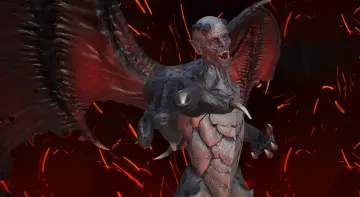
Demon Lord
Explore the Demon Lord asset featuring 23.55K triangles, a 90-bone rig, 24 animations, PBR and legacy shaders, and 5 discrete material setups.
Rigging Structure and Skeletal Setup for the Demon Lord
Integrating a complex creature into an interactive pipeline begins with understanding its skeletal framework. The Demon Lord is constructed around a 90-bone hierarchy, providing the structural articulation required for an underworld fire demon. In real-time production, a 90-bone skeleton allows sufficient resolution for non-human anatomy, distributing control points across standard humanoid segments as well as auxiliary limbs, appendages, and articulated gear.
Because the creature features distinct anatomical elements such as large wings, the extended bone count accommodates multi-joint wing spans without causing unnatural skin stretching. Independent joint chains allow wings to fold, flare, beat, and react to physical forces in world space. The 90-bone limit balances kinematic complexity against runtime CPU evaluation costs, remaining efficient for both character-driven mechanics and computational physics setups.
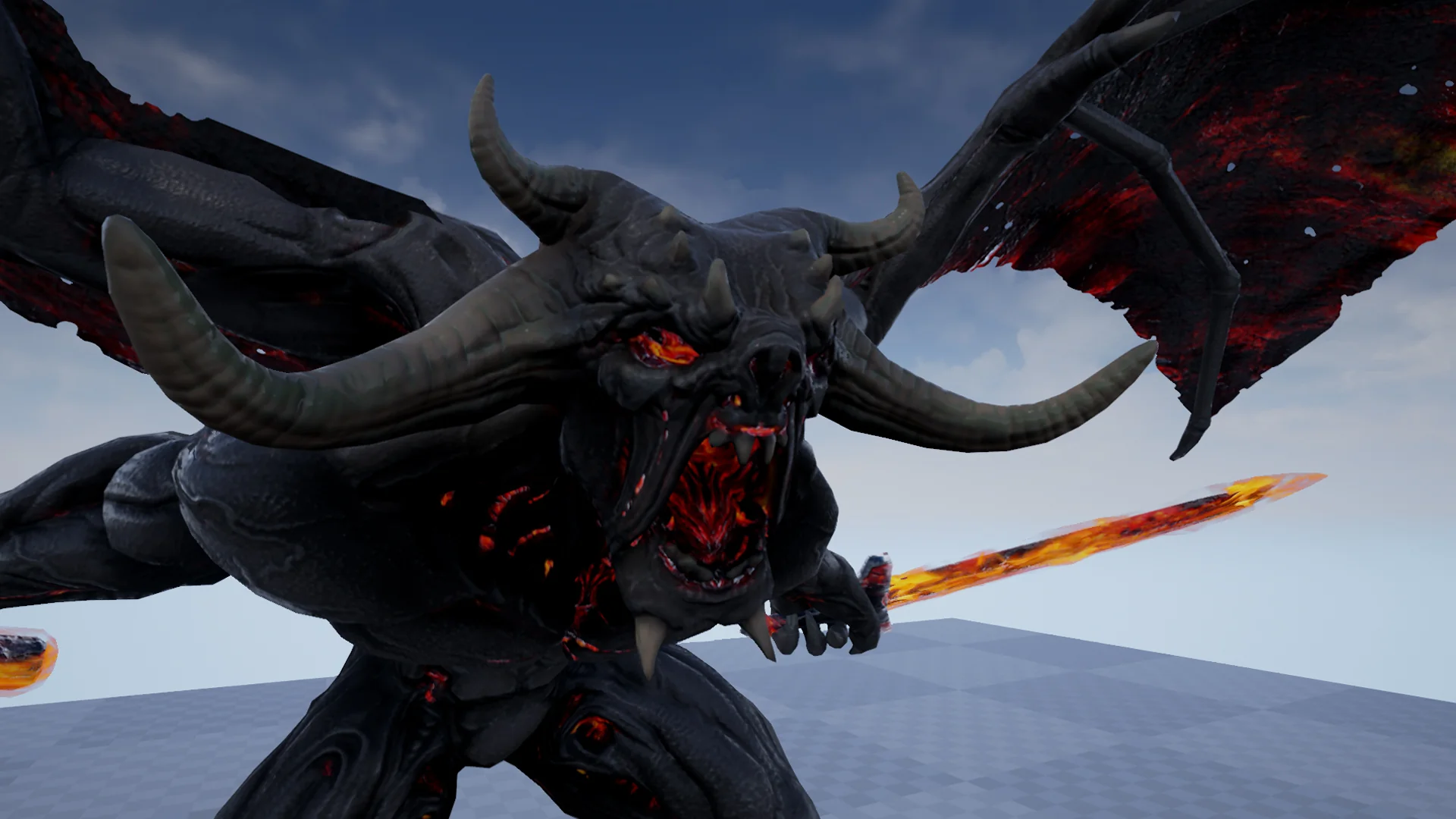
Weapons and dynamic attachments also tie directly into this bone framework. The presence of specialized equipment—namely a whip, a sword, and flame elements—relies on dedicated bone chains or socket attachments. A whip requires continuous articulation along its length to simulate fluid strikes and curling motions, which benefits from the allocated bone count. By managing these components inside a single 90-bone rig, secondary props deform cleanly alongside character locomotion without requiring disparate skeletal roots.
Implementing the 24 Motion Sets and Animationblueprint
Deploying the character into an engine environment takes advantage of its 24 included animations, working in tandem with the Animationblueprint and scripting tags. Having 24 discrete motion cycles allows developers to construct comprehensive state machines that address locomotion, idle variants, offensive actions, and combat transitions straight out of the box.
With weapon assignments split between a sword and a whip, the animation roster supports diverse attack radii and dynamic combat styles. Blending between standard stance work and weapon swings is governed through the Animationblueprint, which handles logic for transitions, speed variables, directional movement, and hit reactions. The inclusion of scripting tags reflects ready integration into procedural behaviors, where code-driven directives trigger specific clips based on player proximity, combat encounters, or scripted cinematic sequences.
In fantasy and horror genres, timing and weight define how imposing an underworld monster feels to the player. The motion data coordinates broad physical movement across the main torso while driving secondary motion in the wings and weapon sets. Organizing these 24 animations within an established animation graph ensures seamless blending between ground locomotion, mid-action swings, and idle posturing without jarring positional pops or misaligned root trajectories.
Material Separation Across the Demon Lord Model
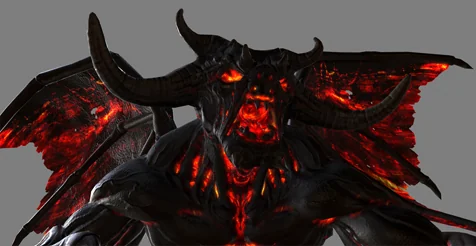
Surface construction on the Demon Lord model is organized into five targeted materials: main body, wings, whip, sword, and flames. Isolating the character into five distinct material draws serves specific visual and technical functions in real-time engines, giving developers granular control over rendering parameters and surface response.
Splitting the main body from the wings allows the fleshy, muscular demon anatomy to be shaded independently from thin, membranous wing surfaces. Wings often require two-sided rendering or distinct transmission values to catch backlighting, which can be applied directly to the wing material without forcing unnecessary rendering overhead onto the main torso. Similarly, separating the whip and sword ensures that hard-surface weapons and flexible tools possess dedicated shader logic, isolating metallic surfaces, blood masks, or sharpness properties from organic flesh.
The dedicated flames material provides an isolated pipeline for dynamic rendering. Fire elements generally require additive blending, scrolling UV coordinates, or emissive boosts to stand out against environmental lighting. By treating flames as their own material draw, artists can adjust glow intensity and translucency settings without modifying the baseline diffuse and roughness attributes of the demon's skin. The asset supports texture resolutions reaching up to 4096×4096, providing dense texel detail across large monitor outputs or high-fidelity camera angles.
PBR and Legacy Shader Pipeline Options
Rendering compatibility covers two distinct workflows: Physically Based Rendering (PBR) and legacy shader setups. This dual-pipeline support expands the technical envelope where the character can be deployed, accommodating both modern deferred rendering engines and legacy forward rendering pipelines.
When working within a PBR context, the 4096×4096 textures handle light response using standardized mathematical approximations for roughness, metallicity, and surface albedo. This setup ensures that the horns, leathery skin, obsidian-like weaponry, and ember-infused surfaces react accurately to dynamic environmental point lights, directional daylight, and reflections. The high-resolution maps preserve organic micro-details, skin folds, and weapon wear even when the camera is positioned tightly against the mesh.
For projects running on older engines, mobile architectures, or stylized forward passes, the legacy shader compatibility allows the model to function without requiring manual map conversion. Legacy shaders typically rely on direct specular-glossiness calculations and baked ambient parameters, allowing developers to maintain consistent visual readability across hardware configurations that do not support complex PBR illumination formulas. Having both approaches ready minimizes asset preparation time when porting between varying target platforms.
Lowpoly Geometry Budget and Scene Integration
The mesh geometry totals 23.55 K triangles (23,550 tris), categorizing the model within a lowpoly budget while retaining the volumetric mass of a realistic horror adversary. In modern production standards, roughly 24,000 triangles represent an optimized sweet spot for central enemy characters, mini-bosses, or summonable entities that demand high visual fidelity without overloading the geometric pipeline.
This polygonal distribution is focused where silhouette definition matters most: the horn curves, facial contours, joint bends, and weapon edges. Efficient topology across these 23.55 K tris prevents mesh collapse during intense deformation, particularly along the 90-bone articulation points such as the shoulders, knees, and wing joints. Managing polygon flow around animated zones ensures smooth deformation without relying on extreme geometric density.
The character is tagged under lowpoly, fantasy, realistic, and horror, reflecting its visual styling as an aggressive underworld creature. Additionally, notes link compatibility considerations to the Farm Animals Pack, ensuring clean operational coexistence within shared system setups. Whether deployed as a towering antagonist or a scripted dungeon encounter, the balanced 23.55 K triangle count, 5-material architecture, 90-bone skeletal rig, and 24-clip motion library provide a production-ready baseline for real-time fantasy projects.
 Characters
 Characters
 Characters
 Characters