"ca3dbdfe6ba54099"{"id":"1002297","slug":"demon-commander","title":"Demon Commander","category":"Characters \u0026 Creatures","engine":"4.18+,5.0+","assetVersion":"","engineVersion":"Engine Version: 4.18+,5.0+","tag":"Characters","accent":"blue","visual":"character","summary":"Demon Commander is a winged demon character with 4K PBR metal/roughness maps, 24,210 tris and a UE4 skeleton — what to weigh before it enters a dark scene.","platform":"Unreal Engine","indexPolicy":"index","publishedAt":"2026-11-05T10:00:00.681Z","updatedAt":"2026-11-05T10:00:00.681Z","sourceNotes":[],"fileContents":[],"compatibility":["Unreal Engine","Engine Version: 4.18+,5.0+"],"featuredImage":{"alt":"Demon Commander","src":"/wp-content/uploads/published/2026/11/498a33f84402-eb30450a-c6ca-42b9-bbfa-32789be6b606-1a61cec5a6.webp"},"hasDownloadLink":true,"downloads":0,"terms":[{"taxonomy":"category","slug":"characters-and-creatures","name":"Characters \u0026 Creatures"}],"galleryImages":[{"src":"/wp-content/uploads/published/2026/11/2dba4b551de1-b9d07557-de4c-41f2-9e9e-209cad379c51-43a59fbbf5.webp","alt":"Demon Commander"},{"src":"/wp-content/uploads/published/2026/11/493805baabe0-0dd79105-04be-415d-9f9d-8292eeeee69a-c0dbb9aceb.webp","alt":"Demon Commander"},{"src":"/wp-content/uploads/published/2026/11/48ad08bc232c-68dc4bad-d8b4-46bc-acb6-2c9da5662c94-164d8f137b.webp","alt":"Demon Commander"},{"src":"/wp-content/uploads/published/2026/11/fff641d2382e-5c82587e-fa4f-469b-8441-ac8ebd024271-0b6d9859fa.webp","alt":"Demon Commander"},{"src":"/wp-content/uploads/published/2026/11/f9b99bacf789-d8b37d8e-3c78-4bbe-b93f-47db73c5c6c2-28cd857456.webp","alt":"Demon Commander"},{"src":"/wp-content/uploads/published/2026/11/216c24e396f5-c0a27eda-bd66-44be-b1a8-94ef7d85b376-47786ecffc.webp","alt":"Demon Commander"},{"src":"/wp-content/uploads/published/2026/11/e23c734f11f8-4f641697-d51a-4d84-9324-a88c05f91e33-d84029d35e.webp","alt":"Demon Commander"},{"src":"/wp-content/uploads/published/2026/11/f129de2a46a2-92e06928-48fc-4103-ad80-b93b993f89fb-bec6ac2090.webp","alt":"Demon Commander"}],"accessPanel":{"kind":"resource","title":"Download this resource","eyebrow":"Free Download","message":"Log in or create a free account to start your download.","fileName":"Content.7z","safetyNote":"Resources are manually reviewed before listing to improve quality and reduce obvious risks.","actionLabel":"Download Free","resourceType":"Resource archive"},"contentHtml":"\u003ch2\u003eScenes that want a winged demon standing in the middle of them\u003c/h2\u003e\n\u003cp\u003eA boss arena, a corrupted cathedral interior, the last chamber of a dungeon run. These are the rooms where a character has to hold a silhouette from across the space and still read as a threat up close. Demon Commander is built for that slot — a demonic, monstrous figure that the tag list files under beast, mutant, undead, reaper and monster, with wings and a dark, horror-leaning tone running through it.\u003c/p\u003e\n\u003cp\u003eIt is a character rather than a set dressing piece. The tags also carry character, script and animation blueprint, which places the asset on the gameplay side of a project instead of in the background decoration layer.\u003c/p\u003e \u003ch2\u003eThe tag cloud reads almost like a scene brief\u003c/h2\u003e\n\u003cp\u003eBeast, demon, mutant, undead, reaper, monster, wing, dark, horror, fantasy, death, realistic, lowpoly. Read together, that is a fairly specific brief: something dead or death-adjacent, something that was once alive and is now bigger than it was, and something with wings that changes its footprint in a frame compared to a humanoid. A winged silhouette occupies vertical space, which matters when you are staging a confrontation and need the camera to feel crowded.\u003c/p\u003e\n\u003cp\u003eThe remaining tags — pbr, character, script, animation blueprint — say less about mood and more about how the asset behaves once it is loaded. Animation blueprint and script are integration signals. This is not a static mesh waiting for a turntable render.\u003c/p\u003e \u003ch2\u003e14,520 vertices and 24,210 triangles\u003c/h2\u003e\n\u003cp\u003eThose are the numbers to plan against. The vertex count lands at 14,520 and the triangle count at 24,210, which is the figure that actually affects your lighting and shadow budget once the character is instanced into a scene. The tag list calls it lowpoly, and both figures coexist with that label — the practical move is to treat 24,210 tris as the real cost per instance and decide how many Demon Commanders a scene can carry before you start blocking out the encounter.\u003c/p\u003e\n\u003cp\u003eWings complicate that calculation in ways a torso does not. They project outward and upward, catch rim light, and throw shadows over a wider area than the rest of the body. If the scene places several of these creatures, the wings are what will define the shadow footprint, not the mesh density of the chest.\u003c/p\u003e \u003ch2\u003eThree materials, eight maps, 4K metal/roughness\u003c/h2\u003e\n\u003cp\u003eThe texture set follows a PBR metal/roughness workflow at 4K, delivered as eight texture maps across three materials. The maps named cover normal, metallic/roughness, base color and ambient occlusion. Splitting the character into three materials means the surface treatment is broken into parts rather than handled as one continuous shell, which is worth knowing when you are deciding whether to swap a material instance for a variant of the creature or keep the original setup intact.\u003c/p\u003e\n\u003cp\u003eBecause the maps are authored at 4K, close-up framing is viable — a hero shot of the face, a slow camera push during a confrontation. The trade is texture memory, so a scene that spawns many instances may want to reconsider how the full-resolution set is applied at distance.\u003c/p\u003e \u003ch2\u003eThe two-sided shader note is part of setup, not a footnote\u003c/h2\u003e\n\u003cp\u003eOne instruction sits apart from the rest of the technical detail: the model is meant to be displayed with a shader that renders polygons from both sides. That is a material and shader setting rather than a texture, and it belongs on the checklist before any look development begins. Get it wrong and the surfaces facing away from the camera will not draw the way the model intends.\u003c/p\u003e\n\u003cp\u003eIt is the kind of detail that costs five minutes at the start of a project and a confusing afternoon if it is discovered later, after lighting has already been tuned around a shader that culls back faces. Set it first, then build the rest.\u003c/p\u003e \u003ch2\u003eA UE4 skeleton, and what that means inside UE5\u003c/h2\u003e\n\u003cp\u003eThe rig comes from UE4. Anyone working in UE5 gets a direct heads-up on that point rather than a promise of native behaviour in the newer engine. Treat the skeleton's origin as something to resolve early — before animation work is scheduled, before an animation blueprint is wired up, and before the character is dropped into a test level and assumed to be ready.\u003c/p\u003e\n\u003cp\u003eThat single sentence is the most consequential line in the whole description for a UE5 team, and it is easy to skim past because it arrives first, before the texture and geometry figures that people usually scan for.\u003c/p\u003e \u003ch2\u003eSitting alongside Demoness Girl Pack 2\u003c/h2\u003e\n\u003cp\u003eDemon Commander is compatible with Demoness Girl Pack 2. If that pack is already part of a project, the compatibility is worth checking against your existing setup rather than assuming two separately sourced characters will sit together without attention. A project running both has a reason to verify how they line up before committing scene time to either.\u003c/p\u003e \u003ch2\u003eWho gets the most out of it\u003c/h2\u003e\n\u003cp\u003eTeams building dark fantasy or horror encounters need a creature that carries a scene on presence alone — wings, mass, a death-and-undead theme — and can be animated rather than posed. The animation blueprint and script tags, combined with a real skeleton and a full PBR texture set, point at that production need specifically.\u003c/p\u003e\n\u003cp\u003eAnyone on UE5 should plan the skeleton question into the schedule from day one. Anyone on UE4 has a shorter path. Either way, three setup items decide how smoothly the character lands: the two-sided shader, the 4K material split, and the rig origin. Handle those and the rest of the scene work can proceed on the assumption that the demon will behave the way it looks.\u003c/p\u003e\n\n\u003ch2\u003eContinue Browsing Similar Packs\u003c/h2\u003e\n\u003cul\u003e\n\u003cli\u003e\u003ca href=\"https://3dcghub.com/young-imp/\" rel=\"noopener noreferrer\"\u003eYoung Imp\u003c/a\u003e\u003c/li\u003e\n\u003cli\u003e\u003ca href=\"https://3dcghub.com/yokai/\" rel=\"noopener noreferrer\"\u003eYokai\u003c/a\u003e\u003c/li\u003e\n\u003cli\u003e\u003ca href=\"https://3dcghub.com/demon-10/\" rel=\"noopener noreferrer\"\u003eDemon 10\u003c/a\u003e\u003c/li\u003e\n\u003cli\u003e\u003ca href=\"https://3dcghub.com/otherside-beast/\" rel=\"noopener noreferrer\"\u003eOtherside beast\u003c/a\u003e\u003c/li\u003e\n\u003cli\u003e\u003ca href=\"https://3dcghub.com/medical-worker-01/\" rel=\"noopener noreferrer\"\u003eMedical Worker 01\u003c/a\u003e\u003c/li\u003e\n\u003c/ul\u003e","contentTextLength":5610,"navigation":{"current":10,"total":4229,"previous":{"id":"1002298","slug":"dynamic-rain-overlay","title":"Dynamic Rain Overlay","category":"Variety","platform":"Unreal Engine","updatedAt":"2026-11-05T10:00:32.178Z"},"next":{"id":"1002296","slug":"rapier-anim-set-3","title":"Rapier Anim Set","category":"Game Development Resource","platform":"Unreal Engine","updatedAt":"2026-11-05T08:33:51.686Z"}},"relatedResources":[{"id":"3830","slug":"yokai","title":"Yokai","category":"Characters \u0026 Creatures","engine":"4.26,5.0+","assetVersion":"Engine version: 4.26,5.0+","engineVersion":"4.21","tag":"Characters","accent":"blue","visual":"character","summary":"Enhance your RPG or action game with this high-quality Yokai character. Featuring a modular design and stylized anime aesthetic, it is perfect for fantasy proje","platform":"Unreal Engine","indexPolicy":"index","publishedAt":"2026-02-09T09:45:03.000Z","updatedAt":"2026-04-19T15:57:33.000Z","sourceNotes":[],"fileContents":[],"compatibility":["Unreal Engine","Engine version: 4.26,5.0+"],"featuredImage":{"alt":"Yokai","src":"https://3dcghub.com/wp-content/uploads/2026/02/677ec363-f836-43a6-9505-d858b5a374a2.webp"},"hasDownloadLink":true,"downloads":0},{"id":"3842","slug":"young-imp","title":"Young Imp","category":"Characters \u0026 Creatures","engine":"4.26,5.0+","assetVersion":"Engine version: 4.26,5.0+","engineVersion":"4.18","tag":"Characters","accent":"blue","visual":"character","summary":"Enhance your fantasy or horror game with this versatile Young Imp character model. Featuring a full animation set, it is perfect for low-poly projects.","platform":"Unreal Engine","indexPolicy":"index","publishedAt":"2026-02-09T09:49:01.000Z","updatedAt":"2026-04-19T15:57:33.000Z","sourceNotes":[],"fileContents":[],"compatibility":["Unreal Engine","Engine version: 4.26,5.0+"],"featuredImage":{"alt":"Young Imp","src":"https://3dcghub.com/wp-content/uploads/2026/02/1e4995ac-c8d0-4682-8e1d-ecaf862d0205.webp"},"hasDownloadLink":true,"downloads":0},{"id":"1998","slug":"demon-10","title":"Demon 10","category":"Creatures \u0026 Monsters","engine":"4.26+,5.0+","assetVersion":"Engine version: 4.26+,5.0+","engineVersion":"4.24","tag":"Creatures","accent":"blue","visual":"character","summary":"Boost your game's horror factor with Demon 10. This 4K PBR creature features Epic Skeleton compatibility, 23 animations, and deep customization options.","platform":"Unreal Engine","indexPolicy":"index","publishedAt":"2026-02-06T22:48:18.000Z","updatedAt":"2026-04-19T15:58:26.000Z","sourceNotes":[],"fileContents":[],"compatibility":["Unreal Engine","Engine version: 4.26+,5.0+"],"featuredImage":{"alt":"Demon 10","src":"https://3dcghub.com/wp-content/uploads/2026/02/90425239-5cb2-4a90-b49b-119596e4f7e5.webp"},"hasDownloadLink":true,"downloads":1}]}
Characters
Demon Commander
Demon Commander is a winged demon character with 4K PBR metal/roughness maps, 24,210 tris and a UE4 skeleton — what to weigh before it enters a dark scene.
Scenes that want a winged demon standing in the middle of them
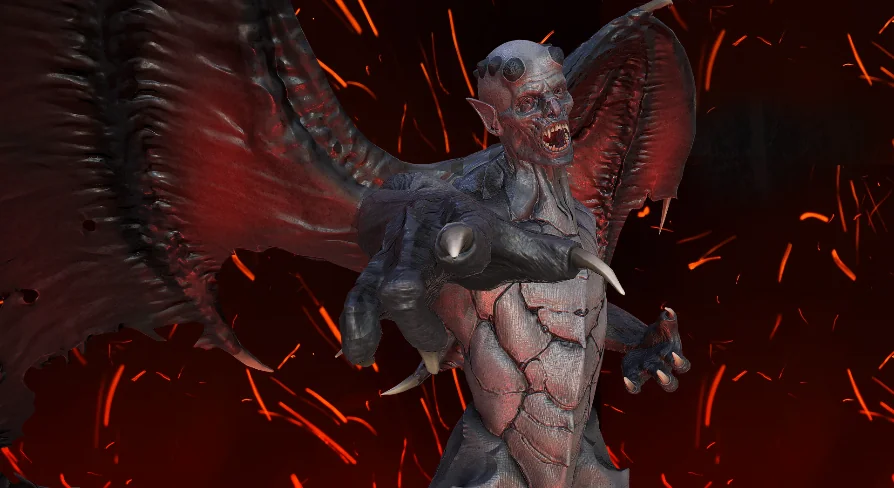
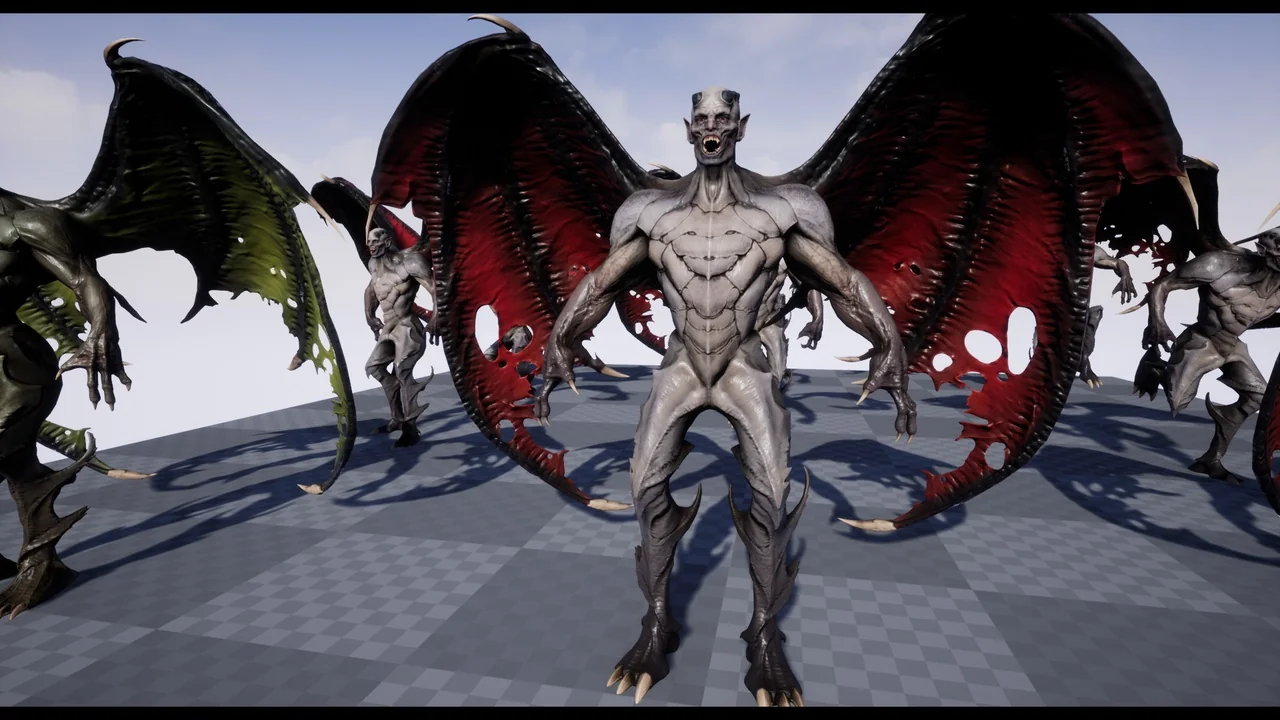
A boss arena, a corrupted cathedral interior, the last chamber of a dungeon run. These are the rooms where a character has to hold a silhouette from across the space and still read as a threat up close. Demon Commander is built for that slot — a demonic, monstrous figure that the tag list files under beast, mutant, undead, reaper and monster, with wings and a dark, horror-leaning tone running through it.
It is a character rather than a set dressing piece. The tags also carry character, script and animation blueprint, which places the asset on the gameplay side of a project instead of in the background decoration layer.
The tag cloud reads almost like a scene brief
Beast, demon, mutant, undead, reaper, monster, wing, dark, horror, fantasy, death, realistic, lowpoly. Read together, that is a fairly specific brief: something dead or death-adjacent, something that was once alive and is now bigger than it was, and something with wings that changes its footprint in a frame compared to a humanoid. A winged silhouette occupies vertical space, which matters when you are staging a confrontation and need the camera to feel crowded.
The remaining tags — pbr, character, script, animation blueprint — say less about mood and more about how the asset behaves once it is loaded. Animation blueprint and script are integration signals. This is not a static mesh waiting for a turntable render.
14,520 vertices and 24,210 triangles
Those are the numbers to plan against. The vertex count lands at 14,520 and the triangle count at 24,210, which is the figure that actually affects your lighting and shadow budget once the character is instanced into a scene. The tag list calls it lowpoly, and both figures coexist with that label — the practical move is to treat 24,210 tris as the real cost per instance and decide how many Demon Commanders a scene can carry before you start blocking out the encounter.
Wings complicate that calculation in ways a torso does not. They project outward and upward, catch rim light, and throw shadows over a wider area than the rest of the body. If the scene places several of these creatures, the wings are what will define the shadow footprint, not the mesh density of the chest.
Three materials, eight maps, 4K metal/roughness
The texture set follows a PBR metal/roughness workflow at 4K, delivered as eight texture maps across three materials. The maps named cover normal, metallic/roughness, base color and ambient occlusion. Splitting the character into three materials means the surface treatment is broken into parts rather than handled as one continuous shell, which is worth knowing when you are deciding whether to swap a material instance for a variant of the creature or keep the original setup intact.
Because the maps are authored at 4K, close-up framing is viable — a hero shot of the face, a slow camera push during a confrontation. The trade is texture memory, so a scene that spawns many instances may want to reconsider how the full-resolution set is applied at distance.
The two-sided shader note is part of setup, not a footnote
One instruction sits apart from the rest of the technical detail: the model is meant to be displayed with a shader that renders polygons from both sides. That is a material and shader setting rather than a texture, and it belongs on the checklist before any look development begins. Get it wrong and the surfaces facing away from the camera will not draw the way the model intends.
It is the kind of detail that costs five minutes at the start of a project and a confusing afternoon if it is discovered later, after lighting has already been tuned around a shader that culls back faces. Set it first, then build the rest.
A UE4 skeleton, and what that means inside UE5
The rig comes from UE4. Anyone working in UE5 gets a direct heads-up on that point rather than a promise of native behaviour in the newer engine. Treat the skeleton's origin as something to resolve early — before animation work is scheduled, before an animation blueprint is wired up, and before the character is dropped into a test level and assumed to be ready.
That single sentence is the most consequential line in the whole description for a UE5 team, and it is easy to skim past because it arrives first, before the texture and geometry figures that people usually scan for.
Sitting alongside Demoness Girl Pack 2
Demon Commander is compatible with Demoness Girl Pack 2. If that pack is already part of a project, the compatibility is worth checking against your existing setup rather than assuming two separately sourced characters will sit together without attention. A project running both has a reason to verify how they line up before committing scene time to either.
Who gets the most out of it
Teams building dark fantasy or horror encounters need a creature that carries a scene on presence alone — wings, mass, a death-and-undead theme — and can be animated rather than posed. The animation blueprint and script tags, combined with a real skeleton and a full PBR texture set, point at that production need specifically.
Anyone on UE5 should plan the skeleton question into the schedule from day one. Anyone on UE4 has a shorter path. Either way, three setup items decide how smoothly the character lands: the two-sided shader, the 4K material split, and the rig origin. Handle those and the rest of the scene work can proceed on the assumption that the demon will behave the way it looks.
 Characters
 Characters
 Characters
 Creatures