"fa182e0cd0a6ea73"{"id":"1001796","slug":"broken-and-burned-trees-pack","title":"Broken and Burned Trees Pack","category":"Trees","engine":"4.26+,5.0+","assetVersion":"","engineVersion":"Engine Version: 4.26+,5.0+","tag":"Trees","accent":"blue","visual":"mech","summary":"Explore the Broken and Burned Trees Pack for Unreal Engine, featuring Nanite opaque dead trees, PCG forests, and an automated burned zone transition system.","platform":"Unreal Engine","publishedAt":"2026-10-21T07:49:02.786Z","updatedAt":"2026-10-21T07:49:02.786Z","sourceNotes":[],"fileContents":[],"compatibility":["Unreal Engine","Engine Version: 4.26+,5.0+"],"featuredImage":{"alt":"Broken and Burned Trees Pack","src":"/wp-content/uploads/published/2026/10/7d7613e4a7f6-b05e21e1-14b0-4fc0-b0c2-22e26198bf83-f29d8d1417.webp"},"hasDownloadLink":true,"downloads":0,"terms":[{"taxonomy":"category","slug":"trees","name":"Trees"}],"galleryImages":[{"src":"/wp-content/uploads/published/2026/10/3eaf9d0677ef-c693306f-b8a7-4867-8e7e-dc72fdf5b327-20816ba4c3.webp","alt":"Broken and Burned Trees Pack"},{"src":"/wp-content/uploads/published/2026/10/d2b7a33282c8-fffa9ee5-0566-4384-8bbe-e9713c92d0f6-fd00a26c05.webp","alt":"Broken and Burned Trees Pack"},{"src":"/wp-content/uploads/published/2026/10/684991cffb3e-1e121cec-1053-40b8-99c9-4f0ef826ef77-c0e42b44cc.webp","alt":"Broken and Burned Trees Pack"},{"src":"/wp-content/uploads/published/2026/10/38ae4b753226-61287b32-e1b7-4875-af8a-b3d46c684740-d1c19c4b67.webp","alt":"Broken and Burned Trees Pack"},{"src":"/wp-content/uploads/published/2026/10/7ceca497e0f5-ee048495-d071-4d22-8f1c-7da24cd52042-c70bd2c11f.webp","alt":"Broken and Burned Trees Pack"},{"src":"/wp-content/uploads/published/2026/10/f956c95df4d5-c8766307-fc05-4876-b90d-3c856197ec41-c3dc67187f.webp","alt":"Broken and Burned Trees Pack"},{"src":"/wp-content/uploads/published/2026/10/74e3aa94edf3-0150e8b2-b313-4c3d-a539-5a787e263ed6-d17d035c95.webp","alt":"Broken and Burned Trees Pack"},{"src":"/wp-content/uploads/published/2026/10/dba1e2c5de04-012a6570-ffa1-4f1d-a910-93bfd7dd4bec-8b8ccd105f.webp","alt":"Broken and Burned Trees Pack"},{"src":"/wp-content/uploads/published/2026/10/897219c8d0b8-3585a3b6-9014-4357-90cd-5e488670a15a-424d2b172b.webp","alt":"Broken and Burned Trees Pack"},{"src":"/wp-content/uploads/published/2026/10/358e20e26aef-fa286f1c-eac5-463e-a4fa-ef6b4912251c-69ce137781.webp","alt":"Broken and Burned Trees Pack"}],"accessPanel":{"kind":"resource","title":"Download this resource","eyebrow":"Free Download","message":"Log in or create a free account to start your download.","fileName":"Content.7z","safetyNote":"Resources are manually reviewed before listing to improve quality and reduce obvious risks.","actionLabel":"Download Free","resourceType":"Resource archive"},"contentHtml":"\u003cp\u003eScattering broken, splintered, and charred timber across a landscape quickly exposes the performance compromises inherent to real-time foliage. While lush green canopies rely on layered alpha cutouts to simulate density, the jagged fractures of charred wood and rotting trunks demand clean geometric definition. The Broken and Burned Trees Pack approaches environmental disaster through a technical art perspective, recreating forest destruction caused by natural fire or human intervention while shifting modern workflows into fully opaque geometry and procedural assembly.\u003c/p\u003e \u003ch2\u003eRebuilding Fallen and Burned Trees with Nanite Geometry\u003c/h2\u003e\n\u003cp\u003eEarly iterations of the project originated in Unreal Engine 4 targeting Xbox One hardware profiles, balancing aggressive level-of-detail transitions across 16 different models of dead trees and bushes. That foundation required meticulously authored custom LOD meshes to maintain silhouette clarity against strict console budgets. With the release of Unreal Engine 5.6, the asset collection underwent a complete technical overhaul, updating the geometry to operate entirely within Nanite.\u003c/p\u003e\n\u003cp\u003eA notable technical shift in the 5.6 edition is the elimination of masked alpha cards. Every burned and fallen tree model is constructed as a fully opaque Nanite mesh. In dense scenes, alpha testing and masked card overdraw can strain GPU fill rates and complicate shadow passes. Fully opaque Nanite meshes sidestep these sorting bottlenecks, allowing hardware Lumen to evaluate geometric contact shadows and ambient occlusion directly against the photogrammetry surfaces. Bark fractures, burned gashes, and splintered cores render as dense, solid geometry rather than optical illusions achieved through transparency masks.\u003c/p\u003e \u003ch2\u003eDynamic Landscape Weightmaps and the Automatic Burning Effect\u003c/h2\u003e\n\u003cp\u003eSimulating the exact path of a wildfire or localized catastrophe typically involves either heavy texture swapping or tedious placement of specialized burned variants alongside unburned props. The pack solves this layout challenge through a semi-automated burning effect driven directly by landscape paint data.\u003c/p\u003e\n\u003cp\u003eThe workflow utilizes the terrain as the spatial reference point:\u003c/p\u003e\n\u003cul\u003e \u003cli\u003eArtists paint charred soil and ash layers across the terrain using the integrated comprehensive landscape master material.\u003c/li\u003e \u003cli\u003eThe painted layer data is exported directly from Unreal Engine as a landscape weightmap texture.\u003c/li\u003e \u003cli\u003eReimporting this texture into the project as a dedicated Burned Map feeds coordinate data back into the asset shader ecosystem.\u003c/li\u003e \u003cli\u003eAny tree or foliage asset situated within the boundary of the burned map receives an automated burning transition, blending charcoal textures and scorched bark smoothly across its surface based on world positioning.\u003c/li\u003e\n\u003c/ul\u003e\n\u003cp\u003eThis automated interaction removes the friction of hand-aligning separate clean and charred meshes along the edges of a firebreak. Environmental artists can freely move, rotate, and duplicate trunks across the terrain; the transition effect automatically recalibrates to reflect whether a tree sits in pristine ground, deep ash, or the gradient between them.\u003c/p\u003e \u003ch2\u003eProcedural Forest Assembly and Master Material Architecture\u003c/h2\u003e\n\u003cp\u003ePopulating extensive forest corridors by hand can produce repetitive clusters that fail to capture the chaotic debris fields left by windstorms, decay, or fire. The collection includes a dedicated Procedural Content Generation (PCG) template designed specifically to seed rotten logs, snapping branches, dead bushes, and burned timber at scale. This PCG framework uses algorithmic distribution logic to assemble tangled dead zones across varied topography without manual stamp placement.\u003c/p\u003e\n\u003cp\u003eSupporting these meshes is a suite of master materials made for broad environment duties rather than isolated prop rendering. The primary vegetation and tree master material includes custom wind simulation logic that functions not only for bare wood and brittle limbs, but also extends to live foliage projects. For wetland scenes, drainage basins, and stagnant marshlands, the pack incorporates an adjustable custom single layer water shader. This water material allows control over surface movement and light absorption, integrating seamlessly with rotten deadfall half-submerged in swampy basins.\u003c/p\u003e \u003ch2\u003ePhotogrammetry Refinements and Environment Compatibility\u003c/h2\u003e\n\u003cp\u003eRealistic wood rot and charred timber require micro-surface detail that procedural noise textures rarely replicate convincingly. The pack utilizes photogrammetry textures remade specifically to accentuate the porous, irregular surfaces left after heat exposure and fungal decay. Bark fissures, scorched rings, and crumbling inner wood surfaces carry calibrated roughness and normal data derived from physical references.\u003c/p\u003e\n\u003cp\u003eFor artists blending dead timber back into living woodlands, the asset set maintains visual and material compatibility with the Oak Tree Pack - White Oak Forest (Quercus Alba). This compatibility allows level designers to transition from healthy, dense white oak stands down into barren wildfire zones, clear-cuts, or natural forest die-offs without clashing art direction or disparate shader parameters.\u003c/p\u003e \u003ch2\u003eEvaluating the Production Map and Real-Time Lighting Setup\u003c/h2\u003e\n\u003cp\u003eTo demonstrate how these features interact under production conditions, the pack includes a fully assembled example environment. This demonstration level combines the procedural PCG deadwood forest, customized water bodies, dynamic burning terrain shaders, and atmospheric effects into an integrated layout.\u003c/p\u003e\n\u003cp\u003eLighting throughout the showcase map is calibrated around physically based lighting (PBL) standards, interacting with Unreal Engine's hardware Lumen to prove stability under high dynamic range conditions. By demonstrating the interaction between Nanite meshes, deep black carbonized bark shaders, and indirect light bounce, the example level offers production teams a concrete baseline for deploying large-scale environmental destruction across modern rendering pipelines.\u003c/p\u003e\n\n\u003ch2\u003eExplore Similar Assets\u003c/h2\u003e\n\u003cul\u003e\n\u003cli\u003e\u003ca href=\"https://3dcghub.com/realistic-trees-2/\" title=\"Realistic Trees 2\"\u003eRealistic Trees 2\u003c/a\u003e\u003c/li\u003e\n\u003cli\u003e\u003ca href=\"https://3dcghub.com/stylized-trees-pack-2/\" title=\"Stylized Trees Pack 2\"\u003eStylized Trees Pack 2\u003c/a\u003e\u003c/li\u003e\n\u003cli\u003e\u003ca href=\"https://3dcghub.com/tree-pack-assorted-maple-trees/\" title=\"Tree Pack (Assorted Maple Trees)\"\u003eTree Pack (Assorted Maple Trees)\u003c/a\u003e\u003c/li\u003e\n\u003cli\u003e\u003ca href=\"https://3dcghub.com/foliage-vol-3-oak-trees-nanite-and-low-poly/\" title=\"Foliage VOL.3 - Oak Trees (Nanite and Low Poly)\"\u003eFoliage VOL.3 - Oak Trees (Nanite and Low Poly)\u003c/a\u003e\u003c/li\u003e\n\u003cli\u003e\u003ca href=\"https://3dcghub.com/norway-spruce-tree-pack-picea-abies/\" title=\"Norway Spruce Tree Pack, Picea Abies\"\u003eNorway Spruce Tree Pack, Picea Abies\u003c/a\u003e\u003c/li\u003e\n\u003c/ul\u003e","contentTextLength":6156,"navigation":{"current":60,"total":3789,"previous":{"id":"1001797","slug":"city-bus","title":"City bus","category":"Service \u0026 Commercial Vehicles","platform":"Unreal Engine","updatedAt":"2026-10-21T07:49:51.255Z"},"next":{"id":"1001795","slug":"blackmoon-boss-pack-2-20-models-characters-weapons-and-items","title":"BlackMoon BOSS PACK 2 - 20+ Models Characters, Weapons and Items","category":"Characters \u0026 Creatures","platform":"Unreal Engine","updatedAt":"2026-10-21T07:47:49.216Z"}},"relatedResources":[{"id":"4255","slug":"realistic-trees-2","title":"Realistic Trees 2","category":"Trees","engine":"4.26+,5.0+","assetVersion":"Engine version: 4.26+,5.0+","engineVersion":"4.19","tag":"Trees","accent":"blue","visual":"audio","summary":"Enhance your projects with 45 realistic tree meshes. Features include 4 LODs, customizable wind systems, and seasonal variations for high-quality game worlds.","platform":"Unreal Engine","publishedAt":"2026-02-10T11:47:41.000Z","updatedAt":"2026-04-19T15:57:11.000Z","sourceNotes":[],"fileContents":[],"compatibility":["Unreal Engine","Engine version: 4.26+,5.0+"],"featuredImage":{"alt":"Realistic Trees 2","src":"https://3dcghub.com/wp-content/uploads/2026/02/8eacf7cb-8eea-490b-a096-197a3017e018.webp"},"hasDownloadLink":true,"downloads":1},{"id":"4298","slug":"stylized-trees-pack-2","title":"Stylized Trees Pack 2","category":"Trees","engine":"4.26+,5.0+","assetVersion":"Engine version: 4.26+,5.0+","engineVersion":"4.22","tag":"Trees","accent":"blue","visual":"animation","summary":"Enhance your game world with the Stylized Trees Pack 2. Featuring advanced shaders, dynamic seasons, and wind effects controlled by simple parameters.","platform":"Unreal Engine","publishedAt":"2026-02-10T11:58:07.000Z","updatedAt":"2026-04-19T15:57:10.000Z","sourceNotes":[],"fileContents":[],"compatibility":["Unreal Engine","Engine version: 4.26+,5.0+"],"featuredImage":{"alt":"Stylized Trees Pack 2","src":"https://3dcghub.com/wp-content/uploads/2026/02/4aae3670-a6e0-47b0-a8b6-cb6362a91608.webp"},"hasDownloadLink":true,"downloads":0},{"id":"4311","slug":"tree-pack-assorted-maple-trees","title":"Tree Pack (Assorted Maple Trees)","category":"Trees","engine":"4.26+,5.0+","assetVersion":"Engine version: 4.26+,5.0+","engineVersion":"4.23","tag":"Trees","accent":"blue","visual":"luts","summary":"Enhance your game worlds with this Maple Tree pack. Featuring 10 unique models, seasonal textures, and wind support for realistic Unreal Engine environments.","platform":"Unreal Engine","publishedAt":"2026-02-10T12:01:01.000Z","updatedAt":"2026-04-19T15:57:10.000Z","sourceNotes":[],"fileContents":[],"compatibility":["Unreal Engine","Engine version: 4.26+,5.0+"],"featuredImage":{"alt":"Tree Pack (Assorted Maple Trees)","src":"https://3dcghub.com/wp-content/uploads/2026/02/3ae3f497-fc13-4dcd-b337-e278d5bd9913.webp"},"hasDownloadLink":true,"downloads":0}]}
Trees
Broken and Burned Trees Pack
Explore the Broken and Burned Trees Pack for Unreal Engine, featuring Nanite opaque dead trees, PCG forests, and an automated burned zone transition system.
Category:Unreal Engine,TreesPlatform: Unreal EngineEngine Version: 4.26+,5.0+Published: Oct 21, 2026
Trees
Resource overview
Scattering broken, splintered, and charred timber across a landscape quickly exposes the performance compromises inherent to real-time foliage. While lush green canopies rely on layered alpha cutouts to simulate density, the jagged fractures of charred wood and rotting trunks demand clean geometric definition. The Broken and Burned Trees Pack approaches environmental disaster through a technical art perspective, recreating forest destruction caused by natural fire or human intervention while shifting modern workflows into fully opaque geometry and procedural assembly.
Rebuilding Fallen and Burned Trees with Nanite Geometry
Early iterations of the project originated in Unreal Engine 4 targeting Xbox One hardware profiles, balancing aggressive level-of-detail transitions across 16 different models of dead trees and bushes. That foundation required meticulously authored custom LOD meshes to maintain silhouette clarity against strict console budgets. With the release of Unreal Engine 5.6, the asset collection underwent a complete technical overhaul, updating the geometry to operate entirely within Nanite.
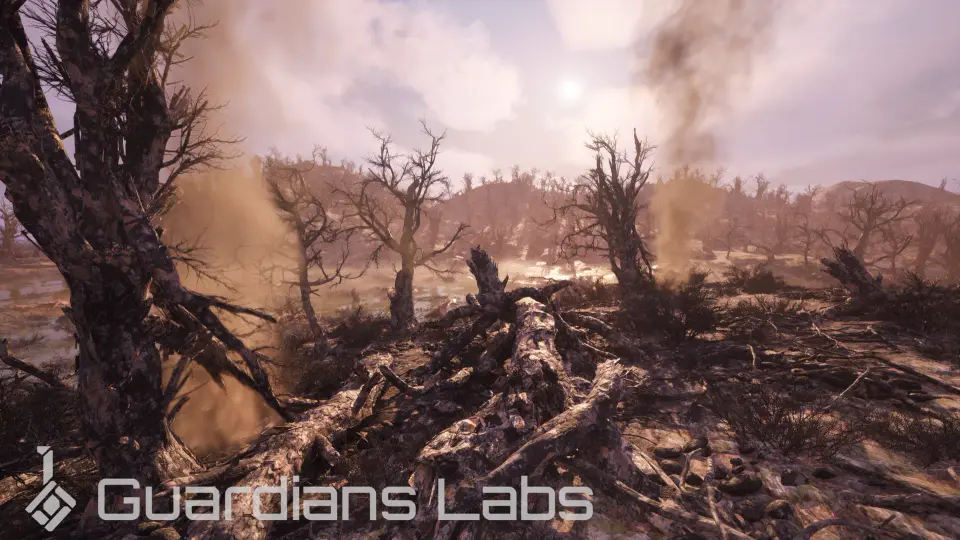
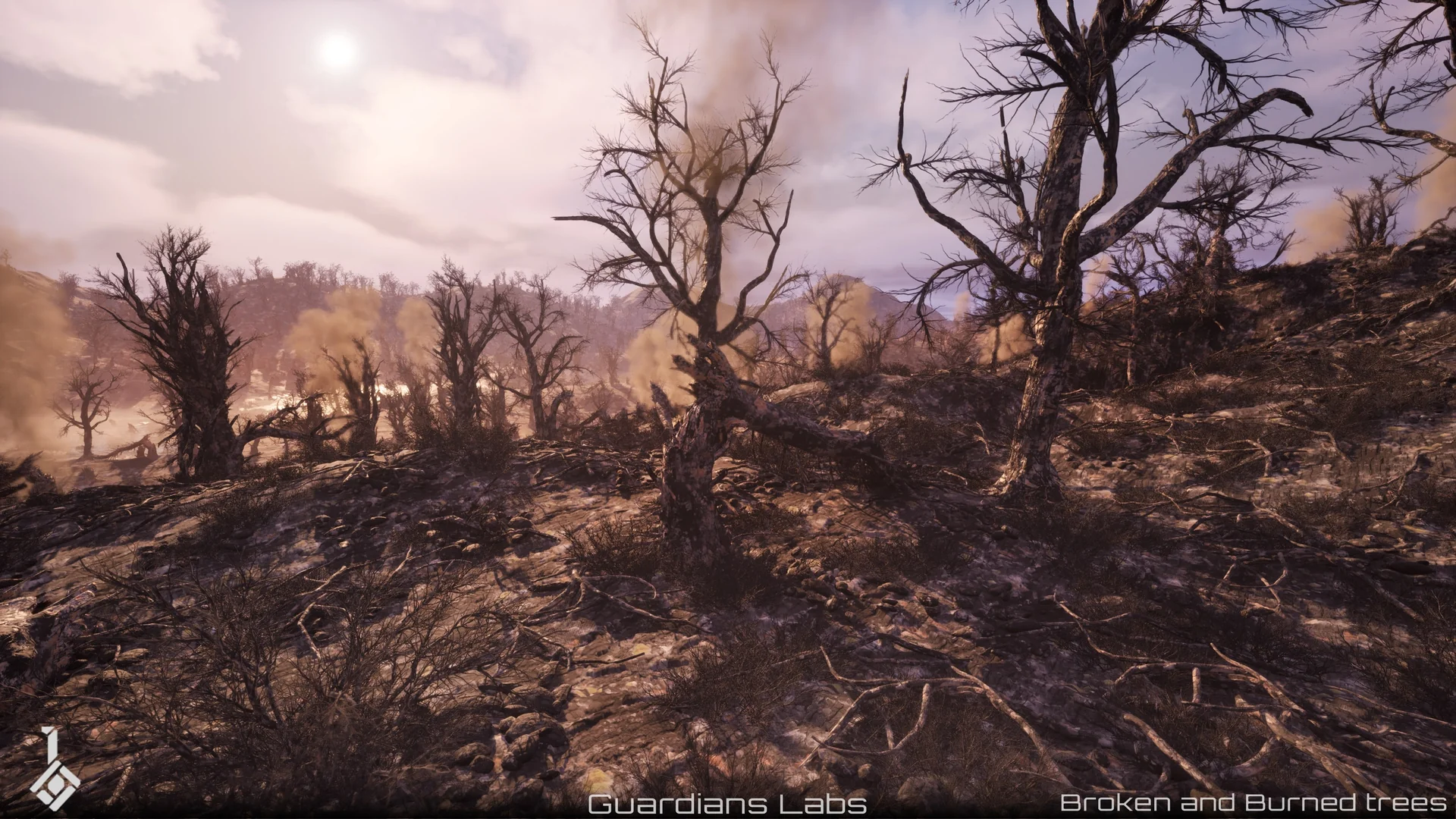
A notable technical shift in the 5.6 edition is the elimination of masked alpha cards. Every burned and fallen tree model is constructed as a fully opaque Nanite mesh. In dense scenes, alpha testing and masked card overdraw can strain GPU fill rates and complicate shadow passes. Fully opaque Nanite meshes sidestep these sorting bottlenecks, allowing hardware Lumen to evaluate geometric contact shadows and ambient occlusion directly against the photogrammetry surfaces. Bark fractures, burned gashes, and splintered cores render as dense, solid geometry rather than optical illusions achieved through transparency masks.
Dynamic Landscape Weightmaps and the Automatic Burning Effect
Simulating the exact path of a wildfire or localized catastrophe typically involves either heavy texture swapping or tedious placement of specialized burned variants alongside unburned props. The pack solves this layout challenge through a semi-automated burning effect driven directly by landscape paint data.
The workflow utilizes the terrain as the spatial reference point:
Artists paint charred soil and ash layers across the terrain using the integrated comprehensive landscape master material.
The painted layer data is exported directly from Unreal Engine as a landscape weightmap texture.
Reimporting this texture into the project as a dedicated Burned Map feeds coordinate data back into the asset shader ecosystem.
Any tree or foliage asset situated within the boundary of the burned map receives an automated burning transition, blending charcoal textures and scorched bark smoothly across its surface based on world positioning.
This automated interaction removes the friction of hand-aligning separate clean and charred meshes along the edges of a firebreak. Environmental artists can freely move, rotate, and duplicate trunks across the terrain; the transition effect automatically recalibrates to reflect whether a tree sits in pristine ground, deep ash, or the gradient between them.
Procedural Forest Assembly and Master Material Architecture
Populating extensive forest corridors by hand can produce repetitive clusters that fail to capture the chaotic debris fields left by windstorms, decay, or fire. The collection includes a dedicated Procedural Content Generation (PCG) template designed specifically to seed rotten logs, snapping branches, dead bushes, and burned timber at scale. This PCG framework uses algorithmic distribution logic to assemble tangled dead zones across varied topography without manual stamp placement.
Supporting these meshes is a suite of master materials made for broad environment duties rather than isolated prop rendering. The primary vegetation and tree master material includes custom wind simulation logic that functions not only for bare wood and brittle limbs, but also extends to live foliage projects. For wetland scenes, drainage basins, and stagnant marshlands, the pack incorporates an adjustable custom single layer water shader. This water material allows control over surface movement and light absorption, integrating seamlessly with rotten deadfall half-submerged in swampy basins.
Photogrammetry Refinements and Environment Compatibility
Realistic wood rot and charred timber require micro-surface detail that procedural noise textures rarely replicate convincingly. The pack utilizes photogrammetry textures remade specifically to accentuate the porous, irregular surfaces left after heat exposure and fungal decay. Bark fissures, scorched rings, and crumbling inner wood surfaces carry calibrated roughness and normal data derived from physical references.
For artists blending dead timber back into living woodlands, the asset set maintains visual and material compatibility with the Oak Tree Pack - White Oak Forest (Quercus Alba). This compatibility allows level designers to transition from healthy, dense white oak stands down into barren wildfire zones, clear-cuts, or natural forest die-offs without clashing art direction or disparate shader parameters.
Evaluating the Production Map and Real-Time Lighting Setup
To demonstrate how these features interact under production conditions, the pack includes a fully assembled example environment. This demonstration level combines the procedural PCG deadwood forest, customized water bodies, dynamic burning terrain shaders, and atmospheric effects into an integrated layout.
Lighting throughout the showcase map is calibrated around physically based lighting (PBL) standards, interacting with Unreal Engine's hardware Lumen to prove stability under high dynamic range conditions. By demonstrating the interaction between Nanite meshes, deep black carbonized bark shaders, and indirect light bounce, the example level offers production teams a concrete baseline for deploying large-scale environmental destruction across modern rendering pipelines.
 Trees
 Trees
 Trees
 Trees