"c68a05d5e51405b3"{"id":"1001861","slug":"ancient-desert-oasis-temple-ruins-w-procedural-block-tiling-system","title":"Ancient Desert Oasis Temple Ruins w/Procedural Block Tiling System","category":"Desert","engine":"4.21+,5.0+","assetVersion":"","engineVersion":"Engine Version: 4.21+,5.0+","tag":"Desert","accent":"blue","visual":"mech","summary":"Build dynamic desert environments using the Ancient Desert Oasis Temple Ruins w/Procedural Block Tiling System featuring 16 meshes and procedural tiling.","platform":"Unreal Engine","publishedAt":"2026-10-22T10:55:49.405Z","updatedAt":"2026-10-22T10:55:49.405Z","sourceNotes":[],"fileContents":[],"compatibility":["Unreal Engine","Engine Version: 4.21+,5.0+"],"featuredImage":{"alt":"Ancient Desert Oasis Temple Ruins w/Procedural Block Tiling System","src":"/wp-content/uploads/published/2026/10/56e64c00a238-1bd3494c-e8d4-4f89-8132-1833050d9a3a-b16fc33ab8.webp"},"hasDownloadLink":true,"downloads":0,"terms":[{"taxonomy":"category","slug":"desert","name":"Desert"}],"galleryImages":[{"src":"/wp-content/uploads/published/2026/10/b6f051d0ae2c-ff0f31a1-9276-496f-aef1-5508868f8d2e-da0032a9fe.webp","alt":"Ancient Desert Oasis Temple Ruins w/Procedural Block Tiling System"},{"src":"/wp-content/uploads/published/2026/10/5ea9f60f6ff7-83ba5556-f0d1-4068-9db8-4086d3d68457-31e28d2d39.webp","alt":"Ancient Desert Oasis Temple Ruins w/Procedural Block Tiling System"},{"src":"/wp-content/uploads/published/2026/10/07b413e6b54c-c69908dd-bd6c-41cd-ac8d-23db2728ddd1-1d365d30a4.webp","alt":"Ancient Desert Oasis Temple Ruins w/Procedural Block Tiling System"},{"src":"/wp-content/uploads/published/2026/10/5bcf03ac05bc-cb22197f-b9f6-42e4-b500-ba398a287e29-6e86aef3ef.webp","alt":"Ancient Desert Oasis Temple Ruins w/Procedural Block Tiling System"},{"src":"/wp-content/uploads/published/2026/10/060c432035eb-196ef599-37d1-4154-9cf5-fe8e5e6df4e3-de12dad354.webp","alt":"Ancient Desert Oasis Temple Ruins w/Procedural Block Tiling System"},{"src":"/wp-content/uploads/published/2026/10/8e3662553c0f-661e60fb-0d4c-4c97-81e3-7f9a68c6ff7c-eb14d6415b.webp","alt":"Ancient Desert Oasis Temple Ruins w/Procedural Block Tiling System"},{"src":"/wp-content/uploads/published/2026/10/6ec1533e2b88-a604049d-a405-4759-b0dd-bdcb5ab67010-addd66e14e.webp","alt":"Ancient Desert Oasis Temple Ruins w/Procedural Block Tiling System"},{"src":"/wp-content/uploads/published/2026/10/3cfb8bcec387-19864b46-9acd-4056-830e-e7640129642a-830f12e3c7.webp","alt":"Ancient Desert Oasis Temple Ruins w/Procedural Block Tiling System"},{"src":"/wp-content/uploads/published/2026/10/c17eb3540579-09850354-a1dc-4d25-a7a5-7008eadd4c0d-806c898c83.webp","alt":"Ancient Desert Oasis Temple Ruins w/Procedural Block Tiling System"},{"src":"/wp-content/uploads/published/2026/10/dc9f11548740-97c95b76-de37-41de-90c8-48cce1e01c95-fb2880e467.webp","alt":"Ancient Desert Oasis Temple Ruins w/Procedural Block Tiling System"}],"accessPanel":{"kind":"resource","title":"Download this resource","eyebrow":"Free Download","message":"Log in or create a free account to start your download.","fileName":"Content.7z","safetyNote":"Resources are manually reviewed before listing to improve quality and reduce obvious risks.","actionLabel":"Download Free","resourceType":"Resource archive"},"contentHtml":"\u003ch2\u003eAssembling Desert Oasis Temple Ruins Without Repetitive Layout Work\u003c/h2\u003e\u003cp\u003eConstructing sprawling archaeological ruins across harsh sand environments frequently turns into a slow, repetitive placement task. Hand-positioning individual fallen stones, weathered foundation segments, and crumbling arches consumes substantial production time while risking visual monotony across large play spaces.\u003c/p\u003e\u003cp\u003eThe Ancient Desert Oasis Temple Ruins w/Procedural Block Tiling System targets this exact bottleneck by automating the distribution and structural alignment of stone components. Instead of manually arranging every broken step and weathered column base, level creators can deploy procedural logic to establish compound structures that mimic the natural decay of an ancient holy site. Arid oasis environments require uneven decay patterns where wind, sand drift, and structural collapse create irregular silhouettes. Using a specialized block tiling foundation lets teams rapidly sketch out courtyards, perimeter barriers, and partially buried sanctuaries without wrestling with individual mesh transforms across expansive level terrains.\u003c/p\u003e\u003ch2\u003eDriving Structure Generation with the Procedural Block Tiling System\u003c/h2\u003e\u003cp\u003eProcedural generation shifts the level artist's role from placing individual stone blocks to defining the perimeter, height, and flow of ruined temple walls.\u003c/p\u003e\u003cp\u003eBy relying on the procedural block tiling system, environment artists can generate coherent ruins that assemble cleanly while reflecting historical ruin patterns. The procedural rules control how structural pieces link, allowing blocks to repeat, step, and terminate without revealing unnatural seam lines or repetitive geometric motifs. This approach is particularly effective when mapping out multi-tiered temple sanctuaries, sunken desert pools, or subterranean stairs emerging from the dunes. Level designers gain the freedom to test pathing and sightlines instantly, altering the procedural boundaries to open new corridors or seal flanking routes without having to manually rebuild masonry walls.\u003c/p\u003e\u003ch2\u003eStructuring Temple Architecture Across 16 Meshes, Materials, and Textures\u003c/h2\u003e\u003cp\u003eThe entire environment kit centers on a targeted selection of 16 meshes, supported by dedicated materials and textures.\u003c/p\u003e\u003cp\u003eA tight set of 16 distinct meshes maintains tight memory footprints while providing the essential architectural elements needed to suggest lost civilizations. Because each mesh is preconfigured with corresponding materials and textures, structural elements blend naturally across diverse configurations. The surface treatments convey weathered stone, worn edges, and the tactile grit expected of ancient masonry exposed to harsh desert climates. When distributed through the tiling algorithms, these sixteen pieces assemble into varied formations such as collapsed altars, fragmented ceremonial gateways, and eroded foundation steps, ensuring that distinct areas of an oasis compound retain architectural unity without appearing carbon-copied.\u003c/p\u003e\u003ch2\u003eBalancing Realistic and Stylized Fantasy Desert Aesthetics\u003c/h2\u003e\u003cp\u003eEnvironmental art pipelines often struggle when assets are locked into an extreme realism or hyper-stylized bracket. The visual framing of this ruin set bridges both realistic and stylized fantasy needs.\u003c/p\u003e\u003cp\u003eIn fantasy and adventure projects, desert sanctuaries often demand a balance between plausible structural weight and mythic proportions. The geometry of the 16 meshes captures crisp, readable shapes that communicate strongly in stylized fantasy projects, while the applied materials and textures preserve surface nuances necessary for grounded, realistic settings. Designers constructing an oasis shrine can easily shift the narrative context—from a forgotten desert tomb steeped in low-fantasy grit to an enchanted spring surrounded by ancient stone relics—without modifying the underlying architectural meshes.\u003c/p\u003e\u003ch2\u003eCombining Temple Ruins with Fateloom All-in-One VFX Essentials\u003c/h2\u003e\u003cp\u003eStatic architecture provides only half the environmental atmosphere; dynamic motion brings ancient ruins into active game spaces.\u003c/p\u003e\u003cp\u003eTo complete the feeling of an active oasis or a cursed sanctuary, the pack integrates smoothly alongside Fateloom All-in-One VFX Essentials – Every Visual Effect You Need. Layering environmental visual effects over the 16 meshes allows developers to accentuate the passage of time and elements. Swirling sand gusts can whip around the corners of procedural temple walls, magical embers can illuminate crumbling altars, or shimmering heat hazes can distort long views down ruined colonnades. Because the geometry provides clean perimeters and defined surfaces, particle volumes and environmental effects align naturally with the generated ruins to ground the temple deeply into its desert setting.\u003c/p\u003e\u003ch2\u003eProduction Deployment for Ancient Oasis Level Layouts\u003c/h2\u003e\u003cp\u003eEarly-stage environment development relies on rapid spatial validation before teams commit to custom hero assets.\u003c/p\u003e\u003cp\u003eThe Ancient Desert Oasis Temple Ruins w/Procedural Block Tiling System serves as an agile architectural framework during level whiteboxing and intermediate dressing. Level builders can assemble broad temple courtyards, subterranean descent chambers, and defensive oasis walls directly within their production pipeline, establishing scale, cover points, and narrative wayfinding early in the development cycle. Once the procedural tiling defines the broad layout, the combined mesh and material kit ensures that the desert temple holds visual integrity from the initial layout phase through final scene polish.\u003c/p\u003e\n\n\u003ch2\u003eRelated Resources Worth Checking\u003c/h2\u003e\n\u003cul\u003e\n\u003cli\u003e\u003ca href=\"https://3dcghub.com/desert-city-ruins/\" title=\"Desert City Ruins\"\u003eDesert City Ruins\u003c/a\u003e\u003c/li\u003e\n\u003cli\u003e\u003ca href=\"https://3dcghub.com/desert-oasis/\" title=\"Desert Oasis\"\u003eDesert Oasis\u003c/a\u003e\u003c/li\u003e\n\u003cli\u003e\u003ca href=\"https://3dcghub.com/mw-dune-desert-biome/\" title=\"MW Dune Desert Biome\"\u003eMW Dune Desert Biome\u003c/a\u003e\u003c/li\u003e\n\u003cli\u003e\u003ca href=\"https://3dcghub.com/desert-ruins-environment-desert-ruins-environment-ruins-desert-ruins-desert/\" title=\"Desert Ruins Environment ( Desert Ruins Environment Ruins Desert Ruins Desert )\"\u003eDesert Ruins Environment ( Desert Ruins Environment Ruins Desert Ruins Desert )\u003c/a\u003e\u003c/li\u003e\n\u003cli\u003e\u003ca href=\"https://3dcghub.com/red-desert-pack/\" title=\"Red Desert Pack\"\u003eRed Desert Pack\u003c/a\u003e\u003c/li\u003e\n\u003c/ul\u003e","contentTextLength":5717,"navigation":{"current":64,"total":3860,"previous":{"id":"1001862","slug":"animated-fp-civilian-arms-pack","title":"Animated FP Civilian Arms Pack","category":"Characters \u0026 Creatures","platform":"Unreal Engine","updatedAt":"2026-10-22T10:58:06.149Z"},"next":{"id":"1001860","slug":"advanced-magic-fx-13","title":"Advanced Magic FX 13","category":"Spells \u0026 Combat","platform":"Unreal Engine","updatedAt":"2026-10-22T10:53:40.573Z"}},"relatedResources":[{"id":"1001511","slug":"desert-city-ruins","title":"Desert City Ruins","category":"Desert","engine":"4.27+,5.0+","assetVersion":"","engineVersion":"Engine Version: 4.27+,5.0+","tag":"Desert","accent":"blue","visual":"city","summary":"Build desolate rocky desert levels and decrepit city ruins with modular PBR assets, realistic sand environments, and project distance field integration.","platform":"Unreal Engine","publishedAt":"2026-10-09T13:11:33.796Z","updatedAt":"2026-10-09T13:11:33.796Z","sourceNotes":[],"fileContents":[],"compatibility":["Unreal Engine","Engine Version: 4.27+,5.0+"],"featuredImage":{"alt":"Desert City Ruins","src":"/wp-content/uploads/published/2026/10/a4f5284dec98-173ba9f0-45ef-4de6-ac8b-060116f8dec4-f67e79dfa8.webp"},"hasDownloadLink":true,"downloads":0},{"id":"1000117","slug":"desert-oasis","title":"Desert Oasis","category":"Desert","engine":"4.26+,5.0+","assetVersion":"","engineVersion":"Engine Version: 4.26+,5.0+","tag":"Desert","accent":"blue","visual":"mech","summary":"Build immersive arid environments with the Desert Oasis pack, featuring over 100 handcrafted meshes, advanced landscape tools, and dynamic sand effects.","platform":"Unreal Engine","publishedAt":"2026-06-09T14:40:55.104Z","updatedAt":"2026-06-09T14:40:55.104Z","sourceNotes":[],"fileContents":[],"compatibility":["Unreal Engine","Engine Version: 4.26+,5.0+"],"featuredImage":{"alt":"Desert Oasis","src":"/wp-content/uploads/published/2026/06/b552b02194f5-b7cec64b-d087-453f-ab9e-e061287f5a86-7112d9f5ce.webp"},"hasDownloadLink":true,"downloads":1},{"id":"7754","slug":"mw-dune-desert-biome","title":"MW Dune Desert Biome","category":"Desert","engine":"4.27,5.0+","assetVersion":"Engine version: 4.27,5.0+","engineVersion":"5.2","tag":"Desert","accent":"blue","visual":"city","summary":"Transform your digital projects with a professional-grade desert environment solution. This comprehensive biome uses photogrammetry and procedural generation to deliver stunning, realistic dunes and oases.","platform":"Unreal Engine","publishedAt":"2026-02-21T17:40:14.000Z","updatedAt":"2026-04-19T15:55:55.000Z","sourceNotes":[],"fileContents":[],"compatibility":["Unreal Engine","Engine version: 4.27,5.0+"],"featuredImage":{"alt":"MW Dune Desert Biome","src":"https://3dcghub.com/wp-content/uploads/2026/02/9157f5aa-d82d-40dc-b2b1-517cafc2983f.webp"},"hasDownloadLink":true,"downloads":3}]}
Desert
Ancient Desert Oasis Temple Ruins w/Procedural Block Tiling System
Build dynamic desert environments using the Ancient Desert Oasis Temple Ruins w/Procedural Block Tiling System featuring 16 meshes and procedural tiling.
Category:Unreal Engine,DesertPlatform: Unreal EngineEngine Version: 4.21+,5.0+Published: Oct 22, 2026
Desert
Resource overview
Assembling Desert Oasis Temple Ruins Without Repetitive Layout Work
Constructing sprawling archaeological ruins across harsh sand environments frequently turns into a slow, repetitive placement task. Hand-positioning individual fallen stones, weathered foundation segments, and crumbling arches consumes substantial production time while risking visual monotony across large play spaces.
The Ancient Desert Oasis Temple Ruins w/Procedural Block Tiling System targets this exact bottleneck by automating the distribution and structural alignment of stone components. Instead of manually arranging every broken step and weathered column base, level creators can deploy procedural logic to establish compound structures that mimic the natural decay of an ancient holy site. Arid oasis environments require uneven decay patterns where wind, sand drift, and structural collapse create irregular silhouettes. Using a specialized block tiling foundation lets teams rapidly sketch out courtyards, perimeter barriers, and partially buried sanctuaries without wrestling with individual mesh transforms across expansive level terrains.
Driving Structure Generation with the Procedural Block Tiling System
Procedural generation shifts the level artist's role from placing individual stone blocks to defining the perimeter, height, and flow of ruined temple walls.
By relying on the procedural block tiling system, environment artists can generate coherent ruins that assemble cleanly while reflecting historical ruin patterns. The procedural rules control how structural pieces link, allowing blocks to repeat, step, and terminate without revealing unnatural seam lines or repetitive geometric motifs. This approach is particularly effective when mapping out multi-tiered temple sanctuaries, sunken desert pools, or subterranean stairs emerging from the dunes. Level designers gain the freedom to test pathing and sightlines instantly, altering the procedural boundaries to open new corridors or seal flanking routes without having to manually rebuild masonry walls.
Structuring Temple Architecture Across 16 Meshes, Materials, and Textures
The entire environment kit centers on a targeted selection of 16 meshes, supported by dedicated materials and textures.
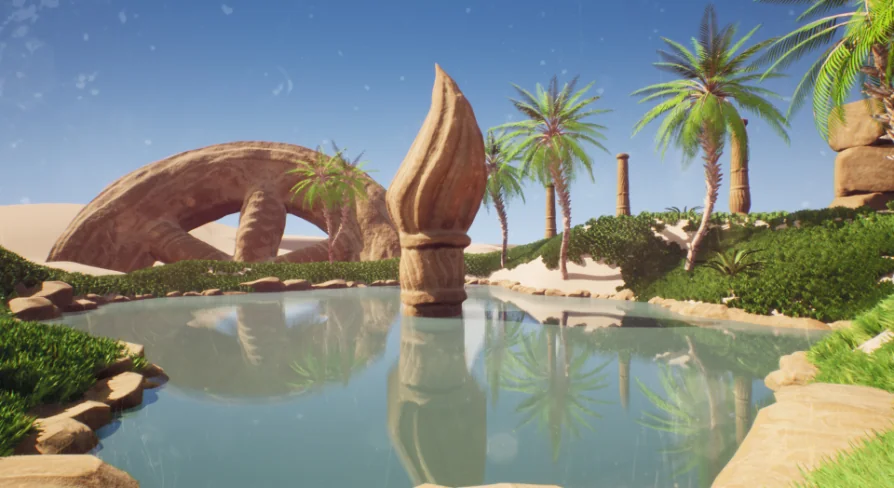
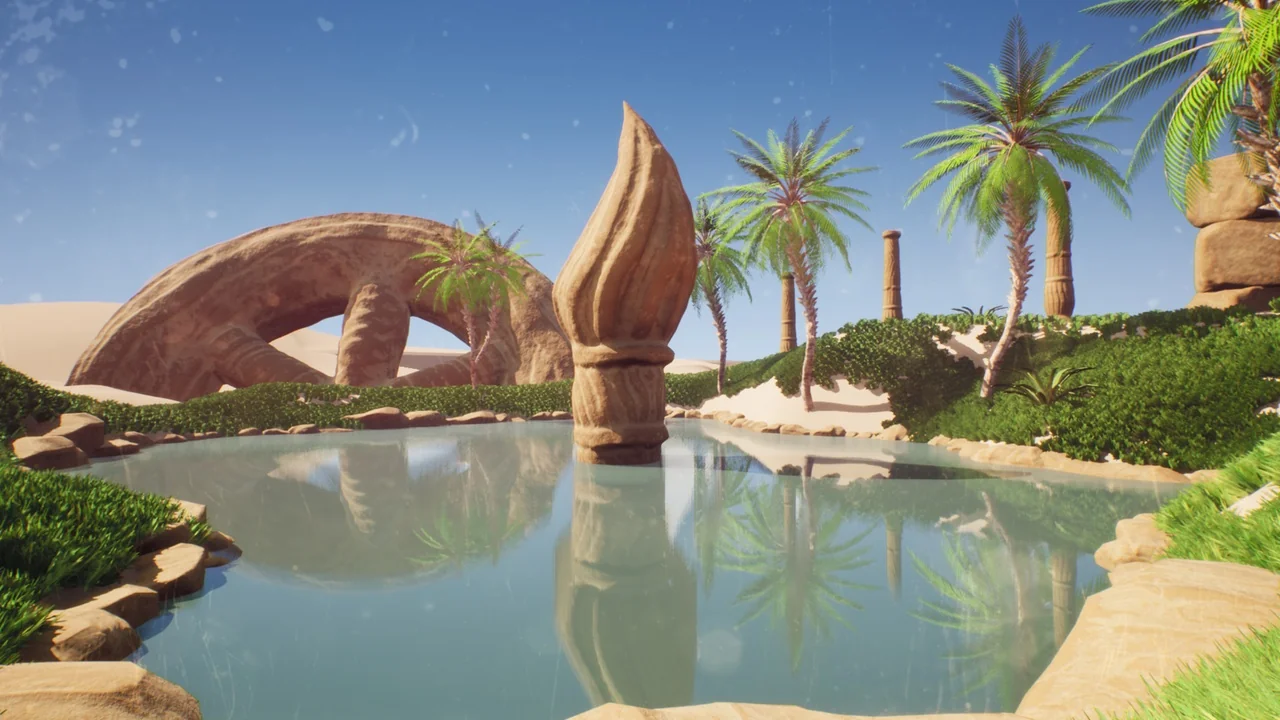
A tight set of 16 distinct meshes maintains tight memory footprints while providing the essential architectural elements needed to suggest lost civilizations. Because each mesh is preconfigured with corresponding materials and textures, structural elements blend naturally across diverse configurations. The surface treatments convey weathered stone, worn edges, and the tactile grit expected of ancient masonry exposed to harsh desert climates. When distributed through the tiling algorithms, these sixteen pieces assemble into varied formations such as collapsed altars, fragmented ceremonial gateways, and eroded foundation steps, ensuring that distinct areas of an oasis compound retain architectural unity without appearing carbon-copied.
Balancing Realistic and Stylized Fantasy Desert Aesthetics
Environmental art pipelines often struggle when assets are locked into an extreme realism or hyper-stylized bracket. The visual framing of this ruin set bridges both realistic and stylized fantasy needs.
In fantasy and adventure projects, desert sanctuaries often demand a balance between plausible structural weight and mythic proportions. The geometry of the 16 meshes captures crisp, readable shapes that communicate strongly in stylized fantasy projects, while the applied materials and textures preserve surface nuances necessary for grounded, realistic settings. Designers constructing an oasis shrine can easily shift the narrative context—from a forgotten desert tomb steeped in low-fantasy grit to an enchanted spring surrounded by ancient stone relics—without modifying the underlying architectural meshes.
Combining Temple Ruins with Fateloom All-in-One VFX Essentials
Static architecture provides only half the environmental atmosphere; dynamic motion brings ancient ruins into active game spaces.
To complete the feeling of an active oasis or a cursed sanctuary, the pack integrates smoothly alongside Fateloom All-in-One VFX Essentials – Every Visual Effect You Need. Layering environmental visual effects over the 16 meshes allows developers to accentuate the passage of time and elements. Swirling sand gusts can whip around the corners of procedural temple walls, magical embers can illuminate crumbling altars, or shimmering heat hazes can distort long views down ruined colonnades. Because the geometry provides clean perimeters and defined surfaces, particle volumes and environmental effects align naturally with the generated ruins to ground the temple deeply into its desert setting.
Production Deployment for Ancient Oasis Level Layouts
Early-stage environment development relies on rapid spatial validation before teams commit to custom hero assets.
The Ancient Desert Oasis Temple Ruins w/Procedural Block Tiling System serves as an agile architectural framework during level whiteboxing and intermediate dressing. Level builders can assemble broad temple courtyards, subterranean descent chambers, and defensive oasis walls directly within their production pipeline, establishing scale, cover points, and narrative wayfinding early in the development cycle. Once the procedural tiling defines the broad layout, the combined mesh and material kit ensures that the desert temple holds visual integrity from the initial layout phase through final scene polish.
 Desert
 Desert
 Desert
 Desert