"7653090fc033c927"{"id":"1000051","slug":"desert-ruins-environment-desert-ruins-environment-ruins-desert-ruins-desert","title":"Desert Ruins Environment ( Desert Ruins Environment Ruins Desert Ruins Desert )","category":"Desert","engine":"4.26+,5.0+","assetVersion":"","engineVersion":"4.26+,5.0+","tag":"Desert","accent":"blue","visual":"city","summary":"A desert ruin environment with ancient ruins, statues, rocks, and ULAT support for building Egyptian-inspired temples, tombs, and modular scenes.","platform":"Unreal Engine","publishedAt":"2026-05-22T12:45:08.649Z","updatedAt":"2026-05-22T20:12:08.751Z","sourceNotes":[],"fileContents":[],"compatibility":["Unreal Engine","Engine version: 4.26+,5.0+"],"featuredImage":{"alt":"Desert Ruins Environment ( Desert Ruins Environment Ruins Desert Ruins Desert )","src":"/wp-content/uploads/published/2026/05/0180dfd3923d-c5af3a72-2a3d-494d-a281-11488b68329c-c1fdbfc507.webp"},"hasDownloadLink":true,"downloads":0,"terms":[{"taxonomy":"category","slug":"desert","name":"Desert"}],"galleryImages":[{"src":"/wp-content/uploads/published/2026/05/bc353d0e367b-d0af3cec-293f-4363-920c-029ebcf72469-e528ad3bbf.webp","alt":"Desert Ruins Environment ( Desert Ruins Environment Ruins Desert Ruins Desert )"},{"src":"/wp-content/uploads/published/2026/05/f9f7a1b1244c-8ca4e97f-b356-40f3-944c-61174ec45ff9-892ae494af.webp","alt":"Desert Ruins Environment ( Desert Ruins Environment Ruins Desert Ruins Desert )"},{"src":"/wp-content/uploads/published/2026/05/a5132e8e4380-c4009edb-c26d-4369-b597-3e7c464d058e-794a8b5524.webp","alt":"Desert Ruins Environment ( Desert Ruins Environment Ruins Desert Ruins Desert )"},{"src":"/wp-content/uploads/published/2026/05/af954fa7d8d2-48b499ec-eca3-407a-b3e9-c8e5e6974785-710de1082f.webp","alt":"Desert Ruins Environment ( Desert Ruins Environment Ruins Desert Ruins Desert )"},{"src":"/wp-content/uploads/published/2026/05/0e8355607133-cce3ad63-88c5-48b7-bf14-4149727084a3-7d2d131fcb.webp","alt":"Desert Ruins Environment ( Desert Ruins Environment Ruins Desert Ruins Desert )"},{"src":"/wp-content/uploads/published/2026/05/8c631379e945-68a1951d-b9f4-48ad-8bab-0c64a0287007-afe557a689.webp","alt":"Desert Ruins Environment ( Desert Ruins Environment Ruins Desert Ruins Desert )"},{"src":"/wp-content/uploads/published/2026/05/79fd6d866cbe-11c3f231-a694-4cb1-b3c7-3f93c5d4070e-66016b5bfe.webp","alt":"Desert Ruins Environment ( Desert Ruins Environment Ruins Desert Ruins Desert )"},{"src":"/wp-content/uploads/published/2026/05/5faca50b0504-acb5a055-d388-44c0-ab2f-a5697f3d65ce-fd1220cab6.webp","alt":"Desert Ruins Environment ( Desert Ruins Environment Ruins Desert Ruins Desert )"},{"src":"/wp-content/uploads/published/2026/05/9f937a83bed0-32558244-b922-4c71-b5d3-6706f3c7d226-b21aa75a4e.webp","alt":"Desert Ruins Environment ( Desert Ruins Environment Ruins Desert Ruins Desert )"},{"src":"/wp-content/uploads/published/2026/05/7e433d8005ac-2d794337-6186-45b3-8624-575b509ec4b4-4bdb0cc61d.webp","alt":"Desert Ruins Environment ( Desert Ruins Environment Ruins Desert Ruins Desert )"}],"accessPanel":{"kind":"resource","title":"Access this resource","eyebrow":"Free Download","message":"Log in or create a free account to start your download.","fileName":"Content.7z","safetyNote":"Resources are manually reviewed before listing to improve quality and reduce obvious risks.","actionLabel":"Download Free","resourceType":"Resource archive"},"contentHtml":"\u003cp\u003eFor artists building sun-beaten temples, buried chambers, weathered stone corridors, or a lost tomb half-swallowed by sand, \u003cstrong\u003eDesert Ruins Environment\u003c/strong\u003e Offers a focused set of scene ingredients. The package centers on ancient ruins and desert architecture, with supporting meshes, statues, and rocks that point clearly toward Egyptian-inspired environments rather than a broad, all-purpose landscape set.\u003c/p\u003e \u003cp\u003eThe visual identity is easy to read from its theme language. Desert, ruins, temple, pyramid, ancient stone, sacred chambers, mysterious carvings, hieroglyphic symbols, and hidden passages all sit within the same creative range. That gives the environment a strong direction for projects that need abandoned monuments, tomb interiors, ritual spaces, or exterior ruin fields framed by sand and erosion. It also gives level artists room to lean into fantasy-inflected history, with cues such as cursed treasure, forgotten relics, golden statues, sacred artefacts, and ancient guardians shaping the mood.\u003c/p\u003e \u003ch2\u003eDesert Ruins Environment and the language of ancient stone\u003c/h2\u003e\n\u003cp\u003eThis package is based on a concept and realized as an environment set, which matters because the contents read as parts of a larger visual world instead of disconnected props. Ancient ruins form the backbone of that world. Statues and rocks push the set further toward places that feel uncovered, worn down, or long abandoned. The combination suggests spaces where structure and collapse coexist: intact temple sections beside eroded walls, ceremonial statuary beside broken ground, and rock formations that help the ruins sit naturally within an arid setting.\u003c/p\u003e \u003cp\u003eThe repeated desert and ruin themes make the intended tone especially clear. This is not just masonry in a dry biome. Its tags point toward Egyptian ruins, pyramids, tombs of the pharaoh, sacred rituals, monolithic structures, crumbling temples, and weathered stone. Those details support scenes that need a sense of age, ritual significance, and buried history. A developer could use that direction for explorable temple courts, puzzle spaces in hidden chambers, relic-focused adventure levels, or eerie catacombs where architecture and mythology meet.\u003c/p\u003e \u003cp\u003eEven when the pack is used in a stylized or fantasy project, the tags keep the setting grounded in recognizable motifs: sun-baked stones, cracked monuments, dunes of mystery, abandoned citadels, echoing ruins, and faded history. That leaves a resource that can support both broad establishing shots and more intimate spaces like ritual halls, secret passages, and chambers marked by symbolic ornament.\u003c/p\u003e \u003ch2\u003eAncient Ruins, Statues, Meshes, and Rocks as scene anchors\u003c/h2\u003e\n\u003cp\u003eThe listed contents are straightforward: \u003cstrong\u003eAncient Ruins, Meshes, Statues, and Rocks\u003c/strong\u003e. That simplicity is useful because each category has a clear role in production.\u003c/p\u003e \u003cp\u003eAncient ruins provide the structural read of the environment. They define where the player is, whether that is a temple approach, a ruined courtyard, a buried sanctuary, or a collapsed complex overtaken by sand. Meshes broaden how those spaces can be assembled and varied, giving environment artists the pieces needed to shape more than a single fixed composition. Statues introduce focal points and narrative weight. In an Egyptian-leaning ruin set, statuary can imply guardianship, ceremony, power, and forgotten belief systems without requiring extra explanation. Rocks help with transition and grounding, letting built forms meet the natural terrain in a way that feels less staged.\u003c/p\u003e \u003cp\u003eTogether, those elements support a scene-building workflow where monumental forms and smaller supporting pieces can reinforce each other. A statue can punctuate an entrance. Rock groupings can frame a collapsed wall. Ruin segments can create corridors, thresholds, and partially open plazas. If a project calls for buried secrets, cursed tomb imagery, or timeworn temple remains, these categories are already aligned with that outcome.\u003c/p\u003e \u003cp\u003eThe tags add more texture to how those pieces might be used creatively. Golden statues, sacred chambers, weathered walls, eroded structures, and glistening relic imagery suggest levels that can swing between grandeur and decay. Hidden chambers and undiscovered passages point toward exploration-based layouts. Forbidden catacombs, eerie chambers, and sands of time push the atmosphere toward mystery and danger. None of that changes the core content of the pack, but it does clarify the kinds of moods the environment is meant to carry.\u003c/p\u003e \u003ch2\u003eULAT inside the pack changes how Desert Ruins scenes can be assembled\u003c/h2\u003e\n\u003cp\u003eOne of the more practical aspects of this environment is that it includes \u003cstrong\u003eULAT\u003c/strong\u003e, short for \u003cstrong\u003eUltimate Level Art Tool\u003c/strong\u003e. The pack is also stated as compatible with the Ultimate Level Art Tool, reinforcing that the environment is not only about placed art assets but also about a scene-construction workflow.\u003c/p\u003e \u003cp\u003eULAT is described as allowing fast creation of custom modular buildings. For developers and environment artists, that makes the pack more flexible than a static collection of ruin pieces alone. Modular building tools are most useful when a project needs multiple layouts from a shared visual language: a larger temple complex for one level, a narrower buried corridor for another, or a fragmented ruin zone scattered through an exterior map. Since ULAT also offers a seamless and distinctive way to populate scenes naturally, it supports not just assembly but the broader task of making a location feel inhabited by its own forms and patterns, even when the setting itself is abandoned.\u003c/p\u003e \u003cp\u003eThat pairing is especially fitting for a ruin environment. Desert ruins often depend on repetition with variation: columns, walls, broken edges, chambers, pathways, and focal monuments arranged in ways that feel ancient rather than obviously modular. A tool aimed at fast custom modular building helps bridge that gap. It can serve artists who want to block out a sacred hall, stretch a complex into a longer approach to a pyramid, or reshape temple remains into a more exploratory route with hidden corners and layered sightlines.\u003c/p\u003e \u003cp\u003eThe translated expansion of the original tool name identifies it as a modular design development tool for mobile and web-based systems. Even without adding technical assumptions beyond that wording, it underlines the tool’s role as part of a structured content-building workflow rather than a purely decorative extra.\u003c/p\u003e \u003ch2\u003eEgyptian temples, lost tombs, and fantasy ruins without forced decoration\u003c/h2\u003e\n\u003cp\u003eThe strength of this environment lies in how tightly its theme holds together. Egyptian, temple, pyramid, mummy, sand, fantasy, lost tomb, forgotten relic, cursed treasure, sacred rituals, and ancient knowledge all point in the same direction. That gives creative teams a stable base for worldbuilding.\u003c/p\u003e \u003cp\u003eA scene can stay close to archaeological fantasy, emphasizing hieroglyphic symbols, sacred chambers, and weathered stone. It can tilt toward adventure, using golden relics, hidden chambers, and secret passages as visual hooks. It can also move into a darker register through cursed tombs, eerie chambers, forbidden catacombs, and ancient mysticism. Because those themes are already embedded in the pack’s identity, artists do not have to force the setting into a mood it does not support.\u003c/p\u003e \u003cp\u003eThis also helps with gameplay presentation. Spaces like ritual halls, tomb interiors, temple courts, and abandoned citadels naturally lend themselves to progression, discovery, and confrontation. Exterior areas can lean on dunes, sunlit ruins, cracked monuments, and arid landscapes. Interior sections can use sacred chambers, mysterious carvings, monolithic forms, and hidden routes to tighten the sense of enclosure and tension.\u003c/p\u003e \u003ch2\u003eA practical note on foliage and the best fit for this environment\u003c/h2\u003e\n\u003cp\u003eThere is one important boundary around what is shown versus what is included: foliage appears only for showcase purposes and is not part of the pack. For production planning, that means the environment’s core identity should be read through its ruins, statues, meshes, and rocks rather than through added plant dressing. Anyone building with it should treat the desert ruins themselves as the primary visual foundation.\u003c/p\u003e \u003cp\u003eThat actually keeps the pack’s strongest use case fairly clear. It suits projects that need ancient desert architecture, ruin-focused scene composition, and a workflow that benefits from ULAT for fast custom modular building and natural scene population. If the target is an Egyptian-inspired temple zone, a pyramid approach, a buried ruin field, or a fantasy tomb with sacred and mysterious overtones, this environment matches that brief closely.\u003c/p\u003e\n\n\u003ch2\u003eRelated Resources Worth Checking\u003c/h2\u003e\n\u003cul\u003e\n\u003cli\u003e\u003ca href=\"https://3dcghub.com/ancient-desert-ruins-environment-w-map-generator-pcg/\" title=\"Ancient Desert Ruins Environment w/ Map Generator PCG\"\u003eAncient Desert Ruins Environment w/ Map Generator PCG\u003c/a\u003e\u003c/li\u003e\n\u003cli\u003e\u003ca href=\"https://3dcghub.com/elite-landscapes-desert-iii/\" title=\"Elite Landscapes: Desert III\"\u003eElite Landscapes: Desert III\u003c/a\u003e\u003c/li\u003e\n\u003cli\u003e\u003ca href=\"https://3dcghub.com/mw-dune-desert-biome/\" title=\"MW Dune Desert Biome\"\u003eMW Dune Desert Biome\u003c/a\u003e\u003c/li\u003e\n\u003cli\u003e\u003ca href=\"https://3dcghub.com/red-desert-pack/\" title=\"Red Desert Pack\"\u003eRed Desert Pack\u003c/a\u003e\u003c/li\u003e\n\u003cli\u003e\u003ca href=\"https://3dcghub.com/elite-landscapes-desert-ii/\" title=\"Elite Landscapes: Desert II\"\u003eElite Landscapes: Desert II\u003c/a\u003e\u003c/li\u003e\n\u003c/ul\u003e","contentTextLength":8785,"navigation":{"current":1594,"total":3501,"previous":{"id":"1000052","slug":"dinosaur-triceratops","title":"Dinosaur Triceratops","category":"Characters \u0026 Creatures","platform":"Unreal Engine","updatedAt":"2026-05-22T20:12:46.021Z"},"next":{"id":"1000053","slug":"dragon","title":"Dragon","category":"Creatures \u0026 Monsters","platform":"Unreal Engine","updatedAt":"2026-05-22T13:33:18.918Z"}},"relatedResources":[{"id":"1001511","slug":"desert-city-ruins","title":"Desert City Ruins","category":"Desert","engine":"4.27+,5.0+","assetVersion":"","engineVersion":"Engine Version: 4.27+,5.0+","tag":"Desert","accent":"blue","visual":"city","summary":"Build desolate rocky desert levels and decrepit city ruins with modular PBR assets, realistic sand environments, and project distance field integration.","platform":"Unreal Engine","publishedAt":"2026-10-09T13:11:33.796Z","updatedAt":"2026-10-09T13:11:33.796Z","sourceNotes":[],"fileContents":[],"compatibility":["Unreal Engine","Engine Version: 4.27+,5.0+"],"featuredImage":{"alt":"Desert City Ruins","src":"/wp-content/uploads/published/2026/10/a4f5284dec98-173ba9f0-45ef-4de6-ac8b-060116f8dec4-f67e79dfa8.webp"},"hasDownloadLink":true,"downloads":0},{"id":"1001512","slug":"deserted-industrial-ruins-abandoned-oasis","title":"Deserted Industrial Ruins - Abandoned Oasis","category":"Desert","engine":"5.5+","assetVersion":"","engineVersion":"Engine Version: 5.5+","tag":"Desert","accent":"blue","visual":"mech","summary":"A deep look at Deserted Industrial Ruins - Abandoned Oasis, featuring 275+ assets, dynamic wind VFX, dual lighting setups, and real-time desert performance.","platform":"Unreal Engine","publishedAt":"2026-10-09T13:12:37.199Z","updatedAt":"2026-10-09T13:12:37.199Z","sourceNotes":[],"fileContents":[],"compatibility":["Unreal Engine","Engine Version: 5.5+"],"featuredImage":{"alt":"Deserted Industrial Ruins - Abandoned Oasis","src":"/wp-content/uploads/published/2026/10/4c23fe6a3a5b-f5239179-537f-4761-bf13-45bfcd113522-3504c1043f.webp"},"hasDownloadLink":true,"downloads":1},{"id":"7668","slug":"ancient-desert-ruins-environment-w-map-generator-pcg","title":"Ancient Desert Ruins Environment w/ Map Generator PCG","category":"Desert","engine":"5.3+","assetVersion":"Engine version: 5.3+","engineVersion":"5.3","tag":"Desert","accent":"blue","visual":"city","summary":"Create vast, detailed desert landscapes with over 170 high-quality modular meshes and advanced procedural generation tools for Unreal Engine 5.3 and above.","platform":"Unreal Engine","publishedAt":"2026-02-21T17:17:51.000Z","updatedAt":"2026-04-19T15:55:56.000Z","sourceNotes":[],"fileContents":[],"compatibility":["Unreal Engine","Engine version: 5.3+"],"featuredImage":{"alt":"Ancient Desert Ruins Environment w/ Map Generator PCG","src":"https://3dcghub.com/wp-content/uploads/2026/02/c821f968-1538-4e75-b659-348c20b41e1a.webp"},"hasDownloadLink":true,"downloads":1}]}
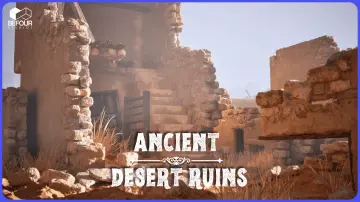
A desert ruin environment with ancient ruins, statues, rocks, and ULAT support for building Egyptian-inspired temples, tombs, and modular scenes.
Category:Unreal Engine,DesertPlatform: Unreal EngineEngine version: 4.26+,5.0+Published: May 22, 2026
Desert
Resource overview
For artists building sun-beaten temples, buried chambers, weathered stone corridors, or a lost tomb half-swallowed by sand, Desert Ruins Environment Offers a focused set of scene ingredients. The package centers on ancient ruins and desert architecture, with supporting meshes, statues, and rocks that point clearly toward Egyptian-inspired environments rather than a broad, all-purpose landscape set.
The visual identity is easy to read from its theme language. Desert, ruins, temple, pyramid, ancient stone, sacred chambers, mysterious carvings, hieroglyphic symbols, and hidden passages all sit within the same creative range. That gives the environment a strong direction for projects that need abandoned monuments, tomb interiors, ritual spaces, or exterior ruin fields framed by sand and erosion. It also gives level artists room to lean into fantasy-inflected history, with cues such as cursed treasure, forgotten relics, golden statues, sacred artefacts, and ancient guardians shaping the mood.
Desert Ruins Environment and the language of ancient stone
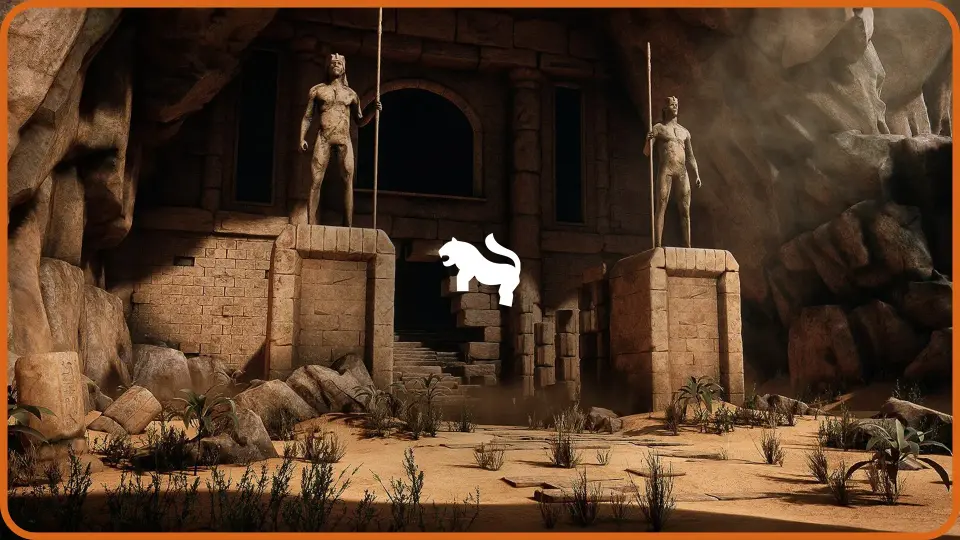
This package is based on a concept and realized as an environment set, which matters because the contents read as parts of a larger visual world instead of disconnected props. Ancient ruins form the backbone of that world. Statues and rocks push the set further toward places that feel uncovered, worn down, or long abandoned. The combination suggests spaces where structure and collapse coexist: intact temple sections beside eroded walls, ceremonial statuary beside broken ground, and rock formations that help the ruins sit naturally within an arid setting.
The repeated desert and ruin themes make the intended tone especially clear. This is not just masonry in a dry biome. Its tags point toward Egyptian ruins, pyramids, tombs of the pharaoh, sacred rituals, monolithic structures, crumbling temples, and weathered stone. Those details support scenes that need a sense of age, ritual significance, and buried history. A developer could use that direction for explorable temple courts, puzzle spaces in hidden chambers, relic-focused adventure levels, or eerie catacombs where architecture and mythology meet.
Even when the pack is used in a stylized or fantasy project, the tags keep the setting grounded in recognizable motifs: sun-baked stones, cracked monuments, dunes of mystery, abandoned citadels, echoing ruins, and faded history. That leaves a resource that can support both broad establishing shots and more intimate spaces like ritual halls, secret passages, and chambers marked by symbolic ornament.
Ancient Ruins, Statues, Meshes, and Rocks as scene anchors
The listed contents are straightforward: Ancient Ruins, Meshes, Statues, and Rocks. That simplicity is useful because each category has a clear role in production.
Ancient ruins provide the structural read of the environment. They define where the player is, whether that is a temple approach, a ruined courtyard, a buried sanctuary, or a collapsed complex overtaken by sand. Meshes broaden how those spaces can be assembled and varied, giving environment artists the pieces needed to shape more than a single fixed composition. Statues introduce focal points and narrative weight. In an Egyptian-leaning ruin set, statuary can imply guardianship, ceremony, power, and forgotten belief systems without requiring extra explanation. Rocks help with transition and grounding, letting built forms meet the natural terrain in a way that feels less staged.
Together, those elements support a scene-building workflow where monumental forms and smaller supporting pieces can reinforce each other. A statue can punctuate an entrance. Rock groupings can frame a collapsed wall. Ruin segments can create corridors, thresholds, and partially open plazas. If a project calls for buried secrets, cursed tomb imagery, or timeworn temple remains, these categories are already aligned with that outcome.
The tags add more texture to how those pieces might be used creatively. Golden statues, sacred chambers, weathered walls, eroded structures, and glistening relic imagery suggest levels that can swing between grandeur and decay. Hidden chambers and undiscovered passages point toward exploration-based layouts. Forbidden catacombs, eerie chambers, and sands of time push the atmosphere toward mystery and danger. None of that changes the core content of the pack, but it does clarify the kinds of moods the environment is meant to carry.
ULAT inside the pack changes how Desert Ruins scenes can be assembled
One of the more practical aspects of this environment is that it includes ULAT, short for Ultimate Level Art Tool. The pack is also stated as compatible with the Ultimate Level Art Tool, reinforcing that the environment is not only about placed art assets but also about a scene-construction workflow.
ULAT is described as allowing fast creation of custom modular buildings. For developers and environment artists, that makes the pack more flexible than a static collection of ruin pieces alone. Modular building tools are most useful when a project needs multiple layouts from a shared visual language: a larger temple complex for one level, a narrower buried corridor for another, or a fragmented ruin zone scattered through an exterior map. Since ULAT also offers a seamless and distinctive way to populate scenes naturally, it supports not just assembly but the broader task of making a location feel inhabited by its own forms and patterns, even when the setting itself is abandoned.
That pairing is especially fitting for a ruin environment. Desert ruins often depend on repetition with variation: columns, walls, broken edges, chambers, pathways, and focal monuments arranged in ways that feel ancient rather than obviously modular. A tool aimed at fast custom modular building helps bridge that gap. It can serve artists who want to block out a sacred hall, stretch a complex into a longer approach to a pyramid, or reshape temple remains into a more exploratory route with hidden corners and layered sightlines.
The translated expansion of the original tool name identifies it as a modular design development tool for mobile and web-based systems. Even without adding technical assumptions beyond that wording, it underlines the tool’s role as part of a structured content-building workflow rather than a purely decorative extra.
Egyptian temples, lost tombs, and fantasy ruins without forced decoration
The strength of this environment lies in how tightly its theme holds together. Egyptian, temple, pyramid, mummy, sand, fantasy, lost tomb, forgotten relic, cursed treasure, sacred rituals, and ancient knowledge all point in the same direction. That gives creative teams a stable base for worldbuilding.
A scene can stay close to archaeological fantasy, emphasizing hieroglyphic symbols, sacred chambers, and weathered stone. It can tilt toward adventure, using golden relics, hidden chambers, and secret passages as visual hooks. It can also move into a darker register through cursed tombs, eerie chambers, forbidden catacombs, and ancient mysticism. Because those themes are already embedded in the pack’s identity, artists do not have to force the setting into a mood it does not support.
This also helps with gameplay presentation. Spaces like ritual halls, tomb interiors, temple courts, and abandoned citadels naturally lend themselves to progression, discovery, and confrontation. Exterior areas can lean on dunes, sunlit ruins, cracked monuments, and arid landscapes. Interior sections can use sacred chambers, mysterious carvings, monolithic forms, and hidden routes to tighten the sense of enclosure and tension.
A practical note on foliage and the best fit for this environment
There is one important boundary around what is shown versus what is included: foliage appears only for showcase purposes and is not part of the pack. For production planning, that means the environment’s core identity should be read through its ruins, statues, meshes, and rocks rather than through added plant dressing. Anyone building with it should treat the desert ruins themselves as the primary visual foundation.
That actually keeps the pack’s strongest use case fairly clear. It suits projects that need ancient desert architecture, ruin-focused scene composition, and a workflow that benefits from ULAT for fast custom modular building and natural scene population. If the target is an Egyptian-inspired temple zone, a pyramid approach, a buried ruin field, or a fantasy tomb with sacred and mysterious overtones, this environment matches that brief closely.
 Desert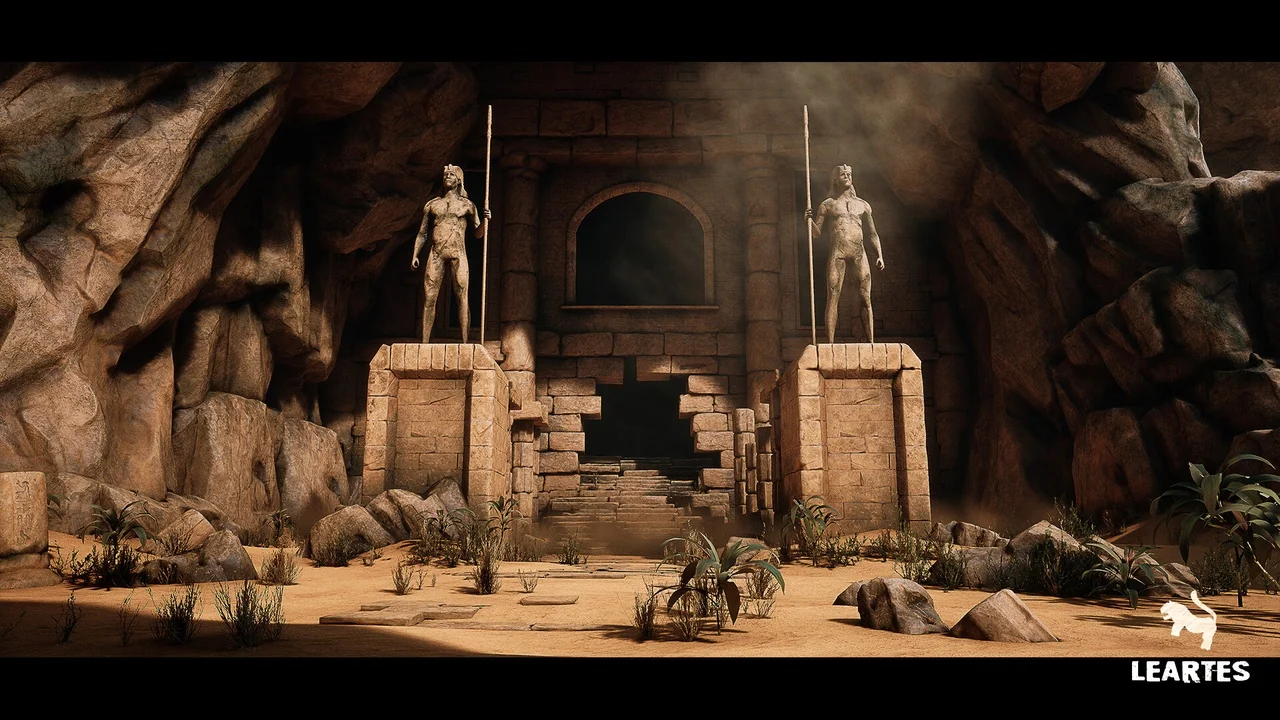
 Desert
 Desert
 Desert