"a338a1d501976271"{"id":"1001395","slug":"vehicle-nitro-vfx-pack","title":"Vehicle Nitro VFX Pack","category":"Spells \u0026 Combat","engine":"4.26+,5.0+","assetVersion":"","engineVersion":"Engine Version: 4.26+,5.0+","tag":"Spells \u0026 Combat","accent":"blue","visual":"mech","summary":"Examine the Vehicle Nitro VFX Pack, featuring 20 Niagara vehicle effects, realistic and futuristic nitro types, start line VFX, and CPU emitter setups.","platform":"Unreal Engine","publishedAt":"2026-10-04T17:18:18.184Z","updatedAt":"2026-10-04T17:18:18.184Z","sourceNotes":[],"fileContents":[],"compatibility":["Unreal Engine","Engine Version: 4.26+,5.0+"],"featuredImage":{"alt":"Vehicle Nitro VFX Pack","src":"/wp-content/uploads/published/2026/10/15158a376d9c-c4fa654d-e9b4-4955-9aec-862413790780-883c342b00.webp"},"hasDownloadLink":true,"downloads":0,"terms":[{"taxonomy":"category","slug":"spells-and-combat","name":"Spells \u0026 Combat"}],"galleryImages":[{"src":"/wp-content/uploads/published/2026/10/080deb539fd7-49c243eb-6dd3-4a94-baad-a89613616449-a7cbf18608.webp","alt":"Vehicle Nitro VFX Pack"},{"src":"/wp-content/uploads/published/2026/10/4676fba48abe-5bf0c34e-e64b-44e6-b506-775072008258-47eac6ab33.webp","alt":"Vehicle Nitro VFX Pack"},{"src":"/wp-content/uploads/published/2026/10/bd2d8169f5e0-30be0e02-c619-43eb-bd73-8343c1a45514-e38c55b94a.webp","alt":"Vehicle Nitro VFX Pack"},{"src":"/wp-content/uploads/published/2026/10/08fb60a30f2b-baea3b9c-1851-4a87-a265-f849dd20b740-ec54beca38.webp","alt":"Vehicle Nitro VFX Pack"},{"src":"/wp-content/uploads/published/2026/10/9039fdc7c438-6c3870da-89d6-44cc-a22a-8bc8424517a0-9ebd06d197.webp","alt":"Vehicle Nitro VFX Pack"},{"src":"/wp-content/uploads/published/2026/10/96aa75cae263-004ad1fa-3589-465c-8410-489d238bf91d-89f9845c5b.webp","alt":"Vehicle Nitro VFX Pack"},{"src":"/wp-content/uploads/published/2026/10/68819689af34-07a89be2-6f5b-4018-975d-97ddd4584e31-35e1d8b949.webp","alt":"Vehicle Nitro VFX Pack"},{"src":"/wp-content/uploads/published/2026/10/0ca99162a529-3c4d43ad-e284-412e-948f-6e5d2f9d90d8-fbb0257c90.webp","alt":"Vehicle Nitro VFX Pack"},{"src":"/wp-content/uploads/published/2026/10/30ff4876facc-81699c6e-8940-46e1-9a82-d7b235f7a014-f37fc2b226.webp","alt":"Vehicle Nitro VFX Pack"},{"src":"/wp-content/uploads/published/2026/10/b6d3acebece3-45be2f1a-2376-4935-88dc-0501f6b959b2-f76fbd9b44.webp","alt":"Vehicle Nitro VFX Pack"}],"accessPanel":{"kind":"resource","title":"Download this resource","eyebrow":"Free Download","message":"Log in or create a free account to start your download.","fileName":"Content.7z","safetyNote":"Resources are manually reviewed before listing to improve quality and reduce obvious risks.","actionLabel":"Download Free","resourceType":"Resource archive"},"contentHtml":"\u003ch2\u003eIntegrating Niagara Vehicle VFX via the VFX_Map\u003c/h2\u003e\u003cp\u003eWorking with vehicle particle setups begins with staging and verification. The package supplies a dedicated level named VFX_Map, which functions as a central testbed to preview the visual assets before attaching them to car rigs or actor blueprints. Within this map, artists can observe how all 20 Niagara VFX behave in real time, checking particle volume, velocity, and visual boundaries against static meshes.\u003c/p\u003e\u003cp\u003eBecause the particle effects run on CPU emitters, testing them directly within the included demonstration scene establishes how emitter cycles interact with system performance under Windows. Integrating these assets into an active vehicle project involves selecting the desired emitter type, identifying socket positions on a chassis or exhaust tailpipe, and triggering the Niagara system via gameplay events like acceleration or nitro boost inputs. The provided map eliminates the need to configure a level from scratch just to isolate and review individual particle nodes.\u003c/p\u003e\u003ch2\u003eFuturistic Nitro Types and Realistic Exhaust Variants\u003c/h2\u003e\u003cp\u003eThe collection spans two distinct design styles: realistic nitros and futuristic nitro types. This dual focus supports diverse visual directions, whether a project demands grounded combustion or high-tech vehicular propulsion. The realistic variations emphasize physical combustion, producing bursts of fire, thermal trails, and sudden explosion-style ignition bursts typical of pressurized chemical fuel injections.\u003c/p\u003e\u003cp\u003eFor science-fiction or arcade projects, the futuristic nitro types incorporate energetic visual motifs like lightning, concentrated energy trails, and dynamic color arcs. These effects convey extreme velocity and alternative power plants through sharp, energized shapes rather than typical fuel exhaust. Having both aesthetics built within the same modular framework lets developers experiment with vehicle performance tiers, visual upgrades, or distinct faction styles across a racing roster.\u003c/p\u003e\u003ch2\u003eStaging Race Starts with Start Line VFX and Wheel Tracks\u003c/h2\u003e\u003cp\u003eBeyond exhaust plumes, the package provides supporting environmental assets to frame competitive driving scenarios. Racing games require distinct visual cues at the beginning of a heat, which are addressed here by dedicated start VFX and start line VFX. These elements establish a prominent visual barrier and countdown indicator across the track, focusing player attention before the green flag.\u003c/p\u003e\u003cp\u003eSurface contact is reinforced by the inclusion of 2 wheel tracks. These track elements visually tie tire physics to the racing surface, offering grounded feedback when vehicles launch, brake, or drift away from the starting grid. Combining the start line markers, launch effects, and wheel tracks provides a cohesive visual loop from the countdown idle to full acceleration down the raceway.\u003c/p\u003e\u003ch2\u003eRecoloring and Editing Through User Parameters and Material Instances\u003c/h2\u003e\u003cp\u003eTailoring the visual identity of each burst is handled through exposed user parameters and a tiered material structure. The asset pack includes 10 main materials alongside 27 material instances, giving creators direct control over visual behavior without requiring lower-level shader reconstruction. Through easy recoloring workflows, particle hues can be aligned with custom vehicle paint schemes, nitro tank tiers, or team identities.\u003c/p\u003e\u003cp\u003eEasy editing workflows allow quick adjustments to parameter inputs such as particle scale, intensity, and burst duration. The package also incorporates 12 static meshes and 12 textures, featuring a unique texture size of 600x4096. This elongated texture dimension suits linear trail generation, stretching gradients, and flame streams cleanly along a vehicle's vector of motion. Adjusting these assets via material instances preserves runtime memory while delivering distinct color and density variations.\u003c/p\u003e\u003ch2\u003eTechnical Architecture, Texture Dimensions, and Project Support\u003c/h2\u003e\u003cp\u003eThe technical structure relies on Niagara particle systems driven by CPU emitters, built explicitly for Windows execution. Level of detail (LOD) states are not included (LODs: NO), meaning the particle calculations render at full fidelity throughout the system's active lifecycle. Creators deploying these effects across crowded grids should account for CPU simulation passes when triggering numerous simultaneous nitro boosts across multiple vehicles.\u003c/p\u003e\u003cp\u003eAsset inventory at a glance:\u003c/p\u003e\u003cul\u003e\u003cli\u003e20 Niagara VFX systems\u003c/li\u003e\u003cli\u003e12 Static Meshes\u003c/li\u003e\u003cli\u003e10 Main Materials\u003c/li\u003e\u003cli\u003e27 Material Instances\u003c/li\u003e\u003cli\u003e12 Textures formatted at 600x4096 resolution\u003c/li\u003e\u003cli\u003e1 VFX_Map demonstration space\u003c/li\u003e\u003cli\u003eCPU emitter pipelines targeting Windows\u003c/li\u003e\u003c/ul\u003e\u003cp\u003eFor technical troubleshooting, the developer provides ongoing correspondence to assist with package issues and pipeline hurdles, ensuring that any integration snags within a project's particle hierarchy can be promptly resolved.\u003c/p\u003e\n\n\u003ch2\u003eContinue Browsing Similar Packs\u003c/h2\u003e\n\u003cul\u003e\n\u003cli\u003e\u003ca href=\"https://3dcghub.com/rotor-downwash-fx-vdb/\" title=\"Rotor Downwash FX VDB\"\u003eRotor Downwash FX VDB\u003c/a\u003e\u003c/li\u003e\n\u003cli\u003e\u003ca href=\"https://3dcghub.com/flying-vehicle-fx/\" title=\"Flying Vehicle FX\"\u003eFlying Vehicle FX\u003c/a\u003e\u003c/li\u003e\n\u003cli\u003e\u003ca href=\"https://3dcghub.com/plane-crash-vfx/\" title=\"Plane Crash VFX\"\u003ePlane Crash VFX\u003c/a\u003e\u003c/li\u003e\n\u003cli\u003e\u003ca href=\"https://3dcghub.com/rocket-thruster-exhaust-fx/\" title=\"Rocket Thruster Exhaust FX\"\u003eRocket Thruster Exhaust FX\u003c/a\u003e\u003c/li\u003e\n\u003cli\u003e\u003ca href=\"https://3dcghub.com/wall-fx-pack/\" title=\"Wall FX pack\"\u003eWall FX pack\u003c/a\u003e\u003c/li\u003e\n\u003c/ul\u003e","contentTextLength":4956,"navigation":{"current":6,"total":3338,"previous":{"id":"1001396","slug":"brushify-floating-islands","title":"Brushify - Floating Islands","category":"Mountain","platform":"Unreal Engine","updatedAt":"2026-10-04T17:50:49.947Z"},"next":{"id":"1001394","slug":"post-soviet-kitchen","title":"Post Soviet Kitchen","category":"Interior","platform":"Unreal Engine","updatedAt":"2026-10-04T17:17:29.857Z"}},"relatedResources":[{"id":"16649","slug":"rotor-downwash-fx-vdb","title":"Rotor Downwash FX VDB","category":"Spells \u0026 Combat","engine":"5.4+","assetVersion":"Engine version: 5.4+","engineVersion":"5.3","tag":"Spells \u0026 Combat","accent":"blue","visual":"city","summary":"Improve the realism of your flight simulations with the Rotor Downwash FX VDB pack. This collection features ten specialized effects designed to simulate the intense wind and dust displacement caused by rotors.","platform":"Unreal Engine","publishedAt":"2026-03-12T17:45:18.000Z","updatedAt":"2026-04-19T15:43:44.000Z","sourceNotes":[],"fileContents":[],"compatibility":["Unreal Engine","Engine version: 5.4+"],"featuredImage":{"alt":"Rotor Downwash FX VDB","src":"https://3dcghub.com/wp-content/uploads/2026/03/9e7df733-1668-42e2-957a-be321482d1fb.webp"},"hasDownloadLink":true,"downloads":1},{"id":"17173","slug":"flying-vehicle-fx","title":"Flying Vehicle FX","category":"Variety","engine":"4.27,5.0+","assetVersion":"Engine version: 4.27,5.0+","engineVersion":"4.27","tag":"Variety","accent":"blue","visual":"animation","summary":"Enhance your aerospace projects with Flying Vehicle FX, a collection of 14 specialized visual systems. From sonic booms to countermeasure flares, this pack adds realistic detail to any flying craft.","platform":"Unreal Engine","publishedAt":"2026-03-13T13:54:09.000Z","updatedAt":"2026-04-19T15:43:36.000Z","sourceNotes":[],"fileContents":[],"compatibility":["Unreal Engine","Engine version: 4.27,5.0+"],"featuredImage":{"alt":"Flying Vehicle FX","src":"https://3dcghub.com/wp-content/uploads/2026/03/561b9040-bfd6-4970-8b31-c1840f1b9b71.webp"},"hasDownloadLink":true,"downloads":0},{"id":"17376","slug":"plane-crash-vfx","title":"Plane Crash VFX","category":"Variety","engine":"4.26+,5.0+","assetVersion":"Engine version: 4.26+,5.0+","engineVersion":"4.26","tag":"Variety","accent":"blue","visual":"luts","summary":"Create high-stakes cinematic aircraft destruction with the Plane Crash VFX pack. This toolkit features customizable Niagara effects for jets, helicopters, and UFOs, complete with adjustable impact materials.","platform":"Unreal Engine","publishedAt":"2026-03-13T14:27:00.000Z","updatedAt":"2026-04-19T15:43:33.000Z","sourceNotes":[],"fileContents":[],"compatibility":["Unreal Engine","Engine version: 4.26+,5.0+"],"featuredImage":{"alt":"Plane Crash VFX","src":"https://3dcghub.com/wp-content/uploads/2026/03/9658262a-048d-41ad-a0de-fc950a697674.webp"},"hasDownloadLink":true,"downloads":0}]}
Spells & Combat
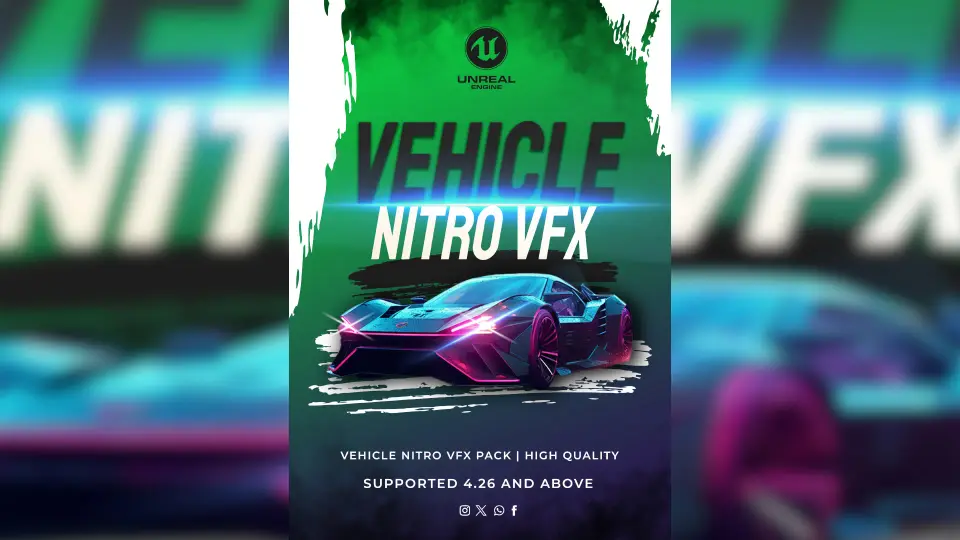
Vehicle Nitro VFX Pack
Examine the Vehicle Nitro VFX Pack, featuring 20 Niagara vehicle effects, realistic and futuristic nitro types, start line VFX, and CPU emitter setups.
Working with vehicle particle setups begins with staging and verification. The package supplies a dedicated level named VFX_Map, which functions as a central testbed to preview the visual assets before attaching them to car rigs or actor blueprints. Within this map, artists can observe how all 20 Niagara VFX behave in real time, checking particle volume, velocity, and visual boundaries against static meshes.
Because the particle effects run on CPU emitters, testing them directly within the included demonstration scene establishes how emitter cycles interact with system performance under Windows. Integrating these assets into an active vehicle project involves selecting the desired emitter type, identifying socket positions on a chassis or exhaust tailpipe, and triggering the Niagara system via gameplay events like acceleration or nitro boost inputs. The provided map eliminates the need to configure a level from scratch just to isolate and review individual particle nodes.
Futuristic Nitro Types and Realistic Exhaust Variants
The collection spans two distinct design styles: realistic nitros and futuristic nitro types. This dual focus supports diverse visual directions, whether a project demands grounded combustion or high-tech vehicular propulsion. The realistic variations emphasize physical combustion, producing bursts of fire, thermal trails, and sudden explosion-style ignition bursts typical of pressurized chemical fuel injections.
For science-fiction or arcade projects, the futuristic nitro types incorporate energetic visual motifs like lightning, concentrated energy trails, and dynamic color arcs. These effects convey extreme velocity and alternative power plants through sharp, energized shapes rather than typical fuel exhaust. Having both aesthetics built within the same modular framework lets developers experiment with vehicle performance tiers, visual upgrades, or distinct faction styles across a racing roster.
Staging Race Starts with Start Line VFX and Wheel Tracks
Beyond exhaust plumes, the package provides supporting environmental assets to frame competitive driving scenarios. Racing games require distinct visual cues at the beginning of a heat, which are addressed here by dedicated start VFX and start line VFX. These elements establish a prominent visual barrier and countdown indicator across the track, focusing player attention before the green flag.
Surface contact is reinforced by the inclusion of 2 wheel tracks. These track elements visually tie tire physics to the racing surface, offering grounded feedback when vehicles launch, brake, or drift away from the starting grid. Combining the start line markers, launch effects, and wheel tracks provides a cohesive visual loop from the countdown idle to full acceleration down the raceway.
Recoloring and Editing Through User Parameters and Material Instances
Tailoring the visual identity of each burst is handled through exposed user parameters and a tiered material structure. The asset pack includes 10 main materials alongside 27 material instances, giving creators direct control over visual behavior without requiring lower-level shader reconstruction. Through easy recoloring workflows, particle hues can be aligned with custom vehicle paint schemes, nitro tank tiers, or team identities.
Easy editing workflows allow quick adjustments to parameter inputs such as particle scale, intensity, and burst duration. The package also incorporates 12 static meshes and 12 textures, featuring a unique texture size of 600x4096. This elongated texture dimension suits linear trail generation, stretching gradients, and flame streams cleanly along a vehicle's vector of motion. Adjusting these assets via material instances preserves runtime memory while delivering distinct color and density variations.
Technical Architecture, Texture Dimensions, and Project Support
The technical structure relies on Niagara particle systems driven by CPU emitters, built explicitly for Windows execution. Level of detail (LOD) states are not included (LODs: NO), meaning the particle calculations render at full fidelity throughout the system's active lifecycle. Creators deploying these effects across crowded grids should account for CPU simulation passes when triggering numerous simultaneous nitro boosts across multiple vehicles.
Asset inventory at a glance:
20 Niagara VFX systems
12 Static Meshes
10 Main Materials
27 Material Instances
12 Textures formatted at 600x4096 resolution
1 VFX_Map demonstration space
CPU emitter pipelines targeting Windows
For technical troubleshooting, the developer provides ongoing correspondence to assist with package issues and pipeline hurdles, ensuring that any integration snags within a project's particle hierarchy can be promptly resolved.
 Spells & Combat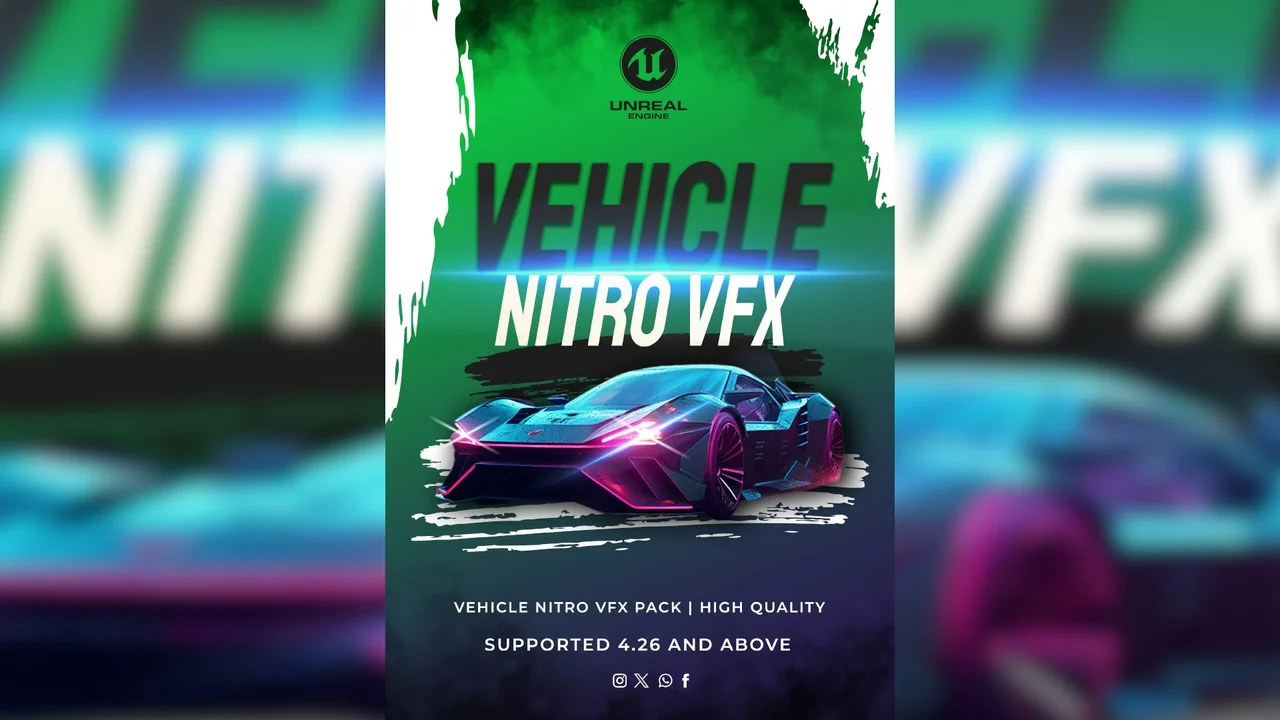
 Spells & Combat
 Variety
 Variety