"fa182e0cd0a6ea73"{"id":"1001846","slug":"valley-of-guldur","title":"Valley of Guldur","category":"Medieval","engine":"4.20+,5.0+","assetVersion":"","engineVersion":"Engine Version: 4.20+,5.0+","tag":"Medieval","accent":"blue","visual":"mech","summary":"Valley of Guldur delivers modular dark fantasy ruins, catacombs, manual LODs, custom collision, 4K textures, parallax shaders, and simple wind in UE5.","platform":"Unreal Engine","publishedAt":"2026-10-21T08:37:10.656Z","updatedAt":"2026-10-21T08:37:10.656Z","sourceNotes":[],"fileContents":[],"compatibility":["Unreal Engine","Engine Version: 4.20+,5.0+"],"featuredImage":{"alt":"Valley of Guldur","src":"/wp-content/uploads/published/2026/10/3fd2a0926441-d70f314b-f68d-4b14-b1b1-1abdc61a8c88-3ed0b29781.webp"},"hasDownloadLink":true,"downloads":0,"terms":[{"taxonomy":"category","slug":"medieval","name":"Medieval"}],"galleryImages":[{"src":"/wp-content/uploads/published/2026/10/fb7866688f74-0437f83d-1e4e-4bfb-9888-18cbedf21c8a-b9d5f73707.webp","alt":"Valley of Guldur"},{"src":"/wp-content/uploads/published/2026/10/79ac8e422d3d-e5c008bd-8714-4910-8a0d-f71186aa602a-e61e3d2d7d.webp","alt":"Valley of Guldur"},{"src":"/wp-content/uploads/published/2026/10/15973a64b08e-ff624cac-1b8e-45b0-9158-9ff314ddc28a-c0df46af45.webp","alt":"Valley of Guldur"},{"src":"/wp-content/uploads/published/2026/10/75146b08fed5-9e8c3d89-3e90-40e1-972f-915ffec3d803-35b566395c.webp","alt":"Valley of Guldur"},{"src":"/wp-content/uploads/published/2026/10/9e8bfb4db468-6f32030c-92a9-4087-b0bc-2c1fae4230ac-53eca3a25e.webp","alt":"Valley of Guldur"},{"src":"/wp-content/uploads/published/2026/10/0cf459e8fdd1-66ee5738-f44d-4a34-9527-9524076925dc-ca04ba17e5.webp","alt":"Valley of Guldur"},{"src":"/wp-content/uploads/published/2026/10/82712295b5d7-0dfe87c6-a4de-4cb9-bbbf-87da58646ddc-47e21abdb3.webp","alt":"Valley of Guldur"},{"src":"/wp-content/uploads/published/2026/10/66df00f767ed-87279167-0216-49d1-9253-667815220124-a463a6f7eb.webp","alt":"Valley of Guldur"},{"src":"/wp-content/uploads/published/2026/10/3af5ddd9bf9c-feec4f47-9e6b-4103-9d01-f5d32682f5a1-fa3579de28.webp","alt":"Valley of Guldur"},{"src":"/wp-content/uploads/published/2026/10/ae242ffacfc7-4183b021-2454-40a4-84e5-27b2daf186df-a0e144b33a.webp","alt":"Valley of Guldur"}],"accessPanel":{"kind":"resource","title":"Download this resource","eyebrow":"Free Download","message":"Log in or create a free account to start your download.","fileName":"Content.7z","safetyNote":"Resources are manually reviewed before listing to improve quality and reduce obvious risks.","actionLabel":"Download Free","resourceType":"Resource archive"},"contentHtml":"\u003ch2\u003eModular Architecture and Dark Necropolis Environments\u003c/h2\u003e\n\u003cp\u003eValley of Guldur establishes a dark fantasy environment focused on modular construction, ruined fortifications, and subterranean burial networks. The asset collection spans dungeon passages, catacombs, castle ruins, and necropolis chambers marked by bone formations and aged stone. Because the architectural pieces adhere to a modular layout, individual structural elements can be snapped, stacked, and rearranged to construct sprawling underground complexes or decaying surface citadels.\u003c/p\u003e\n\u003cp\u003eThe visual direction emphasizes a realistic presentation of grim fantasy locations. Weathered masonry, carved crypt features, and structural debris let level designers assemble diverse spaces, ranging from narrow, suffocating catacomb tunnels to open, derelict courtyards dominated by ruined towers and ancestral lords' tombs. Integrating bone elements directly into structural and decor components reinforces the necropolis theme throughout interior and exterior scenes.\u003c/p\u003e \u003ch2\u003ePrecision Collision Meshes and Hand-Adjusted LODs in Valley of Guldur\u003c/h2\u003e\n\u003cp\u003eGeometry performance and player navigation depend heavily on how meshes handle distance rendering and physical contact. Every object in Valley of Guldur includes manually adjusted levels of detail (LODs) rather than relying exclusively on unrefined automatic reduction passes. Hand-tuned LOD transitions preserve the silhouette and silhouette-defining features of complex ruin walls, bone piles, and architectural arches when viewed from across a large hall or outdoor expanse, switching step-by-step to lighter polygon densities as the camera pulls away.\u003c/p\u003e\n\u003cp\u003eHand-crafted collision meshes accompany every piece across the package. Automatic collision generators often bridge narrow corridors, trap player characters on uneven rubble, or leave invisible gaps around arches and doorway frames. By manually configuring collision hulls to match the actual contours of ruined castle steps, broken floor slabs, and catacomb entryways, the assets guarantee clean character movement, accurate projectile trajectories, and predictable physics interactions throughout complex multi-level dungeons.\u003c/p\u003e \u003ch2\u003e4K Texture Sets and Parallax Surface Depth\u003c/h2\u003e\n\u003cp\u003eSurface definition across Valley of Guldur relies on high-resolution texturing, with the majority of meshes utilizing 4K texture sets. These high-resolution maps capture fine surface details: cracked stone faces, aged mortar seams, weathered carvings, and skeletal remains embedded in catacomb walls. The high pixel density keeps surfaces crisp even when the player character inspects surfaces at close proximity inside tight dungeon corridors or narrow tunnelways.\u003c/p\u003e\n\u003cp\u003eTo push geometric realism beyond flat texture mapping without placing excessive demands on polygon budgets, the package incorporates parallax materials. Parallax shaders simulate perceived physical depth across stone crevices, uneven masonry, and rough structural surfaces. Light sources raking across deep floor joints or crumbling brick walls cast realistic self-shadowing and depth shifts as the player perspective shifts, giving walls and pathways a tactile, heavy appearance consistent with realistic dark fantasy settings.\u003c/p\u003e \u003ch2\u003eDynamic Material Systems: Leaves, Particles, and Simple Wind\u003c/h2\u003e\n\u003cp\u003eStatic architecture is complemented by reactive environmental materials that add subtle motion and atmosphere across ruined scenes. Valley of Guldur includes dedicated materials for leaves, particle systems, and simple wind vertex manipulation. The wind implementation gives organic elements gentle displacement, preventing exterior ruin courtyards, breached castle walls, and foliage-dusted cemetery grounds from appearing frozen in space.\u003c/p\u003e\n\u003cp\u003eParticle materials integrated into the collection support the moody, atmospheric conditions required by dark necropolis settings. Suspended dust within subterranean catacombs, floating spores, or drifting debris caught in subtle drafts help anchor the lighting within dark interiors. When combined with the leaf materials and wind motion, the particle setup allows creators to stage believable transitions where forgotten exterior ramparts meet damp, subterranean crypts.\u003c/p\u003e \u003ch2\u003eUnreal Engine 5 Implementation for Catacombs and Castle Ruins\u003c/h2\u003e\n\u003cp\u003eCaptured in Unreal Engine 5, the package demonstrates high visual fidelity under advanced rendering conditions. The interplay between 4K surface maps, parallax depth, and realistic lighting highlights the decayed surfaces of ruined strongholds, dark arches, and bone vaults. The modular structure allows developers working in Unreal Engine 5 to rapidly assemble full levels, prototype dungeon layouts, and stage moody fantasy encounters.\u003c/p\u003e\n\u003cp\u003eThe collection serves dark fantasy adventure projects, dungeon crawlers, tactical encounters, and narrative-driven exploration games set within catacombs or ruined fortresses. With collision and LOD steps pre-configured across all props and structural units, the assets eliminate repetitive technical cleanup and fit directly into functional level assembly pipelines.\u003c/p\u003e\n\n\u003ch2\u003eExplore Similar Assets\u003c/h2\u003e\n\u003cul\u003e\n\u003cli\u003e\u003ca href=\"https://3dcghub.com/deadly-ruins-modular-asset-pack/\" title=\"Deadly Ruins - Modular asset pack\"\u003eDeadly Ruins - Modular asset pack\u003c/a\u003e\u003c/li\u003e\n\u003cli\u003e\u003ca href=\"https://3dcghub.com/modular-swamp-shack-pack/\" title=\"Modular Swamp Shack Pack\"\u003eModular Swamp Shack Pack\u003c/a\u003e\u003c/li\u003e\n\u003cli\u003e\u003ca href=\"https://3dcghub.com/ancient-cave-ruins-ancient-temple-ruins-ancient-valley/\" title=\"Ancient Cave Ruins (Ancient Temple Ruins, Ancient Valley )\"\u003eAncient Cave Ruins (Ancient Temple Ruins, Ancient Valley )\u003c/a\u003e\u003c/li\u003e\n\u003cli\u003e\u003ca href=\"https://3dcghub.com/sharurs-lost-monastery-ruins/\" title=\"Sharur\u0026#039;s Lost Monastery Ruins\"\u003eSharur\u0026#039;s Lost Monastery Ruins\u003c/a\u003e\u003c/li\u003e\n\u003cli\u003e\u003ca href=\"https://3dcghub.com/castle-modular-pack/\" title=\"Castle Modular Pack\"\u003eCastle Modular Pack\u003c/a\u003e\u003c/li\u003e\n\u003c/ul\u003e","contentTextLength":5245,"navigation":{"current":10,"total":3789,"previous":{"id":"1001847","slug":"countryside-race-game-pack","title":"Countryside Race Game Pack","category":"Towns \u0026 Villages","platform":"Unreal Engine","updatedAt":"2026-10-21T08:38:49.280Z"},"next":{"id":"1001845","slug":"uscans-dishes-01","title":"Uscans Dishes 01","category":"Tools, Objects \u0026 Decor","platform":"Unreal Engine","updatedAt":"2026-10-21T08:36:10.673Z"}},"relatedResources":[{"id":"1001627","slug":"deadly-ruins-modular-asset-pack","title":"Deadly Ruins - Modular asset pack","category":"Medieval","engine":"4.26+,5.0+","assetVersion":"","engineVersion":"Engine Version: 4.26+,5.0+","tag":"Medieval","accent":"blue","visual":"mech","summary":"Deadly Ruins offers over 150 modular meshes, 2K and 4K textures, advanced blending materials, and destroyed prop variants for dark fantasy environments.","platform":"Unreal Engine","publishedAt":"2026-10-13T02:04:16.811Z","updatedAt":"2026-10-13T02:04:16.811Z","sourceNotes":[],"fileContents":[],"compatibility":["Unreal Engine","Engine Version: 4.26+,5.0+"],"featuredImage":{"alt":"Deadly Ruins - Modular asset pack","src":"/wp-content/uploads/published/2026/10/f494e78f4a29-f27eb254-b7ef-473f-a1e3-f3cb3be46c1b-f8c22d6732.webp"},"hasDownloadLink":true,"downloads":0},{"id":"1001485","slug":"modular-swamp-shack-pack","title":"Modular Swamp Shack Pack","category":"Medieval","engine":"4.15+,5.0+","assetVersion":"","engineVersion":"Engine Version: 4.15+,5.0+","tag":"Medieval","accent":"blue","visual":"mech","summary":"Construct detailed wetlands with the Modular Swamp Shack Pack, featuring 2k-4k textures, vertex paint moss shaders, and animated river mechanisms.","platform":"Unreal Engine","publishedAt":"2026-10-08T09:15:20.140Z","updatedAt":"2026-10-08T09:15:20.140Z","sourceNotes":[],"fileContents":[],"compatibility":["Unreal Engine","Engine Version: 4.15+,5.0+"],"featuredImage":{"alt":"Modular Swamp Shack Pack","src":"/wp-content/uploads/published/2026/10/5abd5653389f-9cf78db7-2d54-478d-b722-fbf3ba6659ca-cb608b896e.webp"},"hasDownloadLink":true,"downloads":0},{"id":"27336","slug":"ancient-cave-ruins-ancient-temple-ruins-ancient-valley","title":"Ancient Cave Ruins (Ancient Temple Ruins, Ancient Valley )","category":"Dungeon","engine":"4.26+,5.0+","assetVersion":"Engine version: 4.26+,5.0+","engineVersion":"","tag":"Dungeon","accent":"blue","visual":"city","summary":"Ancient Cave Ruins focuses on stone-heavy cave and ruin pieces for fantasy spaces above or below ground. Its mix of cliffs, rocks, columns, slabs, Blueprint meshes, and landscape handling gives the scene a practical starting point.","platform":"Unreal Engine","publishedAt":"2026-04-24T06:21:26.000Z","updatedAt":"2026-04-24T06:21:28.000Z","sourceNotes":[],"fileContents":[],"compatibility":["Unreal Engine","Engine version: 4.26+,5.0+"],"featuredImage":{"alt":"Ancient Cave Ruins (Ancient Temple Ruins, Ancient Valley )","src":"https://3dcghub.com/wp-content/uploads/2026/04/df0c90184d5e_562c282a-fccc-4389-bd9c-084caf5e1f98.webp"},"hasDownloadLink":true,"downloads":0}]}
Medieval
Valley of Guldur
Valley of Guldur delivers modular dark fantasy ruins, catacombs, manual LODs, custom collision, 4K textures, parallax shaders, and simple wind in UE5.
Category:Unreal Engine,MedievalPlatform: Unreal EngineEngine Version: 4.20+,5.0+Published: Oct 21, 2026
Medieval
Resource overview
Modular Architecture and Dark Necropolis Environments
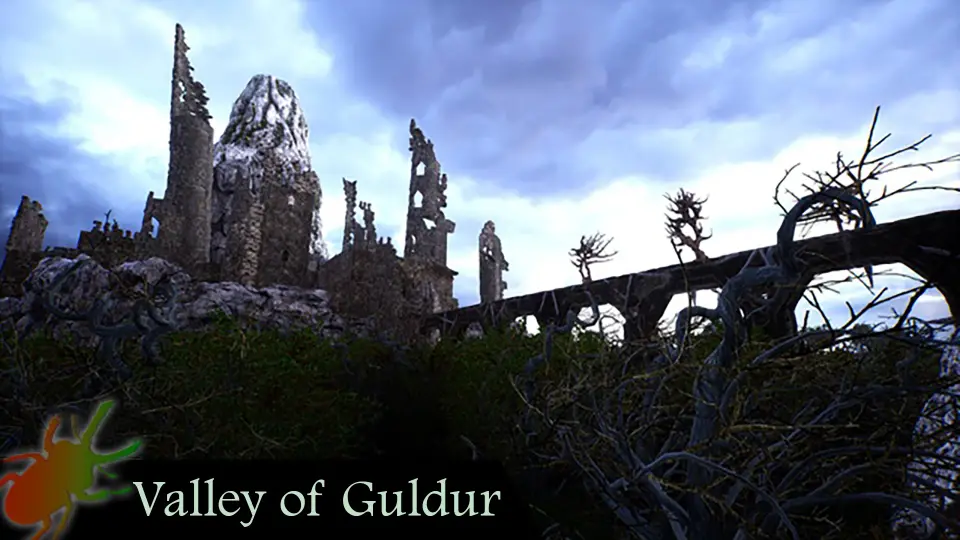
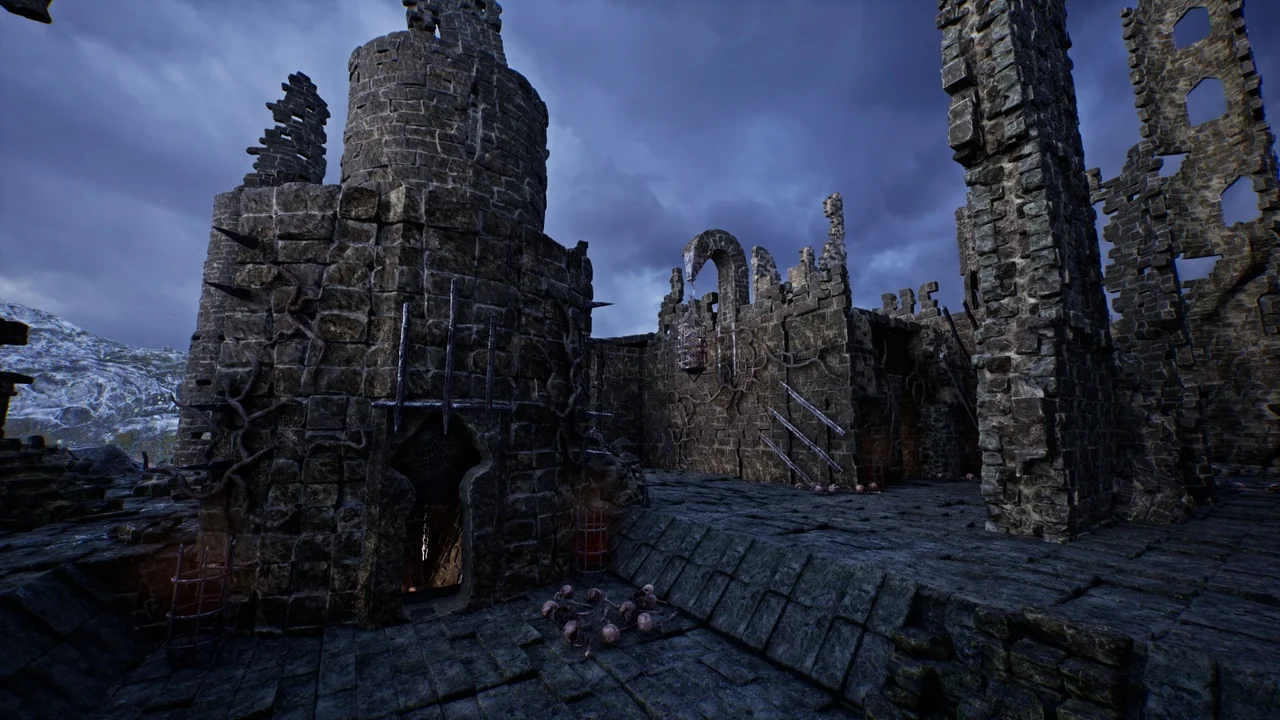
Valley of Guldur establishes a dark fantasy environment focused on modular construction, ruined fortifications, and subterranean burial networks. The asset collection spans dungeon passages, catacombs, castle ruins, and necropolis chambers marked by bone formations and aged stone. Because the architectural pieces adhere to a modular layout, individual structural elements can be snapped, stacked, and rearranged to construct sprawling underground complexes or decaying surface citadels.
The visual direction emphasizes a realistic presentation of grim fantasy locations. Weathered masonry, carved crypt features, and structural debris let level designers assemble diverse spaces, ranging from narrow, suffocating catacomb tunnels to open, derelict courtyards dominated by ruined towers and ancestral lords' tombs. Integrating bone elements directly into structural and decor components reinforces the necropolis theme throughout interior and exterior scenes.
Precision Collision Meshes and Hand-Adjusted LODs in Valley of Guldur
Geometry performance and player navigation depend heavily on how meshes handle distance rendering and physical contact. Every object in Valley of Guldur includes manually adjusted levels of detail (LODs) rather than relying exclusively on unrefined automatic reduction passes. Hand-tuned LOD transitions preserve the silhouette and silhouette-defining features of complex ruin walls, bone piles, and architectural arches when viewed from across a large hall or outdoor expanse, switching step-by-step to lighter polygon densities as the camera pulls away.
Hand-crafted collision meshes accompany every piece across the package. Automatic collision generators often bridge narrow corridors, trap player characters on uneven rubble, or leave invisible gaps around arches and doorway frames. By manually configuring collision hulls to match the actual contours of ruined castle steps, broken floor slabs, and catacomb entryways, the assets guarantee clean character movement, accurate projectile trajectories, and predictable physics interactions throughout complex multi-level dungeons.
4K Texture Sets and Parallax Surface Depth
Surface definition across Valley of Guldur relies on high-resolution texturing, with the majority of meshes utilizing 4K texture sets. These high-resolution maps capture fine surface details: cracked stone faces, aged mortar seams, weathered carvings, and skeletal remains embedded in catacomb walls. The high pixel density keeps surfaces crisp even when the player character inspects surfaces at close proximity inside tight dungeon corridors or narrow tunnelways.
To push geometric realism beyond flat texture mapping without placing excessive demands on polygon budgets, the package incorporates parallax materials. Parallax shaders simulate perceived physical depth across stone crevices, uneven masonry, and rough structural surfaces. Light sources raking across deep floor joints or crumbling brick walls cast realistic self-shadowing and depth shifts as the player perspective shifts, giving walls and pathways a tactile, heavy appearance consistent with realistic dark fantasy settings.
Dynamic Material Systems: Leaves, Particles, and Simple Wind
Static architecture is complemented by reactive environmental materials that add subtle motion and atmosphere across ruined scenes. Valley of Guldur includes dedicated materials for leaves, particle systems, and simple wind vertex manipulation. The wind implementation gives organic elements gentle displacement, preventing exterior ruin courtyards, breached castle walls, and foliage-dusted cemetery grounds from appearing frozen in space.
Particle materials integrated into the collection support the moody, atmospheric conditions required by dark necropolis settings. Suspended dust within subterranean catacombs, floating spores, or drifting debris caught in subtle drafts help anchor the lighting within dark interiors. When combined with the leaf materials and wind motion, the particle setup allows creators to stage believable transitions where forgotten exterior ramparts meet damp, subterranean crypts.
Unreal Engine 5 Implementation for Catacombs and Castle Ruins
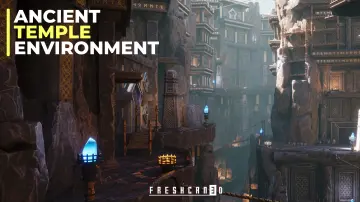
Captured in Unreal Engine 5, the package demonstrates high visual fidelity under advanced rendering conditions. The interplay between 4K surface maps, parallax depth, and realistic lighting highlights the decayed surfaces of ruined strongholds, dark arches, and bone vaults. The modular structure allows developers working in Unreal Engine 5 to rapidly assemble full levels, prototype dungeon layouts, and stage moody fantasy encounters.
The collection serves dark fantasy adventure projects, dungeon crawlers, tactical encounters, and narrative-driven exploration games set within catacombs or ruined fortresses. With collision and LOD steps pre-configured across all props and structural units, the assets eliminate repetitive technical cleanup and fit directly into functional level assembly pipelines.
 Medieval
 Medieval
 Medieval
 Dungeon