"efaa631e936fd3ee"{"id":"1002224","slug":"survival-game-graffitti-and-dirt-texture-set","title":"SURVIVAL GAME GRAFFITTI AND DIRT TEXTURE SET","category":"Art \u0026 Traditional","engine":"4.26+,5.0+","assetVersion":"","engineVersion":"Engine Version: 4.26+,5.0+","tag":"Art \u0026 Traditional","accent":"blue","visual":"luts","summary":"A detailed breakdown of the Survival Game Graffiti and Dirt Texture Set, featuring over 100 textures and editable PSDs for gritty survival environments.","platform":"Unreal Engine","publishedAt":"2026-10-29T15:23:40.699Z","updatedAt":"2026-10-29T15:23:40.699Z","sourceNotes":[],"fileContents":[],"compatibility":["Unreal Engine","Engine Version: 4.26+,5.0+"],"featuredImage":{"alt":"SURVIVAL GAME GRAFFITTI AND DIRT TEXTURE SET","src":"/wp-content/uploads/published/2026/10/bd3356e15d86-7bfa6a90-d427-48d1-b573-5019e6afc669-7b34de2673.webp"},"hasDownloadLink":true,"downloads":0,"terms":[{"taxonomy":"category","slug":"art-and-traditional","name":"Art \u0026 Traditional"}],"galleryImages":[{"src":"/wp-content/uploads/published/2026/10/deac8937f5b9-39655676-ac6c-431e-a12b-7b1c8e9e8a3d-bc5a58edf8.webp","alt":"SURVIVAL GAME GRAFFITTI AND DIRT TEXTURE SET"},{"src":"/wp-content/uploads/published/2026/10/642faf8d4fa9-ef50bded-2167-4c3b-a074-b734dbeee647-dda33a6317.webp","alt":"SURVIVAL GAME GRAFFITTI AND DIRT TEXTURE SET"},{"src":"/wp-content/uploads/published/2026/10/89be9171722b-a8e73bdb-de4f-4c7f-b590-4b121e403cf6-9f7c691320.webp","alt":"SURVIVAL GAME GRAFFITTI AND DIRT TEXTURE SET"},{"src":"/wp-content/uploads/published/2026/10/987654b1c373-7701a950-8bed-4d0c-8887-24f4a5e71354-0a47281e53.webp","alt":"SURVIVAL GAME GRAFFITTI AND DIRT TEXTURE SET"},{"src":"/wp-content/uploads/published/2026/10/58db6e8be00b-cbabd68f-7027-4f03-958d-238b2283ccfb-9c03b276a7.webp","alt":"SURVIVAL GAME GRAFFITTI AND DIRT TEXTURE SET"},{"src":"/wp-content/uploads/published/2026/10/38787c84334f-a73aaa57-b265-4ffc-9e5a-1fbe1eba2163-a4edf7429b.webp","alt":"SURVIVAL GAME GRAFFITTI AND DIRT TEXTURE SET"},{"src":"/wp-content/uploads/published/2026/10/6b402517b9b7-68c0d623-653d-4e8e-b115-f12b05732ca4-15b6e34281.webp","alt":"SURVIVAL GAME GRAFFITTI AND DIRT TEXTURE SET"},{"src":"/wp-content/uploads/published/2026/10/4493f4bb2d6b-fbd6a6e5-cda9-481b-a60c-d8d28e917210-23c7df2da3.webp","alt":"SURVIVAL GAME GRAFFITTI AND DIRT TEXTURE SET"},{"src":"/wp-content/uploads/published/2026/10/750b41dc0d17-3a3691c7-c942-4ca2-9482-f1292857fe59-8660077e15.webp","alt":"SURVIVAL GAME GRAFFITTI AND DIRT TEXTURE SET"}],"accessPanel":{"kind":"resource","title":"Download this resource","eyebrow":"Free Download","message":"Log in or create a free account to start your download.","fileName":"Content.7z","safetyNote":"Resources are manually reviewed before listing to improve quality and reduce obvious risks.","actionLabel":"Download Free","resourceType":"Resource archive"},"contentHtml":"\u003ch2\u003eConstructing Abandoned and Post-Apocalyptic Survival Environments\u003c/h2\u003e\u003cp\u003eEnvironmental storytelling in survival and horror games relies heavily on the physical history left behind on architectural surfaces. Clean walls, pristine concrete, and uniform materials immediately shatter the tension required in desolate wastelands or quarantine zones. To establish an authentic sense of collapse, virtual worlds must show accumulation over time: layers of mud clinging to baseboards, neglected corners gathering grime, and spray-painted warnings marking contested territories.\u003c/p\u003e\u003cp\u003eSurfaces in survival scenarios serve as narrative markers. When a space appears abandoned, the degradation must feel earned rather than procedurally tiled. Weathering effects such as dirt streaks, heavy grime patches, and improvised street markings tell players whether an area was abandoned years ago or recently occupied by desperate survivors. Integrating these surface treatments transforms generic modular structures into specific, believable stages for survival encounters.\u003c/p\u003e\u003ch2\u003eBreaking Down the 100+ Dirt and Graffiti Assets\u003c/h2\u003e\u003cp\u003eThe collection delivers more than 100 individual textures within a 258 megabyte package, tailored directly toward post-apocalyptic, abandoned, and survival-themed world design. Rather than relying on simple color changes, the set provides distinct visual marks that can be applied across walls, road surfaces, barriers, and environmental props to disrupt visual repetition.\u003c/p\u003e\u003cp\u003eDirt textures within the pack focus on the grit, residue, and environmental wear that naturally collect in ruinous environments. These elements allow level designers to ground assets into scenes by blending structural seams, dirtying foundation edges, and weathering clean modular kits. The graffiti elements introduce the human side of environmental destruction, providing the tag marks, scrawls, and symbolic communication typical of chaotic urban collapse, horror zones, and barricaded outposts.\u003c/p\u003e\u003cp\u003eThe range of visual treatments supports both realistic and stylized aesthetics. Whether an environment requires harsh, realistic street damage or more pronounced, stylized horror motifs, having a dedicated set of over one hundred texture variations enables varied dressing across large modular locations without repeating obvious surface identifiers.\u003c/p\u003e\u003ch2\u003eThe Workflow Utility of Editable PSD Files and Image Layers\u003c/h2\u003e\u003cp\u003eA core technical feature of this texture collection is the inclusion of editable Photoshop files alongside standard image files. Many texture collections supply only flattened bitmaps, which lock artists into specific colors, contrast levels, and opacity thresholds. Flattened textures force designers to either accept fixed visual properties or spend production time isolating elements through manual masking.\u003c/p\u003e\u003cp\u003eBy providing editable PSDs, the asset set permits complete control over layer structure. Technical artists and texture designers can inspect the exact composition of every mark, dirt splatter, and spray stroke. This accessibility brings several direct production benefits:\u003c/p\u003e\u003cul\u003e\u003cli\u003eIndividual adjustment of paint thickness, spray feathered edges, and underlying stencil layers.\u003c/li\u003e\u003cli\u003eFine-tuning of dirt opacity and blending modes to match varying base material roughness and albedo standards.\u003c/li\u003e\u003cli\u003eColor remapping of graffiti strokes to reflect specific faction markers, alert codes, or localized lore.\u003c/li\u003e\u003cli\u003eExtraction of custom alpha masks for decal projection and multi-layered material shaders.\u003c/li\u003e\u003cli\u003eDirect scaling and isolation of grime clusters to build custom multi-dirt composite maps.\u003c/li\u003e\u003c/ul\u003e\u003cp\u003eAccess to raw layer data bridges the gap between pre-made texture packs and proprietary art directions, allowing the assets to be tailored precisely to a project's lighting model and environmental palette.\u003c/p\u003e\u003ch2\u003eDecoupled Visual Assets Free of Blueprints or Code\u003c/h2\u003e\u003cp\u003eThe entire library is built exclusively around visual media. It does not contain any blueprints, scripting, custom plugins, or pre-configured gameplay mechanics. This intentional omission ensures that the pack functions as a pure texture resource, devoid of script bloat or framework dependencies that could interfere with custom project architecture.\u003c/p\u003e\u003cp\u003eBecause there is no runtime logic attached, implementation remains entirely in the hands of the developer. The textures and PSD assets must be imported into standard material pipelines, where they can be configured according to the project's rendering engine. Artists can set them up as deferred decals, blend them across material layers using vertex color painting, or combine them directly into prop texture bakes.\u003c/p\u003e\u003cp\u003eThe package delivery focuses strictly on raw images and PSD source data. When handling the archive, users should note that the files are organized straightforwardly as graphic assets. If any file retrieval difficulties occur during unzipping or directory management, alternate distributions of the pack structure can be arranged directly with the developer to ensure all raw images and editable documents transfer cleanly into the production workspace.\u003c/p\u003e\u003ch2\u003eMatching Texture Assets to Horror and Modular Survival Projects\u003c/h2\u003e\u003cp\u003eThis texture set is primarily suited for level designers, environment artists, and UI texture creators working within post-apocalyptic, horror, and abandoned urban themes. Projects utilizing modular architectural packs often struggle with visible seams and repetitive paneling; applying localized dirt patches and distinct graffiti breaks the mechanical symmetry and gives structures an inhabited, decayed presence.\u003c/p\u003e\u003cp\u003eBeyond structural dressing, the raw 2D nature and PSD support make these assets functional for related environmental graphics, survival signage, and gritty UI elements. Teams building games around ruined shelters, quarantined facilities, or survivalist camps will find the asset count substantial enough to dress distinct game zones without visual overlap, keeping the environmental degradation coherent across the entire game world.\u003c/p\u003e\n\n\u003ch2\u003eExplore Similar Assets\u003c/h2\u003e\n\u003cul\u003e\n\u003cli\u003e\u003ca href=\"https://3dcghub.com/dirt-terrain-pack-2/\" title=\"Dirt Terrain Pack 2\"\u003eDirt Terrain Pack 2\u003c/a\u003e\u003c/li\u003e\n\u003cli\u003e\u003ca href=\"https://3dcghub.com/parallax-card-material/\" title=\"Parallax Card Material\"\u003eParallax Card Material\u003c/a\u003e\u003c/li\u003e\n\u003cli\u003e\u003ca href=\"https://3dcghub.com/speed-lines/\" title=\"Speed Lines\"\u003eSpeed Lines\u003c/a\u003e\u003c/li\u003e\n\u003cli\u003e\u003ca href=\"https://3dcghub.com/surroundead-survival-game-assets-bundle/\" title=\"SurrounDead - Survival Game Assets (Bundle)\"\u003eSurrounDead - Survival Game Assets (Bundle)\u003c/a\u003e\u003c/li\u003e\n\u003cli\u003e\u003ca href=\"https://3dcghub.com/dirt-track-general-dirt-decals/\" title=\"Dirt Track \u0026amp; General Dirt Decals\"\u003eDirt Track \u0026amp; General Dirt Decals\u003c/a\u003e\u003c/li\u003e\n\u003c/ul\u003e","contentTextLength":6102,"navigation":{"current":61,"total":4209,"previous":{"id":"1002225","slug":"survival-horror-inventory-props-pack","title":"Survival Horror Inventory Props Pack","category":"Tools, Objects \u0026 Decor","platform":"Unreal Engine","updatedAt":"2026-10-29T15:24:31.835Z"},"next":{"id":"1002223","slug":"supernova-vfx","title":"Supernova VFX","category":"Spells \u0026 Combat","platform":"Unreal Engine","updatedAt":"2026-10-29T15:22:37.717Z"}},"relatedResources":[{"id":"12734","slug":"dirt-terrain-pack-2","title":"Dirt Terrain Pack 2","category":"Nature \u0026 Terrain","engine":"4.26+,5.0+","assetVersion":"Engine version: 4.26+,5.0+","engineVersion":"4.24","tag":"Nature \u0026 Terrain","accent":"blue","visual":"luts","summary":"Enhance your digital environments with Dirt Terrain Pack 2, a collection of eight seamless PBR textures. This pack features a diverse mix of soil, rocks, and mud suitable for various outdoor settings.","platform":"Unreal Engine","publishedAt":"2026-03-09T16:15:08.000Z","updatedAt":"2026-04-19T15:46:37.000Z","sourceNotes":[],"fileContents":[],"compatibility":["Unreal Engine","Engine version: 4.26+,5.0+"],"featuredImage":{"alt":"Dirt Terrain Pack 2","src":"https://3dcghub.com/wp-content/uploads/2026/03/d09e43db-d7fa-4f99-aa60-b5ec09ba73c9.webp"},"hasDownloadLink":true,"downloads":1},{"id":"12250","slug":"parallax-card-material","title":"Parallax Card Material","category":"Art \u0026 Traditional","engine":"4.26+,5.0+","assetVersion":"Engine version: 4.26+,5.0+","engineVersion":"4.25","tag":"Art \u0026 Traditional","accent":"blue","visual":"luts","summary":"Transform flat illustrations into dynamic 3D visuals using the Parallax Card Material. This project includes a master material, five illustrated Tarot cards, and an optimized pipeline for developers.","platform":"Unreal Engine","publishedAt":"2026-03-07T12:03:09.000Z","updatedAt":"2026-04-19T15:48:01.000Z","sourceNotes":[],"fileContents":[],"compatibility":["Unreal Engine","Engine version: 4.26+,5.0+"],"featuredImage":{"alt":"Parallax Card Material","src":"https://3dcghub.com/wp-content/uploads/2026/03/890102b7-18bc-4d80-8936-e17c07325c50.webp"},"hasDownloadLink":true,"downloads":1},{"id":"12262","slug":"speed-lines","title":"Speed Lines","category":"Art \u0026 Traditional","engine":"4.26+,5.0+","assetVersion":"Engine version: 4.26+,5.0+","engineVersion":"4.19","tag":"Art \u0026 Traditional","accent":"blue","visual":"luts","summary":"Enhance your project with dynamic Speed Lines designed for high-speed action and stylized visuals. These texture-free materials offer deep customization for racing games and character intros.","platform":"Unreal Engine","publishedAt":"2026-03-07T12:05:33.000Z","updatedAt":"2026-04-19T15:48:00.000Z","sourceNotes":[],"fileContents":[],"compatibility":["Unreal Engine","Engine version: 4.26+,5.0+"],"featuredImage":{"alt":"Speed Lines","src":"https://3dcghub.com/wp-content/uploads/2026/03/10ef6bab-a151-4db4-94b9-f03d0ce42ccc.webp"},"hasDownloadLink":true,"downloads":1}]}
Art & Traditional
SURVIVAL GAME GRAFFITTI AND DIRT TEXTURE SET
A detailed breakdown of the Survival Game Graffiti and Dirt Texture Set, featuring over 100 textures and editable PSDs for gritty survival environments.
Constructing Abandoned and Post-Apocalyptic Survival Environments
Environmental storytelling in survival and horror games relies heavily on the physical history left behind on architectural surfaces. Clean walls, pristine concrete, and uniform materials immediately shatter the tension required in desolate wastelands or quarantine zones. To establish an authentic sense of collapse, virtual worlds must show accumulation over time: layers of mud clinging to baseboards, neglected corners gathering grime, and spray-painted warnings marking contested territories.
Surfaces in survival scenarios serve as narrative markers. When a space appears abandoned, the degradation must feel earned rather than procedurally tiled. Weathering effects such as dirt streaks, heavy grime patches, and improvised street markings tell players whether an area was abandoned years ago or recently occupied by desperate survivors. Integrating these surface treatments transforms generic modular structures into specific, believable stages for survival encounters.
Breaking Down the 100+ Dirt and Graffiti Assets
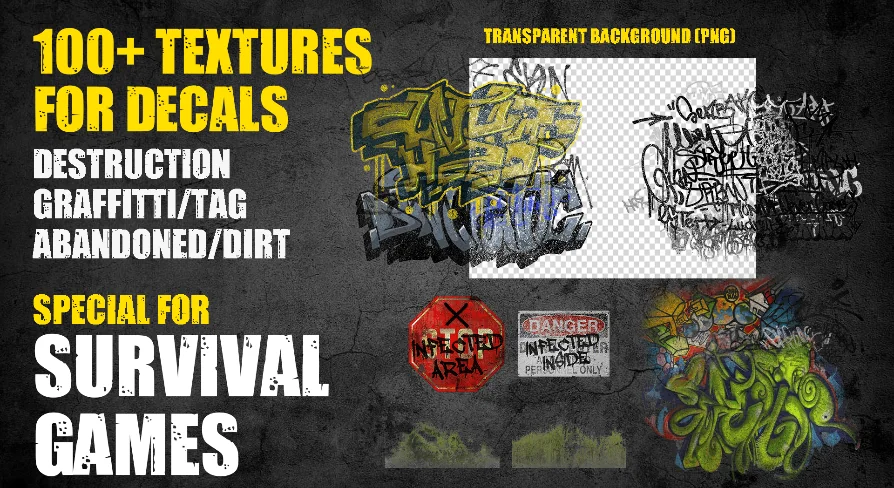
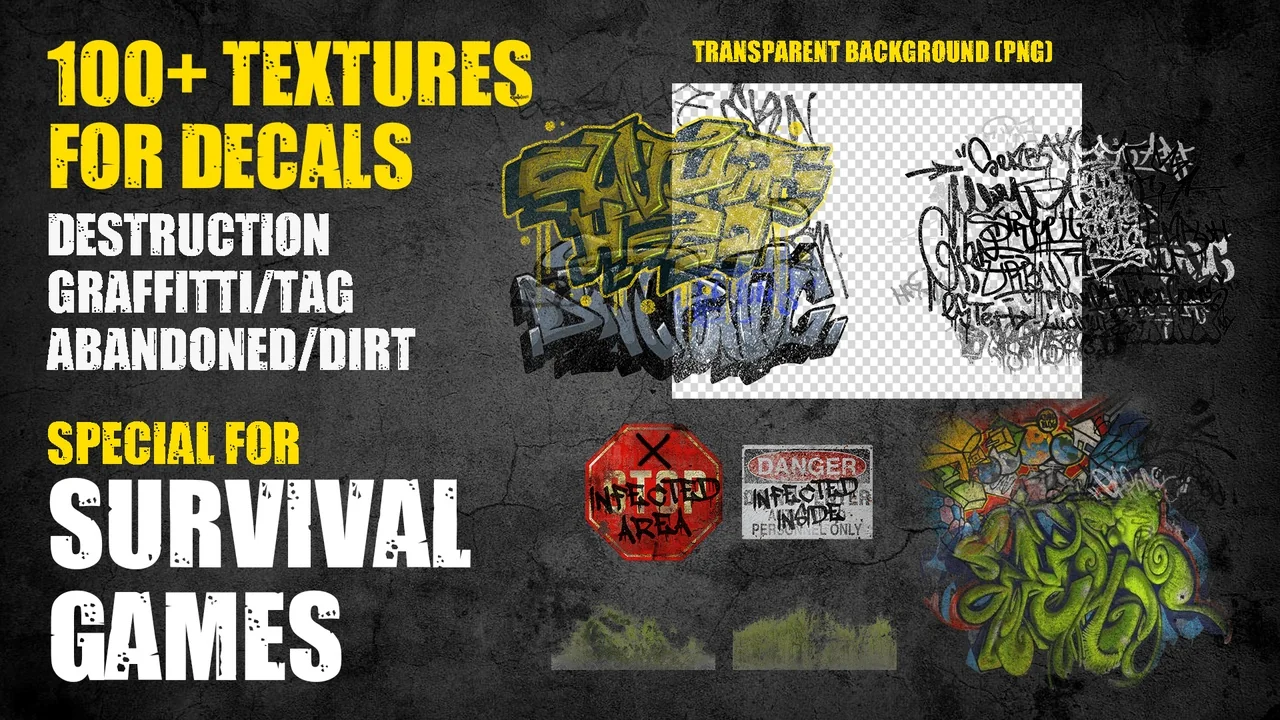
The collection delivers more than 100 individual textures within a 258 megabyte package, tailored directly toward post-apocalyptic, abandoned, and survival-themed world design. Rather than relying on simple color changes, the set provides distinct visual marks that can be applied across walls, road surfaces, barriers, and environmental props to disrupt visual repetition.
Dirt textures within the pack focus on the grit, residue, and environmental wear that naturally collect in ruinous environments. These elements allow level designers to ground assets into scenes by blending structural seams, dirtying foundation edges, and weathering clean modular kits. The graffiti elements introduce the human side of environmental destruction, providing the tag marks, scrawls, and symbolic communication typical of chaotic urban collapse, horror zones, and barricaded outposts.
The range of visual treatments supports both realistic and stylized aesthetics. Whether an environment requires harsh, realistic street damage or more pronounced, stylized horror motifs, having a dedicated set of over one hundred texture variations enables varied dressing across large modular locations without repeating obvious surface identifiers.
The Workflow Utility of Editable PSD Files and Image Layers
A core technical feature of this texture collection is the inclusion of editable Photoshop files alongside standard image files. Many texture collections supply only flattened bitmaps, which lock artists into specific colors, contrast levels, and opacity thresholds. Flattened textures force designers to either accept fixed visual properties or spend production time isolating elements through manual masking.
By providing editable PSDs, the asset set permits complete control over layer structure. Technical artists and texture designers can inspect the exact composition of every mark, dirt splatter, and spray stroke. This accessibility brings several direct production benefits:
Individual adjustment of paint thickness, spray feathered edges, and underlying stencil layers.
Fine-tuning of dirt opacity and blending modes to match varying base material roughness and albedo standards.
Color remapping of graffiti strokes to reflect specific faction markers, alert codes, or localized lore.
Extraction of custom alpha masks for decal projection and multi-layered material shaders.
Direct scaling and isolation of grime clusters to build custom multi-dirt composite maps.
Access to raw layer data bridges the gap between pre-made texture packs and proprietary art directions, allowing the assets to be tailored precisely to a project's lighting model and environmental palette.
Decoupled Visual Assets Free of Blueprints or Code
The entire library is built exclusively around visual media. It does not contain any blueprints, scripting, custom plugins, or pre-configured gameplay mechanics. This intentional omission ensures that the pack functions as a pure texture resource, devoid of script bloat or framework dependencies that could interfere with custom project architecture.
Because there is no runtime logic attached, implementation remains entirely in the hands of the developer. The textures and PSD assets must be imported into standard material pipelines, where they can be configured according to the project's rendering engine. Artists can set them up as deferred decals, blend them across material layers using vertex color painting, or combine them directly into prop texture bakes.
The package delivery focuses strictly on raw images and PSD source data. When handling the archive, users should note that the files are organized straightforwardly as graphic assets. If any file retrieval difficulties occur during unzipping or directory management, alternate distributions of the pack structure can be arranged directly with the developer to ensure all raw images and editable documents transfer cleanly into the production workspace.
Matching Texture Assets to Horror and Modular Survival Projects
This texture set is primarily suited for level designers, environment artists, and UI texture creators working within post-apocalyptic, horror, and abandoned urban themes. Projects utilizing modular architectural packs often struggle with visible seams and repetitive paneling; applying localized dirt patches and distinct graffiti breaks the mechanical symmetry and gives structures an inhabited, decayed presence.
Beyond structural dressing, the raw 2D nature and PSD support make these assets functional for related environmental graphics, survival signage, and gritty UI elements. Teams building games around ruined shelters, quarantined facilities, or survivalist camps will find the asset count substantial enough to dress distinct game zones without visual overlap, keeping the environmental degradation coherent across the entire game world.
 Art & Traditional
 Nature & Terrain
 Art & Traditional
 Art & Traditional