"7aa4acc705f0d80b"{"id":"1000097","slug":"spaceship-pack-1","title":"Spaceship Pack 1","category":"Spacecraft","engine":"Engine Version: 4.26+,5.0+","assetVersion":"Engine Version: 4.26+,5.0+","engineVersion":"","tag":"Spacecraft","accent":"blue","visual":"mech","summary":"A detailed look at Spaceship Pack 1, covering its low-poly warship hierarchy, PBR material setup, and integer-based Blueprint customization system.","platform":"Unreal Engine","publishedAt":"2026-06-07T12:32:14.401Z","updatedAt":"2026-06-07T12:32:14.401Z","sourceNotes":[],"fileContents":[],"compatibility":["Unreal Engine","Engine Version: 4.26+,5.0+"],"featuredImage":{"alt":"Spaceship Pack 1","src":"/wp-content/uploads/published/2026/06/0e2742faa233-c2dc7110-1ac3-4e10-b5ee-42398f81bc4a-b3468556c7.webp"},"hasDownloadLink":true,"downloads":0,"terms":[{"taxonomy":"category","slug":"spacecraft","name":"Spacecraft"}],"galleryImages":[{"src":"/wp-content/uploads/published/2026/06/81020fed7d07-c8963650-c5af-4304-8c70-003d032c3b83-4452c2e517.webp","alt":"Spaceship Pack 1"},{"src":"/wp-content/uploads/published/2026/06/713a3346d1f6-28af9fbd-f849-4c81-982a-d9130e179706-742129ea28.webp","alt":"Spaceship Pack 1"},{"src":"/wp-content/uploads/published/2026/06/773f91282863-4fba5a7f-3bd3-45ad-b91e-89b6fdec5594-4a8c5f380e.webp","alt":"Spaceship Pack 1"},{"src":"/wp-content/uploads/published/2026/06/dbfb8a28aecc-5bb56efd-636d-472a-b319-3f8f8e439f03-215ddea964.webp","alt":"Spaceship Pack 1"},{"src":"/wp-content/uploads/published/2026/06/4eaa98574ba8-053dafaf-3f2e-4514-b24b-74eea0b71741-d35ec5fce1.webp","alt":"Spaceship Pack 1"},{"src":"/wp-content/uploads/published/2026/06/2940c1809a91-bd497775-3352-4b40-a2db-e4788ae2c687-e9c4239a61.webp","alt":"Spaceship Pack 1"},{"src":"/wp-content/uploads/published/2026/06/87caea602b2f-7f3e4a9c-dad6-4f3a-869d-2d2c1a375506-e0500416ca.webp","alt":"Spaceship Pack 1"},{"src":"/wp-content/uploads/published/2026/06/81c94e53906b-84b34428-0e98-484d-bc0b-052c7faa3c4d-c41b2c5ff6.webp","alt":"Spaceship Pack 1"},{"src":"/wp-content/uploads/published/2026/06/372837ac9af2-7e258fca-f6ea-4e82-bf13-38dceadbe1a8-37a8437609.webp","alt":"Spaceship Pack 1"},{"src":"/wp-content/uploads/published/2026/06/c0a500d5df8a-1cf30f71-c809-4a4b-9543-c04be2721194-fbdd70926a.webp","alt":"Spaceship Pack 1"}],"accessPanel":{"kind":"resource","title":"Access this resource","eyebrow":"Free Download","message":"Log in or create a free account to start your download.","fileName":"Content.7z","safetyNote":"Resources are manually reviewed before listing to improve quality and reduce obvious risks.","actionLabel":"Download Free","resourceType":"Resource archive"},"contentHtml":"\u003cp\u003ePopulating a sci-fi project with a cohesive fleet of spacecraft often requires balancing visual consistency with distinct class roles. When developing space combat scenarios, teams need vessels that immediately read as belonging to the same universe while fulfilling vastly different tactical purposes. Spaceship Pack 1 addresses this core workflow requirement by providing an organized hierarchy of low-poly warships, all unified by a standardized PBR material setup and a Blueprint-driven color customization system.\u003c/p\u003e\n\u003cp\u003eDesigning enemy civilizations and player factions demands a high volume of distinct assets. By utilizing an integrated approach to materials and logic, this package allows developers to move quickly from initial block-out to fully populated fleet engagements. Rather than manually configuring materials for every individual ship, the inclusion of integer-based Blueprint controls streamlines the setup process for complex, multi-faction space environments, ensuring that no civilization is safe from the impending armada.\u003c/p\u003e\n\u003ch2\u003eFleet Hierarchy from Fighters to Dreadnoughts\u003c/h2\u003e\n\u003cp\u003eThe package establishes a ready-to-use naval architecture tailored for aggressive space combat. Projects can utilize a scaled approach to fleet building, leveraging five distinct ship classes that range from lightweight interception craft to massive capital ships capable of anchoring an entire armada. At the base level of this hierarchy, the Fighter serves as a nimble space unit, providing the necessary maneuverability for standard dogfighting, escort missions, and rapid interception scenarios.\u003c/p\u003e\n\u003cp\u003eMoving up the scale of the meticulously crafted arsenal, the Commander Ship and Nuke Frigate offer specialized tactical roles within the fleet formation. The Commander Ship operates as a central tactical node, while the Nuke Frigate provides heavy ordnance capabilities. The Super Carrier operates as a larger logistical or deployment vessel, establishing a formidable presence for fighter generation or fleet command operations. Finally, the Dreadnought functions as the ultimate capital ship, functioning as a galaxy-ending vessel intended for maximum structural presence and area denial. By organizing the pack around these specific variations, developers can immediately construct multi-tiered space battles without needing to source disparate, visually mismatched ship models from different 3D libraries.\u003c/p\u003e\n\u003ch2\u003ePBR Materials and Thruster Glow Implementation\u003c/h2\u003e\n\u003cp\u003eTo maintain high visual quality while utilizing a low-poly structural framework, the spacecraft rely on a tailored physical-based rendering (PBR) material workflow. The materials are constructed to maximize flexibility across different lighting environments, ensuring that the spacecraft hulls read clearly whether they are illuminated by a harsh nearby star, enveloped in a dense nebula, or navigating the pitch-black void of deep space.\u003c/p\u003e\n\u003cp\u003eThis material setup specifically incorporates detail normal maps to add vital surface complexity to the ship exteriors. In a low-poly workflow, detail normals are critical for simulating the intricate paneling, armor plating, and mechanical junctions of a spacecraft without increasing the underlying polygon count or sacrificing rendering performance. Alongside the detail normals, roughness maps are included to strictly dictate how light scatters across the hull, allowing the engine to distinguish between glossy metallic surfaces and matte protective components along the fuselage.\u003c/p\u003e\n\u003cp\u003eIn addition, the asset pack utilizes light-baked glow specifically targeted for the thrusters. By baking the emissive properties directly into the thruster components, the ships benefit from a consistent, performance-friendly engine illumination effect that does not require expensive real-time light casting. This baked glow registers immediately in the scene, providing a distinct, brightly colored visual signature for the rear of the vessels during high-speed flight sequences.\u003c/p\u003e\n\u003ch2\u003eBlueprint Integration for Faction Colors\u003c/h2\u003e\n\u003cp\u003eAssigning ships to different teams or factions is handled through an integrated Blueprint system rather than relying on manual material swapping and tedious asset duplication. Each spacecraft is pre-configured with a customized logic script that allows developers to change the ship's team color by simply adjusting a single integer value directly in the editor's detail panel.\u003c/p\u003e\n\u003cp\u003eThis simple integer-based selection seamlessly cycles through the available colored texture variations built into the master materials. Constructed explicitly for team-based gameplay and rapid customization, the included color profiles feature Black, White, Red, Blue, Yellow, and Green variations. This straightforward setup is particularly useful for multiplayer environments, real-time strategy games, or complex faction-based simulations where player forces and enemy civilizations require immediate, recognizable visual distinction on the battlefield.\u003c/p\u003e\n\u003cp\u003eInstead of duplicating static meshes and manually assigning new material instances for every possible team color combination, developers can simply drag the ship Blueprint into the level environment and type a number to lock in the desired faction color. This dynamic approach also inherently allows for procedural spawning logic via Blueprints, where ships can be instantiated at runtime and assigned a specific team color automatically by passing the correct integer variable during the spawn event.\u003c/p\u003e\n\u003ch2\u003eAnalyzing the Nuke Frigate Missile Demo\u003c/h2\u003e\n\u003cp\u003eUnderstanding how to integrate and animate combat sequences for these highly specialized vessels is supported by an included demonstration scene. Moving beyond static models and simple turntables, the package ships with a specific Nuke Frigate missile demo that highlights the operational capabilities and intended visual effects of the heavy frigate class.\u003c/p\u003e\n\u003cp\u003eThis demonstration allows developers to observe exactly how the ship's ordnance is meant to be deployed before attempting to script their own complex combat logic. By reviewing the demo scene in the editor, production teams can study the timing, firing angles, and structural setup of the missile launch system in an isolated environment. Seeing the Nuke Frigate unleash its payload in action provides a clear, functional template for adding similar weapon behaviors, particle effects, and launch sequences to the Fighter, Dreadnought, or Super Carrier within the game engine.\u003c/p\u003e\n\u003ch2\u003eIntegrating the Lowpoly Spacecraft Pipeline\u003c/h2\u003e\n\u003cp\u003eSpaceship Pack 1 is structured for projects needing a streamlined, low-poly sci-fi aesthetic that still fully supports modern PBR rendering techniques. The combination of detail normals and baked thruster glow ensures the models hold up under dynamic, high-contrast space lighting, while the integrated Blueprint controls eliminate the friction of managing large, multi-colored fleets.\u003c/p\u003e\n\u003cp\u003eBy providing a complete range of spacecraft from nimble fighters to massive dreadnoughts, the package equips developers with the foundational architecture needed to build and deploy comprehensive space combat scenarios. Whether constructing a fleet of super carriers for a cinematic sequence or coding the AI for an agile squadron of enemy fighters, the inclusion of flexible materials and integer-based customization ensures the fleet adapts seamlessly to the technical demands of the project.\u003c/p\u003e\n\n\u003ch2\u003eExplore Similar Assets\u003c/h2\u003e\n\u003cul\u003e\n\u003cli\u003e\u003ca href=\"https://3dcghub.com/sci-fi-vehicle-constructor/\" title=\"Sci-Fi Vehicle Constructor\"\u003eSci-Fi Vehicle Constructor\u003c/a\u003e\u003c/li\u003e\n\u003cli\u003e\u003ca href=\"https://3dcghub.com/cyberpunk-japan-holograms-neon-set-cyberpunk-japan-holograms-japans-hologram/\" title=\"Cyberpunk Japan Holograms / Neon Set (Cyberpunk Japan Holograms Japans Hologram)\"\u003eCyberpunk Japan Holograms / Neon Set (Cyberpunk Japan Holograms Japans Hologram)\u003c/a\u003e\u003c/li\u003e\n\u003cli\u003e\u003ca href=\"https://3dcghub.com/stellar-phoenix-shuttle-spaceship-with-controller/\" title=\"Stellar Phoenix Shuttle - Spaceship With Controller\"\u003eStellar Phoenix Shuttle - Spaceship With Controller\u003c/a\u003e\u003c/li\u003e\n\u003cli\u003e\u003ca href=\"https://3dcghub.com/space-station-asteroid-mining-facility/\" title=\"Space Station - Asteroid Mining Facility\"\u003eSpace Station - Asteroid Mining Facility\u003c/a\u003e\u003c/li\u003e\n\u003cli\u003e\u003ca href=\"https://3dcghub.com/spaceships-props-and-modular-environment-tiles-sci-fi-low-poly-voxel/\" title=\"Spaceships, props and modular environment tiles (sci-fi, low poly, voxel)\"\u003eSpaceships, props and modular environment tiles (sci-fi, low poly, voxel)\u003c/a\u003e\u003c/li\u003e\n\u003c/ul\u003e","contentTextLength":7627,"navigation":{"current":1973,"total":3925,"previous":{"id":"1000098","slug":"spanish-cottage-spanish-cottage-spanish-cottage-3d-art-nature-tree-medieval","title":"Spanish Cottage ( Spanish Cottage Spanish Cottage 3D Art Nature Tree Medieval )","category":"Towns \u0026 Villages","platform":"Unreal Engine","updatedAt":"2026-06-07T13:06:49.159Z"},"next":{"id":"1000096","slug":"stylized-lost-paradise","title":"Stylized Lost Paradise","category":"Forest \u0026 Jungle","platform":"Unreal Engine","updatedAt":"2026-06-07T12:27:16.889Z"}},"relatedResources":[{"id":"5249","slug":"sci-fi-vehicle-constructor","title":"Sci-Fi Vehicle Constructor","category":"Spacecraft","engine":"4.26+,5.0+","assetVersion":"Engine version: 4.26+,5.0+","engineVersion":"4.26","tag":"Spacecraft","accent":"blue","visual":"audio","summary":"Build endless futuristic craft with the Sci-Fi Vehicle Constructor. This kit features 300+ modular parts, 4K textures, and professional animations for developer","platform":"Unreal Engine","publishedAt":"2026-02-15T13:52:12.000Z","updatedAt":"2026-04-19T15:56:59.000Z","sourceNotes":[],"fileContents":[],"compatibility":["Unreal Engine","Engine version: 4.26+,5.0+"],"featuredImage":{"alt":"Sci-Fi Vehicle Constructor","src":"https://3dcghub.com/wp-content/uploads/2026/02/9c9a7376-c03b-449b-a7e0-93895fc00818.webp"},"hasDownloadLink":true,"downloads":2},{"id":"1001838","slug":"spaceship-lander-vtol","title":"Spaceship Lander VTOL","category":"Spacecraft","engine":"4.18+,5.0+","assetVersion":"","engineVersion":"Engine Version: 4.18+,5.0+","tag":"Spacecraft","accent":"blue","visual":"mech","summary":"Explore the Spaceship Lander VTOL package, featuring modular flight controls, rechargeable shields, laser weapon systems, and dynamic field spawners.","platform":"Unreal Engine","publishedAt":"2026-10-21T08:29:04.903Z","updatedAt":"2026-10-21T08:29:04.903Z","sourceNotes":[],"fileContents":[],"compatibility":["Unreal Engine","Engine Version: 4.18+,5.0+"],"featuredImage":{"alt":"Spaceship Lander VTOL","src":"/wp-content/uploads/published/2026/10/5b4870b30d18-cdd0da8c-fa0f-4bed-b005-fa58e3fb3b1d-1ffe4d9a07.webp"},"hasDownloadLink":true,"downloads":0},{"id":"1001373","slug":"warp-gates-pack","title":"Warp Gates Pack","category":"Spacecraft","engine":"4.16+,5.0+","assetVersion":"","engineVersion":"Engine Version: 4.16+,5.0+","tag":"Spacecraft","accent":"blue","visual":"mech","summary":"Explore the Warp Gates Pack featuring 3 gate meshes, 48 base material combinations, baked warp-lighting, and event-driven blueprints for sci-fi environments.","platform":"Unreal Engine","publishedAt":"2026-10-04T10:40:51.801Z","updatedAt":"2026-10-04T10:40:51.801Z","sourceNotes":[],"fileContents":[],"compatibility":["Unreal Engine","Engine Version: 4.16+,5.0+"],"featuredImage":{"alt":"Warp Gates Pack","src":"/wp-content/uploads/published/2026/10/058f31b628f0-3f062ad8-dd01-4f4a-80f2-6b77b42c16c5-fe5dc630f6.webp"},"hasDownloadLink":true,"downloads":0}]}
Spacecraft
Spaceship Pack 1
A detailed look at Spaceship Pack 1, covering its low-poly warship hierarchy, PBR material setup, and integer-based Blueprint customization system.
Category:Unreal Engine,SpacecraftPlatform: Unreal EngineEngine Version: 4.26+,5.0+Published: Jun 7, 2026
Spacecraft
Resource overview
Populating a sci-fi project with a cohesive fleet of spacecraft often requires balancing visual consistency with distinct class roles. When developing space combat scenarios, teams need vessels that immediately read as belonging to the same universe while fulfilling vastly different tactical purposes. Spaceship Pack 1 addresses this core workflow requirement by providing an organized hierarchy of low-poly warships, all unified by a standardized PBR material setup and a Blueprint-driven color customization system.
Designing enemy civilizations and player factions demands a high volume of distinct assets. By utilizing an integrated approach to materials and logic, this package allows developers to move quickly from initial block-out to fully populated fleet engagements. Rather than manually configuring materials for every individual ship, the inclusion of integer-based Blueprint controls streamlines the setup process for complex, multi-faction space environments, ensuring that no civilization is safe from the impending armada.
Fleet Hierarchy from Fighters to Dreadnoughts
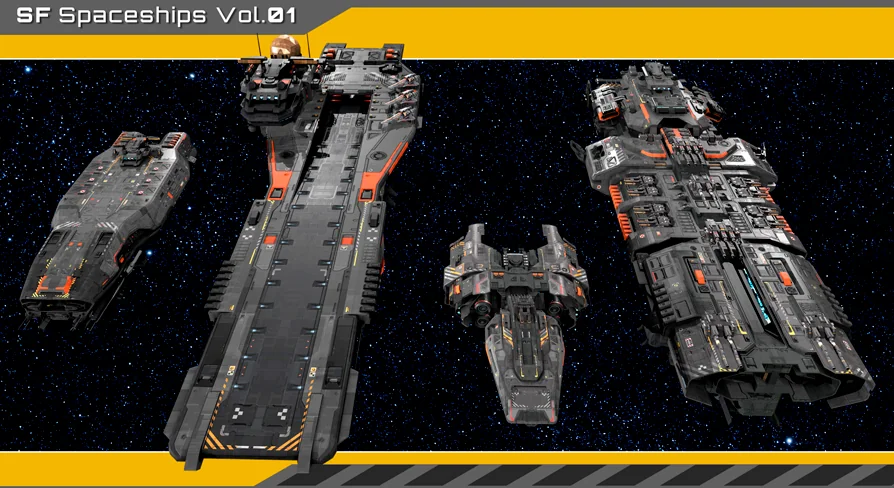
The package establishes a ready-to-use naval architecture tailored for aggressive space combat. Projects can utilize a scaled approach to fleet building, leveraging five distinct ship classes that range from lightweight interception craft to massive capital ships capable of anchoring an entire armada. At the base level of this hierarchy, the Fighter serves as a nimble space unit, providing the necessary maneuverability for standard dogfighting, escort missions, and rapid interception scenarios.
Moving up the scale of the meticulously crafted arsenal, the Commander Ship and Nuke Frigate offer specialized tactical roles within the fleet formation. The Commander Ship operates as a central tactical node, while the Nuke Frigate provides heavy ordnance capabilities. The Super Carrier operates as a larger logistical or deployment vessel, establishing a formidable presence for fighter generation or fleet command operations. Finally, the Dreadnought functions as the ultimate capital ship, functioning as a galaxy-ending vessel intended for maximum structural presence and area denial. By organizing the pack around these specific variations, developers can immediately construct multi-tiered space battles without needing to source disparate, visually mismatched ship models from different 3D libraries.
PBR Materials and Thruster Glow Implementation
To maintain high visual quality while utilizing a low-poly structural framework, the spacecraft rely on a tailored physical-based rendering (PBR) material workflow. The materials are constructed to maximize flexibility across different lighting environments, ensuring that the spacecraft hulls read clearly whether they are illuminated by a harsh nearby star, enveloped in a dense nebula, or navigating the pitch-black void of deep space.
This material setup specifically incorporates detail normal maps to add vital surface complexity to the ship exteriors. In a low-poly workflow, detail normals are critical for simulating the intricate paneling, armor plating, and mechanical junctions of a spacecraft without increasing the underlying polygon count or sacrificing rendering performance. Alongside the detail normals, roughness maps are included to strictly dictate how light scatters across the hull, allowing the engine to distinguish between glossy metallic surfaces and matte protective components along the fuselage.
In addition, the asset pack utilizes light-baked glow specifically targeted for the thrusters. By baking the emissive properties directly into the thruster components, the ships benefit from a consistent, performance-friendly engine illumination effect that does not require expensive real-time light casting. This baked glow registers immediately in the scene, providing a distinct, brightly colored visual signature for the rear of the vessels during high-speed flight sequences.
Blueprint Integration for Faction Colors
Assigning ships to different teams or factions is handled through an integrated Blueprint system rather than relying on manual material swapping and tedious asset duplication. Each spacecraft is pre-configured with a customized logic script that allows developers to change the ship's team color by simply adjusting a single integer value directly in the editor's detail panel.
This simple integer-based selection seamlessly cycles through the available colored texture variations built into the master materials. Constructed explicitly for team-based gameplay and rapid customization, the included color profiles feature Black, White, Red, Blue, Yellow, and Green variations. This straightforward setup is particularly useful for multiplayer environments, real-time strategy games, or complex faction-based simulations where player forces and enemy civilizations require immediate, recognizable visual distinction on the battlefield.
Instead of duplicating static meshes and manually assigning new material instances for every possible team color combination, developers can simply drag the ship Blueprint into the level environment and type a number to lock in the desired faction color. This dynamic approach also inherently allows for procedural spawning logic via Blueprints, where ships can be instantiated at runtime and assigned a specific team color automatically by passing the correct integer variable during the spawn event.
Analyzing the Nuke Frigate Missile Demo
Understanding how to integrate and animate combat sequences for these highly specialized vessels is supported by an included demonstration scene. Moving beyond static models and simple turntables, the package ships with a specific Nuke Frigate missile demo that highlights the operational capabilities and intended visual effects of the heavy frigate class.
This demonstration allows developers to observe exactly how the ship's ordnance is meant to be deployed before attempting to script their own complex combat logic. By reviewing the demo scene in the editor, production teams can study the timing, firing angles, and structural setup of the missile launch system in an isolated environment. Seeing the Nuke Frigate unleash its payload in action provides a clear, functional template for adding similar weapon behaviors, particle effects, and launch sequences to the Fighter, Dreadnought, or Super Carrier within the game engine.
Integrating the Lowpoly Spacecraft Pipeline
Spaceship Pack 1 is structured for projects needing a streamlined, low-poly sci-fi aesthetic that still fully supports modern PBR rendering techniques. The combination of detail normals and baked thruster glow ensures the models hold up under dynamic, high-contrast space lighting, while the integrated Blueprint controls eliminate the friction of managing large, multi-colored fleets.
By providing a complete range of spacecraft from nimble fighters to massive dreadnoughts, the package equips developers with the foundational architecture needed to build and deploy comprehensive space combat scenarios. Whether constructing a fleet of super carriers for a cinematic sequence or coding the AI for an agile squadron of enemy fighters, the inclusion of flexible materials and integer-based customization ensures the fleet adapts seamlessly to the technical demands of the project.
 Spacecraft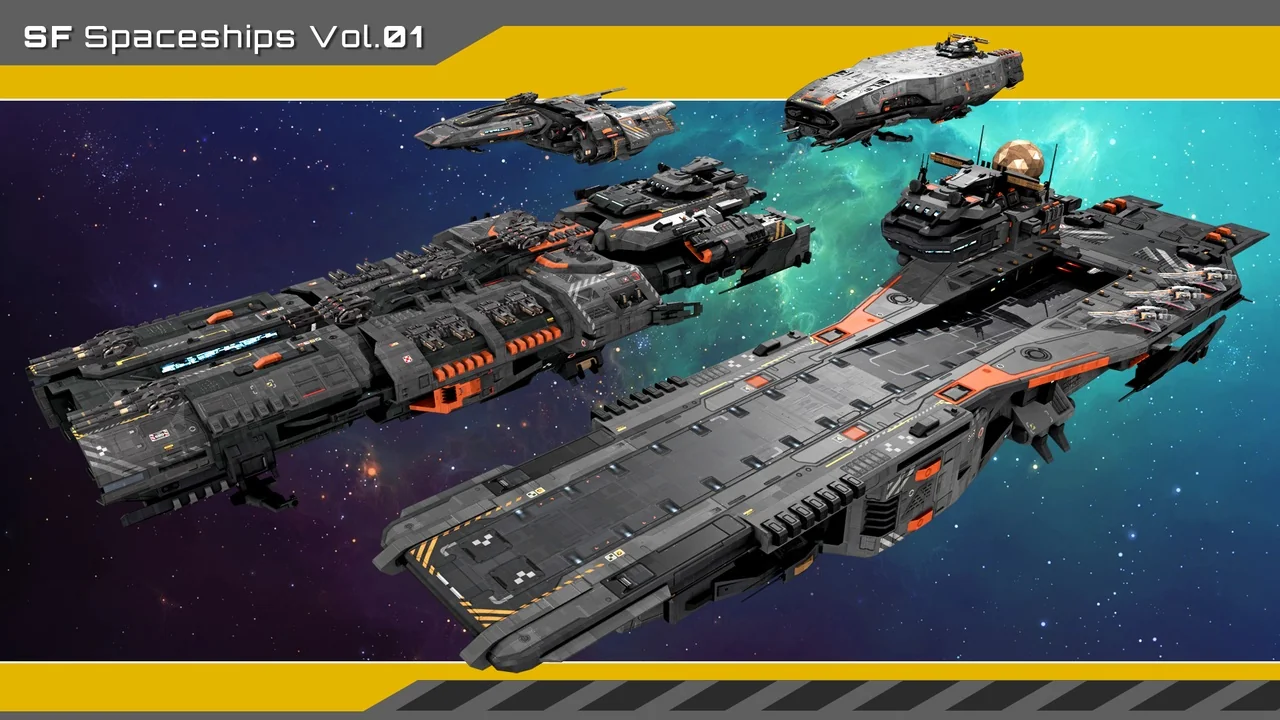
 Spacecraft
 Spacecraft
 Spacecraft