"fa182e0cd0a6ea73"{"id":"1001836","slug":"sovietzombiesoldier-pack","title":"SovietZombieSoldier (Pack)","category":"Characters \u0026 Creatures","engine":"4.26+,5.0+","assetVersion":"","engineVersion":"Engine Version: 4.26+,5.0+","tag":"Characters","accent":"blue","visual":"character","summary":"Explore the SovietZombieSoldier (Pack) featuring 7 undead military characters, dual UE4/UE5 skeletons, 33 animations, and facial morph targets.","platform":"Unreal Engine","publishedAt":"2026-10-21T08:27:08.477Z","updatedAt":"2026-10-21T08:27:08.477Z","sourceNotes":[],"fileContents":[],"compatibility":["Unreal Engine","Engine Version: 4.26+,5.0+"],"featuredImage":{"alt":"SovietZombieSoldier (Pack)","src":"/wp-content/uploads/published/2026/10/e5744403da09-0738955e-da79-46d1-8216-afd9c398ced7-53c35c7805.webp"},"hasDownloadLink":true,"downloads":0,"terms":[{"taxonomy":"category","slug":"characters-and-creatures","name":"Characters \u0026 Creatures"}],"galleryImages":[{"src":"/wp-content/uploads/published/2026/10/2d96e58922c3-5a383b1c-cb73-41a1-b381-6bd463274adc-f53526df1c.webp","alt":"SovietZombieSoldier (Pack)"},{"src":"/wp-content/uploads/published/2026/10/3e0112e007d0-448c002d-78a5-40ca-96b8-d5607459769a-c708fcfeef.webp","alt":"SovietZombieSoldier (Pack)"},{"src":"/wp-content/uploads/published/2026/10/28c0ee44dd4b-146c5f17-b38f-4612-871b-35e8083eb1c7-377d359ae3.webp","alt":"SovietZombieSoldier (Pack)"},{"src":"/wp-content/uploads/published/2026/10/892d098cba3c-857e7727-e202-4574-94e0-29d3cd3d2c3e-3f028be545.webp","alt":"SovietZombieSoldier (Pack)"},{"src":"/wp-content/uploads/published/2026/10/dc2d33094606-acb3a6b5-a421-4884-a003-b1f88057df99-386786fc91.webp","alt":"SovietZombieSoldier (Pack)"},{"src":"/wp-content/uploads/published/2026/10/6882a531d8e9-de4b6e63-19a5-40e6-9221-eb8e94b27aae-976fdd1895.webp","alt":"SovietZombieSoldier (Pack)"},{"src":"/wp-content/uploads/published/2026/10/c2759deffef4-f69e1b9d-6394-42c2-b12c-a3c473c7976e-cbc0a287ba.webp","alt":"SovietZombieSoldier (Pack)"},{"src":"/wp-content/uploads/published/2026/10/3141683e6366-c669e7ab-d6fd-4fcb-a08f-37c156827da1-914868203b.webp","alt":"SovietZombieSoldier (Pack)"},{"src":"/wp-content/uploads/published/2026/10/334b6d489a3f-b6e4c763-fb68-4c66-a66f-6f766f014708-db1fac526c.webp","alt":"SovietZombieSoldier (Pack)"}],"accessPanel":{"kind":"resource","title":"Download this resource","eyebrow":"Free Download","message":"Log in or create a free account to start your download.","fileName":"Content.7z","safetyNote":"Resources are manually reviewed before listing to improve quality and reduce obvious risks.","actionLabel":"Download Free","resourceType":"Resource archive"},"contentHtml":"\u003cp\u003eThe SovietZombieSoldier (Pack) supplies a complete squad of seven distinct undead military figures tailored for real-time horror, action, and role-playing games. Comprising low-poly, PBR-textured models, the collection delivers ready-to-use combatants equipped with dedicated motion clips, dual-generation skeletal structures, and facial morph targets for expressive undead behavior.\u003c/p\u003e \u003ch2\u003eThe Seven SovietZombieSoldier Unit Variants\u003c/h2\u003e\n\u003cp\u003eRather than providing a single repeated enemy mesh with minor surface shifts, the package compiles seven dedicated soldier models: ZombieSoldierWinter, ZombieSoldierSailer, ZombieSoldierTankman, ZombieSoldier1, ZombieSoldier2, ZombieSoldier4, and ZombieSoldierOfficer. Each figure reflects an individual combat specialization or rank corrupted into a monster archetype.\u003c/p\u003e \u003cp\u003eZombieSoldierWinter brings cold-weather military gear to snowy or harsh environment settings, fitting survival encounters where weather-worn uniforms match the climate. ZombieSoldierSailer adapts naval themes into the undead lineup, while ZombieSoldierTankman introduces an armored vehicle crew aesthetic. ZombieSoldier1, ZombieSoldier2, and ZombieSoldier4 function as distinct infantry combatants, giving developers immediate visual variety when populating swarms, checkpoints, or patrol routes without obvious asset repetition. Overlooking these units is ZombieSoldierOfficer, providing a visual hierarchy for encounter design where an undead commander directs or anchors a group of hostile grunts.\u003c/p\u003e \u003cp\u003eA separate version of each model is included within the package. This separation grants access to detached parts or modular asset structures, allowing developers to manipulate individual components, configure broken-down soldier variants, or tailor enemy appearances to suit specific level hazards and combat conditions.\u003c/p\u003e \u003ch2\u003eDual UE4 and UE5 Epic Skeleton Rigging\u003c/h2\u003e\n\u003cp\u003eCharacter integration in modern Unreal Engine development often involves managing discrepancies between legacy and modern skeletal standards. The SovietZombieSoldier collection addresses this by supplying two Epic skeletons for each model—one calibrated to the standard Unreal Engine 4 skeleton and another calibrated to the Unreal Engine 5 Mannequin standard.\u003c/p\u003e \u003cp\u003eProviding native support for both skeletal structures simplifies animation pipelines. Teams operating in Unreal Engine 4 projects can immediately apply native animations to the UE4 skeleton without running manual retargeting passes or converting bone hierarchies. Simultaneously, projects based on Unreal Engine 5 can use the UE5 skeleton directly, seamlessly sharing locomotion systems, combat montages, and standard marketplace sequences that target the newer Epic Mannequin hierarchy. By shipping both setups alongside the seven characters, the pack eliminates the tedious bone-mapping adjustments commonly required when importing historical or stylized military characters into modern engines.\u003c/p\u003e \u003ch2\u003eMotion Systems, Blueprints, and 33 Included Animations\u003c/h2\u003e\n\u003cp\u003eTo support immediate combat deployment, the package includes 33 distinct animations. These clips address the baseline locomotion, idling, attack, and reaction behaviors necessary to bring an undead enemy to life inside a game environment. Because the animations are paired directly with the characters, setup time for core hostile loops remains minimal.\u003c/p\u003e \u003cp\u003eThe models are prepared to work with Unreal Engine Blueprints and Animation Blueprints. Setting up an enemy character blueprint involves assigning the skeletal mesh, referencing the matching skeleton, and plugging the movement logic into the animation blueprint state machines. The 33 motion clips feed directly into blend spaces and state transitions, handling states such as stalking, shambling, charging, or reacting to incoming weapon impacts. For developers building RPG or fantasy-horror systems with scripted enemy waves, the presence of these animation blueprints allows immediate testing of hostile encounters without having to generate an animation library from scratch.\u003c/p\u003e \u003ch2\u003eFacial Morph Targets and Modular PBR Construction\u003c/h2\u003e\n\u003cp\u003eClose-up encounters in horror and action games depend heavily on expressive enemy presentation. Every model in the SovietZombieSoldier collection incorporates face morph targets, providing blend-shape control over the undead facial structures. These morph targets can be driven through animation blueprints, timelines, or blueprint scripts to trigger aggressive snarls, slack-jawed idle expressions, or agonized damage reactions during melee encounters and cutscenes.\u003c/p\u003e \u003cp\u003eThe assets utilize modern PBR surface workflows to balance surface fidelity with performance efficiency. Designed as low-poly meshes, the characters preserve frame budgets during intense horde scenarios while maintaining realistic surface responses across metals, fabrics, and rotted flesh. The materials react accurately to dynamic level lighting, flashlight beams, and dark horror environments. Furthermore, the collection maintains compatibility with the Sci-Fi Soldiers Pack, allowing teams managing broader asset libraries to align their pipeline, skeleton management, and soldier-based character workflows across multiple related packs.\u003c/p\u003e \u003ch2\u003eProduction Role and Project Deployment\u003c/h2\u003e\n\u003cp\u003eThe SovietZombieSoldier collection is set up to solve a clear production challenge: delivering a complete, diverse contingent of military undead enemies without requiring custom modeling, rigging, or retargeting passes. By pairing seven defined character roles with 33 core animations, facial blend shapes, dual Epic skeleton support, and modular file organization, the pack supplies everything needed to drop functional, responsive zombie soldiers directly into active game levels.\u003c/p\u003e\n\n\u003ch2\u003eRelated Resources Worth Checking\u003c/h2\u003e\n\u003cul\u003e\n\u003cli\u003e\u003ca href=\"https://3dcghub.com/cyberpunk-street-boy/\" title=\"Cyberpunk Street Boy\"\u003eCyberpunk Street Boy\u003c/a\u003e\u003c/li\u003e\n\u003cli\u003e\u003ca href=\"https://3dcghub.com/primitive-characters-pack/\" title=\"Primitive Characters (Pack)\"\u003ePrimitive Characters (Pack)\u003c/a\u003e\u003c/li\u003e\n\u003cli\u003e\u003ca href=\"https://3dcghub.com/eastern-assassin/\" title=\"Eastern Assassin\"\u003eEastern Assassin\u003c/a\u003e\u003c/li\u003e\n\u003cli\u003e\u003ca href=\"https://3dcghub.com/robot-robbie-01/\" title=\"Robot Robbie 01\"\u003eRobot Robbie 01\u003c/a\u003e\u003c/li\u003e\n\u003cli\u003e\u003ca href=\"https://3dcghub.com/boar-biker/\" title=\"Boar Biker\"\u003eBoar Biker\u003c/a\u003e\u003c/li\u003e\n\u003c/ul\u003e","contentTextLength":5816,"navigation":{"current":20,"total":3789,"previous":{"id":"1001837","slug":"spaceship-colony-cruiser","title":"Spaceship Colony Cruiser","category":"Weapons \u0026 Combat","platform":"Unreal Engine","updatedAt":"2026-10-21T08:28:03.709Z"},"next":{"id":"1001835","slug":"soldier-future-01","title":"Soldier Future 01","category":"Characters \u0026 Creatures","platform":"Unreal Engine","updatedAt":"2026-10-21T08:26:14.117Z"}},"relatedResources":[{"id":"1001777","slug":"cyberpunk-street-boy","title":"Cyberpunk Street Boy","category":"Characters \u0026 Creatures","engine":"4.25+,5.0+","assetVersion":"","engineVersion":"Engine Version: 4.25+,5.0+","tag":"Characters","accent":"blue","visual":"character","summary":"Examine Cyberpunk Street Boy, featuring modular cybernetic design, PBR materials, facial morph targets, sword combat, and Animation Blueprint support.","platform":"Unreal Engine","publishedAt":"2026-10-20T03:25:10.457Z","updatedAt":"2026-10-20T03:25:10.457Z","sourceNotes":[],"fileContents":[],"compatibility":["Unreal Engine","Engine Version: 4.25+,5.0+"],"featuredImage":{"alt":"Cyberpunk Street Boy","src":"/wp-content/uploads/published/2026/10/52f458aff286-02fd65ac-9315-4dbb-b5bb-521bead39c80-4b9bde6c52.webp"},"hasDownloadLink":true,"downloads":1},{"id":"1001061","slug":"primitive-characters-pack","title":"Primitive Characters (Pack)","category":"Characters \u0026 Creatures","engine":"4.26+,5.0+","assetVersion":"","engineVersion":"Engine Version: 4.26+,5.0+","tag":"Characters","accent":"blue","visual":"character","summary":"A five-character primitive survival pack for UE4 and UE5, featuring dual rigs, facial morphs, weapons, and creature animation compatibility.","platform":"Unreal Engine","publishedAt":"2026-08-30T15:21:04.948Z","updatedAt":"2026-08-30T15:21:04.948Z","sourceNotes":[],"fileContents":[],"compatibility":["Unreal Engine","Engine Version: 4.26+,5.0+"],"featuredImage":{"alt":"Primitive Characters (Pack)","src":"/wp-content/uploads/published/2026/08/934d3635756b-88428e14-2353-46db-93bb-469d965424c6-d696e0ffc4.webp"},"hasDownloadLink":true,"downloads":3},{"id":"1001842","slug":"styled-characters-pack-military-male-female","title":"Styled Characters Pack: Military Male/Female","category":"Characters \u0026 Creatures","engine":"4.19+,5.0+","assetVersion":"","engineVersion":"Engine Version: 4.19+,5.0+","tag":"Characters","accent":"blue","visual":"character","summary":"Stylized modular military male and female characters for third person shooters, rigged to the Epic Skeleton with extra bones, morph targets, and blueprints.","platform":"Unreal Engine","publishedAt":"2026-10-21T08:33:25.353Z","updatedAt":"2026-10-21T08:33:25.353Z","sourceNotes":[],"fileContents":[],"compatibility":["Unreal Engine","Engine Version: 4.19+,5.0+"],"featuredImage":{"alt":"Styled Characters Pack: Military Male/Female","src":"/wp-content/uploads/published/2026/10/98e5fee8073c-dc48ba2c-9c83-4906-825f-7249c0032428-07b9eb71e5.webp"},"hasDownloadLink":true,"downloads":0}]}
Characters
SovietZombieSoldier (Pack)
Explore the SovietZombieSoldier (Pack) featuring 7 undead military characters, dual UE4/UE5 skeletons, 33 animations, and facial morph targets.
The SovietZombieSoldier (Pack) supplies a complete squad of seven distinct undead military figures tailored for real-time horror, action, and role-playing games. Comprising low-poly, PBR-textured models, the collection delivers ready-to-use combatants equipped with dedicated motion clips, dual-generation skeletal structures, and facial morph targets for expressive undead behavior.
The Seven SovietZombieSoldier Unit Variants
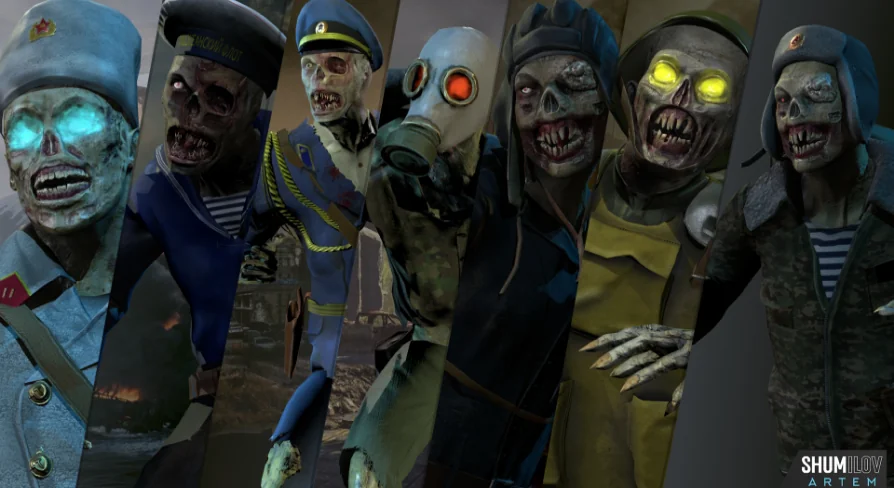
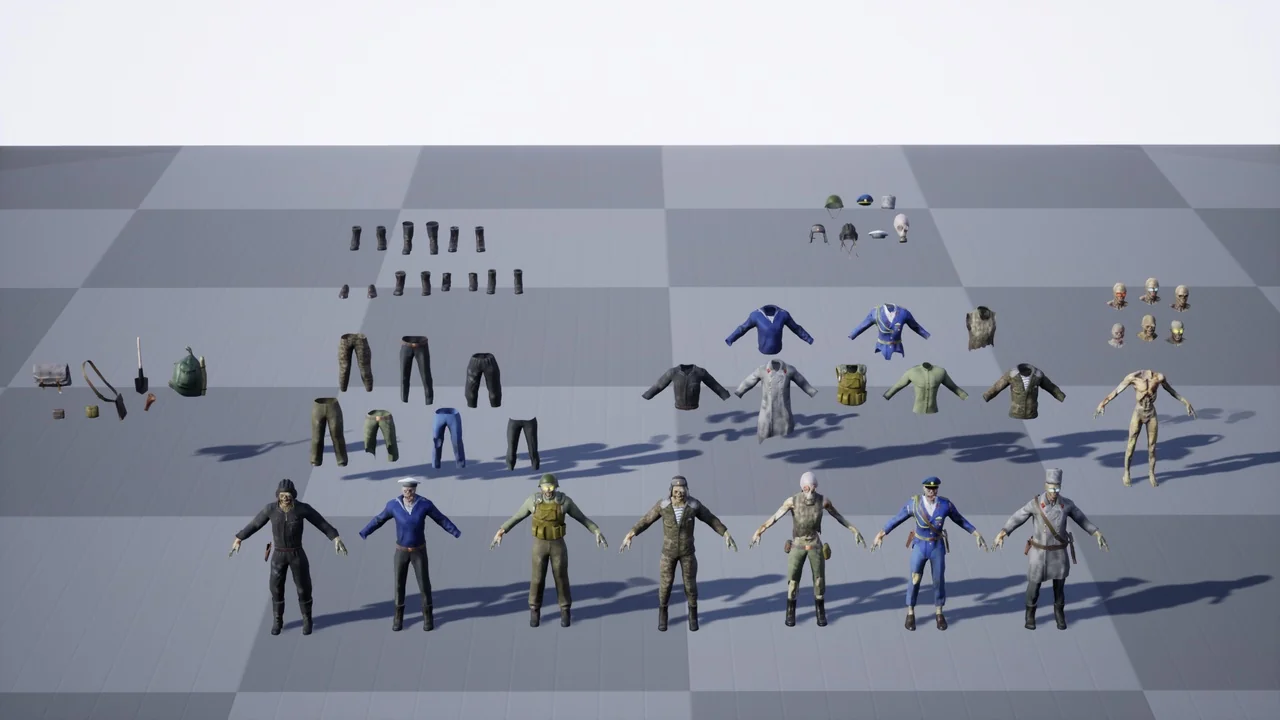
Rather than providing a single repeated enemy mesh with minor surface shifts, the package compiles seven dedicated soldier models: ZombieSoldierWinter, ZombieSoldierSailer, ZombieSoldierTankman, ZombieSoldier1, ZombieSoldier2, ZombieSoldier4, and ZombieSoldierOfficer. Each figure reflects an individual combat specialization or rank corrupted into a monster archetype.
ZombieSoldierWinter brings cold-weather military gear to snowy or harsh environment settings, fitting survival encounters where weather-worn uniforms match the climate. ZombieSoldierSailer adapts naval themes into the undead lineup, while ZombieSoldierTankman introduces an armored vehicle crew aesthetic. ZombieSoldier1, ZombieSoldier2, and ZombieSoldier4 function as distinct infantry combatants, giving developers immediate visual variety when populating swarms, checkpoints, or patrol routes without obvious asset repetition. Overlooking these units is ZombieSoldierOfficer, providing a visual hierarchy for encounter design where an undead commander directs or anchors a group of hostile grunts.
A separate version of each model is included within the package. This separation grants access to detached parts or modular asset structures, allowing developers to manipulate individual components, configure broken-down soldier variants, or tailor enemy appearances to suit specific level hazards and combat conditions.
Dual UE4 and UE5 Epic Skeleton Rigging
Character integration in modern Unreal Engine development often involves managing discrepancies between legacy and modern skeletal standards. The SovietZombieSoldier collection addresses this by supplying two Epic skeletons for each model—one calibrated to the standard Unreal Engine 4 skeleton and another calibrated to the Unreal Engine 5 Mannequin standard.
Providing native support for both skeletal structures simplifies animation pipelines. Teams operating in Unreal Engine 4 projects can immediately apply native animations to the UE4 skeleton without running manual retargeting passes or converting bone hierarchies. Simultaneously, projects based on Unreal Engine 5 can use the UE5 skeleton directly, seamlessly sharing locomotion systems, combat montages, and standard marketplace sequences that target the newer Epic Mannequin hierarchy. By shipping both setups alongside the seven characters, the pack eliminates the tedious bone-mapping adjustments commonly required when importing historical or stylized military characters into modern engines.
Motion Systems, Blueprints, and 33 Included Animations
To support immediate combat deployment, the package includes 33 distinct animations. These clips address the baseline locomotion, idling, attack, and reaction behaviors necessary to bring an undead enemy to life inside a game environment. Because the animations are paired directly with the characters, setup time for core hostile loops remains minimal.
The models are prepared to work with Unreal Engine Blueprints and Animation Blueprints. Setting up an enemy character blueprint involves assigning the skeletal mesh, referencing the matching skeleton, and plugging the movement logic into the animation blueprint state machines. The 33 motion clips feed directly into blend spaces and state transitions, handling states such as stalking, shambling, charging, or reacting to incoming weapon impacts. For developers building RPG or fantasy-horror systems with scripted enemy waves, the presence of these animation blueprints allows immediate testing of hostile encounters without having to generate an animation library from scratch.
Facial Morph Targets and Modular PBR Construction
Close-up encounters in horror and action games depend heavily on expressive enemy presentation. Every model in the SovietZombieSoldier collection incorporates face morph targets, providing blend-shape control over the undead facial structures. These morph targets can be driven through animation blueprints, timelines, or blueprint scripts to trigger aggressive snarls, slack-jawed idle expressions, or agonized damage reactions during melee encounters and cutscenes.
The assets utilize modern PBR surface workflows to balance surface fidelity with performance efficiency. Designed as low-poly meshes, the characters preserve frame budgets during intense horde scenarios while maintaining realistic surface responses across metals, fabrics, and rotted flesh. The materials react accurately to dynamic level lighting, flashlight beams, and dark horror environments. Furthermore, the collection maintains compatibility with the Sci-Fi Soldiers Pack, allowing teams managing broader asset libraries to align their pipeline, skeleton management, and soldier-based character workflows across multiple related packs.
Production Role and Project Deployment
The SovietZombieSoldier collection is set up to solve a clear production challenge: delivering a complete, diverse contingent of military undead enemies without requiring custom modeling, rigging, or retargeting passes. By pairing seven defined character roles with 33 core animations, facial blend shapes, dual Epic skeleton support, and modular file organization, the pack supplies everything needed to drop functional, responsive zombie soldiers directly into active game levels.
 Characters
 Characters
 Characters
 Characters