"6c6413bef81af556"{"id":"1000792","slug":"animated-farm-animals-and-farmer-3d-box","title":"Animated Farm Animals \u0026 Farmer- 3D BOX","category":"Characters \u0026 Creatures","engine":"5.3+","assetVersion":"","engineVersion":"Engine Version: 5.3+","tag":"Characters","accent":"blue","visual":"character","summary":"Rigged and animated farm animals and farmer with shared skeletons, 24-28 animations per animal, 32 farmer animations, and one texture across the full set.","platform":"Unreal Engine","publishedAt":"2026-07-30T14:05:03.752Z","updatedAt":"2026-07-30T14:05:03.752Z","sourceNotes":[],"fileContents":[],"compatibility":["Unreal Engine","Engine Version: 5.3+"],"featuredImage":{"alt":"Animated Farm Animals \u0026 Farmer- 3D BOX","src":"/wp-content/uploads/published/2026/07/53ae199d9dd0-fa80dbe3-aa44-4c2f-baf4-7ca81d8e6d7e-ca77859e91.webp"},"hasDownloadLink":true,"downloads":0,"terms":[{"taxonomy":"category","slug":"characters-and-creatures","name":"Characters \u0026 Creatures"}],"galleryImages":[{"src":"/wp-content/uploads/published/2026/07/993082eeeda5-8b6ed35c-f81a-4980-b25c-ba5d376190ab-58ab3502c7.webp","alt":"Animated Farm Animals \u0026 Farmer- 3D BOX"},{"src":"/wp-content/uploads/published/2026/07/85e4e3754d79-11db115d-9bb5-485c-b4da-fcea5702ea0e-ba499947f7.webp","alt":"Animated Farm Animals \u0026 Farmer- 3D BOX"},{"src":"/wp-content/uploads/published/2026/07/0b7228cedb11-e5116f4d-aa60-4651-8cfa-ff453ad07df5-d128fb10d6.webp","alt":"Animated Farm Animals \u0026 Farmer- 3D BOX"},{"src":"/wp-content/uploads/published/2026/07/ca005a0d62d6-c566df6c-7740-481f-9e61-5c775104409c-bce33cffee.webp","alt":"Animated Farm Animals \u0026 Farmer- 3D BOX"},{"src":"/wp-content/uploads/published/2026/07/34863a43703e-6db500ce-9d23-4afd-afdd-411d3d6d1b02-6d8636858f.webp","alt":"Animated Farm Animals \u0026 Farmer- 3D BOX"},{"src":"/wp-content/uploads/published/2026/07/53ff6c4970cc-1aa92220-285a-412b-999f-e34e55ed5a83-b0be017e6a.webp","alt":"Animated Farm Animals \u0026 Farmer- 3D BOX"},{"src":"/wp-content/uploads/published/2026/07/659a98d99551-eed8b315-b46c-4601-bbf2-98f4f2adecc4-9fd8d6ca2e.webp","alt":"Animated Farm Animals \u0026 Farmer- 3D BOX"},{"src":"/wp-content/uploads/published/2026/07/47d1cfa5cdcf-9b712bf5-0cff-4eea-a70e-00e9a6162986-3000ea8e13.webp","alt":"Animated Farm Animals \u0026 Farmer- 3D BOX"},{"src":"/wp-content/uploads/published/2026/07/dddf4afb8462-eef7c42f-b8e6-41b8-a10c-b0ddfca6fc47-2c1522dc1f.webp","alt":"Animated Farm Animals \u0026 Farmer- 3D BOX"},{"src":"/wp-content/uploads/published/2026/07/24951fc47153-4bc701b5-7f37-451a-8edf-b1a99570e596-0077662218.webp","alt":"Animated Farm Animals \u0026 Farmer- 3D BOX"}],"accessPanel":{"kind":"resource","title":"Download this resource","eyebrow":"Free Download","message":"Log in or create a free account to start your download.","fileName":"Content.7z","safetyNote":"Resources are manually reviewed before listing to improve quality and reduce obvious risks.","actionLabel":"Download Free","resourceType":"Resource archive"},"contentHtml":"\u003cp\u003eDropping a full farmyard cast into a scene usually means juggling a dozen different rigs, textures, and animation sets. \u003cem\u003eRigged and Animated Farm Animals \u0026amp; Farmer - 3D BOX\u003c/em\u003e collapses that workload by giving teams one farmer and fourteen animal types already rigged and animated, with skeleton sharing between several species groups.\u003c/p\u003e\n\n\u003ch2\u003eRigged and Animated Farm Animals \u0026amp; Farmer - 3D BOX: What Lands in the Scene\u003c/h2\u003e\n\u003cp\u003eFifteen rigged characters make up the set: one male farmer and fourteen animals. The animal roster covers horse, cow, bull, goat, sheep, pig, dog, cat, hen, rooster, and duck. Multiple variants ship per species—three horses, three cows, two bulls, two goats, two sheep, one pig, two dogs, three cats, two hens, two roosters, and three ducks. In practice, this gives a scene enough animal variety that a barnyard, pasture, or stylized farm environment can be populated without pulling from multiple packs.\u003c/p\u003e\n\n\u003cp\u003eEvery animal arrives with 24–28 animations. The farmer carries 32 animations of his own. That range covers idle, motion, and behavioral states across the full cast without teams needing to source additional animation clips for the basic set.\u003c/p\u003e\n\n\u003ch3\u003eShared Skeletons Across Species Groups\u003c/h3\u003e\n\u003cp\u003eThe most implementation-relevant decision in this pack is skeleton reuse. Four animal groups share rigs and animation data: goat and sheep share one skeleton, cow and bull share another, birds share one, and dogs share one. When a scene calls for both goat and sheep wandering a pasture, the animation set written for one applies cleanly to the other. The same holds for cows alongside bulls, the hen-rooster-duck group, and multi-dog scenes.\u003c/p\u003e\n\n\u003cp\u003eFrom a pipeline standpoint, this means four animation sets cover more animal variants than a naive count would suggest. The hen, rooster, and duck all draw from the same bird skeleton and animations, so any motion data authored for that group applies across all three species without retargeting steps between them.\u003c/p\u003e\n\n\u003ch2\u003eJaw and Eye Animation Behavior\u003c/h2\u003e\n\u003cp\u003eBlink animations are included for eye movement across the rigs. These blinks use scale keys on the eyes rather than relying on bone rotation or shape morphs. The practical effect is that eye blink motion travels with the character model cleanly when characters are rescaled or repositioned within a scene, since scale-based keyframes remain consistent regardless of the skeleton transform applied elsewhere. Teams that need subtle life signs on animals at a distance get them without needing additional facial rig work.\u003c/p\u003e\n\n\u003ch3\u003eOne Texture Across the Full Cast\u003c/h3\u003e\n\u003cp\u003eEvery character in the set uses a single shared simple texture. This solves a material-loading bottleneck before it begins—when fifteen rigged characters with their respective variants all draw from the same texture asset, memory usage stays predictable regardless of how many animals occupy the frame. For stylized or low-poly projects, this approach keeps draw calls minimal and lets art direction lean on color and shape rather than material complexity. It also means any texture tweak applied to the shared map propagates across every animal and the farmer instantly, which is useful for adjusting a whole scene's color tone in a single step.\u003c/p\u003e\n\n\u003ch2\u003eTag and Style Alignment\u003c/h2\u003e\n\u003cp\u003eThe assets fall under the \u003cem\u003eLowpoly\u003c/em\u003e, \u003cem\u003eFantasy\u003c/em\u003e, \u003cem\u003eStylized\u003c/em\u003e, \u003cem\u003eFarm\u003c/em\u003e, \u003cem\u003eAnimal\u003c/em\u003e, and \u003cem\u003eCharacter\u003c/em\u003e categories. Projects leaning toward stylized farm visuals with a low-poly aesthetic match the intended look without additional shader or normal map work. The simplicity of the single texture reinforces this direction—the visual identity rests on silhouette and motion rather than surface detail, which is why the shared skeleton approach works so naturally with this art style.\u003c/p\u003e\n\n\u003cp\u003eFor setup, the animation count combined with skeleton sharing simplifies the rigging integration phase. A team placing cows in one pen and bulls in another only needs to wire up one animation controller for the shared bovine skeleton. The same applies to goat-sheep, hen-rooster-duck, and dog groups. Each pair or group needs a controller instance for its shared rig, and variants within that group inherit the motion set.\u003c/p\u003e\n\n\u003ch3\u003eCharacter Count and Scene Coverage\u003c/h3\u003e\n\u003cp\u003eThe total roster sums to a useful crowd for establishing farm scenes. With three horses, three cows, three ducks, three cats, two bulls, two goats, two sheep, two dogs, two hens, two roosters, and one pig, plus the farmer, a populated barnyard establishing shot can feature multiple animals of different species without obvious repetition or visible copy-paste within a single frame. That density matters for variety in farm environments where the player or camera sees several animals in one glance.\u003c/p\u003e\n\n\u003cp\u003eFor teams building farming, simulation, or stylized rural scenes, the critical numbers are straightforward: 24–28 animations per animal, 32 for the farmer, four shared skeleton groups covering bird, dog, goat-sheep, and cow-bull clusters, and a single shared texture across the entire cast. The pack collapses a multi-rig, multi-texture farm setup into a rigging plan that keeps animation overhead low.\u003c/p\u003e\n\n\u003ch2\u003eRelated Resources Worth Checking\u003c/h2\u003e\n\u003cul\u003e\n\u003cli\u003e\u003ca href=\"https://3dcghub.com/redshank/\" title=\"Redshank\"\u003eRedshank\u003c/a\u003e\u003c/li\u003e\n\u003cli\u003e\u003ca href=\"https://3dcghub.com/common-pipistrelle-bat/\" title=\"Common Pipistrelle Bat\"\u003eCommon Pipistrelle Bat\u003c/a\u003e\u003c/li\u003e\n\u003cli\u003e\u003ca href=\"https://3dcghub.com/frogs-pack/\" title=\"Frogs pack\"\u003eFrogs pack\u003c/a\u003e\u003c/li\u003e\n\u003cli\u003e\u003ca href=\"https://3dcghub.com/farm-animals-pack/\" title=\"FARM ANIMALS PACK\"\u003eFARM ANIMALS PACK\u003c/a\u003e\u003c/li\u003e\n\u003cli\u003e\u003ca href=\"https://3dcghub.com/animal-variety-pack/\" title=\"ANIMAL VARIETY PACK\"\u003eANIMAL VARIETY PACK\u003c/a\u003e\u003c/li\u003e\n\u003c/ul\u003e","contentTextLength":5155,"navigation":{"current":432,"total":3140,"previous":{"id":"1000793","slug":"archery-skills-vfx-pack-niagara","title":"Archery Skills VFX Pack (Niagara)","category":"Spells \u0026 Combat","platform":"Unreal Engine","updatedAt":"2026-07-30T14:11:37.795Z"},"next":{"id":"1000791","slug":"unreal-engine-5-chaos-destruction-complete-course","title":"Unreal Engine 5 - Chaos Destruction Complete Course!","category":"Unreal Engine","platform":"Unreal Engine","updatedAt":"2026-07-30T12:53:39.502Z"}},"relatedResources":[{"id":"1936","slug":"common-pipistrelle-bat","title":"Common Pipistrelle Bat","category":"Characters \u0026 Creatures","engine":"5.4+","assetVersion":"Engine version: 5.4+","engineVersion":"4.26","tag":"Characters","accent":"blue","visual":"character","summary":"Enhance your Unreal Engine project with this low-poly Common Pipistrelle Bat. Features 26 animations, 4K textures, and clean quad geometry for realistic movemen","platform":"Unreal Engine","publishedAt":"2026-02-06T22:29:40.000Z","updatedAt":"2026-04-19T15:58:27.000Z","sourceNotes":[],"fileContents":[],"compatibility":["Unreal Engine","Engine version: 5.4+"],"featuredImage":{"alt":"Common Pipistrelle Bat","src":"https://3dcghub.com/wp-content/uploads/2026/02/8fa99d45-1dfa-4f2d-8fd7-1dce840ceddf.webp"},"hasDownloadLink":true,"downloads":0},{"id":"3301","slug":"redshank","title":"Redshank","category":"Characters \u0026 Creatures","engine":"5.2+","assetVersion":"Engine version: 5.2+","engineVersion":"4.26","tag":"Characters","accent":"blue","visual":"character","summary":"Enhance your Unreal Engine projects with a realistic Redshank bird model. This low-poly asset features 26 animations, clean topology, and high-quality textures.","platform":"Unreal Engine","publishedAt":"2026-02-09T06:12:36.000Z","updatedAt":"2026-04-19T15:57:40.000Z","sourceNotes":[],"fileContents":[],"compatibility":["Unreal Engine","Engine version: 5.2+"],"featuredImage":{"alt":"Redshank","src":"https://3dcghub.com/wp-content/uploads/2026/02/e82ea66b-09dc-4e89-bf2e-3dfdac2f87b8.webp"},"hasDownloadLink":true,"downloads":0},{"id":"2454","slug":"frogs-pack","title":"Frogs pack","category":"Characters \u0026 Creatures","engine":"4.26+,5.0+","assetVersion":"Engine version: 4.26+,5.0+","engineVersion":"4.25","tag":"Characters","accent":"blue","visual":"character","summary":"Enhance your game environments with these fully animated low-poly frog models. Features high-res textures and a variety of combat and movement animations.","platform":"Unreal Engine","publishedAt":"2026-02-07T09:58:14.000Z","updatedAt":"2026-04-19T15:58:02.000Z","sourceNotes":[],"fileContents":[],"compatibility":["Unreal Engine","Engine version: 4.26+,5.0+"],"featuredImage":{"alt":"Frogs pack","src":"https://3dcghub.com/wp-content/uploads/2026/02/c572b1a3-f7ef-4894-ad8d-ab063423551a.webp"},"hasDownloadLink":true,"downloads":0}]}
Characters
Animated Farm Animals & Farmer- 3D BOX
Rigged and animated farm animals and farmer with shared skeletons, 24-28 animations per animal, 32 farmer animations, and one texture across the full set.
Dropping a full farmyard cast into a scene usually means juggling a dozen different rigs, textures, and animation sets. Rigged and Animated Farm Animals & Farmer - 3D BOX collapses that workload by giving teams one farmer and fourteen animal types already rigged and animated, with skeleton sharing between several species groups.
Rigged and Animated Farm Animals & Farmer - 3D BOX: What Lands in the Scene
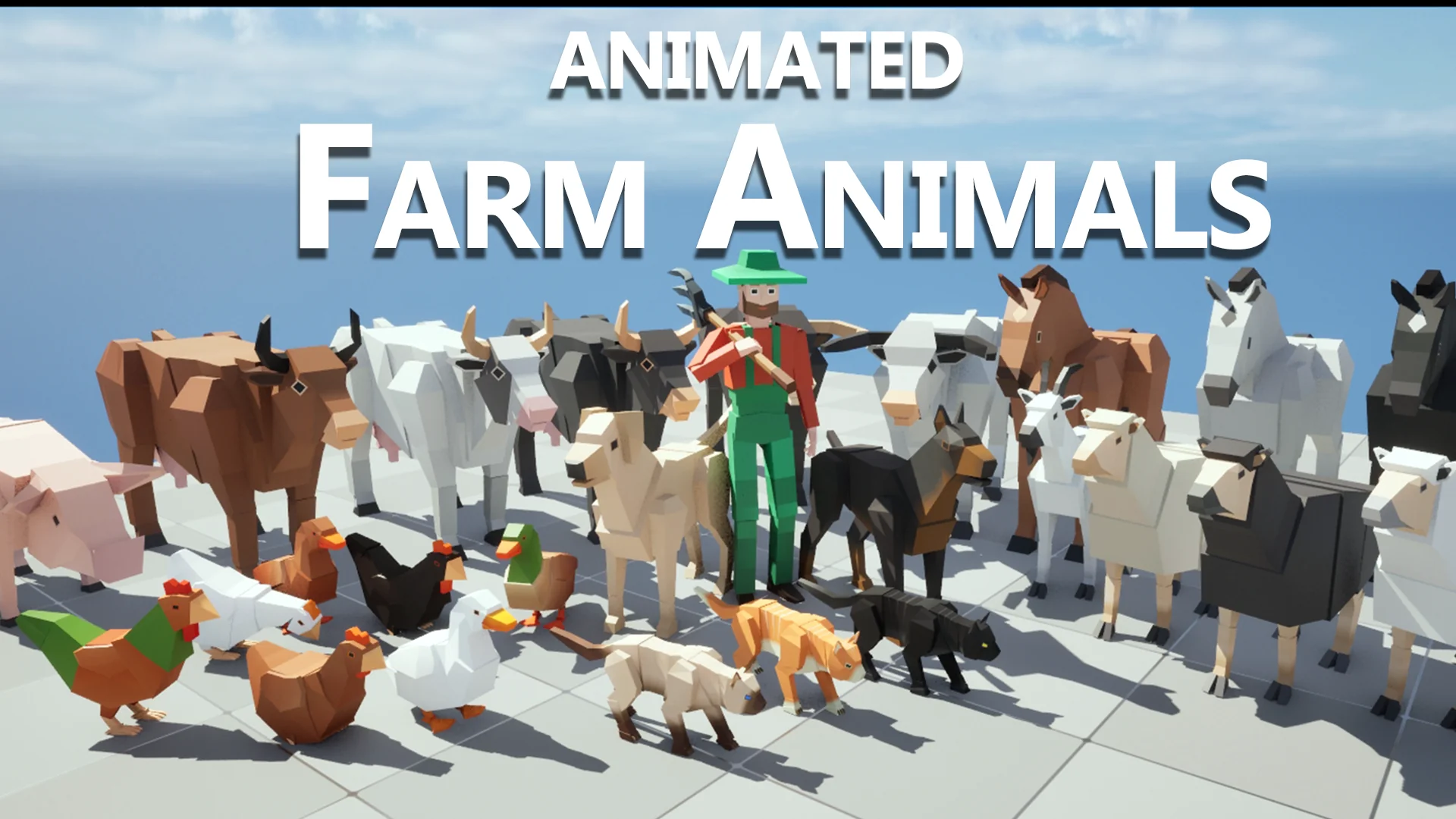
Fifteen rigged characters make up the set: one male farmer and fourteen animals. The animal roster covers horse, cow, bull, goat, sheep, pig, dog, cat, hen, rooster, and duck. Multiple variants ship per species—three horses, three cows, two bulls, two goats, two sheep, one pig, two dogs, three cats, two hens, two roosters, and three ducks. In practice, this gives a scene enough animal variety that a barnyard, pasture, or stylized farm environment can be populated without pulling from multiple packs.
Every animal arrives with 24–28 animations. The farmer carries 32 animations of his own. That range covers idle, motion, and behavioral states across the full cast without teams needing to source additional animation clips for the basic set.
Shared Skeletons Across Species Groups
The most implementation-relevant decision in this pack is skeleton reuse. Four animal groups share rigs and animation data: goat and sheep share one skeleton, cow and bull share another, birds share one, and dogs share one. When a scene calls for both goat and sheep wandering a pasture, the animation set written for one applies cleanly to the other. The same holds for cows alongside bulls, the hen-rooster-duck group, and multi-dog scenes.
From a pipeline standpoint, this means four animation sets cover more animal variants than a naive count would suggest. The hen, rooster, and duck all draw from the same bird skeleton and animations, so any motion data authored for that group applies across all three species without retargeting steps between them.
Jaw and Eye Animation Behavior
Blink animations are included for eye movement across the rigs. These blinks use scale keys on the eyes rather than relying on bone rotation or shape morphs. The practical effect is that eye blink motion travels with the character model cleanly when characters are rescaled or repositioned within a scene, since scale-based keyframes remain consistent regardless of the skeleton transform applied elsewhere. Teams that need subtle life signs on animals at a distance get them without needing additional facial rig work.
One Texture Across the Full Cast
Every character in the set uses a single shared simple texture. This solves a material-loading bottleneck before it begins—when fifteen rigged characters with their respective variants all draw from the same texture asset, memory usage stays predictable regardless of how many animals occupy the frame. For stylized or low-poly projects, this approach keeps draw calls minimal and lets art direction lean on color and shape rather than material complexity. It also means any texture tweak applied to the shared map propagates across every animal and the farmer instantly, which is useful for adjusting a whole scene's color tone in a single step.
Tag and Style Alignment
The assets fall under the Lowpoly, Fantasy, Stylized, Farm, Animal, and Character categories. Projects leaning toward stylized farm visuals with a low-poly aesthetic match the intended look without additional shader or normal map work. The simplicity of the single texture reinforces this direction—the visual identity rests on silhouette and motion rather than surface detail, which is why the shared skeleton approach works so naturally with this art style.
For setup, the animation count combined with skeleton sharing simplifies the rigging integration phase. A team placing cows in one pen and bulls in another only needs to wire up one animation controller for the shared bovine skeleton. The same applies to goat-sheep, hen-rooster-duck, and dog groups. Each pair or group needs a controller instance for its shared rig, and variants within that group inherit the motion set.
Character Count and Scene Coverage
The total roster sums to a useful crowd for establishing farm scenes. With three horses, three cows, three ducks, three cats, two bulls, two goats, two sheep, two dogs, two hens, two roosters, and one pig, plus the farmer, a populated barnyard establishing shot can feature multiple animals of different species without obvious repetition or visible copy-paste within a single frame. That density matters for variety in farm environments where the player or camera sees several animals in one glance.
For teams building farming, simulation, or stylized rural scenes, the critical numbers are straightforward: 24–28 animations per animal, 32 for the farmer, four shared skeleton groups covering bird, dog, goat-sheep, and cow-bull clusters, and a single shared texture across the entire cast. The pack collapses a multi-rig, multi-texture farm setup into a rigging plan that keeps animation overhead low.
 Characters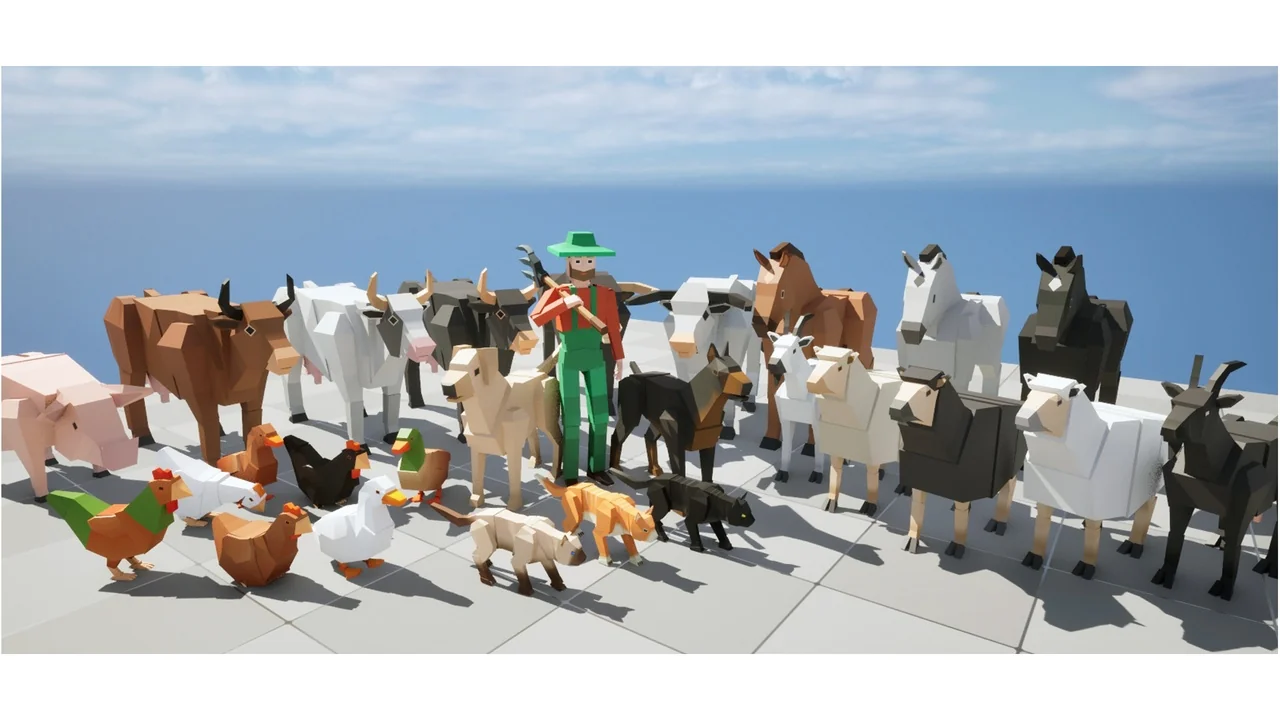
 Characters
 Characters
 Characters